
Roof Cleaning and Moss Removal in Andover
Moss lifted by hand, tiles left as they were made
Our moss removal is done by hand: we clear moss and lichen from Andover roofs, treat the slopes with a biocide, empty the gutters and photograph any faults.
- Photos of your own roof
- One written price
- Repairs, re-roofs and emergencies
- 10-year workmanship guarantee
- Find us on Google (opens Google Maps)
Signs your roof is ready for a clean
- Green cushions of moss along the tile laps
- Clumps of moss sitting in the gutters
- Grey or yellow lichen crusts on the tiles
- Downpipes overflowing after steady rain
- Dark streaks spreading down a shaded slope
Roofs we clean around Andover
Concrete tiles
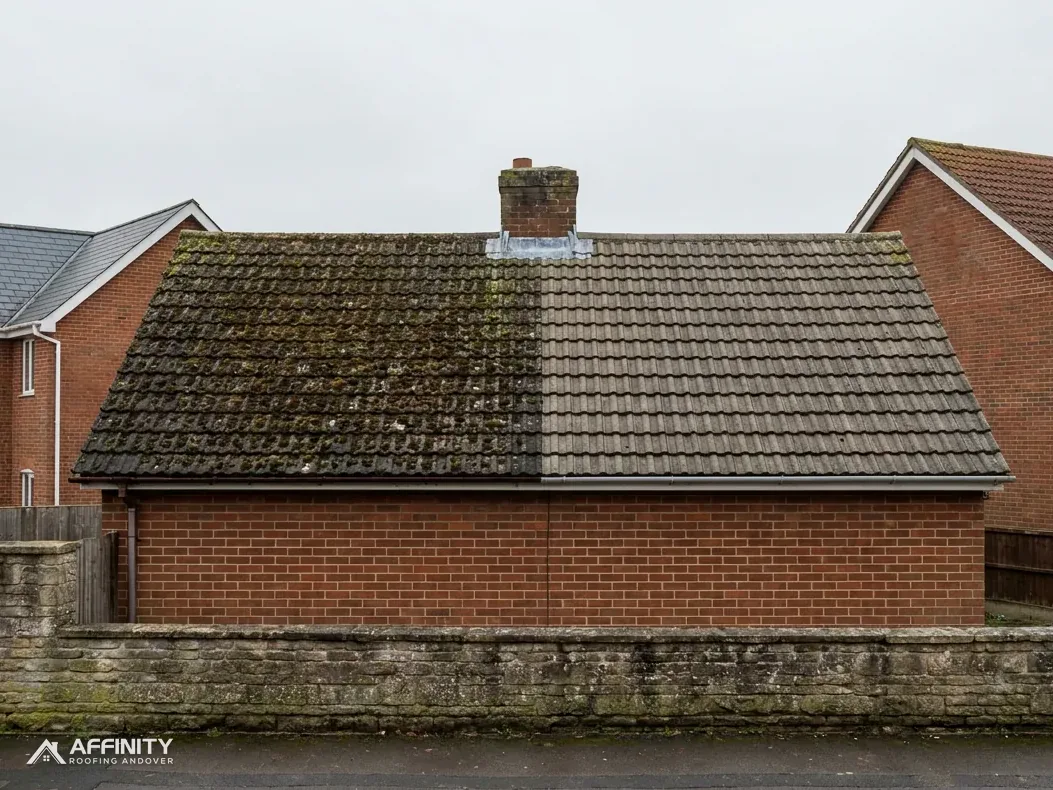
Profiled tiles whose rolls and troughs give moss a deep grip.
Clay plain tiles
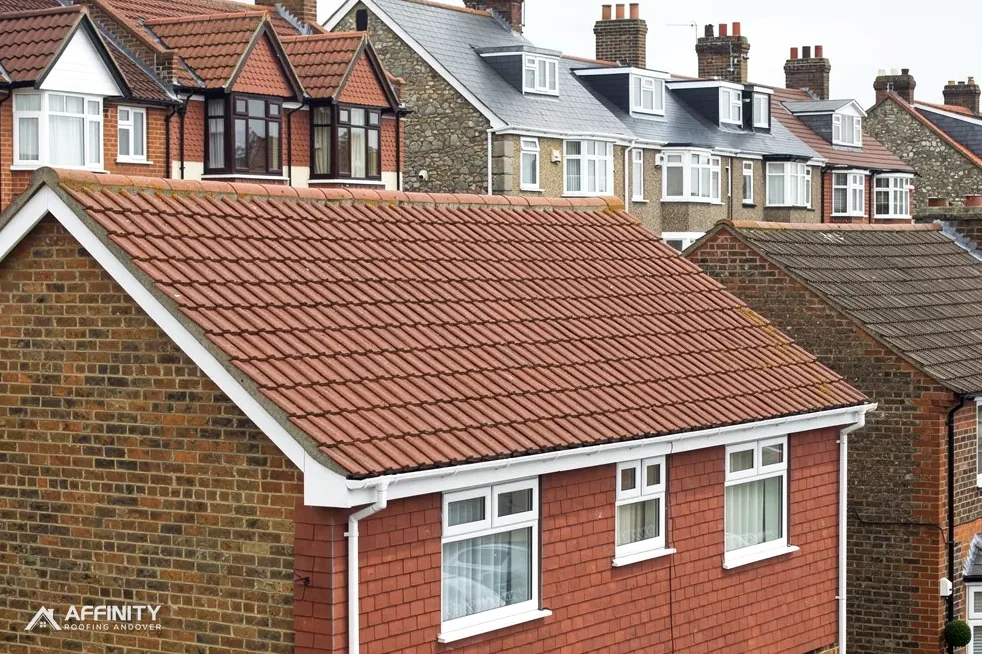
Small cambered tiles brushed gently so their edges stay whole.

Natural slate
Dense, smooth slates where moss sits on top and brushes away.
What we clean and clear
 Moss scraping by hand
 Lichen and algae removal
 Low-pressure biocide wash
 Gutter clearing
 Valley and outlet clearing
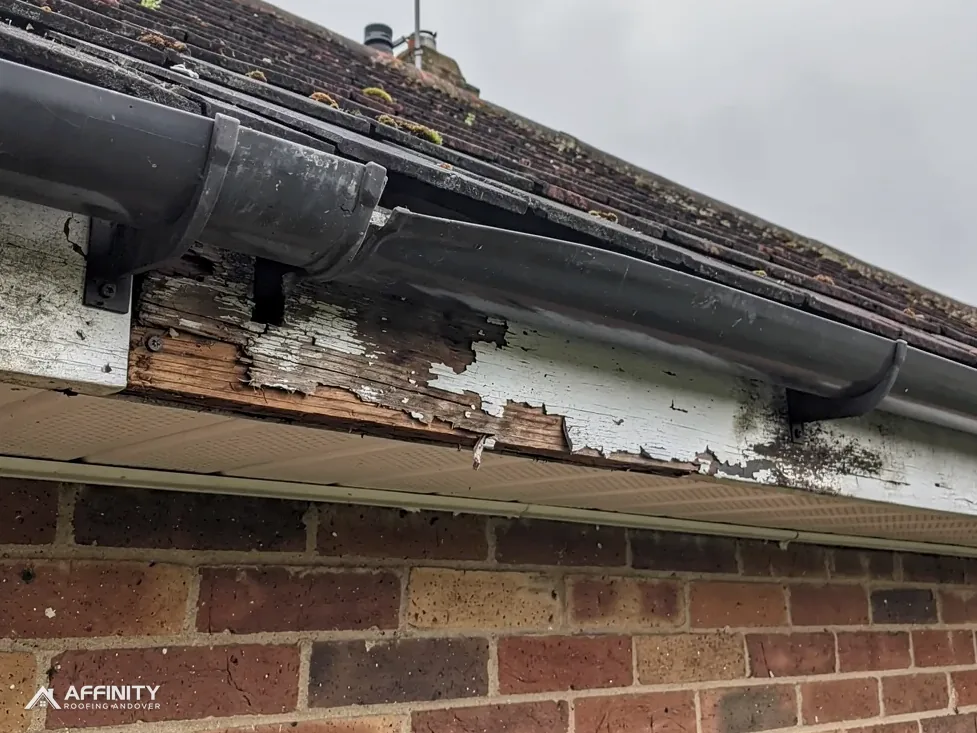 Photo report of faults
Clean it, repair it or replace it?
Clean only
The tiles are sound and the moss is surface growth with nothing broken beneath.
Clean and repair
The clean uncovers cracked tiles, a loose ridge or a blocked valley that needs fixing.
Replace instead
Tiles are flaking and failing across whole slopes, so cleaning them would waste your money.
How a roof clean runs
- Survey and photograph the slopes
- Agree the price and the day
- Clean, treat and clear gutters
- Show you the finished roof
The Andover roof cleaning report
Issue 13Andover, Whitchurch and the Test ValleyA homeowner's guide to moss and lichen
Moss off, tiles intact: how we clean a roof without harming it
Why moss and lichen settle on local roofs, how we lift them by hand, where biocides and the law come in, and which repairs a clean brings to light before they turn into leaks.
Why moss and lichen settle on Andover roofs
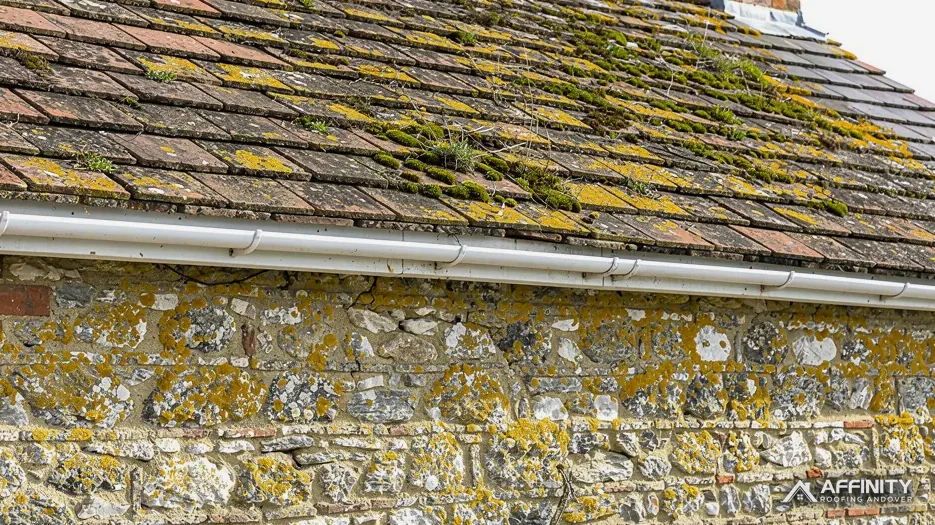
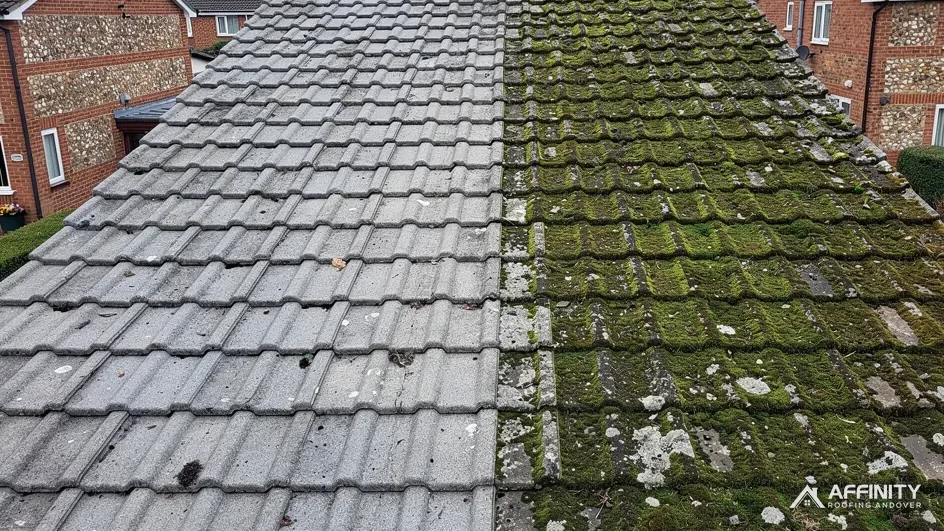
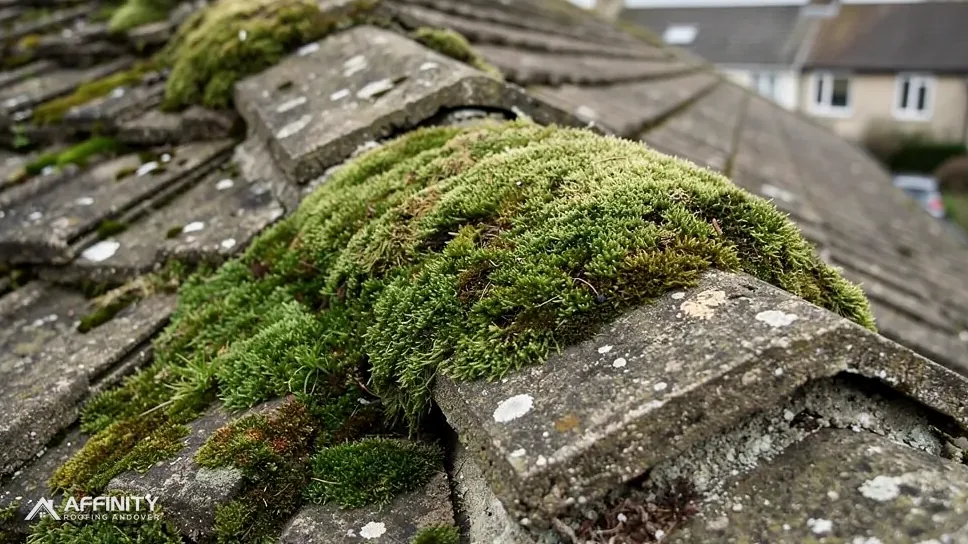
Moss needs three things: shade, moisture and something to grip. A pitched roof offers all of them. The slope that faces north gets little direct sun, so it stays damp for longer after rain and dew. Trees that overhang the eaves drop leaves and spores, shade the tiles and keep the surface wet. The textured face of a concrete tile, and the joints where one tile laps over the next, give the first spores a foothold. Once a cushion of moss forms it holds water like a sponge, and fresh growth spreads out from it.
Lichen is a different organism. It is a partnership between a fungus and an alga, and it forms flat crusts, grey, yellow or orange, that cling tightly to the surface. It grows far more slowly than moss and holds less water, but it bonds to the tile and is harder to shift. Green or black algae is the thinnest layer of all: a stain rather than a growth, which shows as streaks running down the slope. Good moss removal starts with knowing which of the three you have, because each one comes off in its own way. Our guide to moss and lichen on a roof sets out the differences.
Around Andover we see all three on the same house. A semi on one of the newer estates can have a clean south slope and a north slope thick with moss. A cottage in a village such as Hurstbourne Tarrant, sitting under mature trees, can carry lichen on the ridge and moss along every course. Neither is proof that the roof is failing. Moss and lichen are surface growth. What matters is what they do over time and what they hide.
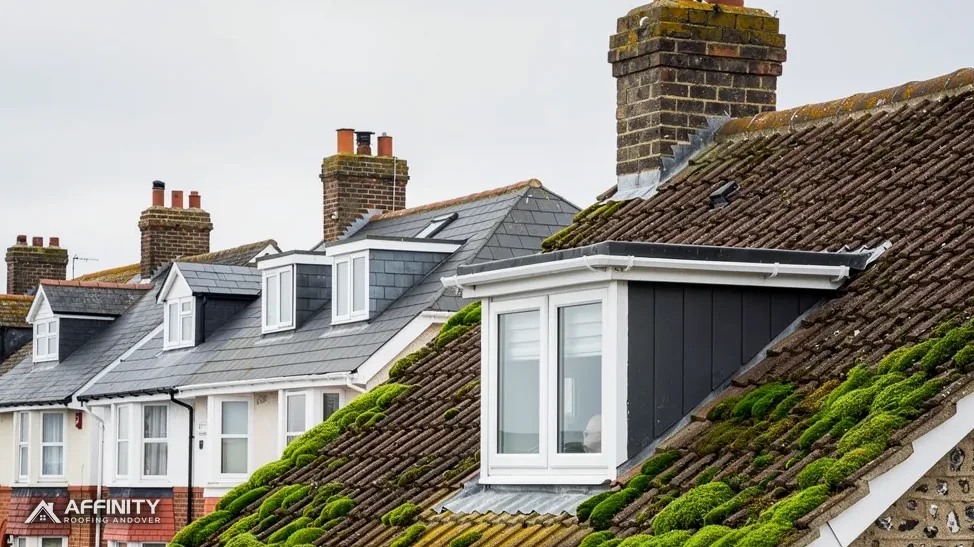
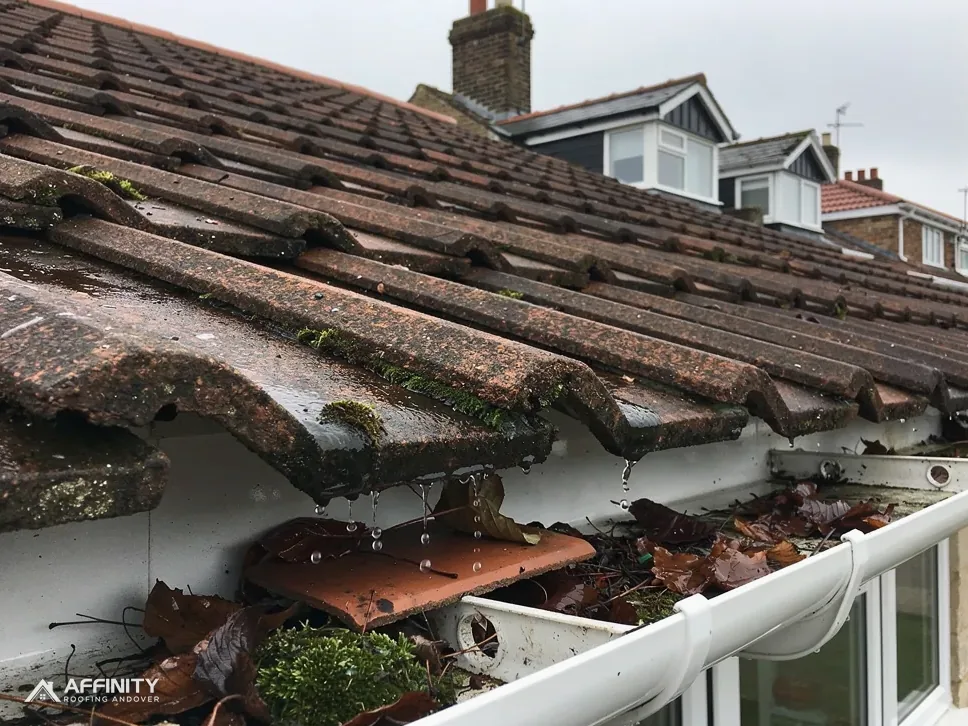
Moss does harm in three ways. It holds water against the tile, so the surface stays wet through cold nights, and a wet tile in a frost is under more strain than a dry one. It builds up at the laps, where it can lift the tail of the tile above and draw water back up the slope. And it washes down in clumps into the gutters, valleys and downpipes, where it blocks the path rainwater needs to leave the roof. A gutter that overflows after only light rain is often full of moss from the slope above.
You can learn a lot from the garden before calling anyone. Stand back far enough to see the whole slope, and look for moss lifting tile edges, clumps on the path after wind, and green water marks under the gutter joints. Note which slopes are worst. That helps us plan access before the survey.
We treat a roof clean as a close look at the whole roof rather than a cosmetic job. With the moss gone we can see the tiles, the ridge and the valleys clearly, and we photograph what we find so that you see it too, on your own roof, before anything else is decided.
Cleaning a roof by hand, course by course
Every clean starts with a survey: first from the garden, then from the top of a ladder where that is safe. We check the covering, the pitch, how thick the growth is and what sits below the slope: a conservatory, a flat roof, a path or a flower bed. We photograph each slope before we price the work. On the day, access goes up first. A single-storey roof may need nothing more than ladders and a roof ladder hooked over the ridge, the capping that runs along the top of the roof. A taller house, or a steep or awkward slope, needs a tower or a scaffold.
Scaffolding on a public footway or road falls under section 169 of the Highways Act 1980, and for Andover addresses the licence comes from Hampshire County Council as highway authority. Hampshire County Council's own page puts the application with the scaffolding company rather than the householder. Hampshire's fee is £211.90 on application for the first 2 weeks, then £72 for every further 2 weeks, with ten clear working days' notice before the licence starts. A scaffold standing wholly on your own drive or garden needs none.
Before we climb, we protect what is underneath. Dust sheets go over beds and paths, boards go over any conservatory or flat roof below, and we ask you to move cars away from the drive. If a neighbour's garden sits under the eaves, we let them know too. Where the only safe way up is through a neighbour's garden, we ask them first and agree a time. On anything above a single storey we never work from a ladder alone: a roof ladder, a tower or a scaffold gives a safe place to stand and stops loose growth and tools falling. Each morning we tell you what the day holds.
Then the clean itself. We work from the top of the slope down, so loosened growth falls onto tiles we have not yet cleaned. Moss comes off with hand scrapers shaped to the tile profile and stiff brushes, a course at a time. We lift it rather than drag it, so that the tile edges and the nibs are not chipped. The nibs are the small lugs that hook each tile over its batten, and battens are the timber strips the tiles hang from. The moss goes into bags rather than over the edge, and anything that does drop is caught on the sheets below.
Lichen takes more patience. Scraping it hard would scar the tile, so we take off the loose crust and leave the rest to the biocide, which kills what remains so that it weathers away over the following months. When the slopes are clear we empty the gutters and the valleys, the lined channels where two slopes meet, and check that every downpipe runs freely. Our guide to roof cleaning methods weighs hand cleaning against the other options on offer.
Last, we go through the photographs with you: the cleaned roof, and anything we found along the way that needs work.
1981
The year of the Wildlife and Countryside Act, which makes it an offence to intentionally damage or destroy a wild bird nest in use.
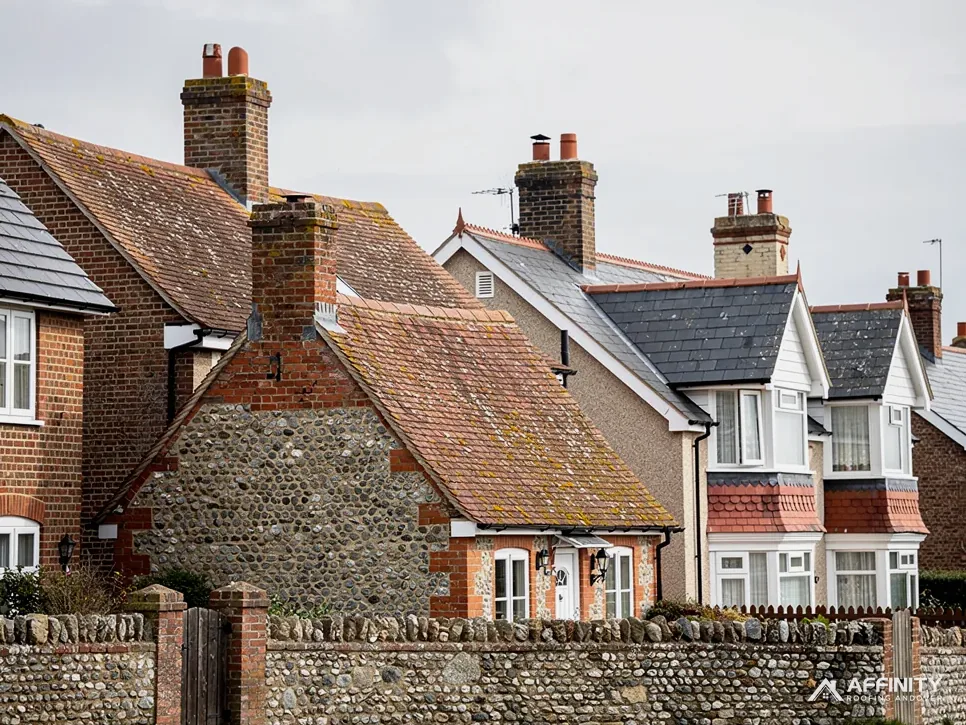
“Moss comes off by hand. The tile underneath should look the way its maker meant.”
Why we never pressure wash a tiled roof
A pressure washer clears moss fast and makes a roof look new for a while, but it does damage that does not show from the ground. We keep it off tiles and slates altogether, and the reason lies in the tile itself. Concrete and clay tiles have a dense outer face that sheds water. A high-powered jet can strip that face and roughen what lies beneath, and a rough tile holds water and gives the next spores an easy grip. Marley, one of the large UK tile makers, does not recommend high-powered jet washes, because they can damage the surface of a slate or tile and shorten its life.
There is more to it than the surface. Water driven hard up the slope goes where rain never would: under the laps, past the head of the tile below and onto the underlay, the sheet beneath the tiles that carries stray water down to the gutter. On an older roof laid with bitumen felt, a soaked underlay sags and holds water between the battens. The force of the jet can also crack a brittle tile, shift a tile that was held only by its nibs, and blow mortar out of the ridge and the verge, the finished edge of the roof at the gable end.
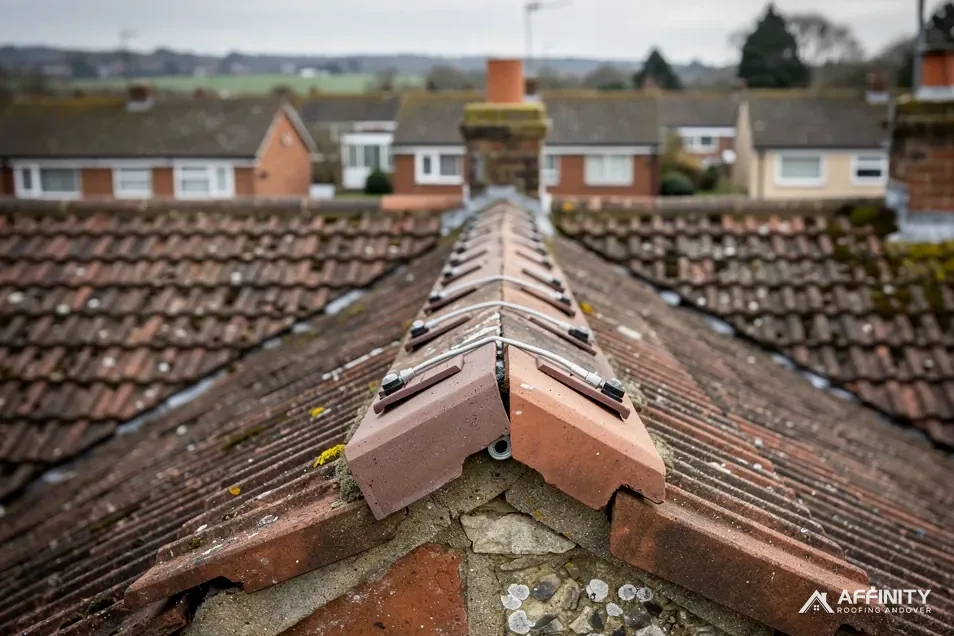
Older roofs with mortar-bedded ridges need extra care. Water forced into a cracked joint can wash out mortar that was barely holding, and a ridge tile that looked sound from the ground can come loose in the next gale.
The mess travels, too. A jet throws water, grit and moss well beyond the roof: onto windows and walls, onto the car on the drive, into the next garden and across any flat or conservatory roof below. The slurry it makes can stain paths and block drains at ground level.
Hand cleaning is slower. It takes longer on the roof and it takes more labour than a quick wash, and we would rather say that up front than surprise you with it. What you get for the time is a tile with its surface intact, laps that stay dry and a ridge that is still bedded or clipped as it was when you called us. For the longer explanation, read our guide on pressure washing roof tiles and the damage it does.
Soft washing is a different thing again. A low-pressure spray carries a cleaning solution that does the work in place of force. Our treatment uses the biocide in that gentle way, but only after the moss is off by hand, because a thick cushion soaks up the solution and shields the tile beneath.
If another firm offers to blast the roof clean in a morning, ask what it will do to the tile face, the underlay and the ridge mortar, and who will look at the tiles once the moss is gone. A good answer should cover all four.
Biocides, the right weather and nesting birds
A biocide is a product that kills living growth: here, the moss spores, lichen and algae left behind after the hand clean. Sprayed at low pressure across the cleared slopes, it soaks into what remains and works slowly. Dead lichen turns pale, loosens and weathers off over the months that follow, so the roof can look patchy for a while before it clears. Some of that debris will reach the gutters, which is worth a look the next autumn. A biocide does not stop moss returning for good. Spores arrive on the wind and from nearby trees every year, and a shaded slope will green over again in time. What the treatment does is clear the growth that scraping cannot reach and slow the start of the next round.
Biocides are controlled products. Article 17(5) of the Biocidal Products Regulation requires every biocidal product to be used within the terms of its own authorisation, so the label sets the rules for each one. HSE is clear that members of the public should never use a biocide meant only for professional users, and that using a non-approved product is an offence. If you treat a roof yourself, buy a product sold for home use and follow its label to the letter. Our guide to roof biocide treatments explains how they work.
Weather matters as well. A treatment washed off the slope by rain before it has dried has been wasted, and frost or a downpour makes a poor day for it. We plan the treatment around the forecast and the product label, and tell you which day we expect to be on the roof. On a large roof the work may run over two dry days. We keep the spray off plants, ponds and pet bowls, cover what sits below, and tell you how long to keep children and animals off treated areas, as the label directs.
Wildlife sets the calendar too. Under the Wildlife and Countryside Act 1981 a person commits an offence if they intentionally take, damage or destroy any wild bird nest that is in use or still under construction, and GOV.UK says no licence can be granted to allow building work to do so. Birds nest under tiles, in gutters and behind fascias, the boards along the eaves that carry the gutter, so before any clean we look for activity. Where a nest is in use, we leave that part of the roof until it is empty.
Bats need the same care. GOV.UK says the law fully protects every bat species, along with the places they breed and rest, and names roof repair and replacement among the activities that can affect them. If we see signs of bats, such as droppings at the eaves or under the ridge, we stop and talk to you about the next step before any work goes ahead.
The report on one roof
- 1Why moss and lichen settle on Andover roofs4 checksThe list starts with cracked tiles hidden beneath thick cushions.Source: chapter 1, Under the moss
- 2Cleaning a roof by hand, course by course7 stepsThe job runs from “Survey and photograph each slope” to “Go through the photographs together”.Source: chapter 2, A roof clean, in order
- 3Why we never pressure wash a tiled roofQWhy not jet wash a tiled roof?Source: chapter 3, From the tile maker
- 4Biocides, the right weather and nesting birds1981The year of the Wildlife and Countryside Act, which makes it an offence to intentionally damage or destroy a wild bird nest in use.Source: Wildlife and Countryside Act 1981, legislation.gov.uk
- 5Clay, concrete and slate, and older cement roofs4 checksThe list starts with asbestos assumed if built before 2000.Source: chapter 5, On a cement roof
- 6Repairs, gutters, coatings and the cost of a clean5 factorsRoof size, height and pitch, covering, growth and findings set the written price.Source: chapter 6, What sets the price
Clay, concrete and slate, and older cement roofs
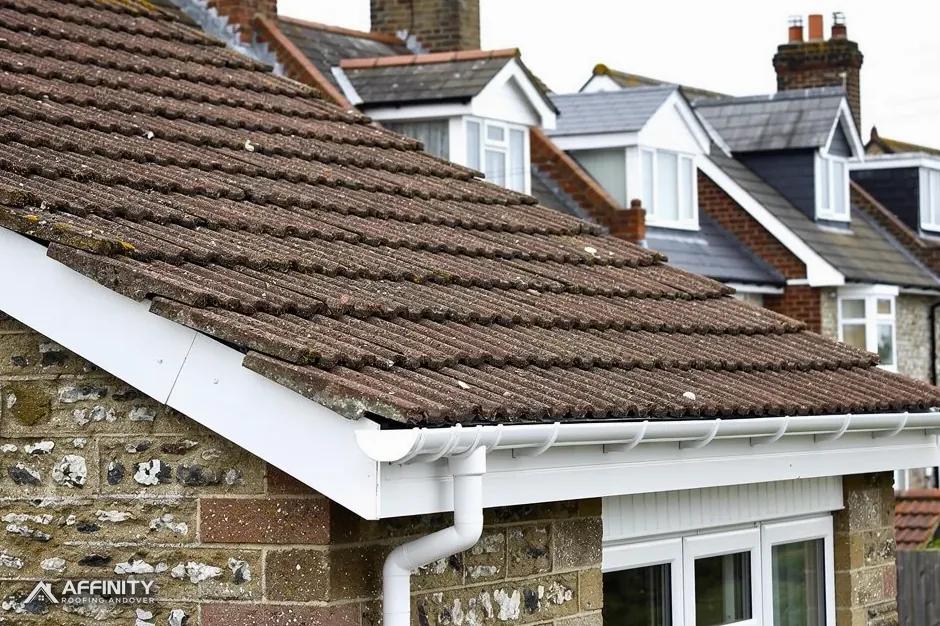
Each covering needs its own approach, and we settle the method after the survey. Interlocking concrete tiles have a raised profile and a textured face where moss roots deep. They take hand scraping well, but an old tile can be soft at the surface, so we use plastic scrapers and brushes on them. Marley puts the expected life of its concrete roof tiles at around 60 years, while HomeBuilding gives plain concrete tiles 40 to 50 years. The two sources differ, so a concrete roof in its fifth decade deserves a careful look before anyone spends money cleaning it.
Clay plain tiles are small, thin and slightly curved, and the oldest were made by hand. Moss gathers in the gaps between them and at the laps. They chip more easily than concrete, so we brush rather than scrape wherever we can. Clay lasts: Marley reports a BRE minimum life expectancy of 60 years for clay tiles, and HomeBuilding gives clay 60 to 80 years. On a sound clay roof the case for a careful clean, rather than replacement, is usually a strong one.
Natural slate is smooth and dense, so moss sits on it rather than rooting into it, and it brushes off. Slate is brittle at its edges, and a slate cracked by a careless boot becomes a repair, so we keep our weight on roof ladders and crawl boards. HomeBuilding gives Welsh slate a life of 100 years or more. Our guide to cleaning a slate roof without damage goes further.
If your home is listed, or sits in a conservation area such as the one in central Andover, talk to us before any treatment beyond a gentle hand clean. Ask the planning officers at Test Valley Borough Council, or Basingstoke and Deane Borough Council for a Whitchurch address, before you agree to any coating or change to how the roof looks.
In villages north of Andover such as Hurstbourne Tarrant, which lies inside the North Wessex Downs National Landscape, older cottages can carry handmade clay tiles that are hard to match. That is one more reason to clean gently: a broken handmade tile can be harder to replace than the moss was to remove.
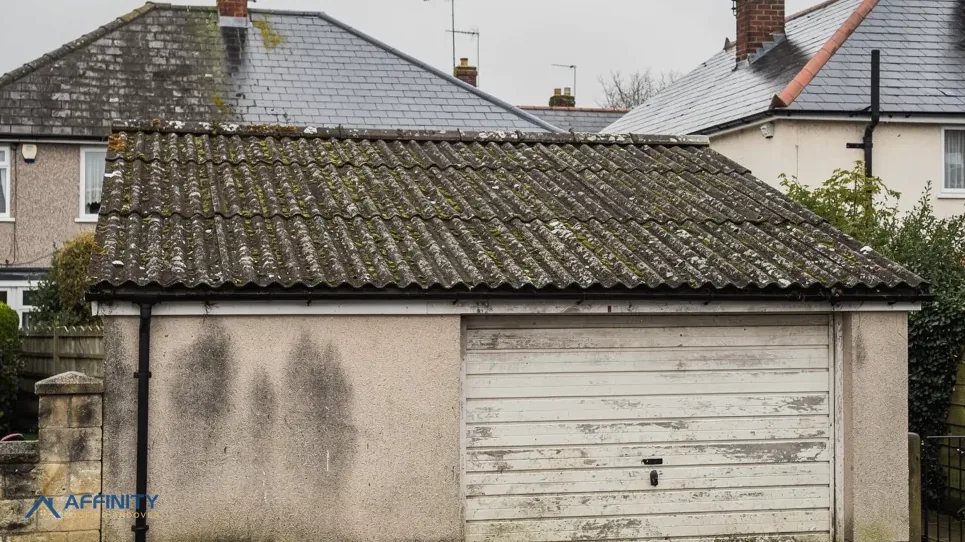
Older fibre-cement slates and sheets need a different first step. HSE tells owners of any building built or refurbished before 2000 to assume it contains asbestos. HSE lists roof sheeting and rainwater goods among asbestos cement products, and treats every asbestos cement roof as fragile, so nobody stands on one. Careful handling of asbestos cement that is weathered but not substantially damaged is non-licensed work under HSE guidance; breaking it up makes it notifiable non-licensed work. On a roof like this we never scrape hard or use water under force. We check the material first, explain what we found and agree the safest approach with you. Any asbestos waste is double-wrapped, labelled and carried away on a consignment note, and it never goes into an open skip. Our page on cleaning an asbestos-cement roof covers the detail.
Repairs, gutters, coatings and the cost of a clean
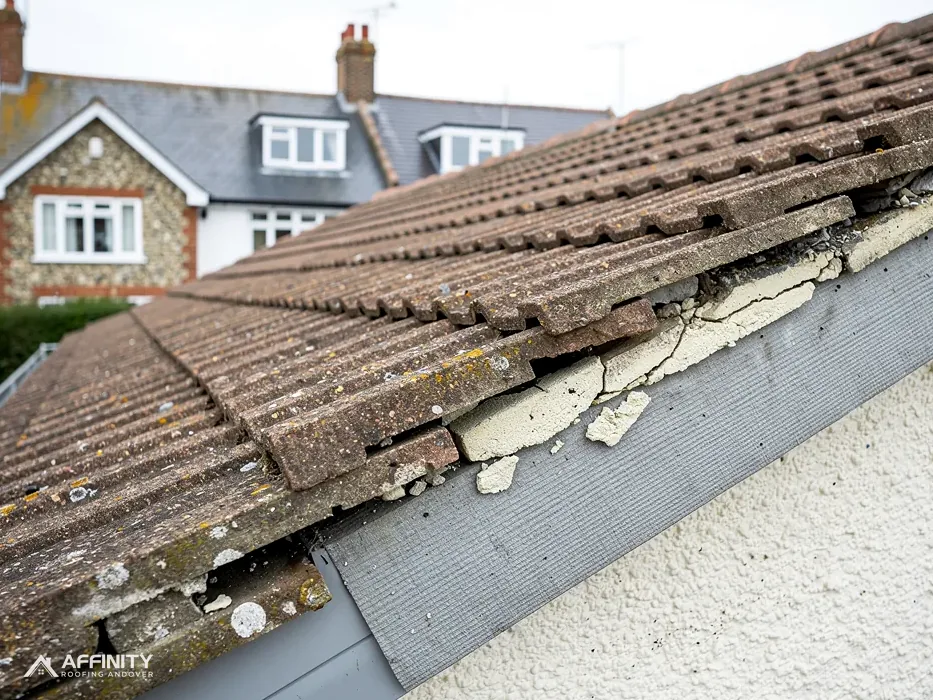
A clean puts us within reach of every course of the roof, so it doubles as a survey. With the moss gone we can see cracked or slipped tiles, broken nibs, ridge and hip tiles with loose or missing mortar, and valleys or flashings that have moved. The hip is the sloping corner where two roof slopes meet. Flashing is the strip of lead or other sheet that seals the joint between the roof and a wall or chimney. We photograph each fault, show you where it is and give you a price to put it right, so you can choose what to do and when. Larger faults go to our roof repairs work.
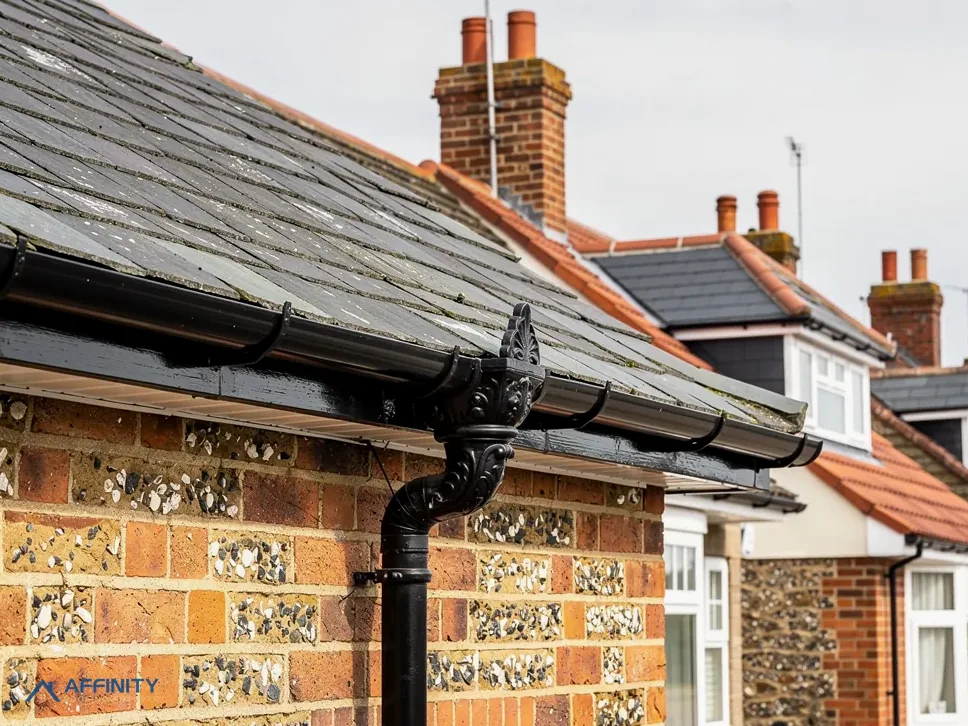
Gutters come next. Moss from the slopes ends up in them, and a gutter full of it spills down the wall or onto the path. We clear the gutters and valleys as part of every clean and check that each downpipe runs. If the gutter itself is sagging, cracked or leaking at the joints, or the fascia behind it has rotted, we show you and price it through our guttering, soffits and fascias service. The soffit is the board that closes the underside of the eaves.
Some firms offer a coating after a clean. A coating is a paint-like layer sprayed onto the tile face. It does not fix a cracked tile, re-bed a loose ridge or refix a slipped course; it covers them over. On a sound roof we see little reason for one, and on a failing roof it hides the faults that need attention.
Is a clean worth paying for? On a roof with years of life left in the tiles, yes: dry laps, clear gutters and early warning of faults all protect what you already own. On a roof whose tiles are flaking across whole slopes, the money is better saved towards repair or a new covering, and we will say which we think it is.
How often does a roof need cleaning? There is no fixed interval. A sunny slope with no trees nearby may stay clear for many years, while a north slope under an oak may need attention far sooner. We would rather you clean when moss starts building at the laps or filling the gutters than by the calendar.
Price follows the same logic. It depends on the size and pitch of the roof, the covering, how thick the growth is, the access needed and what the survey finds. A bungalow with one shaded slope costs far less to reach than a three-storey house that needs a scaffold on the street. We clean roofs across Andover and the villages around it, from Hurstbourne Tarrant to Whitchurch.
When we hand the roof back, you get the photographs of the clean slopes alongside any faults, so you hold a record of the roof's condition on that day. That is useful if you sell the house, or if you want to set the roof against the same photos in a few years' time.
Start with the worst slope
Call or send a photo of the slope where the moss is thickest, and we will come out and look over the whole roof.
Typical UK prices for jobs that follow a clean
| Job | Typical UK range |
|---|---|
| Which?: clear out all gutters, front and back (ex VAT) | £75 to £350 |
| Which?: replace 1 to 6 broken or missing tiles (ex VAT) | £75 to £400 |
| Which?: a new ridge tile fitted (ex VAT) | £80 to £300 |
These are national figures from a cost guide, not prices we charge. A roof clean is priced on your roof alone, and the written total comes after the survey.
Source: Which? cost guide to roofers, prices gathered November 2025, excluding VAT
Roof cleaning guides and answers
Short reads on biocides, lichen, coatings, slate and clay, asbestos cement, and the faults we look for while we are up on the roof.
 Guide · 9 min readRoof cleaning methods comparedRoofers clear growth by hand, with brushes, with a treatment or with low-pressure water. One more method, the jet, is the one…
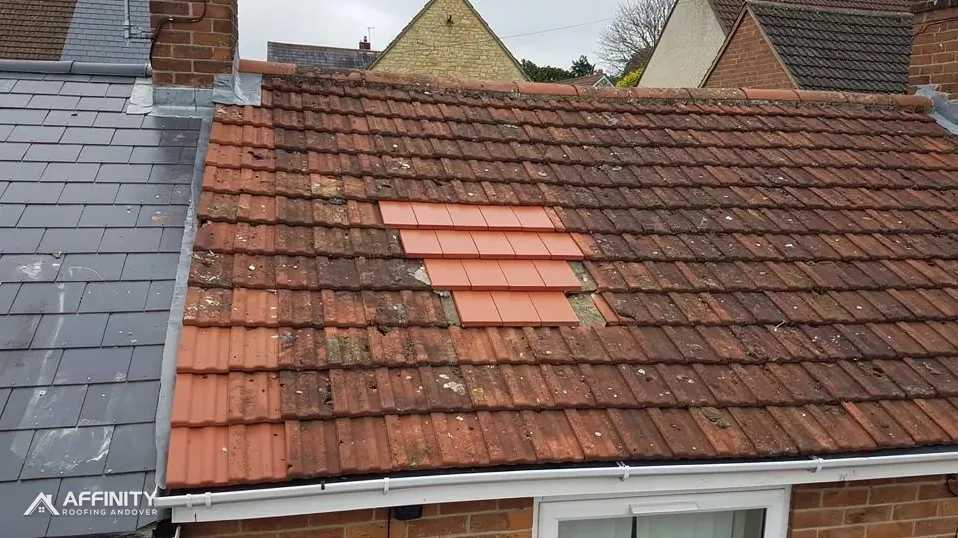 Guide · 9 min readPressure washing roof tiles: why it causes damageA pressure washer makes a roof look clean in an afternoon, but the damage shows up later: cracked tiles, a thinned surface…
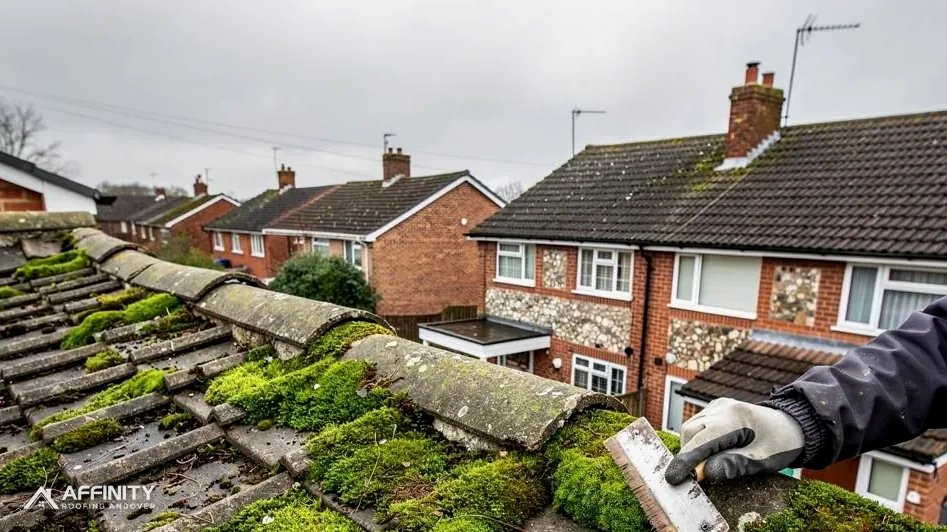 Guide · 10 min readRoof biocide treatments: how they workA biocide treatment kills roof growth where it sits, rather than blasting it off. It is also a regulated chemical, and some…
- GuideMoss and lichen on roofs: the difference
- GuideCleaning clay roof tiles safely
- GuideCleaning concrete roof tiles safely
- GuideCleaning a slate roof without damage
- GuideRoof tile coatings: when they are not needed
- GuideCleaning an asbestos-cement roof: what to know
- GuideRoof problems a roofer spots during cleaning
- GuideWhen is the best time of year to clean a roof?
- BlogDo I need a roofer to clean moss off my roof? Cleaning, biocides and damage to avoid
- AnswerHow much does a roof cleaner charge?
- AnswerHow often should a tile roof be cleaned?
- AnswerIs getting your roof cleaned worth it?
- AnswerWill a roofer clean gutters?
- AnswerIs moss harmful to a roof?
- AnswerWill moss come back after roof cleaning?
- AnswerCan moss cause a roof leak?
- AnswerWhy does moss grow on north-facing roofs?
- AnswerIs DIY roof moss killer safe to use?
- AnswerCan a roof be cleaned in winter?
- AnswerWhat are black streaks on roof tiles?
- AnswerWhy is moss blocking my gutters?
- AnswerHow should a conservatory roof be cleaned?
- AnswerDo zinc strips stop roof moss?
- AnswerHow many days does a roof clean take?
- AnswerIs scaffolding needed for roof cleaning?
- AnswerCan you use bleach on roof moss?
- AnswerHow is lichen removed from a roof?
- AnswerIs green algae on a roof a problem?
- AnswerIs moss on a flat roof a problem?
Work that can follow a roof clean


Before you book a roof clean
How is the price of a roof clean worked out?
We price each clean after surveying the roof. The size and pitch of the slopes, the covering, how thick the moss has grown and the access needed all move the figure, and a roof that needs scaffolding costs more to reach than a bungalow. If we find repairs, we show you the photos and you decide whether to add them.
How often should a tiled roof be cleaned of moss?
There is no set interval. Shade, nearby trees and the way a slope faces decide how fast moss comes back, so some slopes stay clear for many years and others green over sooner. A look from the ground each year, and a check of the gutters each autumn, tells you more than a calendar.
Is paying for a roof clean worth the money?
It is when the tiles have plenty of life left. Taking the moss off keeps the laps dry, stops the gutters blocking and lets us spot faults early. On a roof near the end of its life, the money is better put towards repair or replacement, and after the survey we will tell you plainly which we think it is.
Do you clear the gutters after cleaning the roof?
Yes. Moss from the slopes ends up in the gutters, so we clear the gutters and valleys as part of every clean and check that the downpipes run freely. If a gutter is cracked, sagging or leaking at a joint, we photograph it and give you a price to put it right, and you choose whether to go ahead.
Will moss grow back after the roof is treated?
In time, yes. Spores arrive every year from trees and on the wind, and a shaded slope will green over again. The biocide kills what the hand clean leaves behind and slows regrowth, but no treatment keeps a roof clear for good. Cutting back overhanging branches and keeping the gutters clear both help the clean last longer.
Can thick moss on the tiles make a roof leak?
It can play a part. Moss holds water against the tiles and builds up at the laps, where it can lift a tile tail and draw water up the slope. It also blocks gutters and valleys, so water backs up under the eaves. A leak inside still needs tracing to its source, so we survey before cleaning.
Book a survey of your mossy roof
Send us a photo or call, and we will survey the roof, photograph the moss and price the clean.
10-year workmanship guarantee, in writing.