
Roofers in Salisbury
The Cathedral, the Close and the streets of a listed city
Salisbury has a Grade I cathedral, a conservation area and 556 listed buildings within 900 metres of its centre. A survey begins every job and a clear price ends it.
Salisbury roofs from Close to city streets

Around the Cathedral
Buildings near the Cathedral Church of St Mary, Grade I since 28 February 1952, and the Theological College.

City centre frontages
Shops and offices in the Salisbury conservation area, where a change to a roof's look goes to the council.

St Osmund's and the ramparts
Houses near the Roman Catholic Church of St Osmund, Grade II, and the scheduled City Rampart.
Salisbury, with Laverstock and Wilton beside it
Laverstock lies to the east and Wilton to the west. Alderbury is south-east, Pitton east, Porton north-east and South Newton north-west.
- Distance
- 19.6 road miles south-west of Andover
- Planning
- Wiltshire Council
The Salisbury roof report
Local editionSalisbury, WiltshireA cathedral city and its listed streets
Five hundred and fifty-six listed neighbours: how a Salisbury roof job is planned
Salisbury lies 19.6 road miles from Andover and had 41,552 usual residents at the 2021 Census. This report covers the cathedral and its listings, the rampart, the conservation area, Wiltshire's building control and the city's scaffold permit.
A cathedral, a college and 556 listed buildings
Salisbury parish had 41,552 usual residents at the 2021 Census. Historic England's list records 556 listed buildings within about 900 metres of the city point, and the entries that matter most to a roofer can be read off in a few lines.
- Cathedral Church of St Mary: Grade I status, list entry 1023581, first listed 28 February 1952
- Theological College: Grade I, list entry 1023595
- Wren Hall: Grade I, list entry 1023620
- Church of St Osmund (Roman Catholic): Grade II, list entry 1241985
- City Rampart east of the Council House: scheduled monument, list entry 1004714
Numbers like these mean that a central roof often stands beside a protected building, or is one itself. Any alteration that touches a listed house's character needs listed building consent before it starts. Our guide to listed building roof repairs shows how the application is built. Some churches in use sit outside that regime. St Osmund's is Roman Catholic, a denomination covered by the ecclesiastical exemption, so works go through its own system; a Quaker or Unitarian building is not exempt.
The rampart is different again. Consent for a scheduled monument concerns the monument itself. A roof job on a building nearby will not normally disturb it, yet a base plate or a skip close to the line is another matter, and the extent on the list entry is read before either is placed.
The Salisbury conservation area lies within about 0.75 km of the centre. Its boundary comes from Wiltshire Council, and the council's planners can tell you what it means for a given roof. Put a second question at the same time: does an Article 4 direction apply to your street? We can send both and pass on the replies.
The same conservation area reaches within about 0.75 km of the centre of Laverstock, 0.9 miles to the east, so a house on the city's eastern edge may be inside it although its address says Laverstock. The council's map answers it.
The Theological College and Wren Hall share the cathedral's Grade I status. For a neighbour, what matters is courtesy: a ladder, a skip or a loud morning near a Grade I building is announced in advance, not discovered.
Much of a city roof is invisible from the pavement. Valleys between buildings, parapet gutters behind a frontage, lead-lined flats and shared stacks hide from the street, so a Salisbury survey goes up, along and inside. Each slope, junction and gutter is photographed, and the structure below is inspected from within.
Pictures arrive in repair order, each with a short caption. Hidden parapet gutters are checked along their whole length.
Who owns the roof, and who signs it off
Wiltshire's council is unitary, which puts planning, the highway and building control for Salisbury under one roof, so there is no county layer to consult as well. Wiltshire Council's Building Control service works from Monkton Park, Chippenham, and takes bookings and payments on 0300 456 0113. A registered building control approver offers a private alternative, and the survey note recommends one or the other for your job.
Who owns the roof?
This is a question villages seldom raise. In a block of flats, a parade of shops or a terrace converted to offices, one roof may belong to a freeholder and serve several leaseholders, with upkeep paid through a service charge. We therefore record which parts of the roof serve which unit, so that repairs, costs and consents can be divided on the facts.
In practice that means a conversation among owners. We join it if asked, bringing photographs and a short description of each fault, so that nobody is voting on a rumour.
Shared roofs bring shared decisions. If three occupiers use one flat roof, two may want a repair and one may not. A survey with photographs, a plain account of each fault and a single written total gives them something concrete to discuss, and a managing agent or freeholder something to approve.
The Planning Portal's first test asks how much of the building a re-roof touches: under 25 per cent of the building envelope and under 50 per cent of the roof usually means no application. A whole-roof re-cover on a large block may pass neither, and we raise that early.
Weight is the other test. A replacement covering that comes out 15 per cent heavier or more needs Building Regulations approval at any scale, after a structural check. On an older building, swapping slate for concrete tile is the case to watch, because original timbers may not be sized for it.
Storm damage in a city is handled with the same order of steps wherever the roof is. Insurers expect to hear first, then a temporary repair to limit further damage, with photographs and receipts kept throughout. Whether a storm counts is decided by the wording of your policy, and in a dispute the Financial Ombudsman Service, on 0800 023 4567, is the place to turn. We make a leaking roof safe at the outset, and the claim itself stays yours.
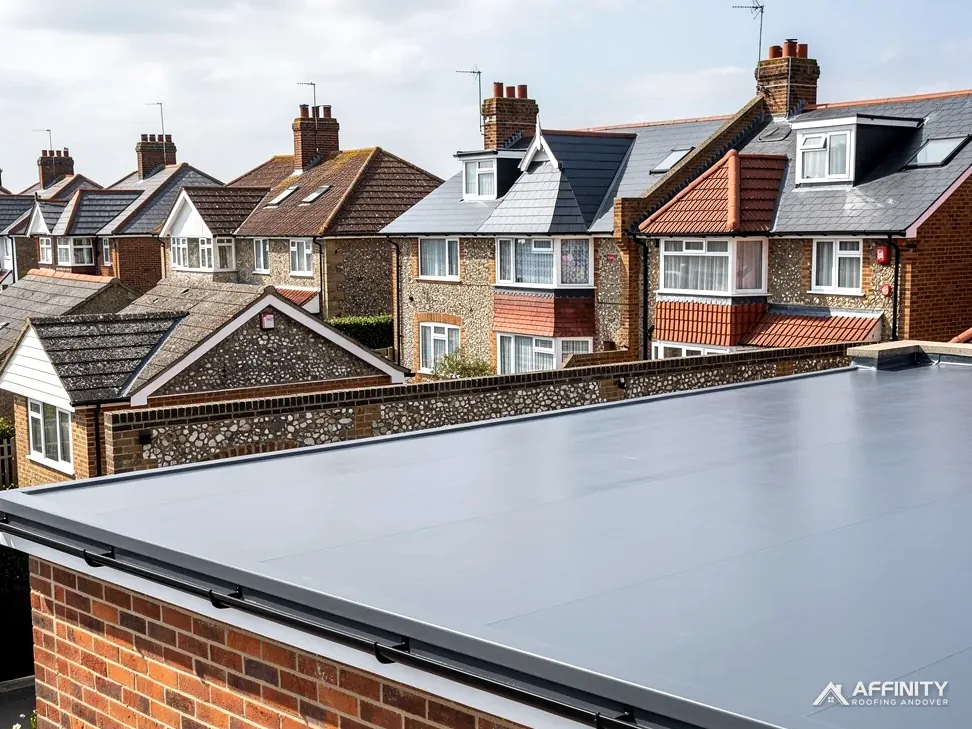
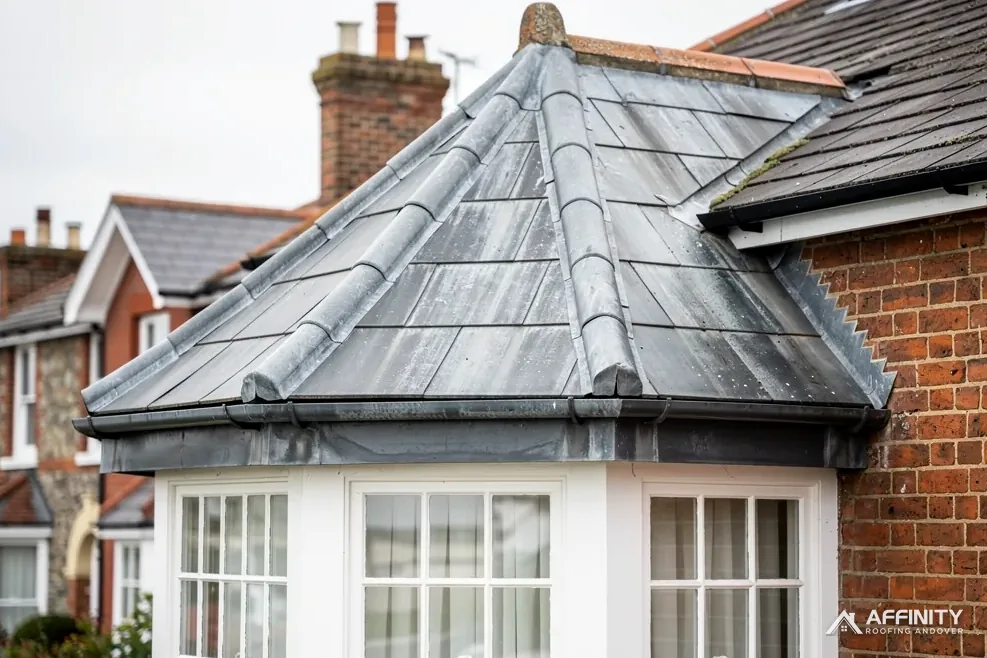
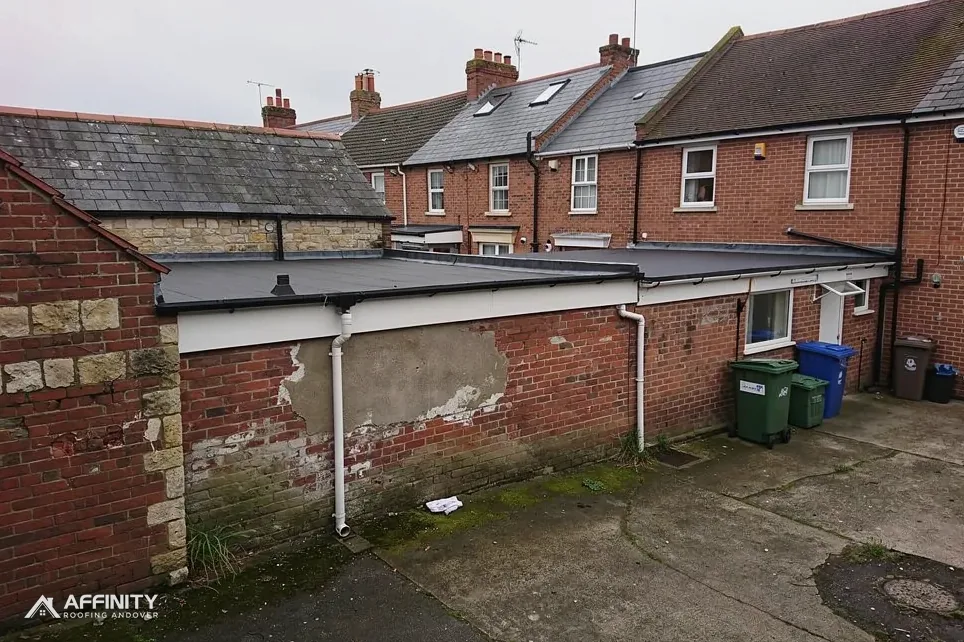
Flat roofs and lead each fail in their own way. Flat roofs give out at outlets, edges and upstands before the open sheet does, and lead fails at laps, joints and fixings. A repair to the failed detail often suffices.
“With 556 listed buildings within 900 metres of the centre, a Salisbury roof seldom stands far from one.”
Source: National Heritage List for England (Historic England), 900 m radius
Scaffold in a city centre: Wiltshire's permit
A scaffold on a city pavement is a public structure, and section 169 of the Highways Act 1980 requires a licence for it. In Salisbury the grantor is Wiltshire Council, whose terms can be set out in a few lines.
- Who applies: the scaffolding supplier, via MiPermit
- Scope: one licence for each site; hoarding needs its own
- Fee: Wiltshire Council charges £143.80 with more than 3 working days' notice, and £164.70 with less
- Duration: valid for 28 days
- Marked parking bays: suspended by separate arrangement
Passers-by come first. The first lift is fenced, the boards are secured, debris netting or fans hang below the work, and the pavement stays passable or a safe way round is settled. For a shop or office, the working day is planned around opening hours, the entrance stays clear and the occupier is told which days will be noisy.
Many city roofs are reached from inside the building. A flat roof behind a parapet, an inner courtyard or a lean-to over a yard can be worked from private ground, with no frame on the pavement at all. The access is assessed at the survey, and the note says which case applies and what permit, if any, goes with it.
Salisbury's pavements carry prams, wheelchairs and delivery trolleys. The width left clear beside a frame is a design decision made at the survey, written into the plan with the scaffolder, not a hope that people will squeeze past.
A frame that stands idle still costs the same. Materials are ordered and checked before it goes up, the strike date is fixed with the scaffolder at the outset, and if weather halts work, any slope left open is sheeted and the programme is reviewed with you.
Skips are a particular nuisance in a city. The position of the skip, with its own permission if the road requires it, is arranged before the date is fixed.
Deliveries need planning where kerbs are busy. A hoist or conveyor lifts tiles, slates and lead, loads arrive in a quiet window and nothing stays on the pavement overnight. Next-door businesses hear on booking day, and again before the frame is struck.
Typical calls in a city are varied. Roof repairs answer slipped slates and lifted flashings. Flat roofing covers membranes, outlets and upstands. Commercial roofing looks after shops, offices and small units.
Quiet matters in a city of offices and homes. Noisy operations such as stripping slates are timed with the occupiers, and the daily start and finish are agreed in advance.
Afterwards the pavement is swept and the rubbish has left.
What we fix on Salisbury roofs


Salisbury roofs: the Close, the rampart and the permit
Can I repair a roof near Salisbury Cathedral without consent?
Only a listed building needs listed building consent, and a neighbour's listing does not put it on your roof. The cathedral holds Grade I status, but many buildings near it are not listed. The survey includes a search of the National Heritage List for your address, and the result goes in the note with the entry number.
Does the City Rampart monument affect scaffold in Salisbury?
The City Rampart, a scheduled monument, lies within about 500 metres of the centre, and the consent it needs concerns the monument alone. A roof repair nearby will not normally touch it, but the list entry's extent is read before a base plate, skip or delivery is placed close to the line.
How much is a scaffold permit for a Salisbury shop front?
Wiltshire Council charges £143.80 with more than 3 working days' notice and £164.70 with less, and each licence lasts 28 days. Wiltshire Council expects the scaffolding company to lodge the form on MiPermit. A hoarding is a separate licence, and a marked parking bay needs separate suspension. Booking early secures the lower fee, and the programme is built to finish inside the 28 days.
Who deals with Building Regulations for a Salisbury flat roof?
Wiltshire Council's own Building Control service, on 0300 456 0113, or a registered building control approver as the private choice. A flat roof meets the same size and weight tests as a pitched one, so nothing special is asked of it, and a covering 15 per cent heavier or more needs approval. We ask the team first, before any date is promised to you.
Beyond the city: Wilton, Laverstock and Alderbury
Get your Salisbury roof surveyed
Name your street and attach a photograph. A survey is always the first step, and the written price follows it.
10-year workmanship guarantee, in writing.