Ask three firms how they clean a roof and you may get three answers. One scrapes and brushes, one sprays a treatment and walks away, one arrives with a trailer-mounted pressure washer that can damage what it cleans. The roof ends up cleaner in each case, but the tiles, the underlay and your gutters do not end up in the same state.
The method is the main decision in any cleaning job, and it is a decision made out of sight. They see a quote with a total on it and a promise that the moss will go. What gets used on the roof, how the cleaner gets there and what happens to the water and the debris are left to the day.
This guide describes the methods in use, what each does well, where each goes wrong and what rules apply. It compares hand removal, brushing, biocide treatment and soft washing, explains the damage a jet wash can do, and it finishes with a short list of questions to put to a cleaner before you accept a price. Roof cleaning is a specialist job, so the figure for your house is fixed after a survey, as one total.
Why the method matters more than the machine
A roof is not a driveway. Its tiles or slates overlap, they hang on small fixings, and the whole arrangement keeps water out only so long as every piece sits where it was put. Anything that moves a tile, scours its face or pushes water sideways into the joints works against that.
What a good method protects
The surface comes first, because it is the part that cannot be replaced without replacing the tile. A tile or slate has a weather-facing side that took years to settle, and every pass of an abrasive tool thins it. Then come the fixings: nibs, clips and nails that can crack or loosen. Beneath sits the underlay, the membrane that catches stray rain, and the battens it lies against. And last of all, the people: whoever is on the roof, and whoever is standing below.
Different roofs, different answers
The covering changes the choice. An old clay roof needs more care than a young concrete one. Natural slate splits along its grain. A cement sheet roof of the kind found on older outbuildings may be asbestos cement, which has its own rules, and our guide to cleaning an asbestos cement roof explains why it is a separate case.
The question a cleaner should answer
The useful question is not what the cleaner can remove but what the cleaner will leave. A method that restores colour while costing the roof ten years is a poor bargain. A good firm can explain its method in a couple of sentences and show you pictures from earlier jobs.
Everything that follows is a way of weighing that trade, and the aim is to leave you able to judge a quote on its method as well as its total.
Hand removal and scraping
The oldest method is also the most controlled. A roofer on a ladder or a platform lifts moss in sections with a hand tool, working slowly across the slope.
What it does well
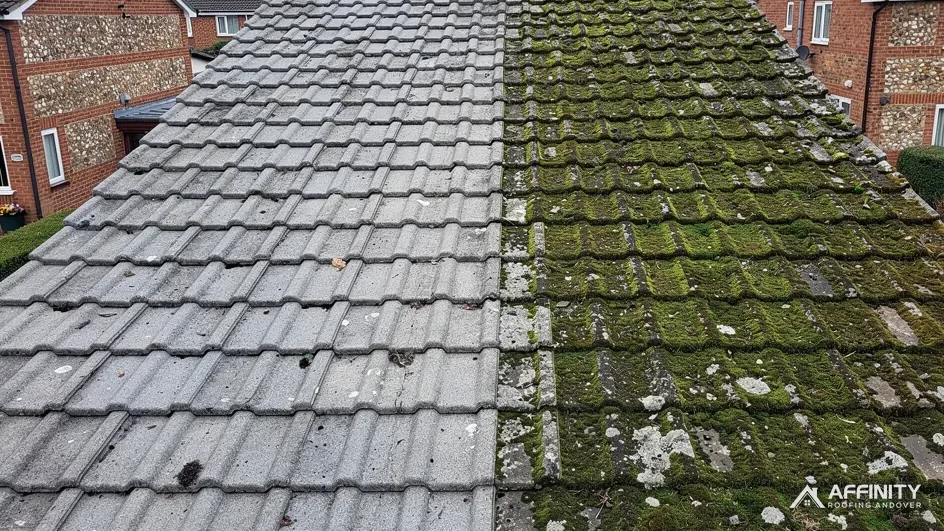
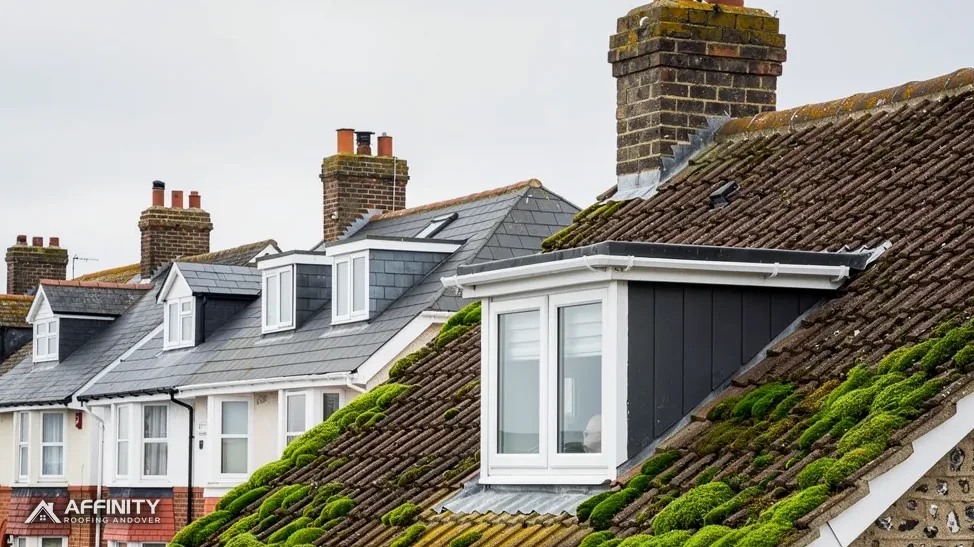
Hand removal clears heavy mats that would otherwise block gutters and trap water, with no water or chemicals involved, and it leaves the surrounding tiles undisturbed. Because the roofer touches each patch, loose, cracked or slipped tiles are noticed at once. For a roof with thick moss and sound tiles, it is a sensible first step before anything else.
Where it goes wrong
A metal scraper can chip the tile face, catch on nibs and gouge a soft clay or a worn concrete surface. Lichen grips tightly, and scraping it removes tile with it. Hand work is also slow, which affects the price, and it needs safe access: a purpose-made roof ladder, a platform or scaffolding.
The right tool
Plastic or wooden tools, or the flat of a gloved hand, do less harm than steel. Nothing should be dragged uphill against the lap of a tile.
Where it fits
Most good jobs start with hand removal and move on to brushing and a treatment. Done alone, it leaves roots and spores, so growth may return quickly. On its own, it is a clearance method rather than a clean.
Our guide on moss and lichen shows why hand work suits the one and not the other.
Brushing downhill with soft bristles
A brush finishes what hand removal starts. It works at the thin layer left on the surface after the mats are gone, and it sweeps loose material down to the gutter.
Soft bristles, downhill strokes
Natural or soft synthetic bristles, used in strokes that follow the fall of the roof, shift dry or dead growth without scoring the tile. A stiff nylon or wire brush does the opposite, scratching the face so that the next spores have a better foothold.
Dry or treated growth works best
Brushing live, wet moss tends to smear it into the pores of the tile and the joints. Brushing after a treatment, once the growth has died and dried, is far easier and cleaner. That is why the order of work matters, and why a cleaner who brushes first and sprays later may be doing it backwards.
Machines with rotating heads
Powered brush heads fitted to a pole exist, and they are sometimes sold as the quick answer. They save time, but they can chip tile edges, and pushed against the slope they lift the tails of tiles. They suit a flat, sound surface and not a roof of interlocking or old tiles.
What brushing cannot do
It does not kill anything. Growth that is only brushed away begins again from whatever stayed behind in the surface. The more porous or worn the tile, the more stays behind.
Brushing is therefore best seen as a step in a sequence, and not as a complete method on its own.
Biocide treatment: gentle but regulated
A treatment is sprayed onto the tiles and left to work. The growth dies in place, dries out and loosens over the following weeks, then falls away or is brushed off.
What it does well
It puts very little force on the roof. It reaches the living growth, including the thin algal film that no brush will shift. On old clay, weathered concrete and natural slate, it is the method that does least harm to the surface.
What it needs
It needs the right product, applied as the label allows, in suitable weather and by someone entitled to use it. The rules are set out in our guide to roof biocide treatments. The headline is that the HSE keeps professional-only products away from householders, and that an unapproved product cannot lawfully be used at all.
What it costs you in patience
It works slowly, and for some weeks the roof can look patchy as the dead growth turns brown. Some owners find that unsettling. A good cleaner warns you beforehand and explains that the pale patches are the treatment doing its job.
Run-off
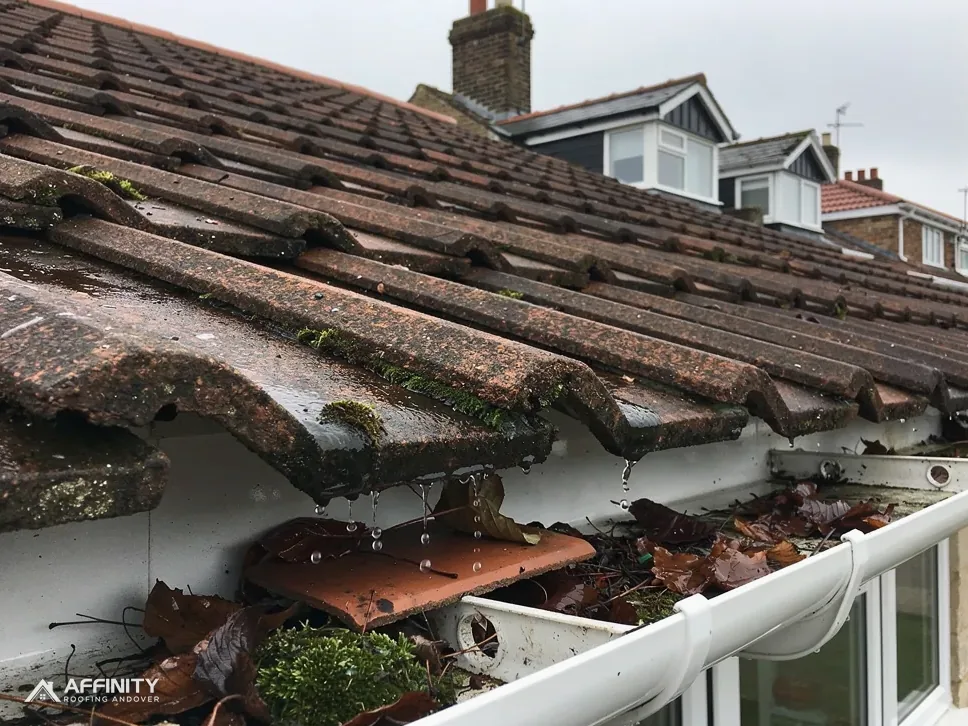
What drips off the roof lands in the gutters, so rainwater butts, ponds and plants below need protection or diverting. Planning for that run-off is part of the method, and a cleaner who does not mention it has probably not thought about it. Ask which downpipes will be capped or diverted.
Treatment is best combined with hand removal of the thick growth beforehand, so that the product works on a thin layer.
Soft washing and low-pressure rinsing
Soft washing is a trade name for applying a treatment and rinsing at low pressure, usually with a pump sprayer that is closer to a garden hose than a jet. It sits between a treatment-only job and a washing job, and the meaning varies between firms, so ask what it involves.
Two things called soft wash
In its good form, soft washing means a treatment applied with a gentle flow, followed by a rinse that carries debris down the slope into the gutter. In its poor form, it means a pressure washer with a wide nozzle, turned down a little, and the risk of damage is still there. The first is a gentle method. The second is still a jet, and it can still push water under the laps.
What to look for
The rinse should be low in force and always directed downhill with the fall of the roof. Nobody should be aiming water up under the tails of tiles to flush the growth out of the joints. Ask about the pressure used and the nozzle, and expect a plain answer.
When it suits
It works well after a treatment has had time to do its work, because the dead growth lets go easily and needs very little help. It also suits roofs where hand removal would be too slow or where brushing is awkward, such as over many small hips or around dormers.
Whatever name is on the quote, the method in practice is what counts, and a short conversation will tell you. Ask to see the equipment if you are unsure.
Why jets damage tiles, and questions to ask
The method to avoid is the jet wash. Marley, a major tile maker, steers owners away from high-powered jet washing of its tiles and slate, and the reason is the damage: the expected life of the roof can be reduced. The harm shows up as cracked and lifted tiles, a thinned face and water forced beneath the courses. Our guide to pressure washing roof tiles sets out the damage in full.
Questions for the cleaner
Ask what method they will use, and whether any jet is involved. Ask what product they use, and whether it is authorised for roofs. Ask how they reach the roof and who will be on it. Ask where the run-off will go, and whether the gutters are cleared. Ask whether you will see photographs of the roof before and after, and of anything found.
Quotes
Citizens Advice recommends collecting written quotes from three traders at the least. When you compare them, look at what each names as the method, whether access equipment, VAT and clearing the gutters are included, and whether the price is a single total. A suspiciously low figure often means a jet and no access equipment.
Access and safety
Cleaning means work at height. Ask how the roof will be reached and what stops a fall. If the answer is that someone will walk across the tiles, think again.
For the scaffolding side of cleaning, see our answer on scaffolding for roof cleaning, and for the whole service the roof cleaning and moss removal hub.