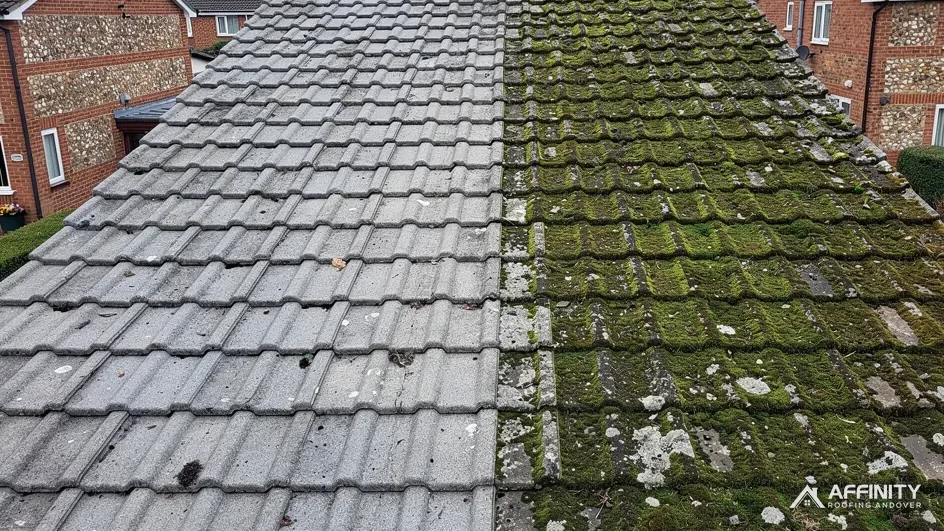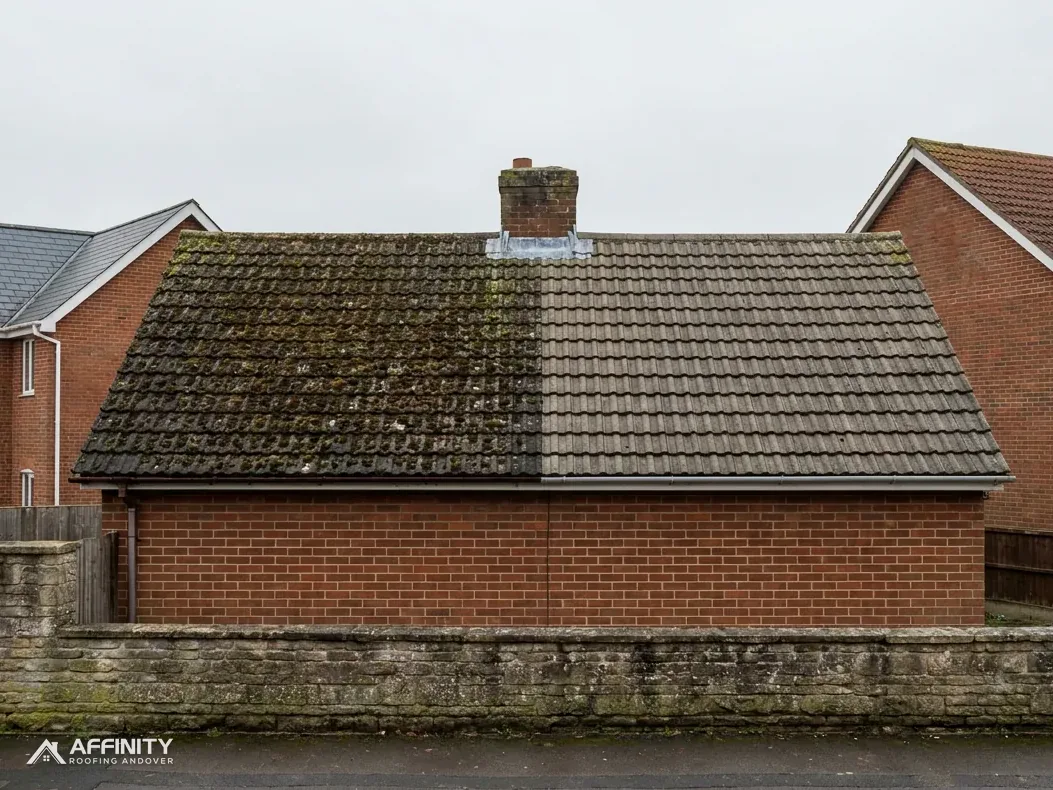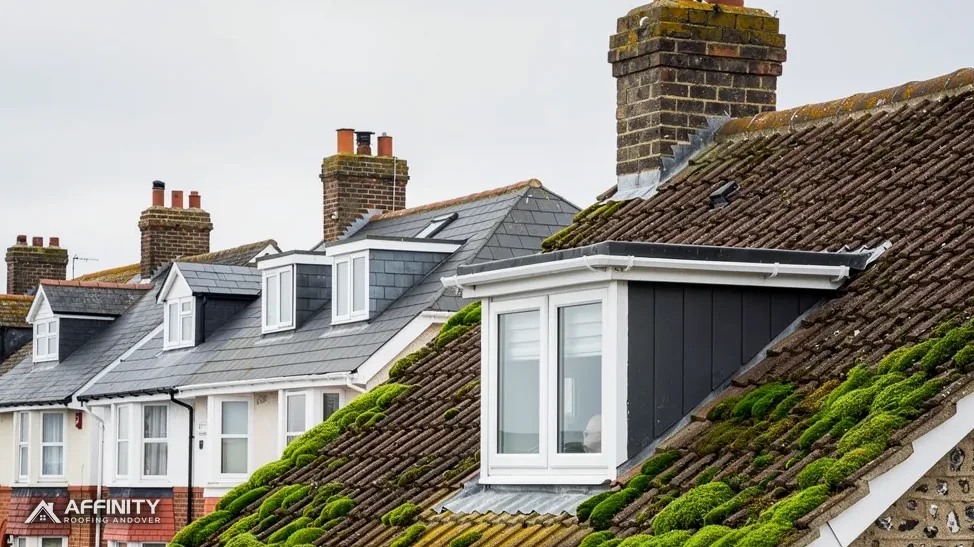
Concrete tiles cover a great share of the pitched roofs built in Britain over the last half century, and they gather moss, lichen and green film with very little encouragement. A shaded slope, an overhanging tree or a gutter that overflows onto the tiles below is enough to start a patch. Once begun, the patch spreads across the courses and thickens in the laps.
The temptation is to hire the strongest wash going. That is the wrong instinct. A concrete tile is a moulded slab with a weathering face, and every year on the roof makes that face a little rougher and thinner. Rough surfaces hold moss, and force removes what is left of the surface. Concrete tiles also interlock, so water driven hard along the laps goes places a shower never would.
This guide explains what you are cleaning, what lifespans the main sources quote, how surface wear and tile laps shape the method, which approaches suit the job, and what aftercare helps keep the growth from returning. As with every cleaning job, the price comes after a survey, as one written total.
What kind of concrete tile is on your roof
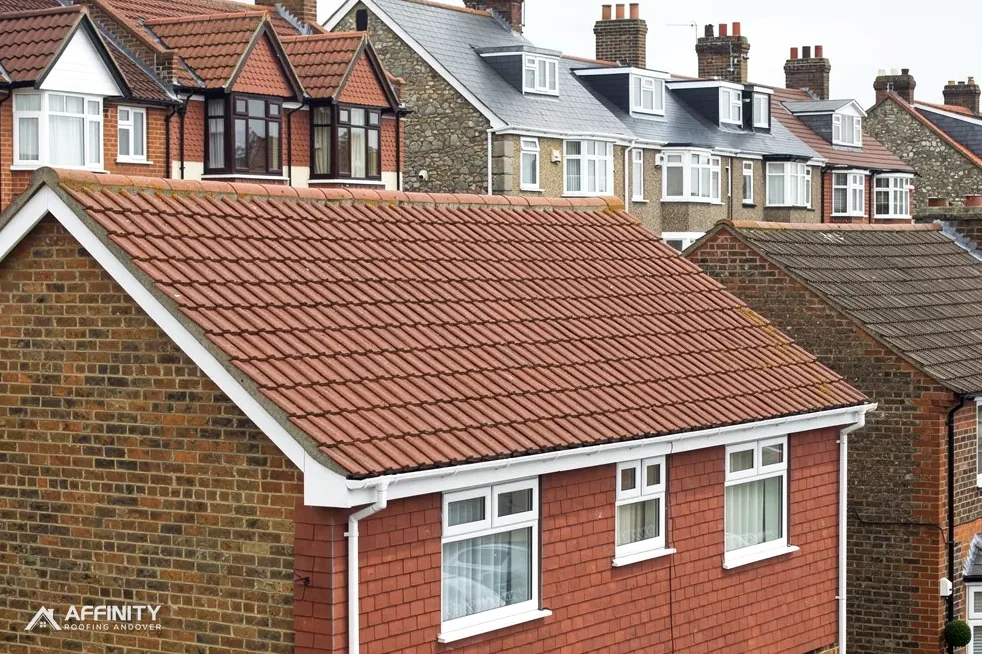
Concrete tiles come in two broad families. Plain concrete tiles are small and flat, hung in overlapping courses much like clay plain tiles. Interlocking tiles are larger and profiled, and each one locks into its neighbour along the side with a shaped edge. The Double Roman is a well-known interlocking profile, a pair of shallow rolls with a flat between them, and Marley and other makers sell a good range of others.
How long they are expected to last
The published figures do not agree, so we give both. Marley puts the expected life of its roof tiles at around 60 years, and it adds that this is not a guarantee or warranty of longevity. HomeBuilding gives plain concrete tiles 40 to 50 years and Double Roman tiles 40 to 50 years. Both are typical ranges, and neither is a promise for your roof.
One figure should not be borrowed: the BRE's 60-year minimum is for clay tiles only. When someone quotes it for this roof, they have the source wrong, and the lifespan that applies is Marley's or HomeBuilding's.
Why age matters when you clean
A roof in its first twenty years can take a gentle clean with little risk. One in its fifth decade has a weathered face, and every method has to be chosen with that in mind. We check the age and condition on the survey before choosing, and we photograph the surface, so the evidence is in your hands.
Profile and pitch
Makers publish a minimum pitch for each profile, and the range is wide: Marley lists 35 degrees for its plain concrete tile, 22.5 degrees for the smooth Double Roman and 15 degrees for the smooth Mendip, with the advice to check each product's data sheet. Pitch matters for cleaning because a shallow slope can be worked from a roof ladder while a steep one usually needs scaffolding. Both are discussed in the roof cleaning and moss removal hub, which also sets out the wider questions.
Surface wear and why moss takes hold
New concrete tiles have a smooth face that sheds water quickly. Over years of rain, frost and sun, that face weathers. The surface becomes rougher and holds a film of moisture for longer, and spores that land on it find somewhere to stay.
Signs the face is wearing
A tile that has lost colour in a patch, a roughness you can feel when you run a finger down a spare tile, and a gritty residue in the gutter are all clues. They are worth noting on a survey, because they tell us how much a cleaner can take off before taking off the tile itself.
Growth that follows wear
Moss thrives where a roof stays damp, so north-facing slopes and areas under trees collect it first. Lichen, the crusty grey-green growth that sits flat on the tile, takes hold on a slow timescale. Green algae form a thin slippery film. Our guide to moss and lichen on roofs shows how to tell them apart.
Why the surface decides the method
Where the face is sound, a careful hand clean and a treatment will do. Where it is worn, scrubbing or blasting removes more than growth. The cleaner has to leave the tile with as much face as it started with, and has to say honestly when a roof is too far gone for the job to help. In that case the better spend is on the repair list, which we draw up from the survey photographs, and the cleaning waits.
For those reasons we treat the surface as the thing to protect. A cleaned roof with a worn face is not a better roof, just a cleaner one that may hold moss again within a season or two.
Interlocking laps and the problem with pressure
A concrete interlocking tile does not simply sit on top of its neighbour. It overlaps the next tile at its side and head, and the shaped edges lock together so that rain runs down the surface and off the tile below. That arrangement is designed for water falling from above.
What jets do to the laps
A pressure washer can damage a roof from several directions at once, because it throws water sideways and upwards as well as down. Aimed along a lap, it pushes water into the gap between tiles and up under them, onto the underlay and the battens. The underlay is the membrane that catches stray rain beneath the tiles, and it is built to cope with a little water, not a sustained blast. Wet battens, a soaked loft and stains on the ceiling can follow a clean that looked successful from the ground.
What the maker says
Marley advises against powerful jet washing of tiles, and it warns that the force can harm the surface and shorten the expected life of the roof. Our pressure washing roof tiles guide goes through the damage in more detail.
Broken tiles and chipped edges
Concrete tiles chip at the edges and corners when struck. A jet can lift a tile or nibble a corner on a weathered course, and once the interlock is damaged the tile is slightly loose in its row. Tiles that rattle in a wind are on the way to slipping. They also let rain pass straight onto the underlay, which is why a clean that loosens interlocks can bring a leak with it.
The practical lesson is that a clean should work with the tile profile, with brushes that follow the roll and water at low pressure to carry debris away.
Methods that suit concrete tiles
On concrete, the methods are much the same as on other coverings, with extra care about the face. The wider comparison lives in our roof cleaning methods guide, and what follows applies it to this covering. Whichever method is chosen, the sequence is the same: lift the bulk of the growth by hand, brush what remains, treat the surface, then rinse gently and clear the gutters.
Scraping and hand removal
Thick moss is lifted by hand or with a flat plastic tool, working from the head of the roof downwards. Metal scrapers catch on laps and nibs and are best avoided on a weathered face.
Soft brushing
After moss is lifted, a soft brush clears what is left. A worn face deserves a lighter hand than a new one, and a brush with stiff bristles can leave pale streaks that show for years.
Treatment
A biocide kills the root of the growth, and the dead material loosens and washes away over weeks. Only an approved product used under its conditions of authorisation is lawful, and the HSE says professional-only products are never for householders. The result is gentle on the tile, though slower than a blast.
Low-pressure rinse
Water used to carry loosened growth into the gutter is not a jet. What counts is how close the nozzle is, how hard the water leaves it, and the direction it travels. The direction is always down the slope, never up under the laps.
Access
Concrete tiles can crack under a boot, and algae makes them slippery. Use a roof ladder or scaffolding, and keep off the tiles themselves. A cleaner who suggests walking across the slope to save on access has priced the job on the wrong basis, and a fall is a far greater cost than the equipment.
Aftercare that slows the return of moss
Moss comes back where the conditions that grew it remain. Cleaning clears a roof but does not alter the shade, the damp or the debris. A few habits help the clean last.
Gutters and downpipes
An overflowing gutter wets the tiles at the eaves and encourages growth along the bottom courses. Keeping gutters clear is the most useful habit, and a cleaner will usually find them full after a roof clean because the dead moss lands there. Our gutter cleaning guide covers the job.
Trees and shade
Branches that overhang the roof drop leaves, hold moisture and block the light and air that dry the tiles. Trimming back, within what the tree's owner and any protection on the tree allow, is a cheap fix. Where a neighbour owns the tree, a friendly conversation is the best first step, and the roofer can show them the photographs of what is landing on the tiles.
Look, then act
At ground level, each spring and autumn, look over the roof with binoculars and photograph anything that changes. Slipped tiles and cracked ridge mortar are repair jobs and not cleaning jobs.
Coatings and sealants
A clear coating over cleaned tiles is sometimes offered. It does not repair worn tiles, and it can trap moisture over a weathered face. We explain when one is and is not worth the money in our guide to roof tile coatings.
Pricing
The cost of a clean turns on roof area, pitch, access, how heavy the growth is and the method chosen, which is why a number given over the phone without seeing the roof is a guess. It is priced as one total after the survey, with the photographs we took.