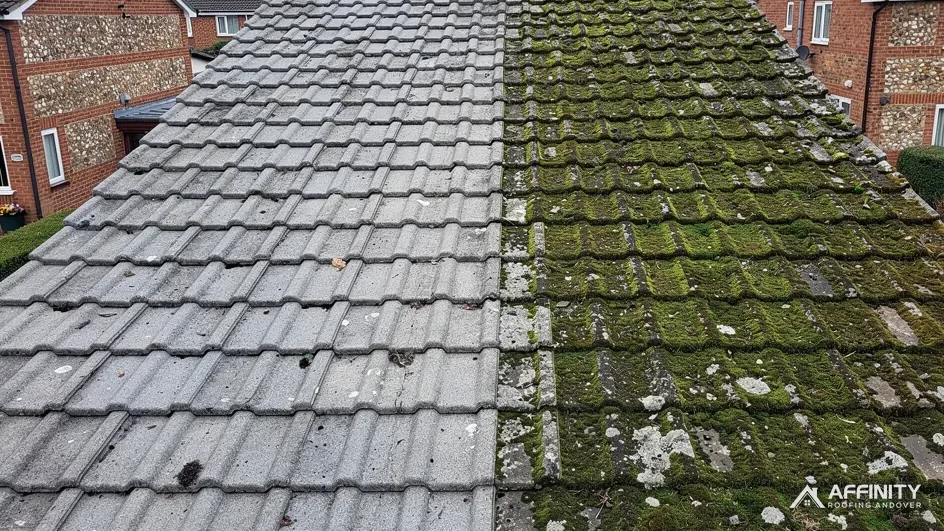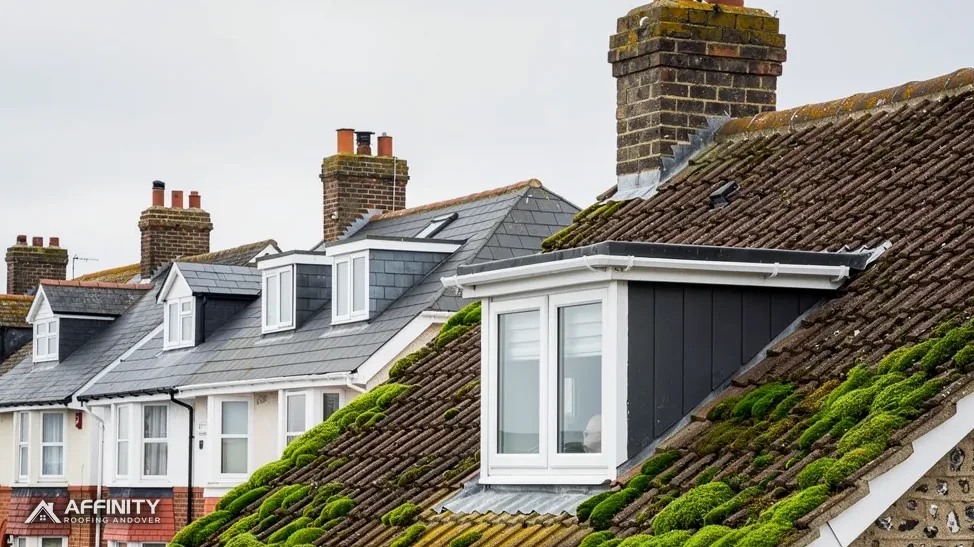
Scraping and brushing take moss off a roof, but they leave the roots, spores and thin films behind. A biocide treatment goes at the living growth itself. A diluted product is applied to the tiles, left to soak in, and the moss, lichen and algae die back over the following weeks. The dead material loosens and, with help from rain and wind, drops away without anyone scrubbing the tile.
That gentleness is why roofers favour treatment on old clay, worn concrete and natural slate. It is also why the law keeps a close eye on it. A biocide is, by definition, a product meant to kill living organisms, and what runs off a roof ends up in gutters, drains and gardens.
This guide explains what a roof biocide is, what the Biocidal Products Regulation and COPR, the pesticides control rules, require, why the HSE tells householders to stay away from professional-only products, how application and timing work, and how to keep run-off under control. It does not give product names or dilution rates, because the label on an authorised product is the instruction that counts.
What a roof biocide treatment is
A roof biocide is a chemical product designed to kill moss, lichen, algae and similar growth. Roofers call the job a treatment, a wash or a moss kill, and the product is sprayed onto the tile surface from a pump sprayer or a low-pressure lance. It is not a cleaner in the sense that a detergent is. It does not lift dirt. It makes the growth die so that it can be taken away, or can simply weather off.
How it differs from other methods
Mechanical methods act on what you can see. A treatment acts on what is living, including the thin dark film of algae and the root-like threads that moss pushes into a rough tile face. Our guide to roof cleaning methods sets treatment beside scraping, brushing and soft washing, so you can see where each fits.
What it does not do
A treatment does not repair anything. It will not refit a slipped tile, reseal a cracked ridge bed or mend a gutter. It also does not stop growth returning for good: if a slope stays shaded and damp, spores will settle again. What it gives is a roof that has been cleared with very little force on the tiles.
Why force is the problem it avoids
The tile makers are blunt about jets. Marley is among those that warn owners not to jet wash tiles, since the tile face can be harmed and the roof's working life cut short. A treatment avoids the cause of that harm by taking the pressure out of the job. The result is slower, and the tile face is kept.
The service that brings these steps together is described on our roof cleaning and moss removal hub.
The Biocidal Products Regulation in plain words
The rules for biocides in Great Britain rest on the Biocidal Products Regulation. You do not need to read it to follow the main point, which is that a biocide may only be sold and used if it is authorised, and it must then be used as the authorisation says.
Authorisation and the label
Article 17(5) of the Regulation ties every use to the approval: a product must be used in line with the conditions that came with its authorisation. In practice, those conditions are printed on the label and in the product's safety data. They set out what the product may be used for, who may use it, how it is diluted, how it is applied and what precautions are needed. Using a product off-label, for a different surface or at a stronger dilution than the label allows, is outside the authorisation.
Why it matters on a roof
A product made for treating patios or fences may not be authorised for a roof, and a trade product may be authorised for roofs only when applied by someone with the right training. The label decides, not the shop it came from and not the price.
Who enforces it
The HSE is the regulator for biocides in Great Britain, and its pages for householders and professionals explain what each group can do. The detail is not something you need to memorise. What you need to remember is that the safest check is simple: does the product on site have an authorised label for roof use, and is the person using it entitled to do so?
If a cleaner cannot show you the product and its label, treat that as a reason to ask for a different cleaner.
Professional-only products: why householders keep away
Some biocides are sold to anyone. Others are intended for professional users only, and the label says so. The distinction exists because the stronger products carry greater risk to people, pets, plants and water, and they need training and protective equipment to use properly.
The HSE's line
The HSE's guidance is direct: the public should keep clear of any biocidal product meant solely for professional users. That is not a matter of preference. A professional-only product is one that the authorisation has restricted to trained users, and a householder who buys one through a trade counter, a website or a neighbour is outside the conditions.
COPR and non-approved products
COPR adds a second layer by barring anyone from advertising, selling, supplying, storing or using a product that has not been approved. A bottle bought abroad, a mixture decanted from a drum with no label or a household chemical pressed into service on the roof can cause a legal problem as well as a practical one. Bleach is a good example of a product that people reach for and that was never meant for this, and our answer on bleach on roof moss explains why.
What householders can do
If you want to treat your own roof, read the label to find out whether the product is for public use at all, and whether it is allowed on roofs. Our answer on DIY roof moss killer covers the questions to ask. Working on a roof also means working at height, which is a risk of its own and one more reason to hire someone.
How application works on the day
A treatment visit is usually shorter than a full clean, and much of the skill lies in the preparation.
Look first
Before any product goes on, the roofer looks at the roof. Which slopes carry growth, what the tiles are like, whether the gutters are blocked and whether anything on the roof needs protecting. Photographs are taken, and anything found that needs repair goes onto the survey notes.
Pre-removal of heavy growth
Thick moss is often lifted by hand first, since a treatment works best on a thin layer, and since heavy mats of dead moss left in place will block gutters. This is done using a roof ladder or scaffolding, never by walking across the tiles.
Application
The product is mixed to the label's dilution and applied evenly across the affected slopes, working from the ridge downwards so it does not run onto treated areas unevenly. Spray patterns matter: the aim is to wet the growth, not to flood the roof, and a steady even pass does better than a heavy one.
Protecting what is below
Plants, water butts, ponds and cars below the roof need covering or moving. Windows are closed. Anyone at home, including pets, is told to stay clear while the work is under way.
Afterwards
The roof is left to do the work. The roofer may return to brush off loose dead growth once it has dried, and the gutters get cleared. There is no number of days we can promise, because how fast growth dies depends on the product, the thickness and the weather. Patchy colour in the first weeks is normal while the dead growth is still on the tiles.
Timing, weather and when not to treat
The label sets the real rules for timing, and it varies from one product to another. A few general points apply to almost every treatment.
Rain and dry spells
A product needs time on the tile to be absorbed by the growth. Heavy rain soon after application can wash it off before it has worked, and many labels ask for a dry spell. A roofer watches the forecast for that reason, and may postpone a job after arriving. That is a good sign, since it shows the product is being used as intended.
Temperature and frost
Some products need mild weather to act, and some become less effective when it is cold. Frost on the tiles also makes access dangerous. A cold-season visit has trade-offs of its own, and the label is the first place to check.
Sun and drying
Strong sun can dry a product before it has soaked in, which is another reason to read the label, and why an overcast, still day often suits a treatment better than a hot one.
When not to treat
There are times when a treatment should be put off. If the roof is leaking, repair it first. If tiles are cracked or loose, replace or refix them before anything goes on. If water from the roof drains into a pond, a stream or a rainwater tank, the run-off needs a plan. And if an owner is unsure what the roof is made of, particularly on an older outbuilding, the first step is to identify the material, since asbestos cement sheet, for example, needs a very different approach.
No treatment is worth doing in a hurry, and a roofer who offers to start without looking at the weather or the label has not understood the product.
Run-off, gutters and the garden
What goes onto a roof comes off it again, and the route is the gutter, the downpipe and the drain. Controlling that route is part of the job.
Gutters and downpipes
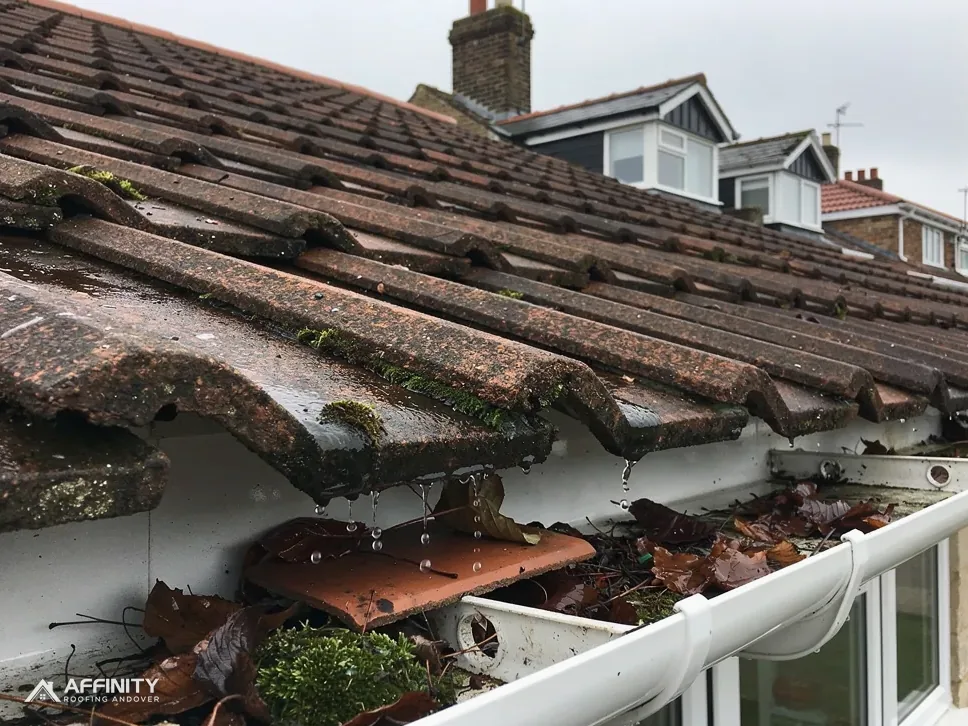
Dead moss and treated debris wash into the gutters. If those are not cleared, they hold water and overflow, which wets the fascia and walls. A roofer clears the gutters during or after the treatment so the run-off has a clear path.
Soakaways, butts and ponds
Rainwater butts should be disconnected from downpipes for the period the label gives. A downpipe that discharges into a garden pond or onto a vegetable bed needs diverting or covering. If you are not sure where the water goes, say so on the survey visit and the roofer will trace it.
Neighbours and boundaries
Spray drift can reach a neighbour's washing, car or greenhouse. Calm weather and low-pressure application keep it where it belongs, and a word with next door beforehand avoids upset.
Cost and the written quote
The price of a treatment turns on the size of the roof, its pitch, how easily it can be reached, the weight of growth and what must be protected, so the figure is set after a survey and written down as one total, never guessed over the phone. If a roofer finds faults while up there, repairs are quoted separately from the treatment, and you decide on each.
The best companion to any treatment is the aftercare in our guide to moss and lichen on roofs, which also shows how to tell what is growing.