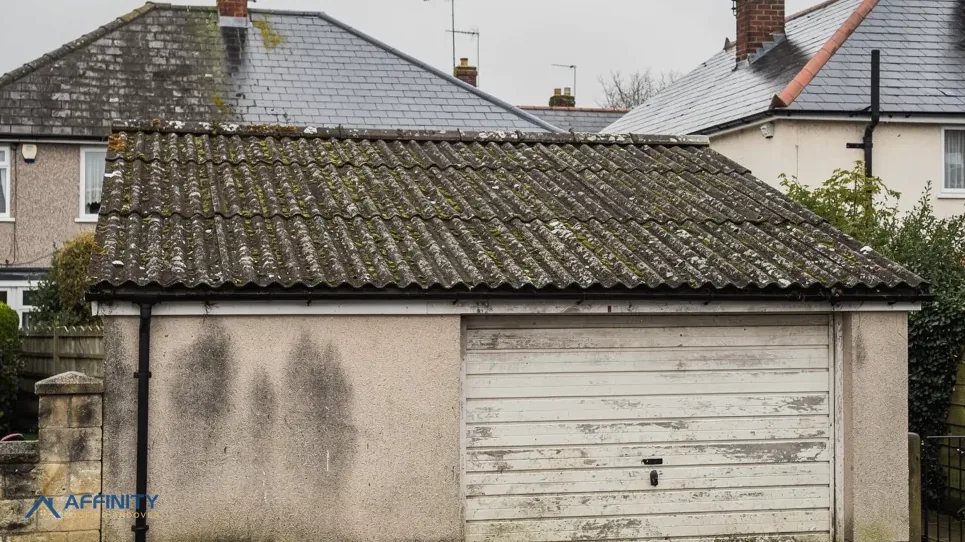
Corrugated grey sheets on a garage, a farm shed, a lean-to or a 1960s outbuilding are often asbestos cement: cement mixed with asbestos fibre and pressed into sheets. The roof gathers moss, green algae and black streaks like any other, and the temptation is to hire a cleaner or borrow a jet wash, a tool that can damage cement sheet, and spend a Saturday on it.
That is the step to stop and think about. The HSE, the Health and Safety Executive, describes every asbestos cement roof as fragile, with no exception. Its guidance also builds its categories of work around whether the material is carefully handled or broken up. A cleaning method that scrubs, scours or blasts a cement sheet can move a simple job into a much more serious one, with a risk to the person on the roof and to everyone downwind of it.
This guide explains how to tell whether a roof is asbestos cement, why we treat it as fragile, which kinds of work the HSE describes, what happens to the waste, and what a sensible survey looks like. It is general information, and the first step is always to identify the material before anyone touches the roof.
Is your roof asbestos cement at all?
Looks are not enough. The HSE says it is difficult to tell asbestos materials from non-asbestos equivalents by eye, and its advice for any building built or refurbished before 2000 is to assume there is asbestos in it. A grey corrugated roof on an older garage or outbuilding falls squarely into that category, whatever the sheets look like from the ground.
Clues worth noting
Large corrugated cement sheets, a flat grey colour, a surface that has weathered and flaked in places and bolt or screw heads along the sheet laps are all reasons to be careful. Cement sheet also appears as rainwater goods, such as gutters and downpipes, and the HSE lists asbestos cement roof sheeting and rainwater goods together as examples of the same family of material. Further under the roof, asbestos insulating board, usually shortened to AIB, is found in external soffits, and it is a different product with different rules, so we cover it in our guide to asbestos soffits.
Getting a definite answer
A sample sent to a laboratory is the way to settle it, and a survey by a competent person is the sensible way to arrange that. MyJobQuote gives an average asbestos survey at around £325 as a typical UK figure (Sep 2026). If a roof is likely to be disturbed by repair or removal, that survey is money well spent before any quote for the work, because the answer changes what you are paying for.
Until you know, treat the roof as asbestos cement. Do not drill it, saw it, scrub it or let anyone else do so for you.
Where the survey shows the roof is an ordinary fibre cement or sheet of another kind, the cleaning questions become the usual ones covered on our roof cleaning and moss removal hub.
Why asbestos cement roofs are always fragile
The HSE's own wording, in its guidance on working with asbestos on roofs, is blunt: asbestos cement roofs are always fragile. That is stated without exceptions, and it applies to a roof that has stood sound for forty years as much as to one that is visibly cracked.
Age makes it worse, not safer
Cement sheet carries weight on its purlins, the horizontal timbers or beams beneath it. Over decades the sheet becomes brittle, and moss growing in the corrugations holds moisture against it through every winter. What looks like a solid sheet can give way under a foot, a ladder foot or a boot slipping on algae. A fall through a fragile roof is a serious risk in its own right, and with asbestos cement the fall comes with a second hazard: broken sheet.
Nobody walks on it for cleaning
The practical result is that cleaning an asbestos cement roof is not something to try from the roof surface. Anyone who needs to work there needs proper access, edge protection and a load-spreading platform set up by people trained for it, and anyone else stays off. We would rather turn a cleaning enquiry into a survey than send anyone up with a brush.
The same rule applies to a neighbour's roof, a farm shed or a commercial unit. If you own, let or manage a non-domestic building, your duties as the person responsible for the premises go beyond a single repair, and our asbestos duty holder answer explains who that is.
Fragility also explains why a cleaning attempt that seems gentle can cause a problem. A stiff brush catches a lifted corrugation, a boot lands on a hairline crack and the damage is done before the moss has moved.
Why force is the wrong tool
Jet and pressure washers damage by design: they throw water at a surface hard enough to strip what sits on it. On a fragile cement sheet, that is the opposite of careful handling. The HSE's description of non-licensed work with asbestos cement is that the material is "carefully handled/removed without breaking up", and that this includes work with asbestos cement "which is weathered but not otherwise substantially damaged". Cleaning that abrades the surface, blasts at the laps or flicks debris from the corrugations is not that kind of handling.
What can go wrong
Water at pressure can open up the weathered top layer and the edges of a sheet. It can drive moss and slurry across the roof and down into a gutter, a garden or a neighbour's yard. Once a sheet is chipped or crumbling, you are no longer dealing with weathered sheet that has simply been left alone.
The HSE puts asbestos cement work into the notifiable non-licensed band when the material is substantially damaged or broken up. That brings extra steps for the contractor, including keeping a register of work with health records for 40 years. Those are the things a competent firm does, and they are the reason such work is not a quick weekend job.
Other cleaning advice does not transfer
Marley's advice on its own tiles and slates is that high-powered jet washes are not recommended because they can damage the surface and reduce the roof's expected life considerably. That is guidance for tiles and slates, and the principle sits even more firmly on a cement sheet. Our guide to pressure washing roof tiles explains the damage on a surface that is far more forgiving than this one.
We would not suggest any cleaning product for a householder to use on an asbestos cement roof.
What the HSE means by licensed and non-licensed work
The HSE sorts asbestos work into three bands, and it helps to know which one your roof falls into before you speak to anyone.
Non-licensed work
Asbestos cement products, such as roof sheeting and rainwater goods, can be handled or removed as non-licensed work provided that is done carefully, without breaking the material up. The HSE's wording includes asbestos cement that is weathered but not otherwise substantially damaged. So a sound old sheet roof, lifted off whole, sits in this band.
Notifiable non-licensed work
Sheets that end up substantially damaged or broken up put the work into notifiable non-licensed work. That is the band a bad cleaning attempt can push you into.
Licensable work
Licensable work is the third band. For example, the HSE lists work on asbestos insulating board where the risk assessment shows it will not be of short duration. That is why soffits are checked first on any roofline job, as AIB can sit behind a fascia board that looks harmless.
Ask to see the paperwork for any licence a firm mentions, because nobody should assume a roofer holds one. What we can do is survey, photograph the roof, tell you what we think it is made of, and explain which route applies before a price is written. If the answer is a specialist, you hear that from us at the start.
For the removal route in more detail, including what a garage roof involves, see our answer on an asbestos garage roof.
Leave it, treat it or replace it
With a verified asbestos cement roof, the useful question is not how to get it clean but what the roof should be doing for the next ten years.
Leaving it alone
A sound roof that is not leaking and not being worked on can be left. Moss on a corrugated sheet is, to a roofer, a sign of damp and shade first and a cosmetic problem second. The decision to leave it should still follow a proper look, since staining, cracked corrugations and rusting fixings are the faults that count.
Treating it
Some surface treatment methods are used on cement sheet from a safe position and without scrubbing. Whether one suits your roof depends on its condition, on access and on who is doing it, and that is a conversation after the survey. A treatment that needs anyone on the sheet itself is off the table.
Replacing it
Where the sheets are cracked, brittle or leaking, taking them off whole and fitting a new covering is the lasting answer. MyJobQuote gives asbestos roof removal at around £2,750 as a typical UK figure (Sep 2026), and the real price turns on roof area, access, pitch and the waste route. We give one written price after the survey. Our guide on overcladding or replacing an asbestos cement roof sets the choices side by side.
A written quote should say what the roof is made of, how the sheets will be lifted and where the waste goes. If it does not, ask.
Waste, skips and who may carry it
Asbestos waste is hazardous waste, and it follows rules that ordinary building rubble does not.
Wrapping and labelling
The HSE's guidance for asbestos waste is to double-wrap and label it. Sheets and fragments are bagged or wrapped and kept apart from other waste on the site.
Not in a general skip
Asbestos waste does not go into a general waste bin, a rubbish pile or an open skip. The HSE allows lockable or sealed skips for asbestos, not an ordinary builder's skip left open on the drive. Waste travels on a hazardous waste consignment note, and the carrier needs the registration the government sets out for hazardous waste carriers.
Householders and the household exemption
GOV.UK's household exemption covers domestic hazardous waste other than asbestos waste. That exemption is about consignment notes, so it does not reach asbestos waste, and a contractor removing sheets from a home must consign them. If you are paying for removal, ask who the registered carrier is and what paperwork you will receive.
You can ask the same of any firm that proposes to clean or work on such a roof. Our job is to explain the route before the work starts and to keep you informed at each stage, and any firm should be able to say where the waste will go before it starts.
If the roof is on commercial premises, the asbestos survey before roof work answer sets out what comes first.