The short answer
Gently, and without ever standing on it. A conservatory roof is glass or plastic sheet carried on a light frame, and it is not built to take a person's weight. It is cleaned with soft brushes, plenty of clean water and mild products, from a ladder, a tower or a long-reach pole, with the gutters and seals checked at the same visit.
Why you should never stand on it
The first rule of conservatory roof cleaning is the simplest: keep off it. Glazing bars and rafters are built to carry the weight of the glass or polycarbonate and some wind and rain, not a person. Polycarbonate sheet flexes and can crack, glass can break without warning, and a fall through a conservatory roof is among the more serious accidents a household can have.
Crawling boards do not make it safe. They spread load across a tile roof, where battens and rafters run at regular spacing, but conservatory panels are supported only at their edges, so a board gives false security. Older panels that have turned brittle in the sun are the least forgiving.
So the work is done from outside the roof surface. That means a ladder against the wall, a tower that sits on the ground beside the conservatory, a long-reach soft brush on a pole, or a platform arranged by the roofer. If the roof cannot be reached without leaning on the panels, the correct answer is a different access method, not a bolder one.
The same advice applies however well built the conservatory is.
Gentle cleaning for glass and polycarbonate
Most of what lands on a conservatory roof is loose: leaves, bird droppings, pollen and a film of fine algae that sits on the outside face. A soft brush and a good flow of clean water lift it without scratching the surface. Warm water with a little mild, non-abrasive cleaner can be added for stubborn patches.
Strong chemicals and hard scrubbing are the usual way these roofs get spoiled. Abrasive pads scratch polycarbonate, and scratches hold dirt for ever after. Solvent-based cleaners can cloud or craze plastic sheet, and high-pressure water can force its way past the glazing seals, which is how a leak starts from the inside of a conservatory that was not leaking before.
The green growth that returns every spring is often algae. A roofer can apply a suitable biocide, but only a product approved for the material and used as its label directs, and the Health and Safety Executive's line is that homeowners should not use professional-only biocides. For moss and algae on the main house roof, our roof biocide treatments guide explains the process.
Always rinse well afterwards, since residue dries into streaks that show from inside.
Gutters, seals and the joins that leak
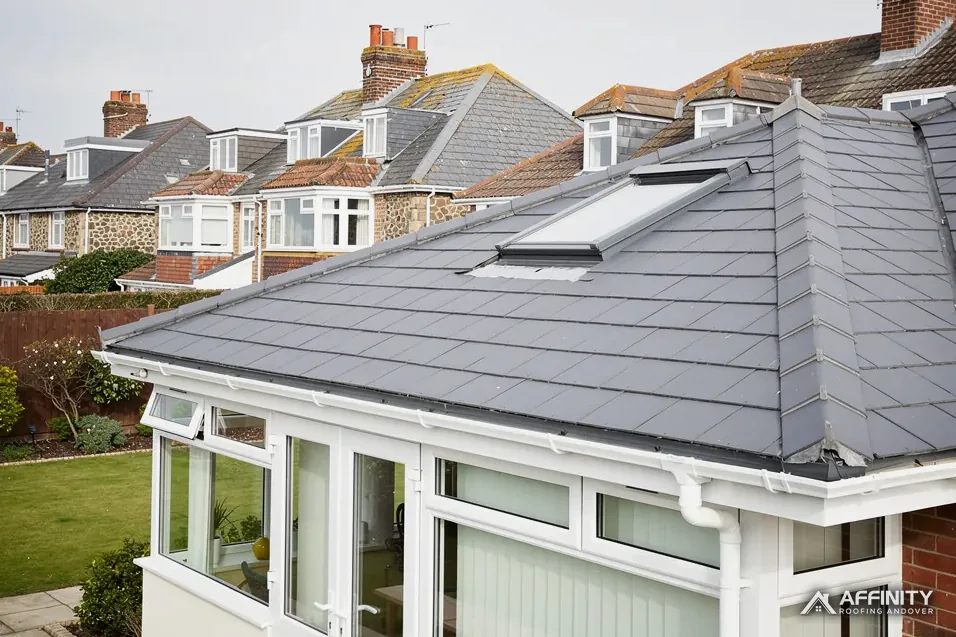
A conservatory roof has a great many joins for its size, and cleaning is the ideal moment to look at them. We check the silicone or rubber glazing seals, the cappings that hold sheet in place, the flashing where the conservatory meets the house wall, and the gutter along the eaves.
The gutter matters most. Conservatory gutters are small, they can sit under overhanging trees, and they clog with leaves and moss that has fallen from the roof. A blocked run overflows onto the frame or the wall and runs indoors. Clearing it is part of every conservatory clean we do, and if the gutter has pulled away or the joints are weeping, we tell you before the next downpour makes the point for us. Our answer on moss blocking gutters explains how a small blockage grows.
Cleaning cannot rescue a roof that is worn out. HomeBuilding puts a typical polycarbonate conservatory roof at around 10 years, and The Eco Experts at about 10 to 15, so a tired, yellowed or cracked polycarbonate roof may call for replacement, not another wash.
Booking a clean and what it costs
A conservatory roof clean is priced after a survey, since the figure depends on the roof's size, its material, how it is reached and what condition the seals and gutters are in. A small lean-to over a patio is a different job from a large gabled conservatory with a pitched glass roof on three sides.
It also makes sense to book the clean for a dry spell in the warmer months. Cleaning products work better on a dry surface, there is no risk of frost on the panels, and the roof dries quickly afterwards so streaks do not set.
If you want to do a little yourself between professional visits, the safe jobs are on the inside and the ground. Wipe down the inside face, sweep leaves from the garden side of the gutter with a long-handled tool from a stable ladder, and cut back any branch that overhangs the frame. Everything above that height is better left alone.
For wider guidance on how we approach different roof types, see the roof cleaning and moss removal page. The quote we send afterwards is one written total price, and the survey photographs come with it.