Look at a tiled roof from the garden and you may see green fur along the north slope, rusty orange or pale grey rounded patches on the tiles, or a dark film running down from the ridge. People call all of it moss, and many roof cleaners do the same. It is worth being more exact, because each growth has its own habits and each calls for a slightly different answer.
Moss is a plant that forms soft, thick cushions and holds a surprising amount of water. Lichen is a crust: a partnership of a fungus and an alga that spreads flat across a surface and grips it. A third growth, green algae, makes a thin slippery film that dulls the colour of a tile without building any thickness.
This guide shows how to tell moss and lichen apart from the ground, how each grows, what harm each can do, and which approach suits each. It also covers the rules on treatment products, because a bottle from a shop is not always the lawful choice. The roof is priced after a survey, as one total.
Telling moss from lichen without climbing up
You do not need to be on the roof to learn a lot, and you should not be. Stand across the road or at the far end of the garden and use binoculars or the zoom on a phone. Note where the growth is, what colour it is and how thick it looks. A slope that carries growth on one side and none on the other is telling you something about shade and drainage, and that detail helps a surveyor before they arrive. Pay attention to the ridge line, the valleys and the courses just above the gutter, because those are the places water lingers.
What moss looks like
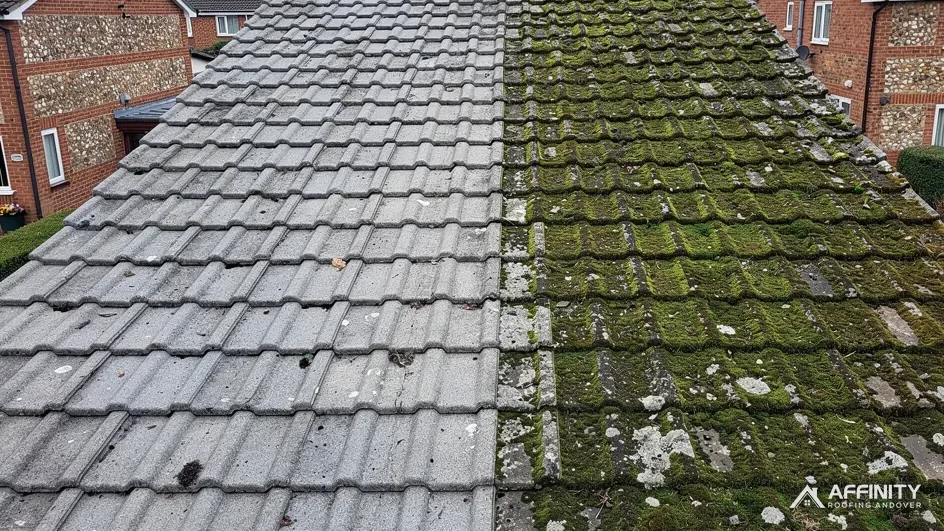
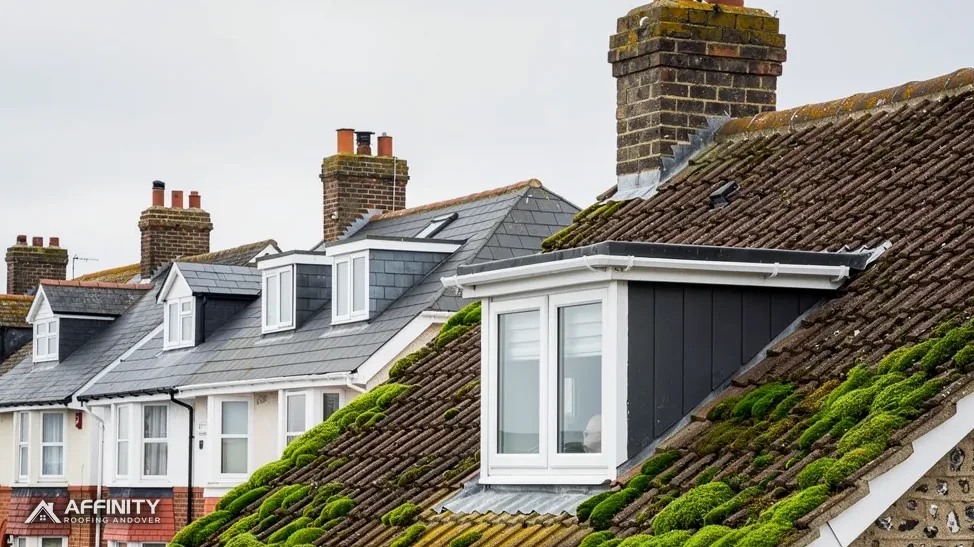
Moss forms raised cushions or tufts, deep green when wet and a dull yellow-brown when dry. It stands up from the tile, so its edges cast a small shadow in low sun. It collects along the joints between tiles, at the bottom of slopes and against hips and valleys, where water and dust gather. In a thick patch you can see it lifting tile edges and bridging gaps between courses. Dead moss goes brown or black, and a roof can carry a good deal of it long after it stopped growing.
What lichen looks like
Lichen lies flat. It forms round or spreading patches that look like paint splashes, in grey, pale green, white or orange, and some have a raised rim or tiny cup-like shapes at the edge. It sits on the face of the tile rather than between tiles, and it does not form a cushion. From a distance a lichen roof can look speckled.
What algae looks like
A dark or green stain with no real thickness, often running in streaks below the ridge or a chimney, is usually algae. Our answer on black streaks on roof tiles goes into that case, and the roof cleaning and moss removal hub shows how the whole service fits together.
Photograph what you see, whichever it is. A picture sent to a roofer before the visit saves time on the day, and photographs taken in different light, wet and dry, show far more of the growth than one snapshot does. If the roof has several types side by side, say so, since the order of work depends on it.
How each grows and why your roof suits it
Both growths need moisture and a surface to hold, and neither needs much else. A roof gives them both. What differs is how fast they establish and where they prefer to settle.
Moss and the damp roof
Moss spores arrive on the wind and settle where the roof stays damp. Shade is the main factor: a north-facing slope, a roof beneath trees, the side of a chimney, a lean-to tucked behind a taller wall. A tile with a rough face holds a film of water for longer and gives spores something to grip. Once a small tuft has formed, it holds yet more water and gives the next tuft a head start, which is why a few small patches can become a mat within a few seasons.
Lichen and the slow settler
Lichen colonises more slowly. It tolerates dryness better than moss does and spreads outwards from a point, often on tiles that are exposed to more light. Its slowness is deceptive: a roof with a lot of lichen has usually stood for a long time in a place where little disturbs it.
Neither is a sign of a poor roof on its own
Plenty of sound roofs carry both. What the growth tells you is that the roof is damp for long periods, and that is worth investigating. A young house with moss on its tiles is as likely to have a shade problem as an old one, so age alone does not explain it. Blocked gutters, overhanging branches and a worn tile face are the usual causes, and our roof biocide treatments guide explains what to do next.
The first question is always why the roof stays wet, and the second is what the tile face looks like underneath. If the answer to the first is a gutter, we fix the gutter. If it is a tree, the tree's owner has a decision to make.
What moss does to a roof
Moss is the growth that tends to cause trouble, because of what it holds and where it grows.
It holds water against the tile
A moss cushion soaks up water like a sponge and releases it slowly. The tile beneath stays wet long after the rain has stopped, and in cold weather that water freezes and thaws against the tile. Over many seasons, a face that never dries wears faster than one that does.
It works into the laps
Thick moss pushes into the gaps between tiles and into the overlaps. In the laps it can lift a tile a fraction at the tail, so rain blown upwards by wind can get under. On an interlocking tile, moss in the side channels can stop water running down the groove.
It ends up in the gutters
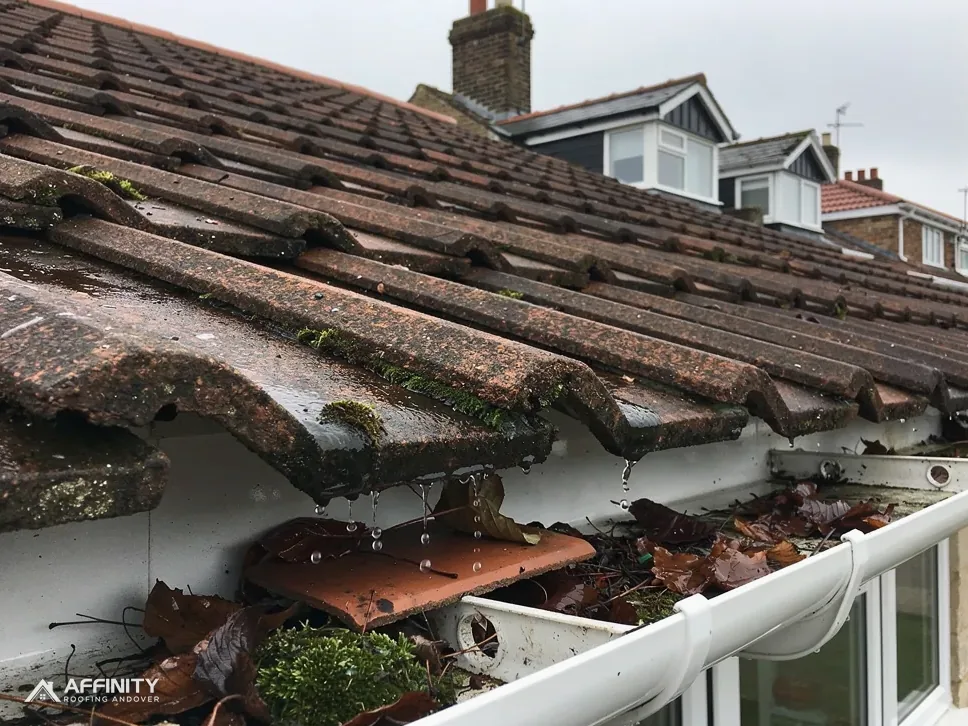
Moss that dies and breaks away drops into the gutter. Over a season or two a gutter can fill with a dark mat of it, and the water then overflows behind the fascia. See our answer on whether moss damages a roof for the longer discussion.
It hides faults
A thick mat can cover a cracked tile, a slipped tile or a patch of failing mortar. Taking the moss off is often the point at which the roofer finds the real problem.
That is why we treat a moss clean as an inspection as well as a clean. The photographs matter as much as the finished roof, because they show what was underneath and give you something to compare against next year.
What lichen does, and why it behaves differently
Lichen is more often a matter of appearance than of structure, though there are things worth knowing before anyone sets about it.
It grips the surface
A lichen crust is attached firmly to the tile. It cannot be brushed or rubbed away the way a moss cushion can be, and scraping at it tends to remove tile face along with it. A tile scraped clean of lichen can be left with a pale, rough patch that looks worse than the lichen did and holds moss more readily later.
It holds less water than moss
Lichen forms a thin layer, so it does not carry the same weight of water as a moss cushion and does not push into the laps. That is why it is commonly judged the milder of the two. It is also slow, and a roof can carry it for a long time without anything showing inside.
Why it is still worth a look
A heavy covering still dulls a roof's colour, hides the condition of the face underneath and can sit alongside moss in the shadier courses. On older clay or slate roofs, which are often in conservation areas, it is part of how the roof looks and should be handled with care. Our guide to removing lichen from a roof covers that case.
The sensible view
Not every roof with lichen needs treating. If the tiles are sound and the gutters are clear, a light covering can be left, and the decision can rest on whether you like how it looks. A roof you plan to sell is a different case, because buyers' surveyors notice growth and ask about it, so a tidy, treated roof saves argument.
Treatment: what suits moss, what suits lichen
The right method follows from what is growing and what the tiles are like.
For moss
Heavy moss comes off first, raised gently in sections and swept down the slope with a soft brush, and the treatment follows. Done in that order, it takes off the weight of the growth first and leaves the treatment to deal with what remains. The dead material then falls away over time, and it can be swept from the gutters when it does. Expect the roof to look patchy for a while before the colour evens out, which is normal and no sign of a failed treatment.
For lichen
Lichen is not scraped. A treatment is applied and left to work, and the dead crust loosens by itself. The result is slower than a blast of water, though the face of the tile is kept.
For algae
Algae streaks respond to the same treatment, and they often fade without any brushing. They need no heavy hand, and a clean that tackles algae with force is the one most likely to do harm for the least gain.
No jet washing
Marley advises against high-powered jets on tiles, because the surface can be damaged and the roof's expected life cut, and our guide on pressure washing roof tiles covers why. Lichen in particular is not removed by jet without taking the tile face with it.
The product rules
A moss or lichen killer is a biocide. Under the Biocidal Products Regulation a product may only be used as its authorisation allows. The HSE adds that householders must keep clear of any biocide made for trained users alone, and under COPR a non-approved product is an offence to use. Read the label, and if it restricts use to professionals, hire one.
Treatment cost turns on roof area, access and how much growth there is, so the survey sets it as one total price.