
Roofers in Whitchurch
From the Silk Mill streets out to the downland edge
Whitchurch has 54 listed buildings within about 900 metres of its centre. We survey each roof, photograph what is there and match the repair to the way it was built.
Whitchurch roofs, from mill town to downs

Conservation-area streets
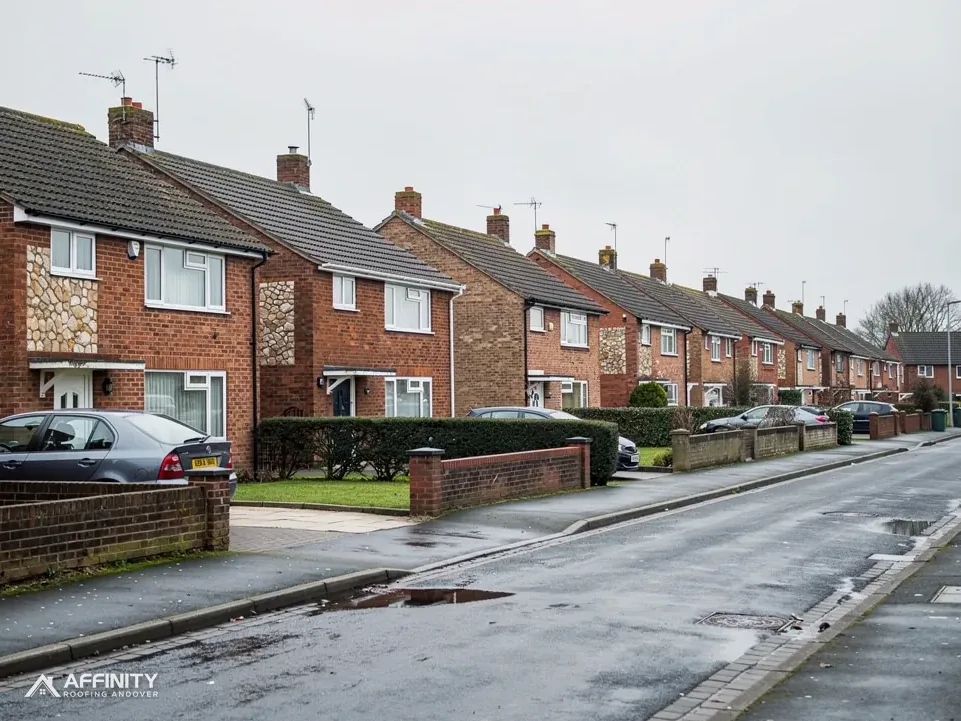
Houses inside the Whitchurch conservation area, where we check any change to how a roof looks with the council first.

Grade II* landmarks
The Silk Mill and the Town Hall, both first listed on 10 January 1953, and the Church of All Hallows.

Homes facing the downs
Houses on the side of town facing the chalk downs to the north and west, protected as North Wessex Downs.
Whitchurch between Overton and Longparish
Overton lies to the east, St Mary Bourne and Hurstbourne Tarrant to the north-west, Longparish to the south-west and Barton Stacey to the south. We survey and repair roofs in each.
- Distance
- 7.2 road miles east of Andover
- Planning
- Basingstoke and Deane Borough Council
- Council
- Basingstoke and Deane Borough Council and Hampshire County Council
The Whitchurch roof report
Local editionWhitchurch, HampshireCouncils, listings and the downland edge
Silk Mill town: who signs off a Whitchurch roof, and what we check first
Whitchurch sits 7.2 road miles east of Andover but answers to a different council. This report sets out who decides on roof work in the town, what its listed buildings change, and where the chalk downs to the north and west come into it.
Basingstoke and Deane, not Test Valley
A town this close to Andover is easy to file under Test Valley, but Whitchurch is in Basingstoke and Deane Borough. That makes Basingstoke and Deane Borough Council the planning authority for every roof in the parish, and its own Building Control team (01256 844844) handles building regulations. Hampshire County Council sits above both as the county council and the highway authority. At the 2021 Census the parish had 5,521 usual residents.
The difference shows up in the paperwork. A roof in Andover goes to Test Valley Borough Council for planning; a roof in Whitchurch goes to Basingstoke. Two jobs a short drive apart can follow two different sets of council pages, so we never assume the route from the last job we priced.
For a re-roof, the national starting point is the Planning Portal's test. Work touching under 25 per cent of the whole building envelope, and under 50 per cent of the roof, does not normally call for a building control application. Basingstoke and Deane adds its own wording on top: its building control page names the replacement of pitched and flat roof coverings among the alterations that it says might also need approval. That is a reason to ask, and we ask before a Whitchurch re-roof is booked rather than guessing.
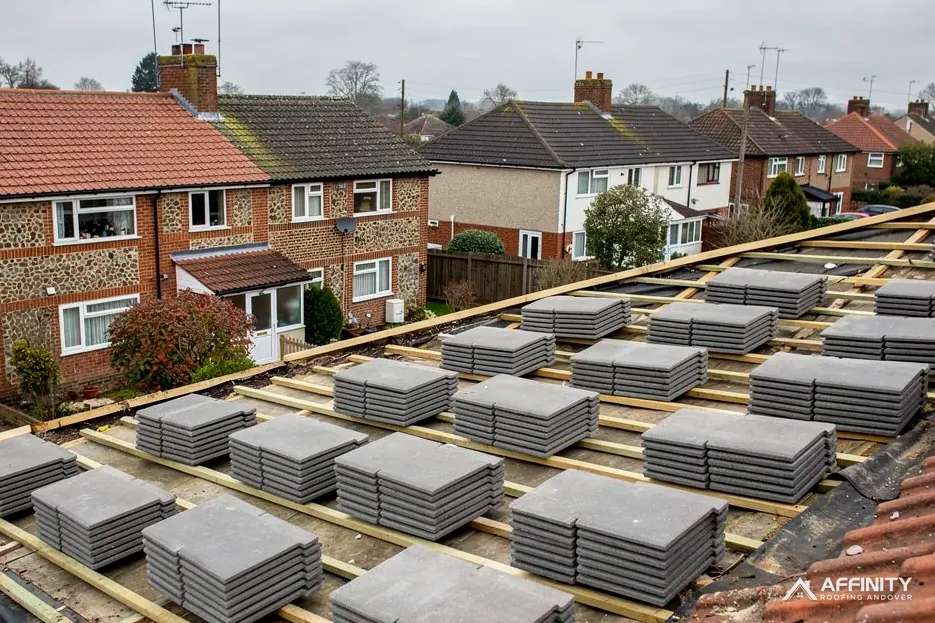
One change goes to building control wherever the house stands. A replacement covering that weighs 15 per cent or more above the existing one triggers Building Regulations approval, and the Planning Portal suggests getting a structural engineer or surveyor to look at the roof before work begins. Swapping a light slate roof for heavy concrete tiles is the case we look out for. It is a Building Regulations question, not a planning one.
The survey decides which of these tests matters. We look at the slope that needs work, lift a tile or slate where it is safe to, and photograph the battens and underlay beneath. If the trouble is confined to one patch, it is a repair and the thresholds never come into play. If the covering has failed across a whole slope or more, we set out the re-roof route, what Basingstoke and Deane's page says about it and what we will ask the Building Control team.
You can use a registered building control approver instead of the council if you prefer. Either way, the route is settled before the scaffold goes up, and you see it in writing alongside the price, with the survey photographs that show why the work is needed.
Silk Mill, Town Hall and the conservation area
The middle of the town is the Whitchurch conservation area, whose boundary the council draws. The council's appraisal and management plan for it notes that the chalk downs to the north and west of the town are protected as part of the North Wessex Downs. Inside it, a change to how a roof looks from the street gets closer attention than on an ordinary road, and a change of shape is a question for the council first. Our guide to planning permission for roof work sets out where the lines fall. Whether an Article 4 direction applies to your street is a question to check with Basingstoke and Deane.
Three buildings stand out. The Silk Mill was built in 1813 to 1815 as a water-powered sawmill and turned into a silk mill in 1817 to 1819; it was first listed on 10 January 1953, Grade II* (list entry 1092645). The Town Hall was listed Grade II* on that date too (1092680), and the Church of All Hallows is also Grade II* (1339652). Historic England's list holds 54 listed buildings within about 900 metres of the town point, and the survey reads it for your house and its neighbours. Even on an unlisted house, the roof next door may be one of them, which is worth knowing before a scaffold goes up against a shared wall.
A listed house needs listed building consent for any work that affects its character. Like-for-like repair with matching materials is where we start. Where consent is needed, the application goes to Basingstoke and Deane's planning team and the work waits until it is granted. We supply the photographs and a plain description of the existing covering and the proposed repair, so the officer can see exactly what would change and what would stay. An unlisted house inside the conservation area needs no listed building consent, but a change to how its roof looks from the street still deserves a call to the council first. All Hallows follows its own route: worship there is Church of England, so works to its fabric go through the faculty system instead of listed building consent.
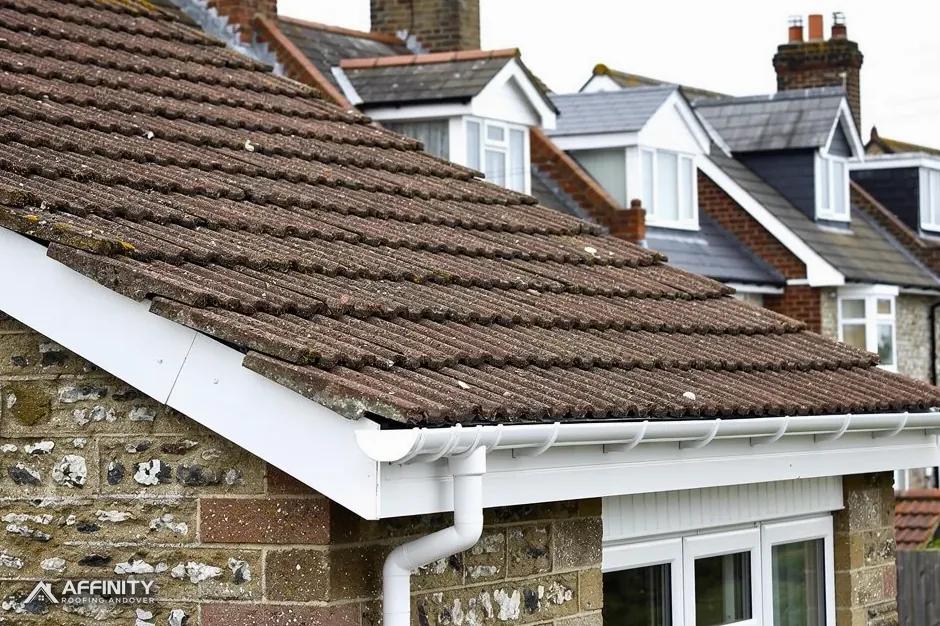
On a survey here we photograph the covering, the ridge, the verge and the chimney detail closely. We note the size and colour of the slates or tiles, how they are fixed and what the flashings are made of. That record lets us source reclaimed material that sits in with the rest of the roof, and it gives the council's planning team something clear to look at if a question comes up.
“In Whitchurch, the first call about a roof goes to Basingstoke, not Andover.”
Scaffold on Whitchurch streets, downs beyond
Where a Whitchurch house fronts the pavement, the scaffold stands on the public highway, and that needs a scaffold licence under section 169 of the Highways Act 1980. In Whitchurch the licence comes from Hampshire County Council, not the borough. Hampshire County Council's own page says the scaffolding company applies, acting for its customer, so you never fill in the form yourself.
Hampshire County Council asks for at least ten clear working days between the application and the start of the licence. Tacit consent does not apply and it does not offer extensions, so the dates are fixed before anyone books the scaffold. Hampshire County Council charges £211.90 on application for the first 2 weeks, then £72 for each further 2-week period. The county also asks the scaffolding company for a 1:500 plan, signing and guarding proposals, and a scaffold that complies with BS EN 12810/12811 or NASC guidance TG20:13. A scaffold on a private road or your own drive needs no licence at all. We sort the licence out through the scaffolder, and its cost sits inside the one figure you are quoted.
North and west of the town, the chalk downs form part of the North Wessex Downs National Landscape, formerly an AONB. Its partnership has a non-statutory, advisory role in planning, so Basingstoke and Deane remains the planning authority. Changes to a roof's shape face tighter rules inside the designation, much as they do in the conservation area, while repairs carry on as normal. The partnership's planning page puts it plainly: within an AONB the primary role for planning rests with the local planning authority, and Natural England has a role as statutory consultee. In practice that means a Whitchurch homeowner deals with Basingstoke and Deane, not with the downs partnership, whichever side of town the house stands on.
Timing matters most on listed and conservation-area jobs. If a consent decision is still pending, we hold back the licence application until it arrives, because a Hampshire licence cannot be extended and a scaffold standing idle for a fortnight still has to be paid for. You get the start date once both pieces of paper are in hand.
Whitchurch roofs take services of an everyday sort: roof repairs after a slipped tile, slate roofing on older terraces, and chimney repairs where a stack has lost its pointing or flashing. Each one starts with the same survey and the same photographs, so you see the problem for yourself before you agree to the fix and the date.
Whitchurch homes: our roof services



Whitchurch roofs: consent, scaffold and the downs
Does a re-roof on a Whitchurch house need building control approval?
It can. Basingstoke and Deane's building control page puts new coverings on pitched and flat roofs among the jobs that might also need approval. We put that question to its Building Control team before booking. A heavier covering, 15 per cent or more over the old one, always needs Building Regulations approval and a structural check. We give you the council's answer in writing.
Can a listed house near the Whitchurch Silk Mill keep its original slates?
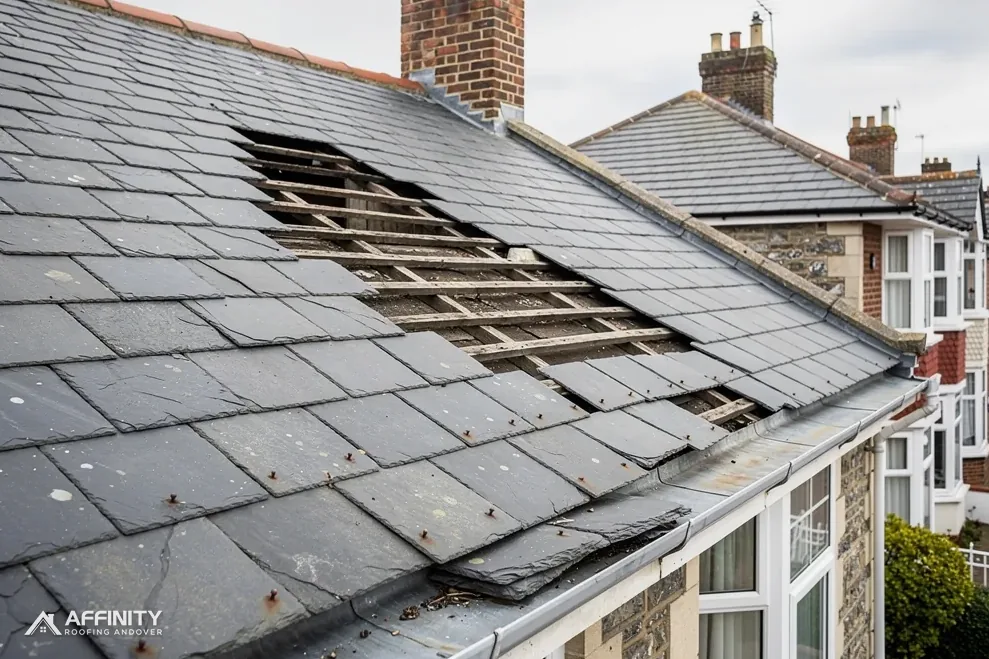
That is usually the aim. Listed building consent is needed for work that affects a listed building's character, and like-for-like repair with matching materials is the normal starting point. We photograph the existing slates, count what can be reused and source reclaimed matches. Ask Basingstoke and Deane's planning team before anything changes in look or material, and keep the decision on file.
Who sorts the scaffold licence for a Whitchurch roof job?
Under Hampshire County Council's rules the scaffolding company applies for its customer, at least ten clear working days ahead. Hampshire's fee is £211.90 for the first 2 weeks and £72 for each further 2-week period. We sort it out through the scaffolder, and the cost goes into your price. Scaffold on a private road or your own drive needs no licence at all.
Does the North Wessex Downs designation affect a roof repair in Whitchurch?
Not for a straightforward repair. The North Wessex Downs partnership is advisory only, and Basingstoke and Deane Borough Council stays the planning authority. Changes to a roof's shape, such as a dormer, face tighter rules inside the designation and in the conservation area. Repairs and like-for-like re-covering are judged as they would be elsewhere in the borough with nothing extra to file.
Villages around Whitchurch
Book a survey of your Whitchurch roof
Send the address and a photo. We survey, check the consent route, then send one written price.
10-year workmanship guarantee, in writing.