
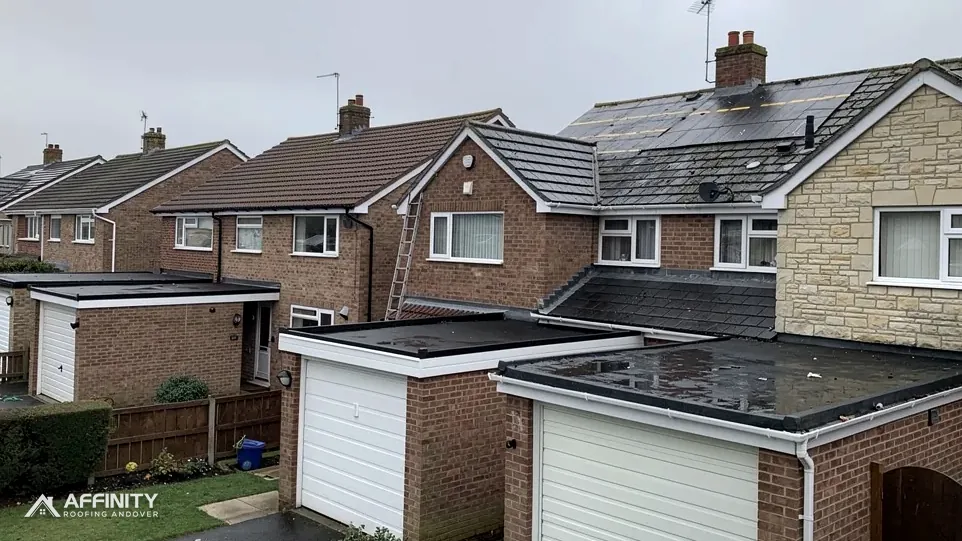
A price given without anyone seeing the roof is a guess. Ours follows a visit, so the figure describes the work that is really needed rather than the work that was imagined over the phone.
Before you send
What to send with your enquiry
The more we know beforehand, the more useful the first visit becomes. The enquiry form asks for the essentials, and a few extras help.
- The full address with postcode, so we can confirm it falls inside our working area.
- What you have noticed: a brown ring on a bedroom ceiling, a slipped tile on the drive, water spilling over a gutter.
- Whether it is pitched tiles, slate or a flat roof, if you can tell.
- Photos taken standing in the garden or up in the loft, sent by WhatsApp to 07880 284133 or attached to an email.
- Any listing or conservation area status you know the building to have.
Nothing has to be exact. A few lines in your own words are enough, and we will fill the gaps when we phone.
On the roof
What the survey looks at
The visit covers the roof covering, ridge and hips, verges, valleys, flashings around chimneys and abutting walls, and the gutters and fascias. Where access allows, we examine the loft side as well: the underlay, the battens and the rafters. On a flat roof the attention shifts to the falls, the outlets and the laps in the membrane.
Each fault is photographed where it sits. A cracked tile or a lifted flashing is far easier to judge as a picture on the kitchen table than as a description given over the phone.
The written price
One total price, in writing
The visit ends with one written price covering everything, alongside a plain description of the work. The price is good and fair, and it stands as one number rather than a menu of parts.
When you weigh us against other roofers, put the same two questions to each: is VAT in the figure, and is scaffolding in it? The Which? cost guide quotes its prices ex VAT, so a quote that leaves VAT out will look smaller than the bill that eventually arrives.
Citizens Advice suggests you gather at least 3 written quotes from different traders, and we are glad for you to do that.
Access
Scaffolding and the highway
Some roofs can be reached by ladder or tower. Others need a full scaffold, and any scaffold erected over the pavement or road needs a licence from the highway authority under section 169 of the Highways Act 1980. Poles set up inside your boundary do not.
Notice periods are set by the highway authority, so ask who applies for the licence and how many working days it needs. A start date that depends on a licence is something you should hear about before agreeing the work.
Your rights
Cancelling after a home survey
Sign at your own address after our visit and you have made an off-premises contract. The Consumer Contracts Regulations 2013 let you cancel it within 14 days, without giving a reason, counting from the day after you enter the contract. Reg 28(1)(e) removes that right where you specifically asked for a visit to carry out urgent repairs.
If you want advice, the Citizens Advice consumer helpline is 0808 223 1133.
You get in touch
Ring 01264 548364, send a WhatsApp picture or use the enquiry form with your address and a note of the problem.
A surveyor visits
Someone goes up, inspects each part of the roof and records the faults in photographs taken on the spot.
One price arrives
A written total arrives, with the work explained beside the survey pictures.
Work begins
Access goes up properly, you hear what each day holds, and the site is left clear with the rubbish removed.