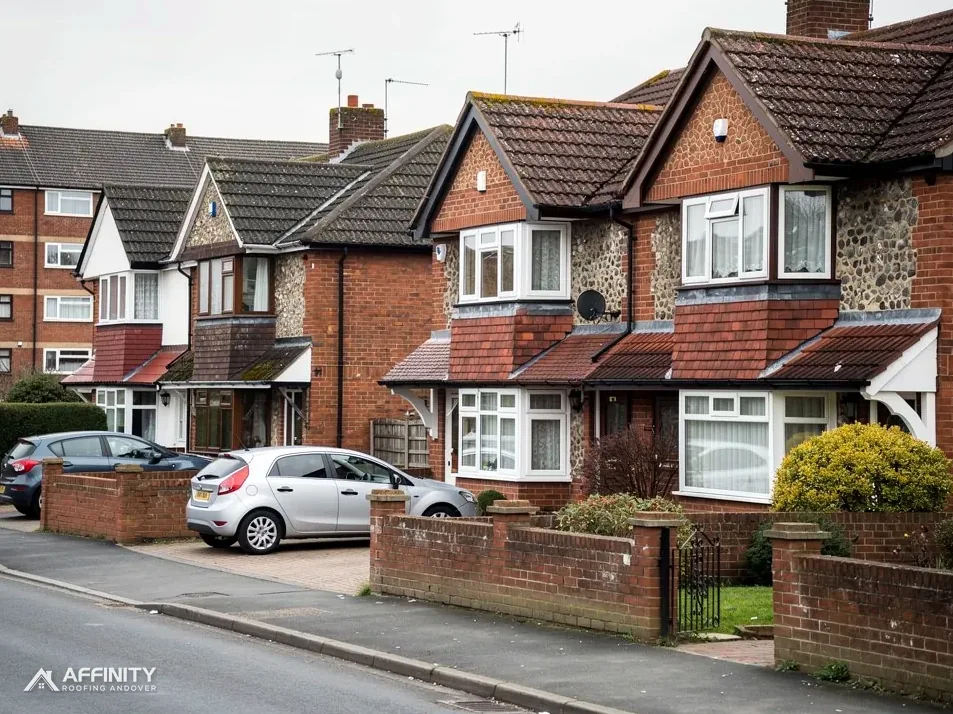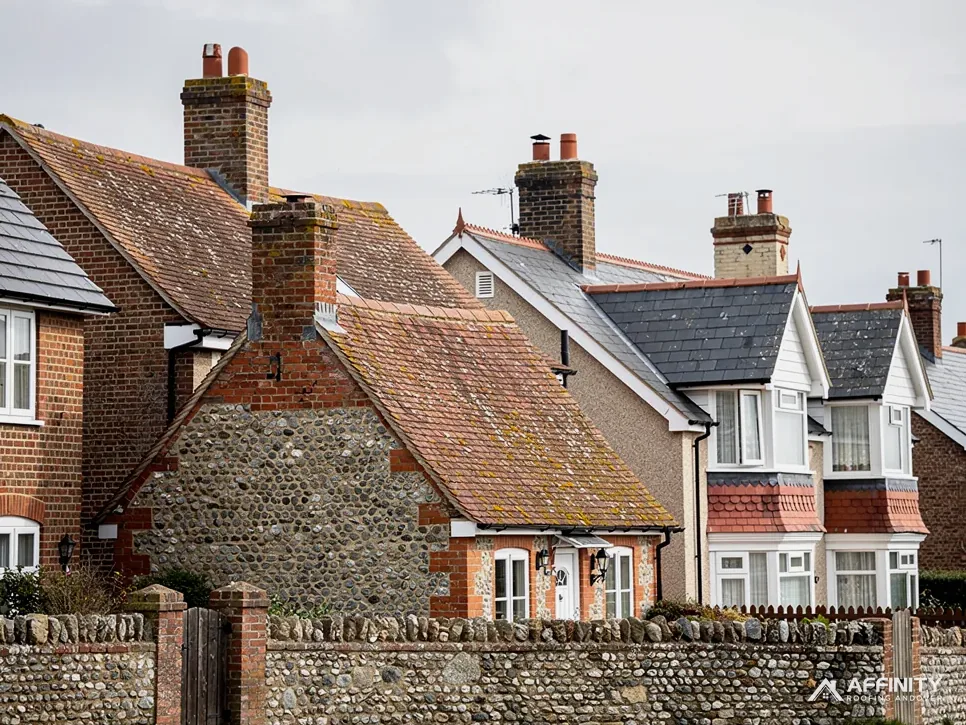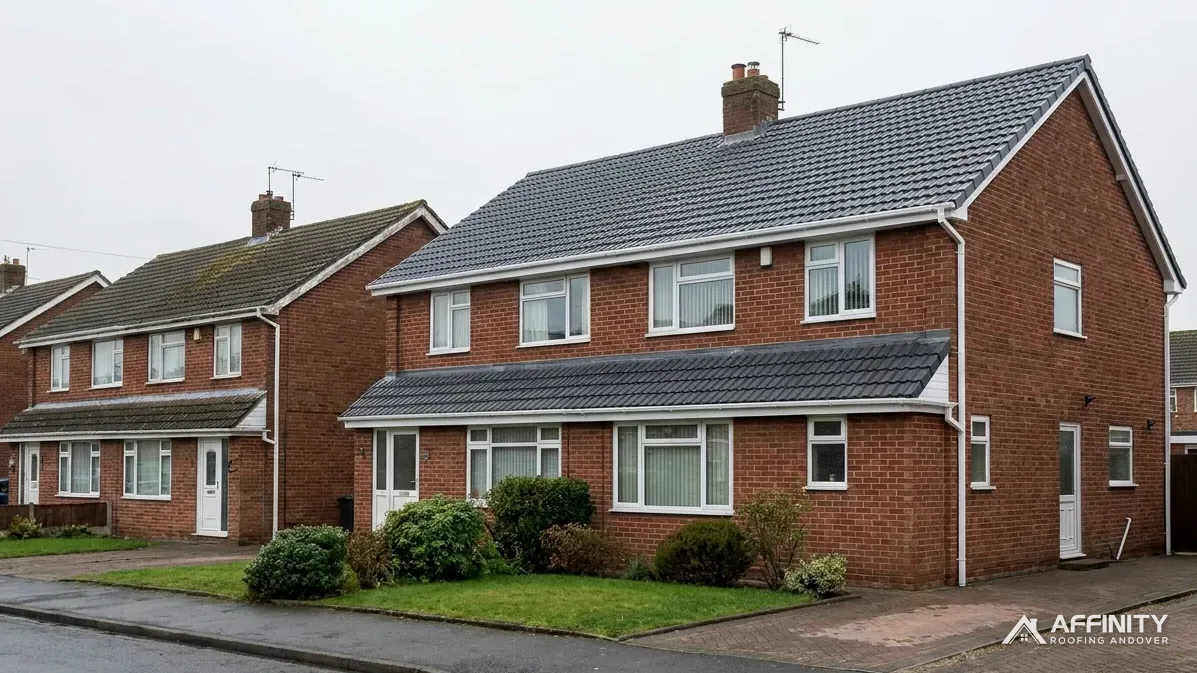
Drive out of Andover in any direction and the roofs change. Within a few miles the streets give way to village greens, church towers, farmhouses and rows of cottages, some of them centuries old. The roofs on those buildings were laid by hand with local materials, and many have been patched, re-covered and patched again.
Working on them is a different job from working on a modern estate. The covering may be handmade clay or natural slate. The lead is older and more varied. The chimney stacks are taller in proportion, and they are often shared. Access can be difficult. And the land itself may carry extra controls, from a conservation area to a National Landscape.
This guide describes the four main parts of a village cottage roof, then the protected-land position around Andover, then the villages we cover, with a link to each place. Planning decisions for every one of them rest with Test Valley Borough Council. For the way we survey and price a roof, see our Andover roofing page.
Clay tiles on cottage roofs
Clay tiles are the traditional covering of southern English cottages, and a village roof may carry plain clay tiles in a shape and colour that no longer match anything on a builder's merchant's shelf. Each tile weathers differently, and a roof that has stood for generations often shows a patchwork of tones.
That variety is part of the charm, and part of the difficulty. A new tile laid beside an old one looks too bright for a few years, and a roofer who knows this will mix reclaimed and new tiles across a slope instead of dropping a block of new ones in one corner.
How long they last
HomeBuilding (September 2025) gives clay tiles a typical life of 60 to 80 years. The BRE gives a minimum life expectancy of 60 years for clay tiles, according to Marley, and that figure applies to clay only, not to concrete. Treat these as typical spans rather than promises; an old roof with sound battens and a good pitch can outlast them.
Pitch matters
Marley lists minimum pitches by tile pattern, for example 40 degrees for its Canterbury clay tile and 35 for Ashdowne; check the data sheet. Cottage roofs are often steep, which suits plain clay, but a dormer or an outshut with a shallower pitch needs a covering that works at that angle.
Repair before replacement
A good approach on a cottage is to keep what is sound, replace what has failed and match it carefully. A roofer who strips an entire slope when only a dozen tiles have gone is spending your money. Which? (November 2025) gives £75 to £400 per job, excluding VAT, for replacing a handful of standard tiles, so a patch repair is a very different figure from a re-roof. A survey with photographs shows which tiles are cracked, which nibs have broken and which battens are at fault.
Our guides on clay plain tile roofs and matching old roof tiles go into the detail.
Slate, lead and fixing details
Slate is the other common covering on older village houses, especially on larger farmhouses and on later extensions. Natural slate is long-lived. HomeBuilding gives Welsh slate as 100 years or more, Spanish natural slate as 75 to 100, and reclaimed Welsh slate as 50 to 80.
Pitch and fixing
BS 5534 indicates a minimum pitch of 20 degrees for natural slate. Cupa advises against slate hooks on any pitch under 25 degrees. Those figures matter when a cottage gets an extension, because the new roof must be pitched for the slate chosen.
Slipped slates
A slipped slate usually means a nail has rusted through. One slate can be replaced alone. When many are going, the nails are failing across the roof, and patching only delays the day. Our slate roofing hub explains the choice between repair and re-slating.
Lead
Lead is used at the junctions: chimney flashings, valley gutters, abutments and bay roofs. MyJobQuote says lead flashing can outlast 80 years, though that is a lower bound. Lead sheet is graded by code, which fixes its thickness. Code 3 is for soakers only, codes 4 and 5 suit flashings, and heavier codes are used for gutters and flat areas.
The standard for lead sheet roofs is BS 6915, to which Approved Document C refers. Sealant smeared over a failed junction is not a lead repair.
MyJobQuote (September 2026) gives full chimney leadwork as between £350 and £920 depending on the scaffold, and a full roof valley replacement as around £540. Those figures come from national guides rather than from us, and they explain why a village stack with awkward access can sit at the top of the range.
Chimneys on village houses
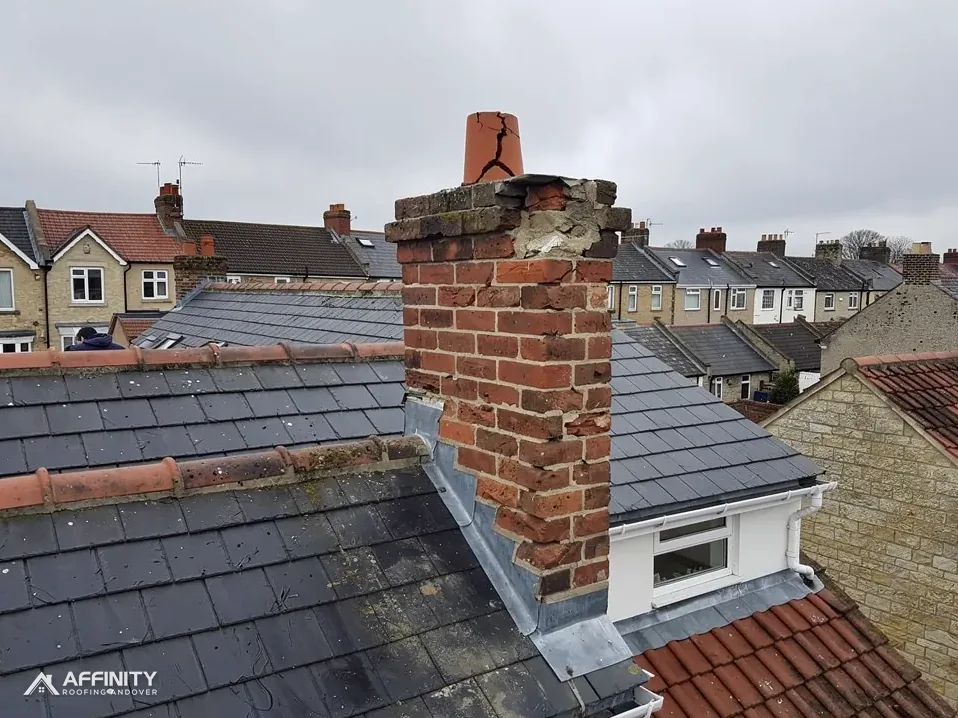
On an old village house, look at the chimney early on. Stacks stand high and exposed. Their mortar is weathered, their pots lean, and the flaunching at the top has often cracked. Below the roofline, the flashing that ties the stack to the slope may have split.
What goes wrong
Cracked flaunching lets rain into the stack, loose pots can fall, and eroded mortar joints let water into the brickwork. On a cottage, where a stack may serve two rooms and a shared wall, the damp can be hard to trace from inside. Our chimney repairs hub explains the range of repairs.
Birds and bats
Old stacks and roof spaces shelter birds and sometimes bats. The Wildlife and Countryside Act 1981 section 1 covers intentionally damaging a nest in use, and bats and their roosts are legally protected throughout the year. A survey checks for signs before any work begins, and if anything is found, the job waits for advice.
Thatch is a specialist trade
Some villages have thatched houses. The Victoria County History described thatched cottages at Chilbolton (1908) and Chilworth (1908), and at Nursling a "square farm-house" with "low thatched outbuildings" at Nursling Farm. Thatching belongs to specialists in that craft. For the chimney stack through it, or for the tile or slate roofs next door, we survey and give one written price.
No count of thatched buildings is published for Test Valley, and the list entries that mention thatch in their names are not proof that a roof is thatched today.
National Landscape, conservation areas and the council
Several villages sit under extra planning controls. The council remains the local planning authority throughout, but the rules differ from the town.
North Wessex Downs
Hatherden and Hurstbourne Tarrant, north of Andover, lie within the North Wessex Downs National Landscape, the designation once called an AONB. Its partnership gives advice on planning, while decisions on applications stay with the council. Test Valley Borough Council decides. The National Landscape is article 2(3) land, so permitted development dormers are not available there, but a like-for-like re-roof under Class C is still normally permitted development.
Conservation areas
Many villages have a conservation area close to their centre. The Chilbolton and Wherwell conservation areas lie within about 0.75 km of both village centres, and Longparish, Abbotts Ann and others have areas of their own. Check the council's map for your address, because the boundary decides whether dormers are allowed and whether an Article 4 direction might apply.
Listed buildings and churches
Villages hold many listed buildings. Wherwell has a Grade I stable block, and Hurstbourne Tarrant's Church of St Peter is Grade I. Listed homes keep Class B and C rights but need listed building consent as well. An Anglican church in use goes via the faculty system. Our listed building roof guide sets out the route.
For Article 4, Test Valley is not a council whose directions we can describe, so ask Test Valley Borough Council whether any applies to your street.
Villages close to Andover that we cover
We work in every village in Test Valley within reach of Andover, and across the border into Wiltshire and beyond. Distances below are measured by road from East Street, Andover.
Within about three miles
Upper Clatford is 1.9 miles south-west. Charlton is 2.1 miles north-west, and Anna Valley and Enham Alamein are 2.3 miles away, south-west and north. Goodworth Clatford is 2.3 miles south.
Four to six miles
Abbotts Ann, Penton Mewsey and Wherwell are about four miles out. Hatherden and Weyhill are 4.2 miles, and Monxton 4.6. Hurstbourne Tarrant, Longparish and Chilbolton lie between 5.4 and 5.5 miles away, and Appleshaw is 6.1.
Further out
Amport, Longstock and Thruxton are 6.3 to 6.4 miles away, and Barton Stacey is 7.1. Stockbridge is 7.7 miles south, Over Wallop 8.4 and Nether Wallop 9.6.
If your village is not on the list, ask. The full set is on our areas page, and the survey, the photographs and the single total price are the same wherever the roof is.
Access, lanes and scaffold in a village
Village jobs often turn on the practical details. A lane may be too narrow for a lorry, a cottage may sit hard against the road with no front garden, and a roof may only be reachable from a neighbour's land. All of this affects the programme and the price, and it is better settled at the survey than on the first morning.
Scaffold on the lane
Scaffold on a public lane is a highways matter, and the application takes time, so a village job rarely starts the week it is booked. Our guide to preparing your home for roof work sets out who applies, the lead times and the fees council by council. None of that applies when the scaffold sits entirely within your own land.
Deliveries and parking
Tiles, slates and lead arrive in quantity. Tell the roofer where a lorry can stop, whether the lane is passable at school times, and whether a neighbour's drive can be used for unloading. A skip on a narrow lane may need to go on your own land.
Shared walls and stacks
Terraced cottages often share a chimney stack or a party wall, so the Party Wall etc. Act 1996 can come into play for chimney work. Two months' notice applies to some cutting-away, and a neighbour's silence is not consent.
A survey that suits the building
A village survey looks at the covering from the ground, from a ladder or tower, and from inside the loft. The report gives photographs of each fault and one total price. If the roof is old, the report also says what can wait.