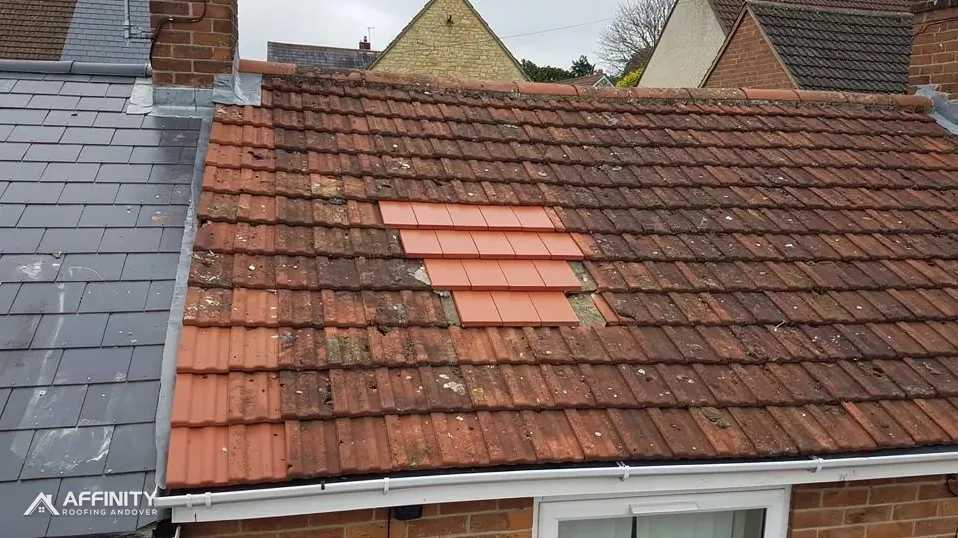
A period house wears its roof like a face. Clay tiles that have weathered for generations carry a soft mix of reds, browns and oranges, with edges worn to a gentle irregularity and a surface speckled with lichen. When a section has to be replaced, any new tile beside them looks new, sharp-edged and slightly too even. The eye picks it out at once, and the repair announces itself.
The aim of a good repair is not to make the new tile invisible, which is impossible, but to make the roof read as one. That depends on choosing the right tile, from the right source, and putting it in the right place. Reclaimed tiles, new handmade tiles and new machine-made tiles each have a part to play.
Matching is also a matter of regulation on many older houses. In a conservation area or on a listed building, the material and appearance of a roof can be controlled by the council. This guide covers what makes a good match, how reclaimed and new tiles compare, where the best tiles should go, and what to check with the planning authority before work begins around Andover and the Test Valley.
What makes one tile match another
People usually think of colour first, but a successful match rests on several things at once.
Size and thickness
A tile of the wrong length will not sit correctly on the battens. Plain tiles are laid to a gauge, the distance from one row to the next, and a tile that is a few millimetres off throws the course out of line across the slope. On a small repair the error is hidden. Across a whole slope it shows as a wandering line.
Camber and edges
Plain clay tiles are made with a slight curve in two directions. That curve keeps the tail of each tile clear of the one below, and it gives the roof its ripple. A flat modern tile among cambered old ones lies differently and catches the light differently, even when the colour is close.
Colour and texture
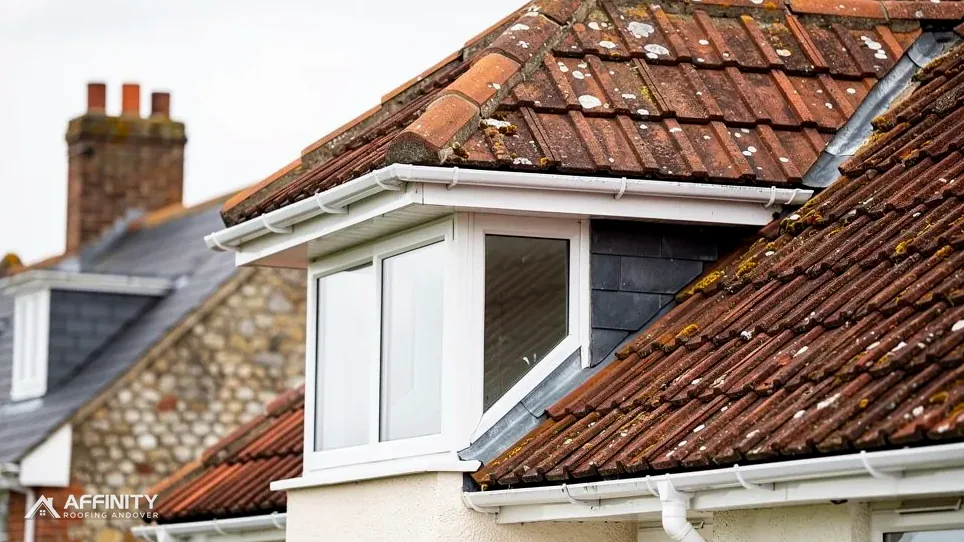
Old clay is rarely one colour. It runs through a range on a single roof, with darker and lighter areas depending on the firing and the weathering. A new tile may be uniform, or may come in a mixed blend meant to imitate that range. The surface texture, whether sand-faced, smooth or heather-textured, changes how it reads.
Age and weathering
Even a perfect colour match looks different for the first few years, because lichen and soot have not yet arrived. Our guide to clay plain tile roofs explains how plain tiles are made and laid, which helps in judging a sample.
Reclaimed tiles and new tiles compared
There are three realistic sources for a tile, and each has its place.
Reclaimed tiles
Reclaimed tiles come from demolished or re-roofed buildings. Their great advantage is that they have already weathered, so they blend with an old roof straight away. The drawbacks are supply and condition. Reclaimed stock varies in size, and a batch may include tiles with nibs worn or broken, hairline cracks or frost damage. Good reclaimed tiles have to be sorted, and some will be rejected. They are often priced above new ones for that reason.
New handmade tiles
New handmade clay tiles are formed by hand in a mould and fired. They have the irregular edges and varied colour of old tiles, and for a large replacement they usually give the closest new match. They cost more than machine-made tiles and are slower to obtain.
New machine-made tiles
Machine-made tiles are pressed or extruded to one uniform size. They are flatter and more even, and on an old roof they look obviously new. They cost the least of the three and are common on later houses where the existing roof is itself machine-made.
Choosing between them
The survey records the existing tile size, colour range and condition, and tiles are sourced to suit. A tile maker's sample board is a useful start, but it cannot stand in for the roof itself, since colour reads differently on a board in a showroom than on a slope in changing light. Samples are laid against the roof in daylight, wet and dry, before a decision is made. Our guide to types of roof tiles shows the main kinds side by side.
Where the reclaimed tiles should go
The usual practice on a period house is to put the best tiles where they are seen and the compromises where they are not.
The front slope
A slope that faces the road is judged by everyone who walks past. When a section of it needs replacing, the best-matching tiles, whether reclaimed or new handmade, go there. Where a good supply of old tiles exists, it is worth using the sound ones from a rear slope on the front, and then re-covering the rear slope with new tiles. The change stays hidden from the street.
The rear and the hidden slopes
Slopes that can be seen only from the back garden, or from a neighbour's upper window, carry less visual weight. New tiles there will weather in without anyone noticing, and the cost of matching is lower.
Mixing within a slope
When tiles must be mixed on one slope, they are scattered, not grouped. A patch of new tiles in a block draws the eye, while a loose scatter among old ones blends within a season or two.
Hips, valleys and details
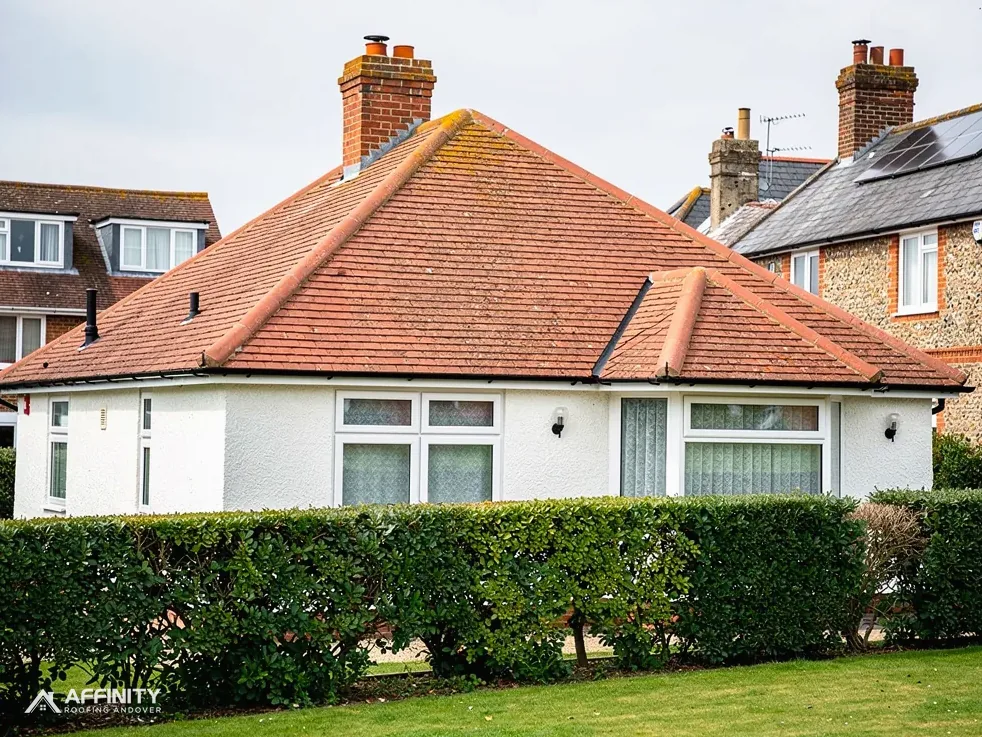
Hip tiles and ridge tiles are matched separately, and it is worth doing them at the same time as the main slopes so the whole roof ages together. They are different shapes, and old bonnet hips or cranked ridge tiles can be hard to source. Our answer on what peg tiles are is useful if your roof has the older pegged type, which needs particular care to match.
Conservation areas and listed buildings
On a protected house, the choice of roof material is more than a matter of taste.
What permitted development covers
Re-covering a house falls under Class C of the General Permitted Development Order, which deals with alterations to a dwellinghouse's roof. Flats have no such rights. Conservation areas are article 2(3) land: that takes away permitted development dormers but leaves Class C untouched.
Article 4 directions
A council can make an Article 4 direction to withdraw particular permitted development rights across a defined area. Basingstoke and Deane is the clearest local example. For four of its town areas it asks that original Welsh slate and clay tiles stay on the roof, and it describes concrete tiles as an unlikely fit. For any other council, check whether an Article 4 direction applies before you order tiles. Test Valley Borough Council draws the Andover conservation area boundary, and for Test Valley addresses the council's planning team can say what applies to yours.
Listed buildings
Listed status leaves Class B and C rights in place; where the building's character is affected, consent for listed buildings is required on top. Andover's Grade II* entries on the National Heritage List name the Church of St Mary and the Guildhall, with two historic inns, so a roof near the centre of the town may well have a protected neighbour. Because St Mary's is in Church of England use, its own repairs go through the faculty system.
Matching helps the application
A tile sample, with photographs of the existing roof, makes a consent request much easier for a conservation officer to assess.
Weight, fixing and the practical limits of a match
A good match is more than looks. The new tiles have to do the same job as the old.
Weight and approval
If the replacement is a different material from the original, check the weight. As the Planning Portal puts it, a covering at least 15 per cent heavier than the one it replaces calls for approval under the Building Regulations and a structural check. Matching clay with clay avoids the question. Switching to concrete does not.
Fixing
New tiles are fixed to current practice, which means to BS 5534:2014+A2:2018 for nails and clips, even when the old tiles were hung on their nibs alone. Ridge and hip tiles follow the same standard. The extra fixings are not visible from the ground.
Frost and durability
Clay that absorbs a lot of water can flake in frost. Reclaimed tiles with a history of frost damage are best left out, and a supplier who can describe where the tiles came from is worth more than a cheap pile of unknown stock.
Lifespan
HomeBuilding gives clay tiles 60 to 80 years, and Marley quotes a BRE minimum life expectancy of 60 years for clay. Those are typical ranges, not warranties. A reclaimed tile is already part-way through its life, which is a reason to inspect it carefully before it goes on a roof that has decades still to run.
Where tiles cannot be matched, a full re-cover of a slope in a consistent new tile can look better than a patchwork.
How we approach a matching job
A matching repair starts with the existing roof, not with a catalogue, and the first visit is mostly looking and measuring.
Survey and samples
We photograph the roof from several points, measure a sample of tiles and note their length, width, thickness, camber and colour range. We lift a few tiles to check the battens and the nibs. The photographs go to you, with notes on which slope is the most visible and which tiles look worth reusing.
Sourcing
Reclaimed stock is checked in person where possible, since photographs hide cracks and frost damage. New handmade tiles are ordered as samples, and the colour blend is judged against the roof in natural light.
Cost context
For standard tiles, Which? gives £75 to £400, ex VAT, for swapping a handful that have broken or gone (Nov 2025), and MyJobQuote gives around £215 for five tiles (6 October 2026). Matching old clay normally costs more, since the tiles are harder to find, and the stock available sets the price.
Consent first, then price
Where a house is listed or lies inside a conservation area, we help you prepare the evidence for the council before work starts. The written price follows as one total.
If your roof has already been patched in the wrong tile, our pitched roofing page explains how a mismatched slope can be put right.