
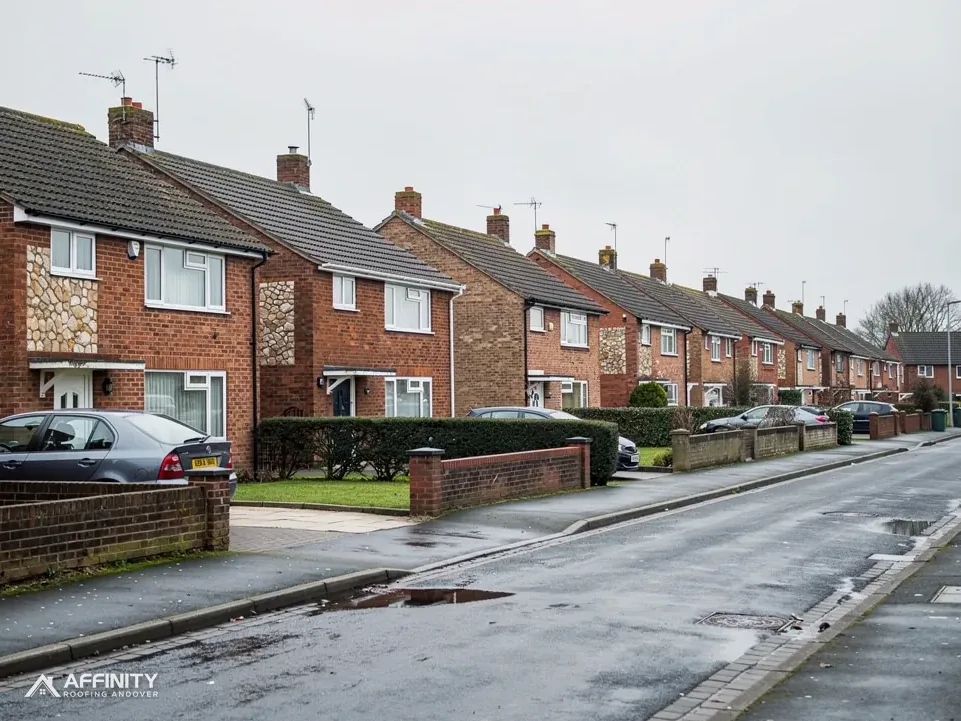
Roofers in Anna Valley
Clatford Lodge, Bury Hill Camp and the village roofs between them
Anna Valley has a listed lodge, a scheduled monument nearby and a conservation area shared with Upper Clatford. The roof is surveyed and each finding photographed.
Anna Valley roofs, from lodge to village lane

Lodge to Clatford Lodge
A Grade II listed lodge, first listed on 15 January 1985, where like-for-like repair is the starting point.

Houses in the conservation area
Homes within about 0.75 km of the centre, inside the Upper Clatford conservation area boundary.

Roofs beside Bury Hill Camp
Properties within about 500 m of the scheduled monument, where Historic England is asked before any work disturbs the ground.
Anna Valley between Abbotts Ann and Upper Clatford
Abbotts Ann lies to the west, Upper Clatford to the east, Goodworth Clatford to the south-east and Charlton to the north. We survey roofs in each of them. Anna Valley is 2.3 road miles south-west of East Street in Andover, so a survey visit is a short trip for us.
- Distance
- 2.3 road miles south-west of Andover
- Planning
- Test Valley Borough Council
- Council
- Test Valley Borough Council and Hampshire County Council
The Anna Valley roof report
Local editionAnna Valley, HampshireLodge, camp and lead flashings
Anna Valley roofs: one parish with Upper Clatford, a lodge, a camp and the rules between them
Anna Valley has one listed building within 500 m, a scheduled monument close by and a conservation area drawn around its neighbour. This report explains how those fit with ordinary roof repair, and who licenses a scaffold.
Anna Valley and Upper Clatford share a parish
Anna Valley is 2.3 road miles south-west of Andover's East Street, and the village lies in Upper Clatford parish. Census figures are published for the parish as a whole, so the village shares its 2021 count with Upper Clatford and has no figure of its own. The council that matters is clear enough: planning belongs to Test Valley Borough Council, and Hampshire County Council licenses any scaffold that stands on the road.
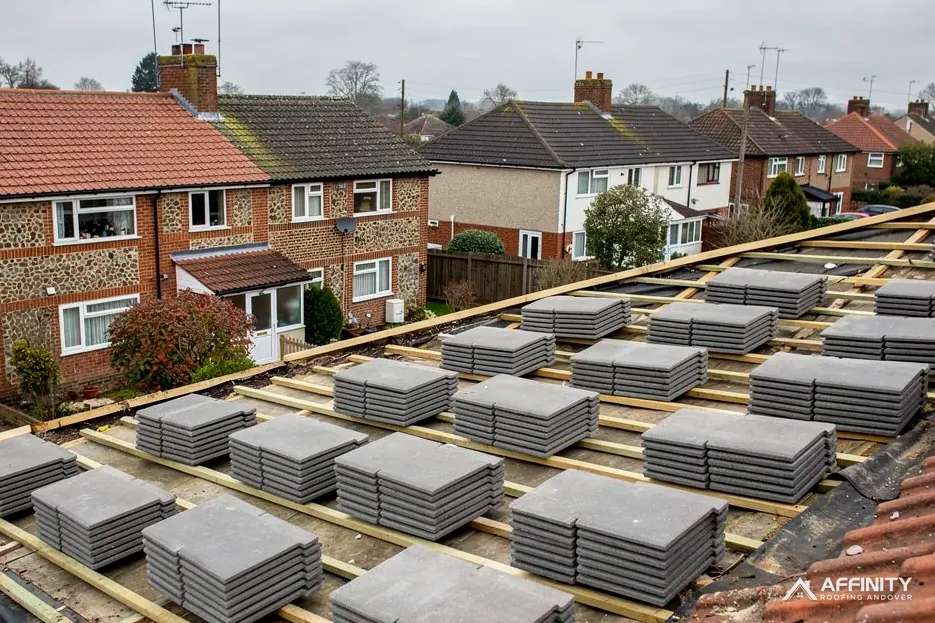
Two questions come before any price. The first is whether the work needs anyone's approval; the second is who gives it. For a re-roof the Planning Portal draws the line at 25 per cent of the building envelope and 50 per cent of the roof: below both, building control approval is not normally needed. The envelope means the outer skin of the house, so a small slope on a large building is comfortably under the line. Above it, we ask your building control body how it wants the job handled.
Weight is the exception that applies however small the roof. A covering that is 15 per cent or more heavier than the one it replaces needs Building Regulations approval, and the Planning Portal advises that the roof is checked first by a structural engineer or a surveyor. On an older cottage the swap from natural slate to concrete is the one to look for, because the timbers beneath a slate roof were cut for a lighter load. A short written note on what the rafters can carry costs little and prevents an expensive surprise once the new covering is on.
Planning is a separate matter again. A repair that leaves the roof looking as it did is one thing; a change to the covering, the pitch or the shape is another, and Test Valley Borough Council's planners are the people to raise it with. Our guide to planning permission for roof work sets out the rules for houses and flats, and says what changes inside a conservation area.
You can use local authority building control or a registered building control approver for the sign-off. What we add is the evidence: photographs of the battens and underlay, a note of which rafters we could see and a plain account of what the covering is doing. With that in hand the building control body can give a quick, informed answer, and you can see the job as it is before you decide, with the options set out side by side. Nothing is ordered until you have seen the photographs and agreed the way forward.
Clatford Lodge and the camp on the hill
Historic England's list records 1 listed building within about 500 m of the centre of Anna Valley: Lodge to Clatford Lodge, Grade II (list entry 1230059), first listed on 15 January 1985. A lodge is a small building with a prominent roof, and on a listed lodge the question is rarely whether to repair but how closely the repair must match. Work that touches its character requires listed building consent, which Test Valley Borough Council decides, and a lodge's small roof leaves little room to hide a poor match.
The Upper Clatford conservation area also lies within about 0.75 km of the centre of Anna Valley. That boundary is drawn around the neighbouring village and reaches this far. Inside a conservation area, anything that alters a roof's appearance from the road deserves an early word with the council, and a dormer needs planning permission. For an Article 4 direction, the council is again the place to ask, because only the council can confirm whether one applies.
Bury Hill Camp is a scheduled monument within about 500 m of the centre (list entry 1001951). Scheduled monuments have their own consent, called scheduled monument consent, which is decided by the Secretary of State, and carrying out works to the monument without it is an offence. A house roof is not the monument, and ordinary repair to it is a different matter. Even so, anything that would disturb ground close to the camp, such as a scaffold base or a trench for a drain, is something to mention to the council before it is done. We note it at survey so that it is not discovered once the frame is ordered.
For a house with no listing, the sensible approach is to treat the conservation area as the working rule. Keep the covering, the colour and the ridge detail as they are unless there is a reason to change them, and photograph them before the first tile is lifted. That is what we do on every survey, and the pictures serve two uses: to show you the fault, and to show the council what existed.
When a lodge or cottage roof is being repaired, reclaimed material is worth asking about. It can take time to find, so the survey comes early. Tiles, ridge pieces and slates are all matched by size, colour and thickness, and a few of each, laid side by side, will show whether a supplier's stock fits. The ridge, the top line where two slopes join, is seen from the lane, so a mismatch shows.
“Anna Valley borrows its conservation area from Upper Clatford and its history from the hill above.”
Lead, slate and the scaffold that reaches them
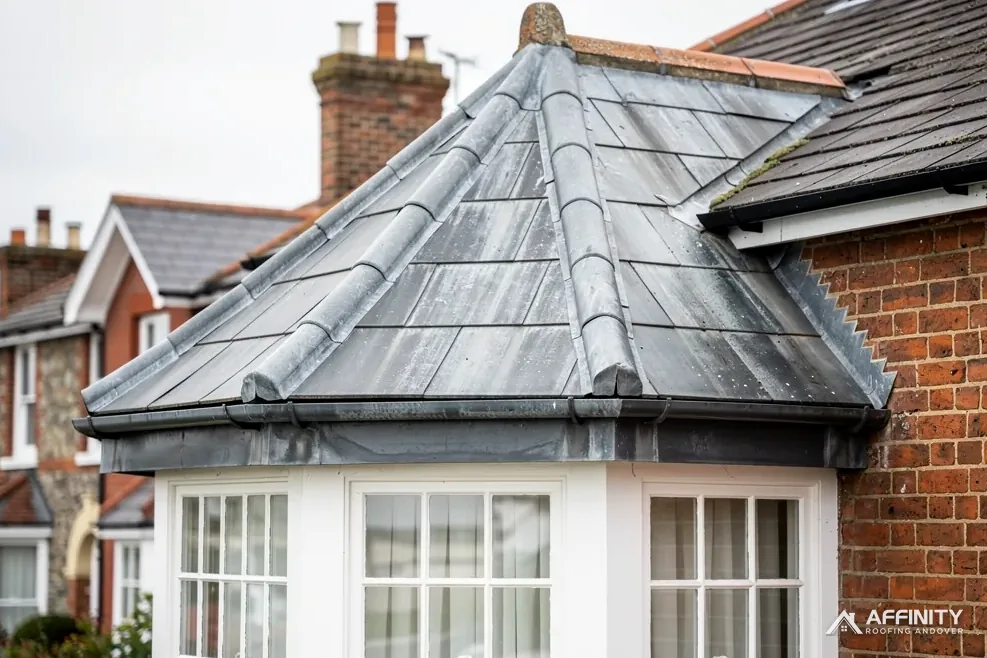
Many of the repairs that matter on an older roof involve lead: the flashings round a chimney, the soakers that tuck under each course of tiles where a roof meets a wall, and the lined valleys between slopes. MyJobQuote (September 2026) puts the life of lead flashing at over 80 years, a lower bound and not a promise. When it fails it is usually because it has been pulled by movement, or because the mortar that held it has crumbled.
Sheet lead comes in numbered codes, each a different thickness. One maker's brochure, from Royston Lead, matches code 4 to soakers, flashings, pitched valley gutters and dormer work, and code 5 to flashings, valley gutters, parapets and dormers. Lead work follows BS 6915, which is the standard that Approved Document C points to. The right code depends on the detail, and on what the survey finds, not on a preference.
Scaffold on the public road is licensed under section 169 of the Highways Act 1980. Hampshire County Council issues it, and it wants the scaffolding company to be the applicant, with ten clear working days between filing and the start. Hampshire County Council charges £211.90 on application for the first 2 weeks and £72 for each further 2-week period, with no extensions. A frame on private land needs no licence, so we look at where the base would stand at survey.
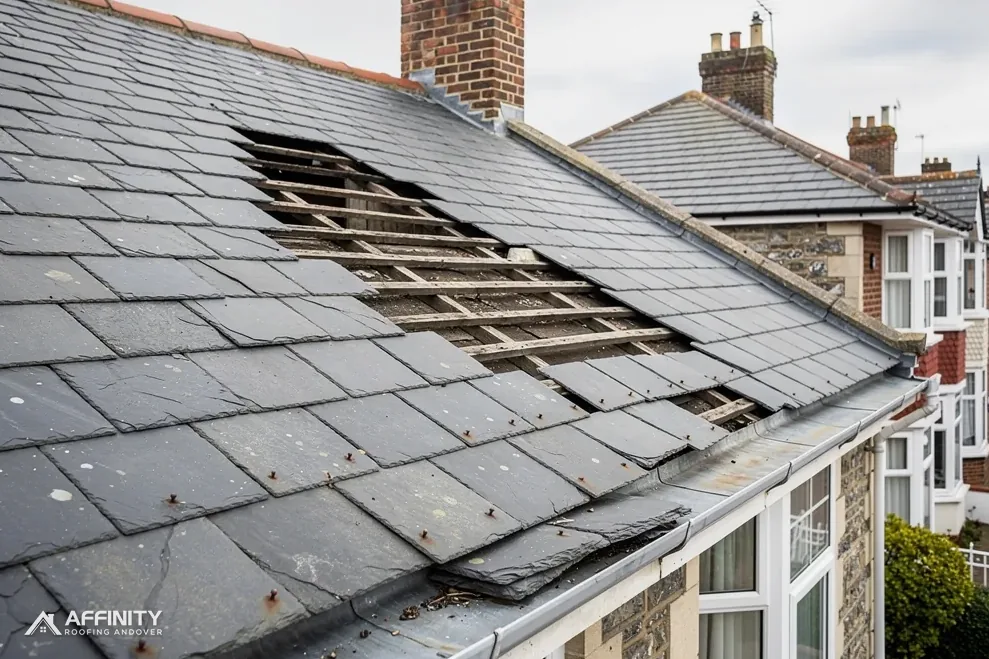
The services that fit Anna Valley roofs are lead roofing for flashings and valleys, chimney repairs where a stack has weathered, and roof repairs after a slipped tile. In each case the first thing a customer sees is a set of photographs with the fault marked, followed by a plain explanation of what we would do and why.
If the survey shows that a repair would be wasted money, the report says that plainly, because replacing a failed covering is sometimes the better answer. Where the roof has years left, the repair is cleaner, simpler to arrange and cheaper than a new roof. Either way the site is left tidy and the waste goes with us.
Gutters are the quiet partner of every roof repair. A gutter that has dropped from its brackets spills water onto the wall below, and the stain it leaves is often read as a roof leak. We check the fall of the run, the joints and the brackets while the access is in place, and photograph any fascia board that has softened. Fixing that at the same visit saves a second scaffold, and one set of photographs covers both jobs.
Anna Valley roofing services



Anna Valley roofs: lead, the camp and the conservation area
How long does lead flashing last on an Anna Valley chimney?
According to MyJobQuote (September 2026), good lead flashing can last for over 80 years, which is a lower bound and not a guarantee. Movement in the stack or crumbling mortar usually causes failure sooner. At survey we photograph the flashing and the brickwork behind it, then explain in plain words whether the lead can be re-dressed or needs renewing.
Does Bury Hill Camp affect roof repairs on nearby Anna Valley houses?
Bury Hill Camp is a scheduled monument within about 500 m of the centre of Anna Valley, and scheduled monument consent covers works to the monument itself. A house roof is a different thing. Anything that would disturb ground close to the camp, such as a scaffold base, is worth raising with Test Valley Borough Council first, and we note it at survey.
Is my Anna Valley house inside the Upper Clatford conservation area?
The Upper Clatford conservation area lies within about 0.75 km of the centre of Anna Valley, but only the council's own map settles whether your road is inside it. Ask Test Valley Borough Council. The roof is photographed as it stands, which lets the planning team see exactly what would alter and what would remain.
Which scaffold licence does an Anna Valley roof need?
If the frame stands on the public road, a section 169 licence from Hampshire County Council, which wants the scaffolding company to apply ten clear working days ahead. Hampshire County Council's fee is £211.90 for the first 2 weeks and £72 for each further 2-week period. Scaffold on private land needs none, and we check which case you have at survey.
Around Anna Valley
Get your Anna Valley roof looked at
Send the address and one clear photo. A survey comes first, then a single written price.
10-year workmanship guarantee, in writing.