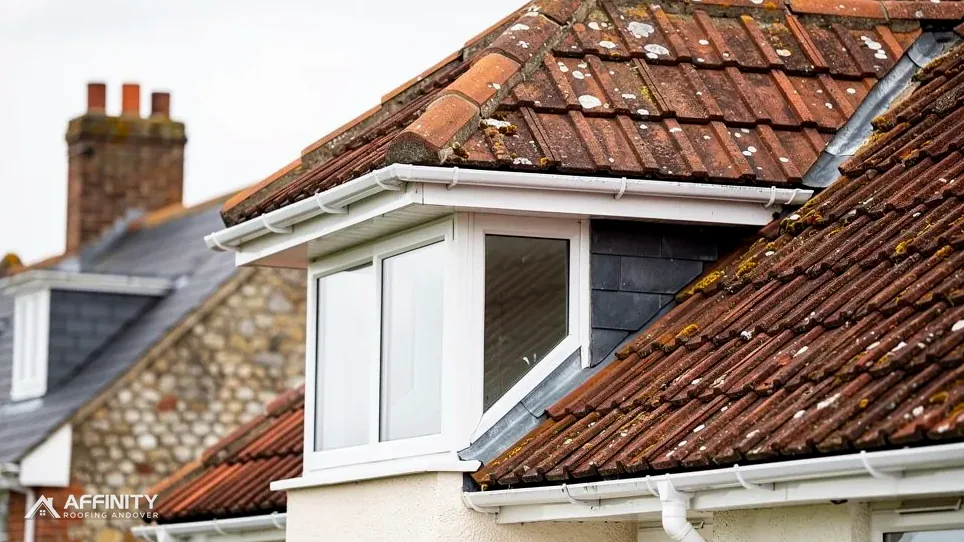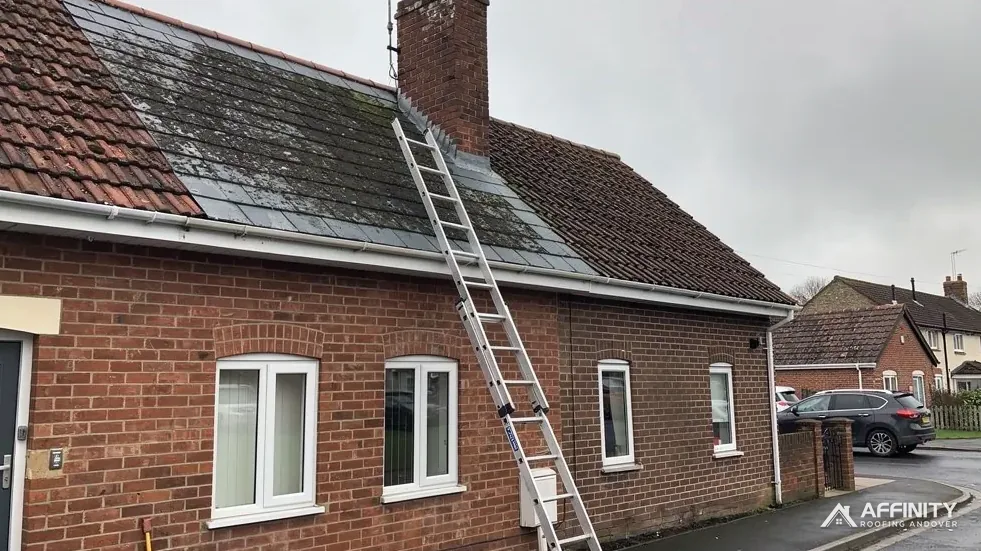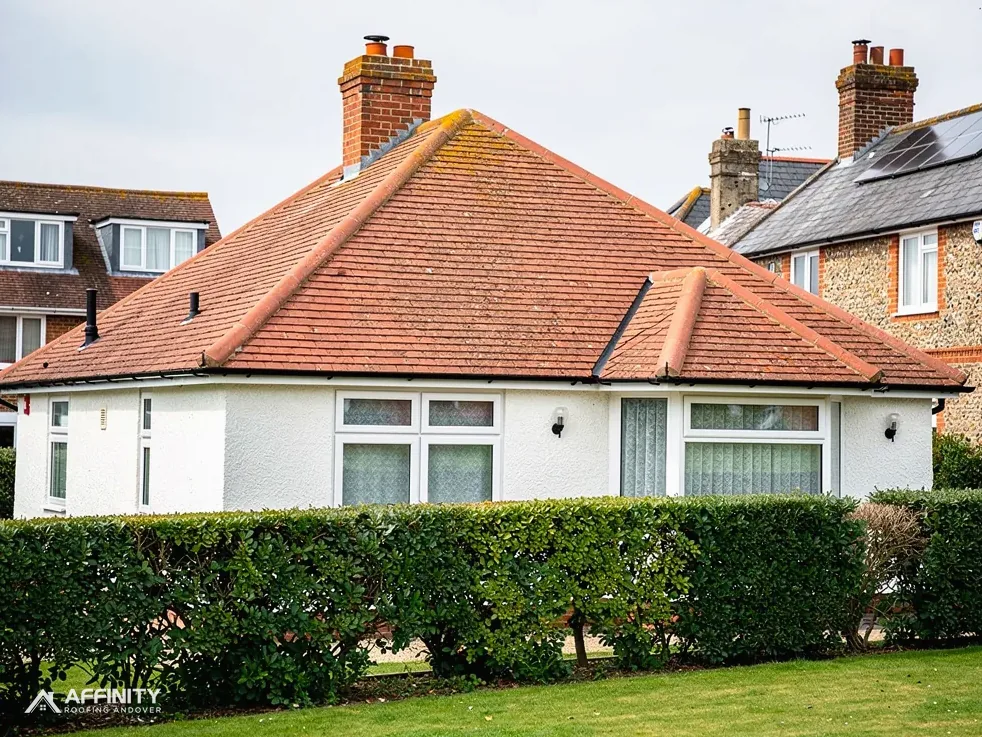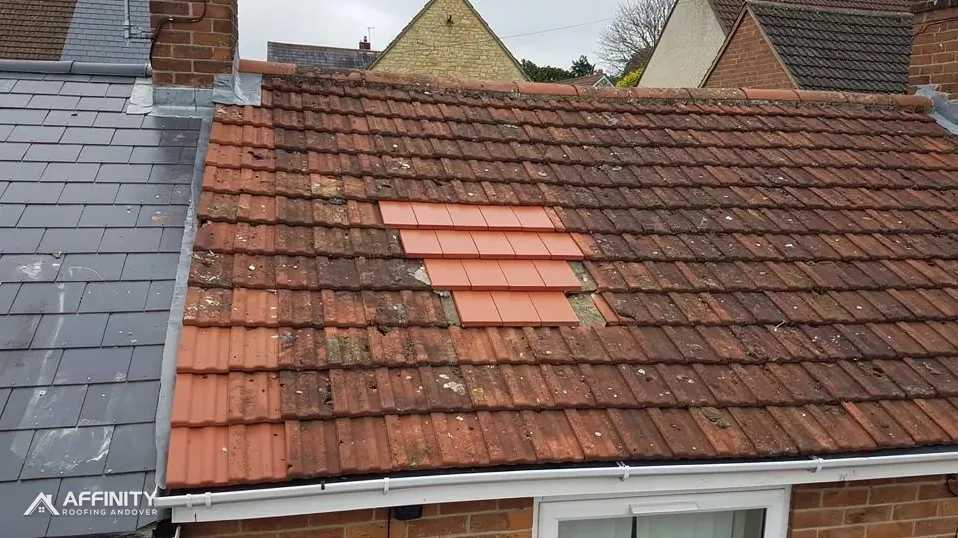
Plain tiles are the small clay tiles with a slightly curved face that cover many older roofs. Each one is only a little larger than a paperback, which gives a plain tile roof its fine, close texture and means a single slope carries a very large number of them. They are laid in overlapping rows, held to the battens by two projecting nibs and, on some courses, by nails.
That small scale is both the charm and the difficulty. A plain tile roof sheds water well on a steep pitch, ages gracefully and can last a very long time. It is also harder to repair than an interlocking roof, because the tiles are individually small, the colour varies from tile to tile, and an old tile may no longer be made.
This guide covers how plain tiles are laid and lapped, the minimum pitches the maker publishes, how handmade and machine-made tiles differ when a repair has to match, what typically goes wrong and what conservation-area and listed-building status mean for the work. Older streets and villages around Andover include protected areas, so those rules get a section of their own.
How a double-lap plain tile roof works
Most modern roof tiles interlock with their neighbours and are laid with a single overlap. Plain tiles do not. They are double-lap, which means each row is covered by the row above it and also by the row above that, so any point on the roof is protected by at least two thicknesses of clay.
Why the lap matters
Water that gets past the first tile meets a second one before it can reach the underlay. This is why plain tiles tolerate steep pitches and driving rain, and why a plain tile roof does not rely on every single joint being perfect. The price of that protection is quantity. A double-lap roof needs many more tiles per square metre than a single-lap roof.
How they are held
Each tile has two nibs, small clay lugs moulded on the back at the top. The nibs hook over the batten, the timber strip that crosses the rafters, and the tile hangs from it. Nails are added to some courses as the fixing specification requires, and every tile at an edge, a verge or an eaves needs more security than one in the middle of a slope. The standard for slating and tiling fixings is BS 5534:2014+A2:2018.
The curve
Plain tiles are made with a slight camber, a curve in both directions. It lets the tail of each tile lift away from the one below, so water is not drawn up between them by capillary action. It also gives the roof its gentle ripple, which is the first thing the eye notices when a flat modern tile is set among old ones. Our guide to types of roof tiles sets plain tiles alongside the other main kinds.
Minimum pitch for clay plain tiles
Plain tiles need a steep roof. The more a tile overlaps, the less slope it needs in theory, but plain tiles are small and the flat face is not designed to shed water at a shallow angle.
The figures
Marley, which publishes minimum pitches for its range, gives these for clay tiles: Canterbury 40°, Ashdowne 35°, Hawkins 30° and Acme Single Camber 30°, and 15° for the Lincoln pantile, which is a larger, interlocking clay tile. For concrete, Marley gives 35° for its plain tile. The pantile figure is a reminder that tile shape changes the answer completely.
Always the data sheet
Those numbers are examples from one maker, and the rule is to check the data sheet for the specific tile being used. A given tile can have a different minimum for a sheltered site and an exposed one, and the pitch is measured on the actual roof. A roof that falls short of the minimum for its tile will leak in wind-driven rain however well it is fixed.
When pitches matter most
Pitch becomes an issue on extensions and dormers, where a low roof is built against a taller one. If you are adding a pitched roof to a house, the extension has to meet the tile's minimum before anything else is decided. When re-roofing an existing steep roof, the pitch is already fixed and the tile choice has to respect it.
Our pitched roofing page shows how pitch, covering and ventilation fit together on a house.
Handmade and machine-made tiles: the matching problem
Colour and character vary far more in clay than in concrete, and that is what makes matching difficult.
Handmade tiles
A handmade tile is shaped by pressing clay into a mould by hand or in a semi-hand process, then fired. No two are quite the same. Edges are slightly irregular, the surface carries small marks, and the fired colour runs through a range, from deep reds to browns and oranges. When a whole roof of them is laid, the variations blend into a rich overall effect.
Machine-made tiles
A machine-made tile is extruded or pressed to a uniform size and shape. They are flatter, sharper and more even in colour. A new machine-made tile placed among old handmade ones looks like a replacement and stands out immediately, because the old tiles have also weathered over decades.
What this means for a repair
A match rests on three points: tile size and thickness, camber, and colour. A tile that is the wrong size will not sit on the gauge, which is the distance between battens, and so it will not lap correctly. A few millimetres of difference in length shows up as a wandering course across the slope. Salvaged tiles from a similar age are often the best answer, and on a visible front slope they are worth the extra search, and our guide to matching old roof tiles explains how they are chosen and where they go.
If you are not sure what kind of tile you have, look at the edges and the back. Peg tiles, held by wooden pegs and not nibs, are a separate type, and not every older roof is what it first appears.
What goes wrong on a clay plain tile roof
Clay tiles are tough, and when they fail it is usually the fixings or the frost that do the damage.
Nibs and nails
The nibs can snap, and nails in the battens corrode. Either leaves a tile with nothing to hold it, and it slips. One slipped tile in a row is a fixing fault. Several slipping together suggests the batten behind them has gone.
Frost and delamination
Clay that absorbs water can flake in cold weather. The face comes off in layers, a fault called delamination. A tile in this state may still be whole, but it is losing thickness and will break soon. Replacing individual tiles is practical when only a few are affected. A widespread problem means the clay itself is failing.
Hips and ridges
Hips are the sloping edges where two roof planes meet outward, and ridges run along the top. Old roofs often have clay ridge and hip tiles bedded in mortar. According to Marley, the 2014 revision of BS 5534 ended the idea that mortar could hold ridge and hip tiles by itself, and dry-fixed systems are tested under BS 8612. Mortar bedding still happens, but it now sits alongside a mechanical fixing.
Mortar and moss
Old pointing at the verge and on the hips cracks and falls out. Moss collects in the gaps between small tiles and holds water against the clay. Keeping the roof free of debris helps, and a careful, hand-led clean is gentler on the clay than a hard blast. Marley does not recommend using a high-powered jet wash on clay.
Clay tile lifespan and the cost of repair
Clay has an excellent record, though every published figure is a typical range, never a warranty.
Lifespan
Marley quotes the BRE for a minimum life expectancy of 60 years on clay tiles. That figure applies to clay only and is a minimum, not an average. HomeBuilding gives clay tiles 60 to 80 years (Sep 2025). Concrete tiles carry lower figures in the same guides: HomeBuilding has plain concrete at 40 to 50 years, while Marley expects its own tiles to reach around 60 years, adding that the figure carries no guarantee. A roof that has survived for a century is no promise of the next hundred years, and repairs along the way matter as much as the clay.
Repair costs
Which? gives £75 to £400, ex VAT, for putting right a handful of broken or absent standard tiles (Nov 2025). MyJobQuote puts the average at around £215 for replacing five tiles (6 October 2026). These are typical UK figures for standard tiles. Matching old plain tiles is usually dearer than those figures suggest, because suitable tiles are harder to find.
Repair or re-tile
A few isolated faults justify repair, and a survey that lifts tiles at the eaves, the ridge and the worst-looking patch gives a fair sample of the roof as a whole. Widespread flaking, failing battens or rotting underlay point towards stripping the roof, replacing the timber and relaying sound tiles. Our guide to the cost to re-tile a roof covers the whole-roof figures. After the survey the price comes in writing, with photographs of what we found.
Conservation areas, listed houses, consent
Many clay plain tile roofs belong to older houses, and some of those houses sit in conservation areas or are listed.
Re-roofing as permitted development
Changing the covering on a house generally comes under Class C of the General Permitted Development Order, which deals with other alterations to a dwellinghouse's roof. Flats sit outside it, as they have no permitted development rights. Conservation areas count as article 2(3) land, and that takes away dormers under Class B while leaving Class C alone.
Article 4 directions
A council can use an Article 4 direction to remove particular permitted development rights from a defined area. Only one council in this area has roof wording on file. Basingstoke and Deane applies directions to four town areas: the town centre, Fairfields, South View and Brookvale West and asks for original clay roof tiles to stay, adding that concrete tiles are unlikely to be accepted. Everywhere else, ask the council whether a direction applies. At an Andover or other Test Valley address, that means Test Valley Borough Council.
Listed buildings
Listed houses keep their Class B and C rights, but consent is also required for work that alters their character, and moving from plain tile to a different covering counts. Church of England churches in use follow the faculty system and not listed building consent.
Weight
Where the new covering is at least 15 per cent heavier than the old, approval under the Building Regulations is needed with a structural check, so trading a lighter roof for a heavier tile brings that step in.