
Roofers in Hurstbourne Tarrant
St Peter's, Rookery Farmhouse and the roofs below the Downs
Hurstbourne Tarrant lies in the North Wessex Downs and has 61 listed buildings near its centre, a Grade I church among them. We begin with a survey and photographs.
Hurstbourne Tarrant roofs, church to farmhouse

Church of St Peter
A Grade I church on the list since 20 December 1960, with a roof under the faculty system.

Rookery Farmhouse
A Grade II* farmhouse listed on the same 1960 date, where any repair follows the covering already there.

Houses in the Downs
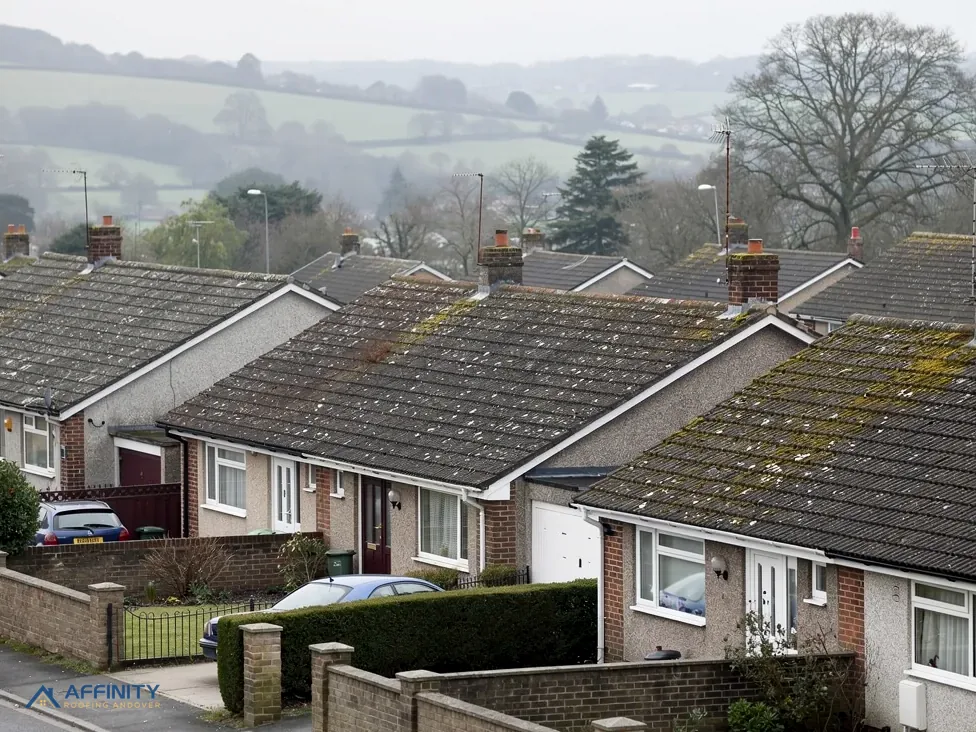
Homes inside the National Landscape and the Hurstbourne Tarrant and Ibthorpe conservation area, where roof shape is controlled.
Hurstbourne Tarrant above Enham Alamein
Enham Alamein lies to the south, Hatherden to the south-west, St Mary Bourne to the south-east and Charlton further south-west. All are within our patch, as are the lanes between.
- Distance
- 5.4 road miles north of Andover
- Planning
- Test Valley Borough Council
- Council
- Test Valley Borough Council and Hampshire County Council
The Hurstbourne Tarrant roof report
Local editionHurstbourne Tarrant, HampshireDowns, Grade I church and storm damage
Hurstbourne Tarrant roofs: 61 listings under the Downs and what to do after storm damage
Hurstbourne Tarrant sits wholly inside the North Wessex Downs National Landscape and holds 61 listed buildings near its centre. This report covers the designation, the church and farmhouse, and the steps to take after a storm.
Under the Downs: who decides what
Hurstbourne Tarrant lies 5.4 road miles north of Andover's East Street, wholly inside the North Wessex Downs National Landscape, the designation that was an Area of Outstanding Natural Beauty until recently. The 2021 Census counted 865 usual residents in the parish. Planning belongs to Test Valley Borough Council. Advice may come from the Downs partnership and Natural England is consulted, yet the council alone takes the decision on a roof. Anyone with a roof question here therefore deals with one authority, and a short enquiry at the start saves a longer one later. That is a simpler position than the word designation suggests.
Where the designation bites is on roof shape. Land in a National Landscape is article 2(3) land, so adding a dormer starts with a planning application here, and a conservation area adds the same restriction. A conservation area covering Hurstbourne Tarrant and Ibthorpe is recorded within about 0.75 km of the centre, with Test Valley Borough Council supplying the line. The reading for an owner is simple: repairs go ahead as normal, while a change to a roof's shape starts with the planners. Our guide to planning permission for roof work sets out where the lines fall.
Check with Test Valley Borough Council whether an Article 4 direction reaches your street. It is a single enquiry, and the answer travels with the survey. We make it before any quotation is drawn up, since a direction can change what a roofer may fit.
Building control comes next. For a re-roof, the Planning Portal draws its line at 25 per cent of the building envelope and 50 per cent of the roof, below which approval normally does not arise. A full slope re-covered is the case to put to your building control body, or a registered building control approver may act instead of local authority building control. Weight is the other trigger. Add 15 per cent or more to the load and Building Regulations approval follows, with an inspection of the structure advised beforehand.
The survey is the part we control. A ladder visit, a raised tile and a set of photographs of the timber and the sheet under the tiles turn an opinion into a record. The report that follows names what has failed, what is sound and what each choice would involve, in words that do not need a trade dictionary. The services that fit Hurstbourne Tarrant roofs are roof repairs and pitched roofing, and the report says which applies, with the photographs beside each finding so that nothing rests on our word alone.
St Peter's, Rookery Farmhouse and 61 listings
Historic England's list records 61 listed buildings within about 500 m of the centre of Hurstbourne Tarrant. St Peter's Church carries a Grade I listing (list entry 1093367) that dates from 20 December 1960. Rookery Farmhouse is Grade II* (1093338) and carries the same date. In a place with that many protected buildings, the roof beside yours is likely to matter to somebody.
Because St Peter's is a working Anglican church, roof work follows the Church of England's faculty system, a procedure apart from the council's, its faculty coming from the diocese's consistory court, Hurstbourne Tarrant's church included. The roofer's addition is evidential: a survey, close images of tiles, ridge and lead, and a plain statement of what is wrong and what will mend it. We assemble those for the faculty application.
Rookery Farmhouse is a home, and the council applies. Listed building consent from Test Valley Borough Council is required for any work that touches its character. A farmhouse roof can run to several slopes and stacks, so a repair plan has to say which parts are in scope. The simplest application to support is a repair that copies the present covering. Switching material, or changing the ridge or the stacks, makes a harder case that the council may refuse, and asking early avoids a plan that cannot go ahead.
The conservation area carries a joint name, Hurstbourne Tarrant and Ibthorpe, which tells you it takes in more than the village centre alone, so houses near its edge should be checked against the council's map and not from memory. We ask the council about any house within reach of the line, and pass its answer on with the photographs.
For unlisted houses nearby, no consent is needed for a plain repair, but the neighbours matter. We photograph each roof against the one beside it, from the lane, so that the covering chosen sits in. Where originals are out of production, reclaimed stock is sought from salvage suppliers, and holding a sample to the roof in good light settles the colour. Where a stack or a gable end touches a neighbour's property, the neighbour is told about the work before it begins.
Where the farmhouse or church stands on a shared boundary, the owner next door is told before a scaffold or tower is placed. A quiet word at the start costs nothing and heads off disputes.
“In a National Landscape, one council still decides, and the survey is the evidence for it.”
After a storm: the sequence that protects a claim
After wind or heavy rain damages a roof, the order of actions counts for more than speed. Ring the insurer before anyone starts work. Make the house dry and safe with a temporary repair where one is possible. Photograph everything and keep each receipt. A temporary repair stops water getting in and is a different job from the permanent repair, which may wait for the insurer's agreement where the policy asks for it. The Institution of Structural Engineers describes photographs as essential evidence for a claim, and the survey photographs we take are dated, which helps.
Whether damage counts as a storm is the insurer's decision, under the storm wording in your policy. The Financial Ombudsman Service takes a wide view of the word: violent wind with rain, hail or snow is the usual picture, but a storm can occur without high wind, and heavy rain, hail or snow by itself may qualify. It looks at the Beaufort Scale. Some insurers set a wind level in the policy, so the wording matters more than the weather report.
Where a roof was already in poor condition and the owner knew, or where the storm merely exposed an old fault, the Financial Ombudsman Service is unlikely to side with the owner, and gradual damage and wear and tear are common policy exclusions. A dated survey carried out before a storm records what the roof was like on a given day. Dated pictures from before the damage, such as a survey or a report from a house sale, help show that the damage is new, though they promise nothing about a settlement.
If an insurer refuses, the Financial Ombudsman Service (0800 023 4567) is free to use. It can be approached once eight weeks pass without a final response, and after a final response is issued, six months run from its date. The claim is a matter for you and your insurer; our part is the evidence about the roof and the repair it needs.
A frame on the road for the repair needs a section 169 licence from Hampshire County Council under the Highways Act 1980. In Hampshire County Council's scheme the scaffolding firm makes the application for the household, a fortnight or more ahead (ten clear working days), at £211.90 on application for the first 2 weeks and £72 for each further 2-week period. After a storm, repairs come first and re-covering follows only if the roof is beyond patching. The site is left clear when the work is done, and the waste goes with us. A plan for each day goes to you before the start.
Hurstbourne Tarrant roof repairs and more






Hurstbourne Tarrant roofs: the Downs, the church and storm claims
Is a dormer allowed on a Hurstbourne Tarrant house in the Downs?
Yes, with planning permission from Test Valley Borough Council, since National Landscape land and conservation areas are article 2(3) land, where the ordinary dormer freedom is lost. The Downs partnership is only an adviser. A plain repair that keeps the roof's shape proceeds as normal, and the council is asked first about anything bigger.
Does the Church of St Peter's roof need a faculty?
Yes. St Peter's is a Church of England church still used for worship, so works go through the faculty system rather than listed building consent. The roofer's contribution is a survey, pictures and a short note on the roof surface and the repair for a faculty from the diocese's consistory court; Hurstbourne Tarrant's church advisers may want measurements and pictures of the lead and ridge.
What counts as a storm for a Hurstbourne Tarrant roof insurance claim?
The storm wording in your policy decides. The Financial Ombudsman Service accepts that a storm can bring violent wind with rain, hail or snow, or even none of the wind, and it considers the Beaufort Scale. Ring your insurer first, make the house safe, take photographs and keep receipts, then call us for the survey that shows what the roof needs.
Who applies for the scaffold licence in Hurstbourne Tarrant?
Hampshire County Council's scheme makes the scaffolding firm the applicant, not the householder. Hampshire County Council's fee is £211.90 for the first 2 weeks and £72 for each further 2-week period. Land of your own sits outside the licence, and the survey settles which case you have, long before any start date is agreed.
Villages round Hurstbourne Tarrant
Arrange a roof check in Hurstbourne Tarrant
Name the house and describe what the roof has done. A survey goes first; one written price follows.
10-year workmanship guarantee, in writing.