
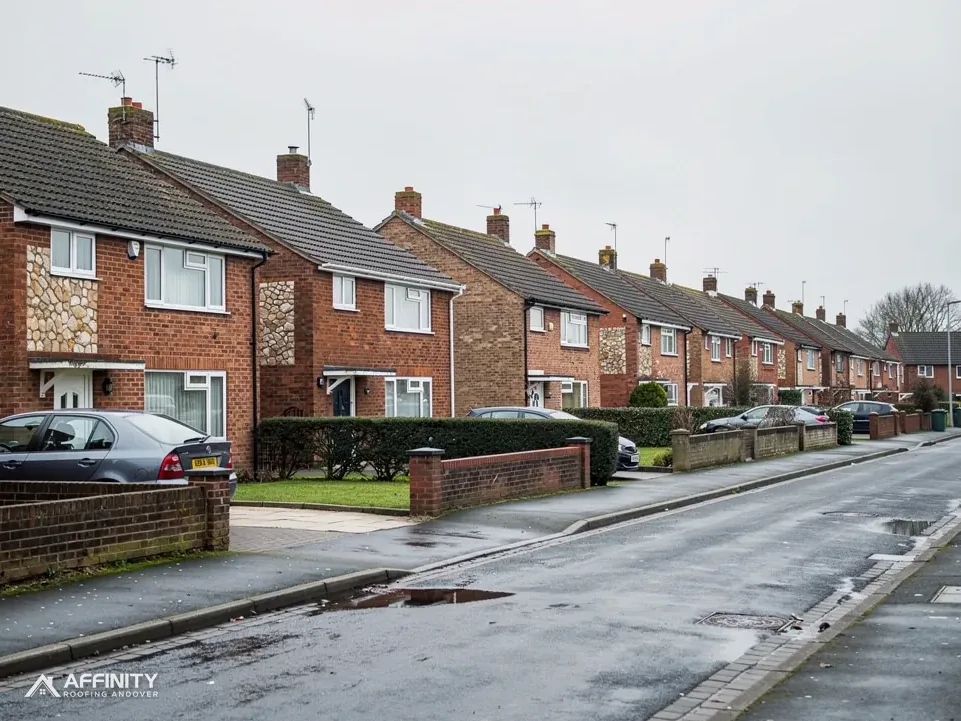
Roofers in Appleshaw
Old Vicarage, St Peter in the Wood and the timbers beneath
Appleshaw has a Grade II* vicarage, a Grade II church and a conservation area of its own. A survey with photographs shows what the roof timbers are doing.
Appleshaw roofs, vicarage to village street

The Old Vicarage
A Grade II* house on the list since 20 December 1960, where repairs follow the covering already there.

St Peter in the Wood
A Grade II Anglican church, also listed on 20 December 1960, whose roof goes through the faculty system.

Conservation-area homes
Houses within about 0.75 km of the centre, near the boundary that Test Valley Borough Council supplies.
Appleshaw north of Amport and Monxton
Weyhill and Penton Mewsey lie to the south-east, Thruxton to the south-west, and Amport and Monxton to the south. All are within our patch.
- Distance
- 6.1 road miles north-west of Andover
- Planning
- Test Valley Borough Council
- Council
- Test Valley Borough Council and Hampshire County Council
The Appleshaw roof report
Local editionAppleshaw, HampshireConsents, timbers and spray foam
Appleshaw roofs: a conservation area, an Old Vicarage and what spray foam hides in the loft
Appleshaw has 29 listed buildings near its centre and its own conservation area. Read on for what the council decides, how a church roof differs from a house roof, and why foam sprayed onto roof timbers complicates a repair.
Appleshaw's conservation area and the council that draws it
Start with the map. The Appleshaw conservation area is recorded within about 0.75 km of the village centre, and Test Valley Borough Council supplies its boundary. That makes the council the first call for any plan that would change the look of a roof from the street, and a dormer is a planning application. Ask Test Valley Borough Council whether an Article 4 direction reaches your road. The 2021 Census counted 587 usual residents in the parish, small enough that a changed roof gets noticed.
Appleshaw lies 6.1 road miles north-west of Andover's East Street, and Hampshire County Council looks after its roads. No national park or National Landscape covers it. Beyond planning comes building control. The Planning Portal says a re-roof touching under 25 per cent of the building envelope and under 50 per cent of the roof does not usually need an application. Anything larger goes to your building control body, which may be local authority building control or a registered building control approver.
The load test comes into play when a covering changes. Replace a covering with one 15 per cent heavier or more and Building Regulations approval is required, with a structural check recommended by the Planning Portal. Rafters cut for clay or slate do not always suit concrete, and finding that out after the tiles are delivered is an expensive way to learn it.
What we bring to those tests is a record. We walk round the house, look up, climb where the roof allows and raise a tile to see the timber below. A few photographs of the battens, the laths the tiles hang from, and the underlay, the membrane beneath them, with a note of the pitch, turn a question into an answer. The report that follows is short, plain and readable by the council.
If a repair is all that is needed, the report says so. A slipped tile, a loose ridge piece or a lifted flashing is a quick job and sits below the thresholds. Where the covering is spent, the photographs show the reason, and the order of work is set out before a date is fixed. No order is placed until the evidence has been shown to you, and the order of work is explained.
Photographs from the road matter in a conservation area. Planners judge a repair by how it appears from where the village sees it, so the full view of the roof is taken along with the close-ups and included in the report. If a question comes back from the council, the answer is already in the file.
Old Vicarage, St Peter in the Wood, 29 listings
Historic England's list records 29 listed buildings within about 500 m of the centre of Appleshaw. The Old Vicarage is Grade II* (list entry 1229290), first listed on 20 December 1960. The Church of St Peter in the Wood is Grade II (1279202), on the list from the same date. A vicarage of that rank may have a large, complicated roof, and it deserves a survey that treats each slope on its own terms.
The church is a working Church of England church, so work on its roof comes under the faculty system and not under listed building consent. Its faculty comes from the diocese's consistory court, Appleshaw's church being Anglican. Evidence is what a roofer prepares: survey, near pictures of the covering, ridge and gutters, and a plain note on the fault and the cure proposed. The work waits for the faculty.
The vicarage is a house, so its route is the council's. Test Valley Borough Council grants listed building consent where work reaches its character. A repair that mirrors the existing covering is the easiest request to grant; a different material, a new ridge or changed chimneys is the hardest. Ask the planners before any price is agreed, because their answer costs less than a mistake.
An unlisted house in the village has none of this, but its neighbours may. With 29 listings so close together, the roof next door could be protected, and a frame placed against a shared wall is something the neighbour should hear about first. We tell owners before the date is fixed, and we keep scaffolding clear of old masonry.
Across all these roofs the discipline is the same: record what is there before changing it. Tile colour, size and thickness, the laying pattern, the ridge and hips, the lead at the chimney. A record of that kind lets a salvage supplier match a delivery and lets the council see exactly what would change. It also gives the owner a dated reference for the day the house is sold.
A listed roof's survey takes longer because each part is recorded in turn: the main slopes, the valleys, the porch, the outbuildings and each stack. For a house of the vicarage's size the report may run to several pages of photographs, each tied to a part of the roof by a plain label, so the council, the owner and a contractor are looking at the same thing. Where the council grants consent with conditions about materials, we read them against the survey before ordering, so the stock that arrives is the stock that was agreed.
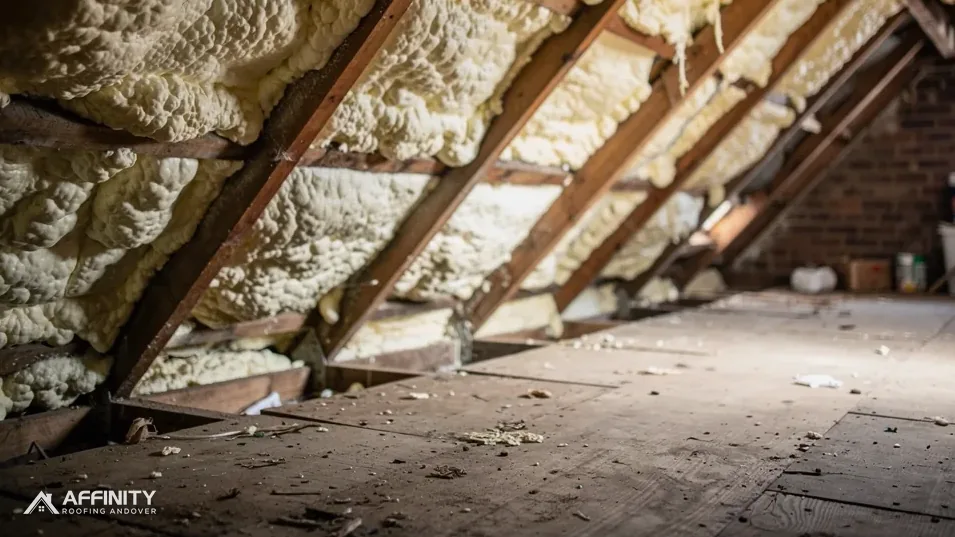
“Foam on the underside of a roof hides the timbers, so leaks beneath it are harder to trace.”
When spray foam covers the roof timbers
Some roofs are insulated by spraying foam onto the underside of the covering, which buries the rafters and battens. A March 2023 RICS release spoke of unease in parts of the lending market, equity release first, and its consumer guide tells owners to ask their mortgage provider whether lender policy allows such products. Once foam coats the timbers, the same guide points out, nobody can inspect them properly. For a roofer that is the heart of the matter.
RICS adds that poor installation can upset ventilation and bring moisture damage, and the timbers beneath are out of sight when it does. A leak in a foamed roof can be harder to trace, because the foam hides the underside of the covering where water first appears. The Energy Saving Trust, in guidance updated in May 2026, says of spraying foam onto a leaking roof: "We don't recommend doing this." The leak has to be found and mended first.
Our approach is to inspect before deciding anything. We look at the roof from outside and from the loft, record what the loft shows and say plainly whether foam has hidden a fault. Taking foam off is specialist work, and our page on spray foam insulation removal explains how that is judged. A roof that is sound beneath foam may need nothing, while a faulty one needs the foam off before the repair.
A frame on the road is licensed by Hampshire County Council under section 169 of the Highways Act 1980. In Hampshire County Council's scheme the scaffolding firm applies for the household, ten clear working days ahead, and the charge is £211.90 on application for the first 2 weeks and £72 for each further 2-week period. Frames on private land sit outside the scheme altogether.
If foam is found, the report records where it starts and stops, whether the covering is damp beneath it, and whether any timber looks stained or soft from the loft side. Probing is gentle, because the aim is to learn about the roof without making a new hole in it. If the roof is dry, the advice is to leave the foam alone and keep an eye on it; if it is wet, the report says how far the problem runs. A mortgage provider's view is a separate matter from the roof's condition, and the report keeps the two apart.
The usual work stays the same. Roof repairs after slipped tiles come first, and pitched roofing follows when a slope has failed. The site is left clear and the waste leaves with the crew.
Roofing help for Appleshaw streets




Appleshaw roofs: foam, the church and the conservation area
Should I have spray foam removed from my Appleshaw loft?
Not necessarily. If the roof is sound and the foam was properly installed, it may need nothing. RICS said in March 2023 that some lenders had concerns, so check with your mortgage provider. Foam over timbers cannot be fully inspected, so a survey decides whether removal is needed before any repair.
Does Appleshaw's conservation area stop a roof being re-covered?
Not by itself. A changed roof appearance should go to Test Valley Borough Council first, and a dormer needs permission. The Appleshaw conservation area is recorded within about 0.75 km of the centre. A repair that mirrors the existing covering is the easiest case, and we ask the planners before pricing.
Does St Peter in the Wood need a faculty for roof work?
Yes. St Peter in the Wood is an Anglican church in use, so the Church of England's faculty system, and not listed building consent, governs its roof. The roofer hands over a survey, photographs and a written note on covering and repair, and no work is booked before a faculty from the diocese's consistory court reaches Appleshaw.
What does an Appleshaw scaffold licence involve?
Hampshire County Council issues it under section 169 of the Highways Act 1980, and expects the scaffolding firm to apply, with ten clear working days to spare. Hampshire County Council's fee is £211.90 for the first 2 weeks and £72 for each further 2-week period. Frames on your own land need no licence; the survey shows which case applies, and the dates follow from that.
Ask for an Appleshaw roof survey
Name the house and the fault, and mention any foam in the loft. Survey first, then one written price.
10-year workmanship guarantee, in writing.