
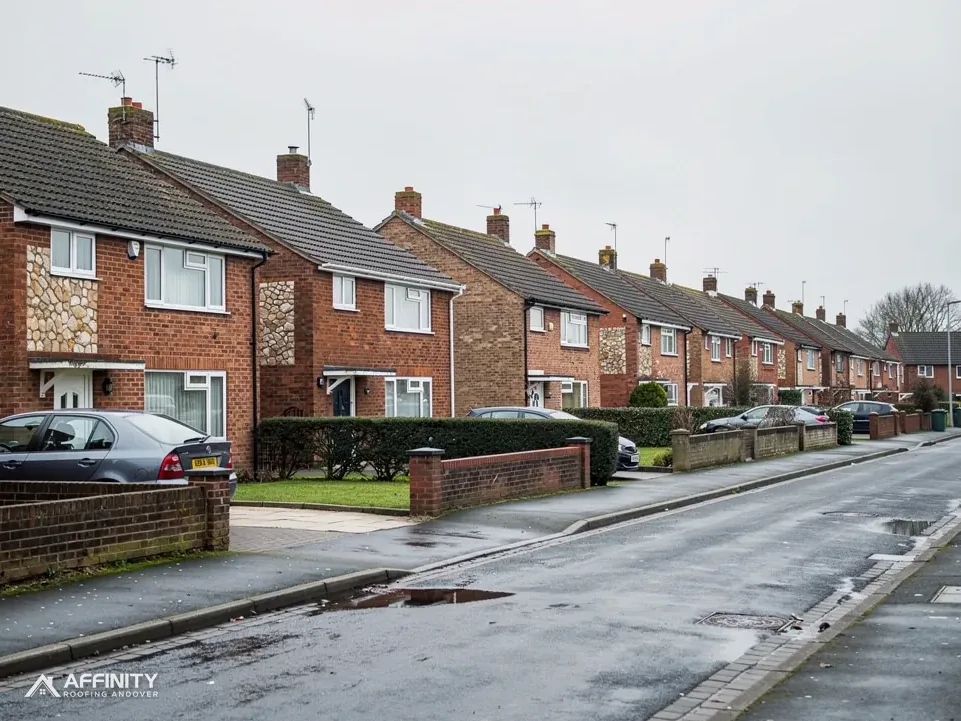
Roofers in Monxton
Little Bec, St Mary's church and the roofs that share a wall
Monxton has 270 residents and 56 listed buildings within about 500 m of its centre. Every repair begins with a survey and pictures, so the work suits its neighbours.
Monxton roofs, from church to cottage

Church of St Mary
Grade II*, entered on 30 April 1985, a Church of England church whose roof goes through the faculty system.

Little Bec
A Grade II house on the list since 20 December 1960, where repairs copy the covering already there.

Houses on shared walls
Homes whose chimneys, gables or roof edges meet a neighbour's, so a repair can involve two owners.
Monxton beside Amport and Abbotts Ann
Amport lies just to the west, Abbotts Ann to the south-east, Weyhill to the north and Thruxton to the north-west. All four are ours to survey.
- Distance
- 4.6 road miles west of Andover
- Planning
- Test Valley Borough Council
- Council
- Test Valley Borough Council and Hampshire County Council
The Monxton roof report
Local editionMonxton, HampshireListings, shared walls and neighbours
Monxton roofs: 56 listings in a village of 270, shared walls and the permissions that follow
Monxton packs 56 listed buildings into a parish of 270 residents, so a roof job here can easily touch a protected building or a neighbour. This report covers the consents, the party wall rules and how a scaffold gets in.
Where 56 listings meet 270 residents
Historic England's list holds 56 listed buildings within about 500 m of the village centre, and the 2021 Census counted 270 usual residents in the parish. Put those side by side and your roof may well have a listed neighbour, or be one. St Mary's Church is Grade II* (list entry 1093882), on the list since 30 April 1985, and Little Bec is Grade II (1093252), listed on 20 December 1960.
Test Valley Borough Council decides listed building consent for houses, and Hampshire County Council looks after the lanes. For work that touches a listed building's character the application goes to the council, and the surest route is a repair that matches what is on the roof. Swapping slate for tile, or clay for concrete, is a change to raise with the council first. Ask the council what it will accept before any quotation is requested, because the answer shapes the work. We pass on what the planners say, along with the photographs they were shown.
The church needs a different question. St Mary's, Monxton, appears on A Church Near You within the Portway and Danebury Benefice and holds services, which places its roof under the Church of England's faculty and outside listed building consent. The faculty itself comes from the diocese's consistory court, and the survey and pictures we prepare can support the application. A dated photograph of every slope goes with them.
The Amport and Monxton conservation area sits within about 0.75 km of the village centre, a name the two villages share. The boundary comes from Test Valley Borough Council's own data. A repair that keeps the look of a roof is simple in planning terms, while a change of covering or a new dormer deserves an early word with the planners. Check with Test Valley Borough Council whether an Article 4 direction reaches your lane.
None of this stops a leak being mended. A roof that is letting water in is made safe first, and the consent questions run alongside. What the listings change is the order in which things are done and the care taken over matching, since a poorly chosen tile on a listed roof stays in view for as long as the roof lasts.
Where Monxton roofs sit close together, the photographs are taken in sequence from the lane so that the council can see one roof beside the next. A repair that looks acceptable alone can look wrong in a row, and the sequence shows it before the work is agreed.
Chimneys and gables that two owners share
Where houses sit close, a roof job can cross a boundary. A chimney stack can stand on a wall that belongs to two houses, a gable can meet a neighbour's roof, and a scaffold may need a foothold on the next-door garden. Each of those is a neighbour question, and the law that governs them is the Party Wall etc. Act 1996, not building control. Party wall questions go to a party wall surveyor.
Two provisions matter most to roof work. The Act's section 2(2)(g) allows a chimney breast, jamb or flue that juts out from a party wall to be cut away; under section 3(2)(a) the neighbour must be given notice of two months or more. GOV.UK adds two cautions: you cannot assume that no reply means your neighbour agrees, and you must appoint a surveyor if you and your neighbour cannot agree. A leaning stack repaired in place is a separate matter, and whether taking one down touches the Act is a question for a party wall surveyor. Where a shared stack is sound and only its flaunching has failed, the repair is a modest one, and telling the neighbour first is the sensible start. Where the stack needs rebuilding, a party wall surveyor can set out the steps.
The building rules add one more layer. The Planning Portal states that Building Regulations approval always applies to removing a chimney breast, since the breast is part of the building's structure. A repair to pointing, flashing or flaunching is not removal, and a survey tells which job a given stack needs. Our chimney repairs page sets out what each repair involves.
The Construction (Design and Management) Regulations 2015 also apply to a domestic job, in a light form. In a domestic job regulation 7(1) passes the client's duties on to the contractor, and a contractor working alone then prepares a construction phase plan under regulation 15(5). That plan is written for the site as part of the job.
The practical result is a short conversation with the neighbour at survey. We say what is planned, where the frame or tower will stand and for how long, and, with the owner's agreement, the neighbour sees the same photographs. A neighbour who hears of the work before it starts has time to raise a concern while it is easy to deal with. A short note through the door, with a date and a contact number, does the job.
“In Monxton a shared stack can bring in two owners, a listing and the county.”
The lane, one licence and a plain survey
Scaffolding that stands on the public road, even briefly, must be licensed under section 169 of the Highways Act 1980. Hampshire County Council issues it. In its scheme the applicant is the contractor putting up the frame, the application has to arrive ten clear working days early, and a licence once running is fixed. Hampshire County Council's charge is £211.90 on application for the first 2 weeks and £72 for each further 2-week period. A frame on private land is outside the scheme, so the lane and the frontage are measured at survey and the survey settles which case you have. A listed or conservation-area job also needs time for the paperwork, so dates are fixed backwards from the consent decision.
Where the road is too tight, a tower on private ground or a ladder with a roof ladder can reach a small repair without any licence. The survey establishes this, because a frame booked and then not needed costs time and a return trip. A bigger job such as a full re-cover has to be planned around the lane, with deliveries, the skip and the scaffold all fitted into the width available, and neighbours warned when the road will be tight.
Re-roofing carries two building control tests. The Planning Portal puts the first at 25 per cent of the building envelope and 50 per cent of the roof; work under both does not normally call for approval. The second is weight. If the covering adds 15 per cent or more to the load, Building Regulations approval follows, and an engineer's or surveyor's inspection of the structure is advised beforehand. Your building control body, local authority building control or a registered building control approver, is the place to ask.
The survey itself is plain. The roof is viewed from the lane and from above, a tile is raised where that is safe and the timbers beneath are photographed. The report lists, in everyday words, the failures and the sound parts. Whether the answer is a few tiles, a stack or a whole slope, the evidence is on the table before money is mentioned.
For Monxton, the starting points are roof repairs or pitched roofing. When a slope is stripped, new battens and underlay go on as the tiles do, so the covering rests on sound timber. The site is cleared as the job proceeds, and the waste leaves with us. If the weather turns while a slope is open, it is sheeted over and the tarpaulin is checked before anyone leaves, so the house is dry overnight.
Where we can help in Monxton





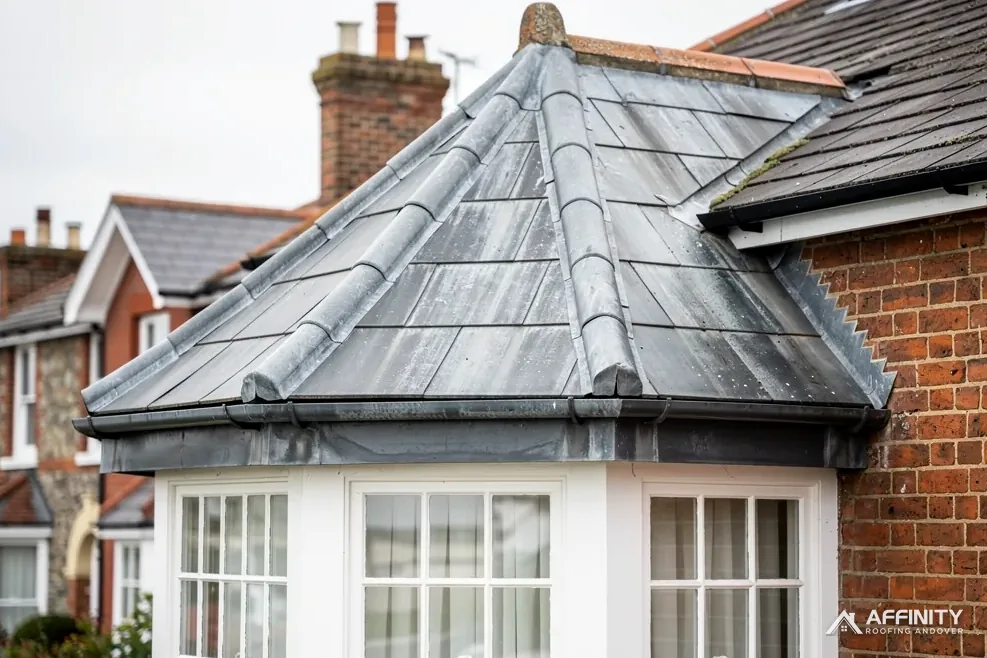
Monxton roofs: shared walls, listings and the lane
Do I need to tell my neighbour before repairing a shared Monxton chimney?
Telling them is wise whatever the repair. Cutting away a projecting chimney breast brings in the Party Wall etc. Act 1996, which calls for two months' notice, and GOV.UK says silence is not agreement. A repair that leaves the stack in place is different. We explain which case yours is and photograph the stack for both owners.
Which consent route covers the Church of St Mary in Monxton?
The faculty system. St Mary's is a Church of England church with services shown on A Church Near You, in the Portway and Danebury Benefice, so roof works need a faculty rather than listed building consent. Whoever makes the application, we supply survey, photographs and a covering note for it, so nobody climbs up twice.
Is Little Bec's roof treated differently from a neighbouring cottage?
Yes, because Little Bec is Grade II listed, since 20 December 1960. Any work touching its character needs listed building consent from Test Valley Borough Council, while an unlisted neighbour keeps the ordinary rules. Matching the tiles now on the roof is the safest course. Which of your neighbours are listed is checked before a frame is placed.
What does a scaffold cost to licence on a Monxton lane?
Hampshire County Council charges £211.90 on application for the first 2 weeks and £72 for each further 2-week period, and wants the contractor erecting the frame to apply, lodged no less than ten clear working days ahead. The cost sits inside the one price you are given. On private land no licence is needed, and a tower may reach a small repair without any frame.
Villages near Monxton
Have your Monxton roof surveyed
Say which house and what you can see. A survey goes first, and one written price follows.
10-year workmanship guarantee, in writing.