
Roofers in Charlton
Upper Charlton House, Charlton Street and the flat roofs on later extensions
Charlton is a parish of 2,121 residents with listed houses on Charlton Street. A survey with photographs precedes every Charlton repair, whatever the roof is covered in.
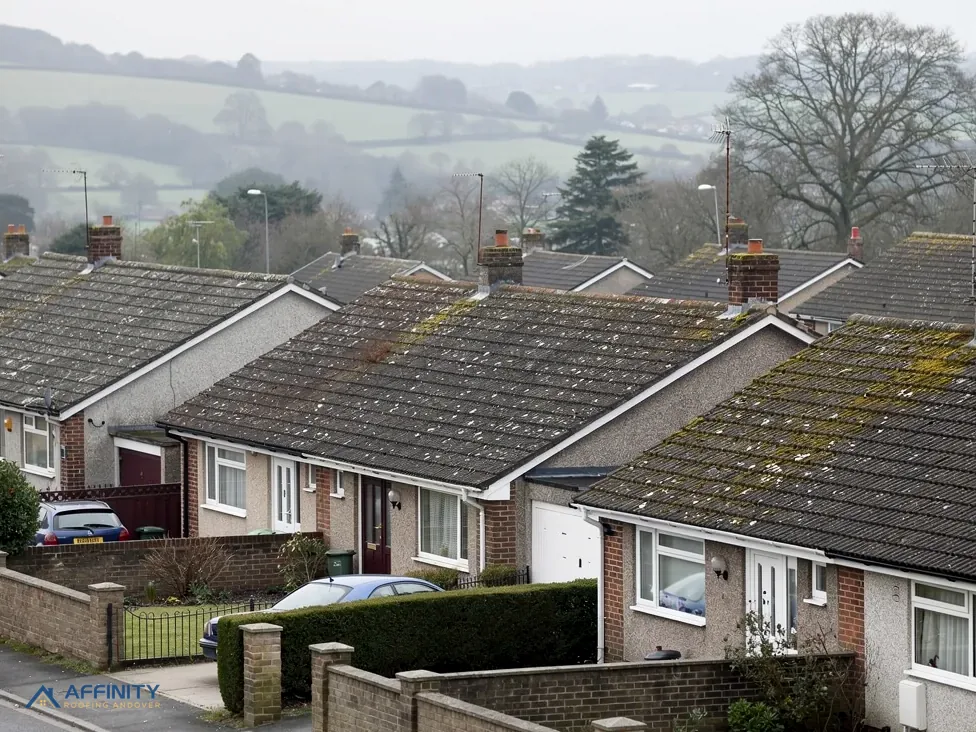
Charlton roofs, old houses and new additions

Upper Charlton House
A Grade II listed house, first listed on 24 February 1950, where repairs follow the materials already on the roof.

70 Charlton Street
Another Grade II listing, dating on the list from 24 June 1983, with neighbours that share its street frontage.

Extensions and garages
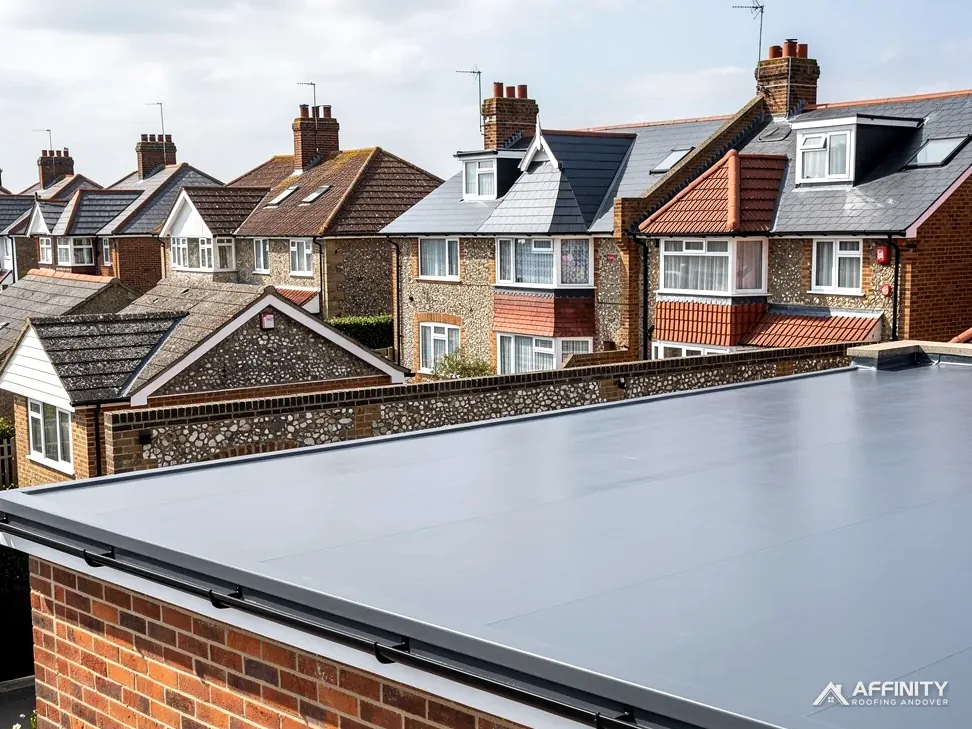
Flat-roofed additions behind older houses, where falls, outlets and the membrane decide how long a repair lasts.
Charlton between Penton Mewsey and Enham Alamein
Penton Mewsey lies to the west, Enham Alamein to the north-east, Weyhill to the west beyond it and Upper Clatford to the south. We reach roofs in all of them.
- Distance
- 2.1 road miles north-west of Andover
- Planning
- Test Valley Borough Council
- Council
- Test Valley Borough Council and Hampshire County Council
The Charlton roof report
Local editionCharlton, HampshireA parish beside Andover, roof by roof
Charlton roofs: a parish beside Andover, who decides on a roof and what the survey looks for
Charlton has its own parish, its own listed houses and a mix of old roofs and later flat-roofed additions. This report explains which council decides what, what the listings mean and how flat roofs are judged.
A parish of its own, a council shared with Andover
Charlton counts as a suburb on the north-west side of Andover, 2.1 road miles from East Street, yet it has a parish of its own. The 2021 Census recorded 2,121 usual residents there. Planning belongs to Test Valley Borough Council, the same authority as for Andover itself, and Hampshire County Council is the highway authority. A roof in Charlton therefore follows the routes you would use in the town, with one check to make: the town has a conservation area through its middle, and whether one reaches Charlton is a separate question.
That second point deserves care. The Andover and The Pentons conservation areas lie within about 2.5 km of Charlton, but a nearby boundary is not the same as one that covers your road. The only reliable answer is on Test Valley Borough Council's own map, so the council is asked before we advise on any work that would alter the roof's appearance from the street. The same goes for an Article 4 direction, which can remove rights that houses normally have.
Re-roofing brings two tests. The Planning Portal says building control approval is not normally needed when under 25 per cent of the building envelope and under 50 per cent of the roof is touched by the work. A covering that makes the roof 15 per cent or more heavier needs Building Regulations approval, and the Planning Portal advises that a structural engineer or surveyor looks at the roof first. Neither test applies to patching a few slipped tiles, and neither is a reason to delay a repair that is stopping a leak. The survey notes the area of roof involved, so the figure for any larger job is measured.
We begin every job with a survey that is the same in kind as the work it leads to: a walk round the outside, a climb where it is safe, and photographs of the battens and underlay once a tile has been lifted. Battens are the laths the tiles are hung on; underlay is the layer under them that catches whatever gets past a tile. You see what we saw, and the explanation that goes with it is in plain words rather than trade shorthand. A repair is recommended where one will do, and where the covering is finished the photographs show it.
If the survey points towards a larger job, your building control body is asked how it wants the work handled, either local authority building control or a registered building control approver. Our guide to Building Regulations for roof work explains the two tests in more detail than a survey visit allows.
Upper Charlton House and 70 Charlton Street
Historic England's list records 7 listed buildings within about 500 m of the centre of Charlton. Upper Charlton House is Grade II (list entry 1093490), first listed on 24 February 1950. At 70 Charlton Street the listing is also Grade II (1093489), and it dates from 24 June 1983. Sundial Cottage, another Grade II building, completes the three the record names. Seven is a small number, but on a street where two of them stand it means a neighbouring wall or boundary may belong to a protected building. Matching the colour of mortar and the profile of its joints matters on these houses, because a repair that is the wrong shade shows from the pavement for years.
A listing does not stop repairs. Listed building consent is required where work touches a listed house's character, on top of any other permission the job needs, and the application goes to Test Valley Borough Council. The sensible reading is that replacing like with like, in the same material, size and fixing, is the easiest case to argue, and a change of covering or ridge detail is the hardest.
For that reason the photographs matter more than usual on a listed roof. We record the colour and thickness of each tile, the pattern in which they are laid, the lead or mortar at the ridge and the way each chimney is flashed. The list is then a short document that an officer can check against the building without a visit. It also lets a supplier of reclaimed tiles match the roof from pictures and measurements.
An unlisted house on the same street has no such requirement, but the same logic holds for a neighbour. When a scaffold or a tower is going up against a party wall, the owner next door should be told, and the first of those conversations is easier when the listed status of both houses is already known. We find that out before the date is set, not on the morning. Where the neighbouring roof is also in poor order, mention it, because a scaffold put up once can sometimes serve both.
Gutters and fascias on older houses are often fixed straight to the rafter ends, so replacing them can reveal rot that was hidden behind the board. We photograph it where it is found, mark which timbers are affected, and explain whether the fix is a splice or a larger repair. A splice is a new length of timber joined to the sound part of the old one.
“Charlton has its own parish and listed houses, but takes its planning rules from Test Valley.”
Flat roofs on Charlton extensions and garages
Not every roof in the parish is pitched. Extensions and garages often have a flat roof, and a flat roof fails differently from a tiled one: water stands where the fall is too shallow, and the membrane ages in the places where it ponds. BS 6229:2025 sets 1:80 as the minimum finished fall for the main roof area and internal gutters, and IKO advises designing for 1:40 so that the roof still drains once the building has settled. A roof that holds a puddle for days is a roof that has dropped below that line. Typical lifespans differ between guides. HomeBuilding gives glass-reinforced plastic (GRP) 25 to 30 years where Less says 25 to 40, and torch-on felt 10 to 15 years where Less says 10 to 20. Those are typical ranges and never promises, which is why the condition of your own roof counts for more than the date it was laid.
BS 6229 covers flexible-membrane flat roofs and not lead, which follows its own standard. That matters at the survey, because the first thing we check is what the covering actually is. The repair for a patch of torch-on felt, a single-ply sheet and a glass-reinforced plastic roof differs, and a repair that suits one can ruin another. Where a roof drains badly across its whole area, the honest answer may be new layers and a corrected fall rather than another patch.
On a flat roof the scaffold question can come out differently. A low extension behind the house can often be reached from private ground, which needs no licence. Where the work needs a frame on the road, Hampshire County Council is the licensing authority under section 169 of the Highways Act 1980. Hampshire County Council expects the firm putting up the frame to make the application, and needs ten clear working days' notice. Hampshire County Council's published fee is £211.90 for the first 2 weeks and £72 for each further 2-week period.
For a Charlton flat roof we start with flat roofing, compare it with roof repairs where only a section has failed, and look at guttering, soffits and fascias where the edge detail is the cause. The survey photographs show which of these it is before any price is given. If a flat roof has failed in one corner only, a localised repair can be the better buy, and the report says so plainly. If the whole membrane has crazed or lifted, replacing it is the straightforward answer, and the fall and outlets can be corrected at the same time.
What we fix on Charlton roofs





Charlton roofs: listings, flat roofs and scaffold
Why does my Charlton flat roof keep holding water after a repair?
A flat roof holds water when its fall is too shallow or the outlets sit too high. BS 6229:2025 asks for at least 1:80 as the finished fall across general areas and internal gutters, while IKO's design figure is 1:40. We measure the fall and photograph the ponding, so you can see whether the cure is a patch or a corrected roof.
Do I need listed building consent to re-roof near 70 Charlton Street?
The listed building is what needs it, and 70 Charlton Street is listed Grade II. Work that affects a listed building's character needs listed building consent from Test Valley Borough Council. An unlisted neighbour does not, but may share a wall or boundary with a listed one, which we check before a scaffold is booked and a start date is agreed with you.
Is Charlton inside the Andover conservation area?
That is for Test Valley Borough Council's map to answer. The Andover and The Pentons conservation areas both lie within about 2.5 km of Charlton, which is not the same as covering your road. We ask the council about work that would change a roof's appearance from the street before a price is given, and we pass the answer on.
Who takes care of the scaffold licence on a Charlton road?
The scaffolding company handles the paperwork. As highway authority, Hampshire County Council looks to the firm erecting the frame to apply, with ten clear working days' notice. Hampshire County Council's fee is £211.90 for the first 2 weeks and £72 for each additional 2-week period. Private ground needs no licence.
Parishes around Charlton
Book a survey for your Charlton roof
Tell us the address and whether the roof is pitched or flat. We survey first, then send one written price.
10-year workmanship guarantee, in writing.