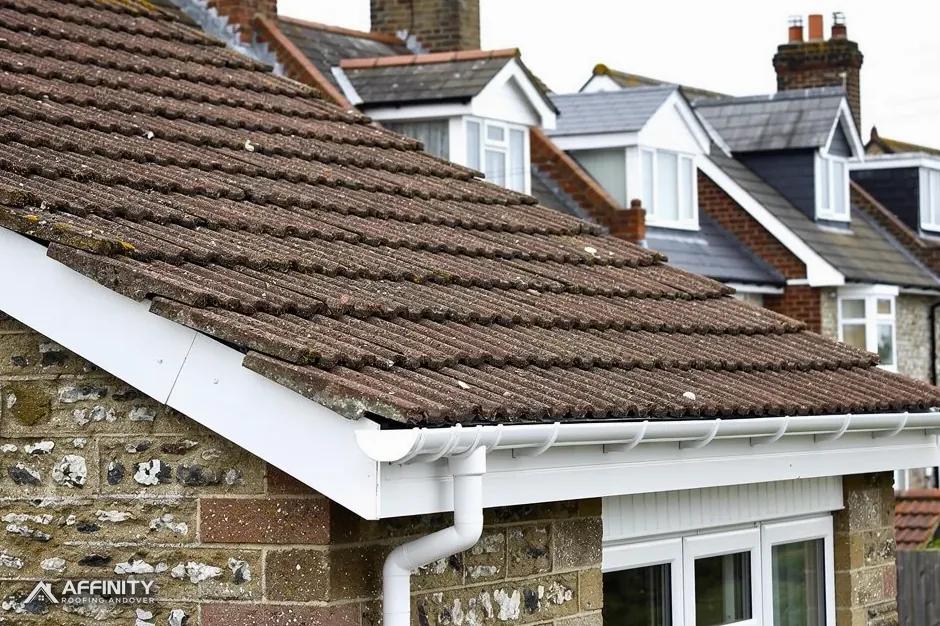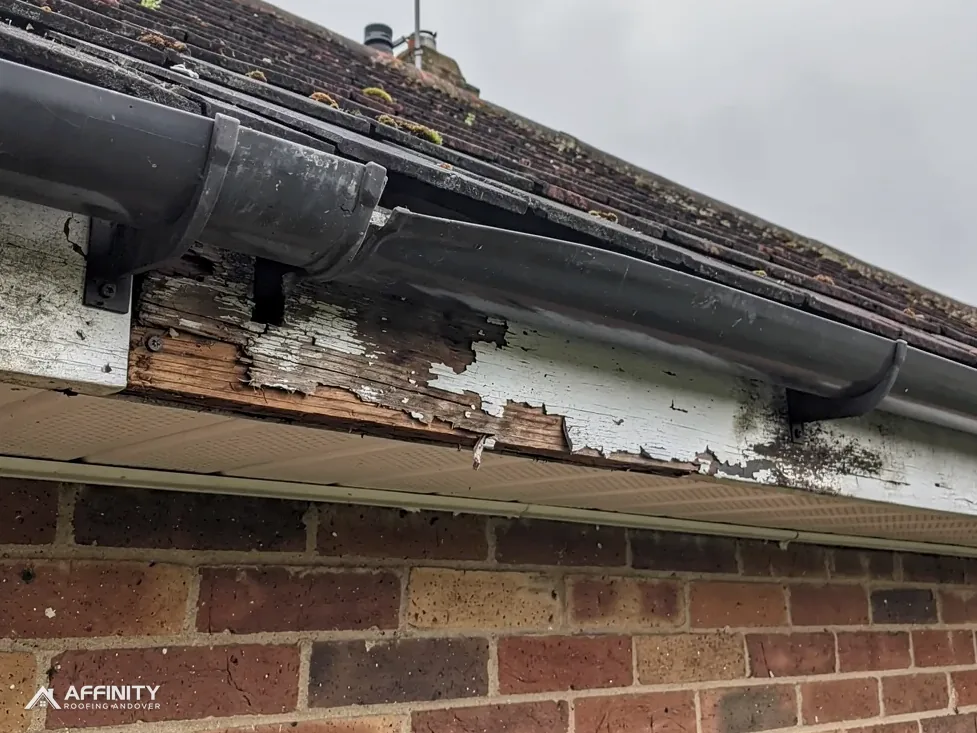
The soffit is the flat board closing off the eaves from below, spanning from the wall out to the fascia, which is what you see looking up at the roof edge. On many older houses it was made of a flat sheet material that was cheap, rigid and fire-resistant. Some of those sheets were asbestos insulating board, known in the trade and in HSE guidance as AIB.
Asbestos is only dangerous when its fibres are released into the air and breathed in, which happens when the material is drilled, sawn, snapped or sanded. An intact board left alone is not the immediate problem. The problem begins when someone sets about replacing a fascia, or fixing new gutter brackets, and does so without knowing what the board is made of.
This guide sets out what the Health and Safety Executive (HSE) says about soffits, why you cannot identify the material by looking at it, how the rules separate licensable from non-licensed work, and how waste has to be handled. Treat it as general information rather than legal advice; the survey always comes first. Our guttering, soffits and fascias hub covers the rest of the roofline.
Why soffits are checked first
When a roofer prepares to replace roofline timbers, the soffit is one of the first things to be looked at, and the reason is in the HSE's own guidance.
Where AIB is found
The HSE lists external soffits among the places where asbestos insulating board is found. It was used for panels, partitions, ceiling tiles and the boards beneath eaves because it resisted fire and was easy to cut. It is a different material from the corrugated cement sheet you see on old garage roofs, though both contain asbestos.
The date rule
The HSE's advice for a property built or refurbished before 2000 is to treat asbestos as present until an assessment shows it is not. That is a precaution, not a statement that every soffit of that age is affected. Plenty are timber, plywood or fibre cement without asbestos. The point is that you cannot know without checking.
Why a roofer cares
Replacing a soffit means removing the old board, and removal means pulling nails and levering sheets away from the frame. That breaks the edges and creates dust. Fitting new gutters or a cap-over system can involve drilling or fixing through the board as well. Both are the actions that release fibres.
So the first step on any roofline job on an older house is to find out what the board is, not to get on with the work and hope.
You cannot tell by looking
Whether a soffit can be identified by eye is a fair question. The HSE's answer is that it is difficult.
What the HSE says
The HSE points out that AIB is hard to separate by eye from similar boards that contain no asbestos. A flat, painted board with a dull surface and a few visible nail heads can be AIB, fibre cement without asbestos or a modern calcium silicate board that looks the same. Paint hides texture, and decades of weather change the colour.
Clues that prove nothing
The house's age, the style of the eaves, the thickness of the sheet and the pattern of nails all suggest a likely material, but none confirms it. A neighbour having the same boards removed safely tells you nothing about yours, because builders switched materials mid-estate and owners replaced boards at different times.
How it is confirmed
The material is identified by an asbestos survey or by a laboratory test on a sample, taken by a competent person using the right precautions. MyJobQuote gives around £325 as the average cost of an asbestos survey (Sep 2026), which is a national figure and one reason to ask about it early. The cost is small beside the cost of a contaminated site.
If in doubt
Treat the board as asbestos until proven otherwise. Do not drill it, scrub it with a wire brush or pressure wash it, and do not allow anyone to remove it until you know what it is.
Licensable and non-licensed work
The rules depend on which asbestos material you have and how the work will disturb it. They are set by the HSE and are not a matter of opinion.
Non-licensed work
The HSE classes work with asbestos cement as non-licensed where the material is taken off carefully and not broken up, and that includes weathered cement that is not otherwise substantially damaged. Roof sheets, gutters and downpipes are typical asbestos cement items. Work is still controlled, with proper methods and protective equipment.
Notifiable non-licensed work
Where the cement will be badly damaged or broken into pieces, the work becomes notifiable non-licensed work, which means the enforcing authority must be told and health records kept. Short-duration work on AIB, such as taking it down as part of a refurbishment, can also fall into this group. The HSE says registers of the work (health records) must be kept for 40 years.
Licensable work
Work on asbestos insulating board is licensable unless the risk assessment shows the job is of short duration. Only a contractor holding the licence that work requires may carry it out.
What this means for a homeowner
It means you cannot assume that all soffit asbestos is the easy kind. Some of it is, some is not, and the classification depends on the material and the job. Our guide to capping over or replacing fascias explains how that affects the choice of method. A firm that claims it can simply take any old soffit down without a test is not following the guidance.
What to do before any work starts
The sensible order of events is the same whatever the board turns out to be.
Leave it alone
An intact board in good condition that nobody is touching presents little immediate risk. Do not drill into it to hang a light or a bird box, do not scrape off flaking paint with a power tool, and do not let children or pets knock it. If it is already cracked or hanging, keep clear and get advice.
Tell whoever is quoting
Mention the age of the house when you ask for a price. A competent roofer will raise the question themselves. If anyone gives a fixed price for taking down the soffits without mentioning asbestos on a house of that age, ask them why.
Get the material identified
If the board is to be disturbed, get it identified first, by a survey or a laboratory test, before any scaffold is put up for the job. The result tells you which rules apply. If it comes back as non-asbestos, the job carries on as an ordinary roofline replacement. If it is asbestos, the next step is decided by which type it is and what the method will do to it.
Plan the route
Depending on the material and the work, the route might be careful removal by a suitably trained team, or a licensed specialist, or in some cases leaving the board in place and working round it. The decision is made on the findings, with the reasons given to you in writing, before anyone starts.
Waste, skips and where it goes
How asbestos waste leaves a property is regulated as strictly as how it is removed.
Two layers and a warning label
HSE guidance EM9 says asbestos waste should be double-wrapped and labelled. Each sheet goes into heavy-duty polythene, taped and marked, then kept in a closed container until collection. Offcuts and dust are bagged with them. It is never left loose on the ground, in a pile or in an open skip.
Skips
Asbestos never goes in an ordinary builder's skip or in general waste. The HSE allows asbestos waste to travel in lockable or sealed skips, which are supplied for the purpose, not in the skip that holds the rest of a job's rubble.
Carriers and consignment notes
Asbestos is hazardous waste. It travels with a consignment note, and the carrier needs to be registered as an upper-tier waste carrier. The household exemption that lets homeowners move some waste themselves leaves asbestos out of the domestic hazardous waste it covers, so a homeowner should check with the council before taking any to a recycling centre.
What this means for the job
These requirements add a step and a cost to a roofline job on a board that tests positive, and the price should say who carries the waste and how. If a quote does not mention it at all, ask. Leftovers in the garden or under the shed are a risk to you and your neighbours.
Never store broken asbestos board in a household bin, a bag in the garage or a skip left on the drive.
How we handle an older soffit survey
On a house where the soffits may be asbestos, the survey changes shape.
We look first
We assess the board from ground level and, where it is safe, from a ladder, without drilling, scraping or lifting it. We note its condition, its fixings, the gutter brackets and whether anything has already broken it. You receive photos of what we see.
We say what we cannot tell
If the board is of an age or type that may contain asbestos, we tell you plainly that the material has to be identified before it is disturbed, and we recommend the test. We do not guess, and we do not start anything that disturbs the board while the result is outstanding.
The result decides the plan
If the board is not asbestos, we price the roofline work in the usual way. If it is, we explain the options: leaving it in place and working around it where that is sound, or removal by a team that holds the right authority for that material. Where the work is licensable, it goes to a contractor holding the right licence.
One total
You then get one written total for the route chosen, covering scaffold, testing where we have arranged it, waste handling and the new roofline. Our guide to soffit ventilation explains what the new boards should provide for the roof.
If you have a loose or damaged soffit now, tell us, and keep away from it.