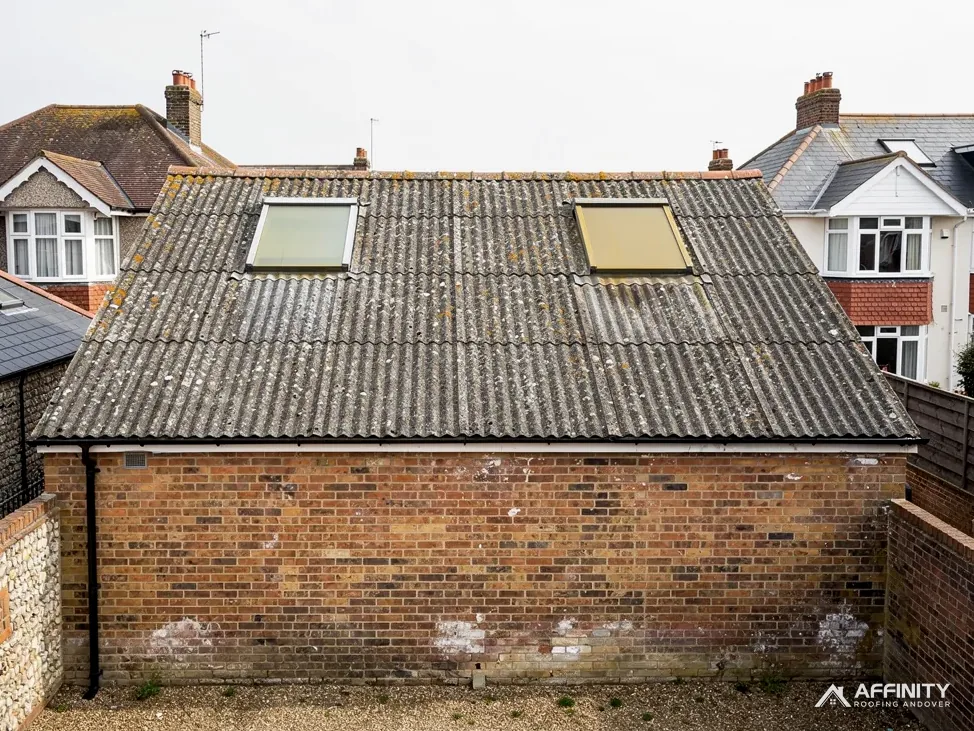
A unit with a corrugated sheet roof from before 2000 raises the same question for its owner sooner or later. The sheets leak, or have gone brittle and green, or a skylight panel has cracked. Someone says they can be covered with a new metal roof. Someone else wants them taken off. Either can suit, depending on the building.
This post sets out the choice between overcladding and replacement for an owner or tenant of an industrial unit, workshop or farm building around Andover and the Test Valley, including the older units on estates such as Walworth Business Park. It covers what the HSE says about finding and managing asbestos, how the two options differ in load, fire performance and long-term obligations, and what removal involves when it goes ahead.
It is not legal advice, and it does not replace an asbestos survey of your own building. A roofer's survey can tell you what the roof is made of and what state it is in. It cannot tell you what the law requires of you as a duty holder, and for that you should read the HSE guidance or take advice.
Why these roofs are still around
Asbestos-cement is a mixture of cement and asbestos fibre pressed into corrugated sheets, and it was widely used for roofing and rainwater goods on industrial, agricultural and garage buildings. The risk comes from fibres released when the sheets are broken, drilled, scrubbed or worn down, and sheeting that is left alone in good order is a lesser worry.
On age, the HSE is direct: treat a building built or refurbished before 2000 as containing asbestos until a survey shows otherwise. That is the working rule for any older unit, and it applies whether or not the roof looks sound. Without a survey, nobody should drill, cut or walk across it.
It also matters that the HSE's guidance on asbestos-cement roofs says they are always fragile. A sheet that looks solid can fail under a person's weight, and the fall through a roof is a hazard in its own right, separate from the fibre risk. Anyone going on the roof needs proper access equipment, crawling boards or a platform, and an edge system.
Roofs of this type are found across the area on units of the kind that line industrial estates. We do not assume that any given unit has one. The material, the age and the condition are all things to establish on the day, and the survey is where that begins.
What a survey looks for
We look at the profile of the sheet, the fixings, the state of the surface, the condition of the roof lights and the gutters, and signs of earlier patching. Where the material is in doubt, it is sampled and tested by a laboratory before anyone cuts into it.
The duty to manage for owners
The HSE publishes guidance on the duty to manage asbestos in non-domestic premises. In plain terms, the person responsible for maintaining the building, whether the owner, the landlord or the tenant under the lease, has to find out whether asbestos is present, assess its condition, and manage the risk. Which party holds the duty on your unit depends on your lease and arrangements, and it is worth reading the lease or asking a solicitor if you are unsure.
For a roof, managing the risk usually starts with an asbestos register entry: where the material is, what it is, how damaged it is, and what the plan is for it. If you already have an asbestos survey report for the building, check the roof entry before you ask anyone for a quote. If you do not, an asbestos survey is the first spend, and MyJobQuote (Sep 2026) gives around £325 as a typical UK figure for one.
The duty is continuing. A roof that is in reasonable condition can be left in place and managed. A roof that is deteriorating needs a decision, and that decision is the subject of this post. In either case the register should be kept up to date, and anyone who might disturb the material, such as a contractor, should be told where it is before they start.
None of this requires a particular roofing method. The duty is to manage, not to remove. Overcladding and replacement are two ways of dealing with a roof that has reached the point where managing it in place is no longer enough.
The HSE's pages on finding and managing asbestos are worth reading before you commission work. Your insurer or mortgage lender may also ask about the asbestos register for an older commercial building.
Overcladding: what it does and what it leaves behind
Overcladding means fixing a new weatherproof layer over the existing roof, usually a profiled metal sheet on new purlins or brackets, and leaving the asbestos-cement beneath it undisturbed. The attraction is clear. The old sheets are not removed, so there is no breaking up, no waste to carry and far less disruption to the people working below.
The trade-offs are real, though. The old roof stays in place and stays your responsibility. It has to remain on the asbestos register, and anyone who later strips the building will have to deal with it, along with the new layer on top. The fixings for the new roof have to be made into a structure that was designed for the old one, which means a structural check: the Planning Portal's advice is to have the frame assessed by a structural engineer or surveyor before any work, and a covering that raises the roof load by 15 per cent or more brings Building Regulations approval into play.
Fixing the new layer without disturbing the old is a skill in itself. Drilling through fragile sheets or the fixings that hold them can release fibres, so the method of fixing and the way the roof is accessed need to be planned before anyone starts, with the survey in hand.
Overcladding tends to suit a roof that is structurally sound but leaking, where the owner wants to stay in the building and keep the cost and disruption down, and where the building has a long working life ahead. It suits less well where the sheets are badly cracked, where the purlins beneath have rotted, or where the building is to be sold or redeveloped soon.
Replacement: removing the sheets
Replacement means taking off the asbestos-cement sheets and putting a new roof in their place. It deals with the asbestos for good, and it gives you the chance to inspect and mend the structure under the sheets before the new roof goes on. The trade-offs are cost, disruption and the rules around the work.
In HSE terms, lifting asbestos-cement roof sheets off with care, and without cracking them apart, falls under non-licensed work. Asbestos-cement that has weathered, without other substantial damage, falls in that group too. Should the sheets end up substantially broken, the work moves into the HSE's notifiable non-licensed category. Asbestos insulating board is a different case, because longer-running work on it can be licensable. Ask any contractor which category the job falls into and who will carry out each part of it.
Waste has its own rules. Waste from the job is wrapped twice, labelled and moved by a registered carrier, with a consignment note. It cannot go in an open skip or the general bin, so ask where it is headed and who carries it.
On cost, MyJobQuote (Sep 2026) gives around £2,750 as a typical UK figure for removing asbestos from a roof. An industrial unit's real price depends on its area, its height and its access, and our written quote follows the survey as a single total.
If you are weighing it up against overcladding, ask for both options priced on the same basis.
Comparing the two on your unit
There is no rule that favours one option on every building. These are the questions that usually decide it.
- How long will you keep the building? A short horizon favours leaving the asbestos managed in place. A long one makes removal more attractive.
- What is the condition of the sheets and the purlins? Badly broken sheets or rotten timber push towards replacement.
- Can the building bear the extra layer? Overcladding adds weight, so a structural check comes first.
- Is the building occupied? Removal is easier to plan when the unit is empty, and overcladding disturbs people less.
- What does your lease say? Responsibility for the roof, and for the asbestos register, may sit with the landlord.
Fire performance and energy performance matter too. The Planning Portal's re-roofing guidance also flags approval where the new covering's fire behaviour would differ markedly from the old one's. For a new insulated metal roof on a commercial building, ask the supplier for the fire and thermal data, and ask your building control body whether an application is required.
For a unit on an estate such as Walworth Business Park, a neighbouring occupier or the managing agent may also have a view. Check your lease for requirements about alterations, and tell the agent before work begins.
Our survey photographs the sheets, the purlins and the fixings, and we explain each option in plain words without leaning on either. Our pages on fragile roof safety and commercial roof surveys explain how a survey starts.
Planning the work with one contractor
If you go ahead with either option, a little planning avoids most of the problems. Appoint a single contractor for the whole job where you can, and ask for a written method statement before the work begins.
CDM 2015 brings in further duties when two or more contractors share the job. Even where only one contractor is on site, a construction phase plan is still that contractor's job to write. That plan should say how the roof will be accessed, how the asbestos-cement will be handled and where the waste will be stored until it leaves the site. Ask to see it. If your building is occupied, it should also say how the people inside are kept clear.
Tell the people who work in the building what is planned and when. Keep doors and windows near the work closed, and ask whether anything stored under the roof needs covering or moving first. If asbestos-cement sheets are to be broken or removed in numbers, ask about the notification and who makes it.
Before the new roof goes on, the structure beneath should be examined. Purlins, rafters and fixings may have been hidden for decades, and a replacement is the best chance to check them. Ask what happens if timber needs replacing, and whether the price covers it or the figure will change.
After the work, ask for the paperwork: the consignment note for the waste, the building control completion if one applied, and an updated asbestos register entry. Those documents are what you show a buyer, a landlord or an insurer later.
Our commercial roofing page explains how we price and run a unit roof job.