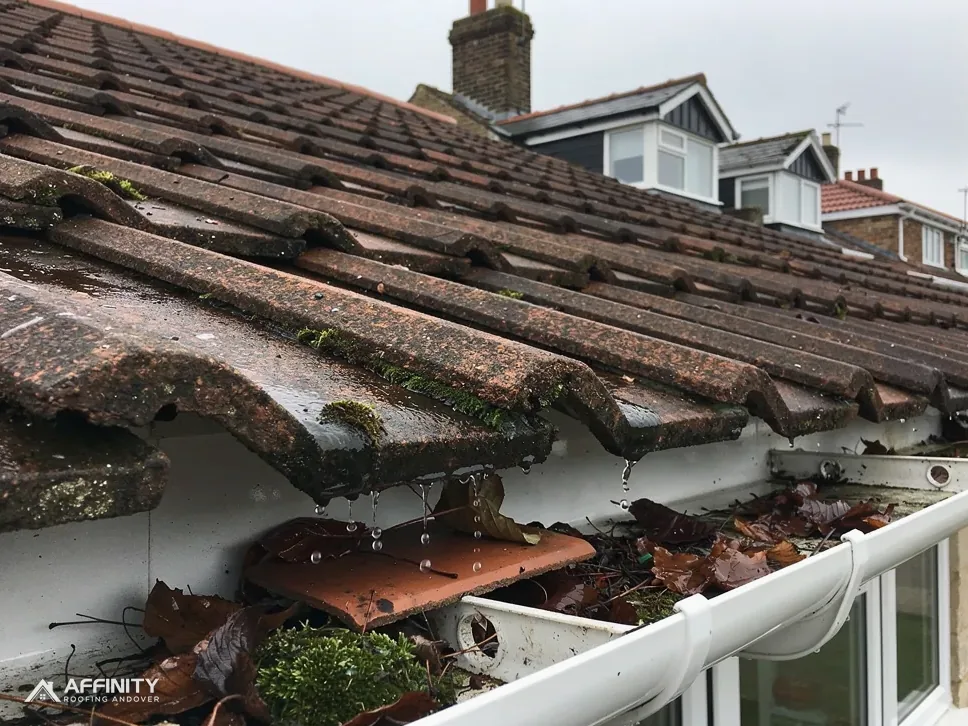
A gutter is a narrow channel that spends its life collecting whatever falls on the roof: leaves, moss, grit washed off the tiles, seeds, feathers and the occasional ball. Left alone, that material packs down into a damp mat, grass and weeds root in it, and the water that should run to the downpipe spills over the edge instead.
Overflowing water is not harmless. It runs down the wall and stains the brick, soaks the fascia and the rafter tips behind it and, over seasons, rots the timber. It can also overload the ground at the foot of the wall. A clear gutter costs very little compared with the damage a blocked one does.
This guide explains how to tell when yours need doing, who should do it, what access is involved, what a thorough clean includes and what a good cleaner looks for while up at the roof edge. It also covers nesting birds and old asbestos cement gutters, which both change how the job is done. Our guttering, soffits and fascias hub covers repairs and replacements.
How often, and the signs that it is due
There is no single timetable that suits every house. How quickly a gutter fills depends on what stands nearby and what the roof sheds.
What decides it
Overhanging trees are the main factor. A house under an oak or a sycamore will collect leaves and seeds far faster than one in the open. A moss-covered roof sheds spores and clumps into the gutter, and tiles that are wearing release grit and granules. A flat roof with a parapet can collect silt. A gutter with a shallow fall holds water and fills sooner.
When to look
Check after the leaves have come down in autumn, because that is when the heaviest load arrives. Check again after storms, which strip twigs and debris off trees and roofs. A spring look catches what the winter left, and a check after a dry spell shows whether anything has dried into a plug. Our answer on how often gutters should be cleaned goes through the timing in more detail.
Signs that cleaning is overdue
Water spilling over the front of the gutter during rain, green or black streaks on the wall below, plants growing out of the gutter, a gutter that sags between brackets under the weight of debris, and a downpipe that stays dry in rain when the gutter is full. Staining at the fascia and wet patches on the wall inside are later signs.
Who does it, and the published cost
A householder with a good ladder and a head for heights can clear a single-storey gutter. Beyond that, it is better left to someone equipped for it.
Doing it yourself
For a single-storey roof, a stable ladder, a trowel, a bucket and gloves will do. Ladders must stand on firm, level ground and be secured, and you should never overreach. For anything above the first floor, or where the ground is soft, sloping or crowded with obstacles, do not do it yourself. Falls from ladders are a leading cause of household accidents, and a gutter is not worth one.
Hiring someone
A gutter-clearing service uses a long pole, a vacuum system or a cherry picker for height, and it can clear a house without a ladder, which keeps the risk of a fall off the table. The cost reflects the equipment. A roofer can clear gutters during a survey and fit guards at the same time.
What Which? publishes
Which? prices clearing all the gutters on a house at £75 to £350, ex VAT (Nov 2025). That is a national range. The cost rises with the height, the length and the amount of debris, and with whether scaffold or access equipment is needed.
Combining with other work
If scaffold is up for other roofline or roof work, cleaning the gutters and checking the brackets at the same time costs little extra. Our answer on gutter guards explains the options for reducing how often the job is needed.
Access, ladders and scaffold
Getting to the gutter safely is the real work. The clearing itself is simple.
Ladders and towers
For a two-storey house, a ladder reaches the eaves but gives a poor working position. A stand-off bracket keeps the ladder off the gutter and makes it more stable. Towers and access platforms give a flat base and free both hands. Whatever is used, the ground beneath should be firm, and someone should footing the ladder if the job needs it.
Why scaffold is sometimes used
On tall or complex houses, or where the gutters need repair as well as cleaning, scaffold is safer and more efficient. If scaffold is erected over a public footway, the highway authority licenses it. In the Andover area that is Hampshire County Council, and the scaffold firm, not the householder, puts in the application. The scaffold is part of the written price when it is needed.
Roofs and valleys
Gutters at the foot of a valley, the angle where two roof slopes meet, take a heavy flow and clog sooner. Parapet gutters between roof and wall are hard to reach and often need roof access, which is a job for a roofer, not for a casual cleaner.
Roof pitch and weather
Wet moss, frost, wind and rain all make a roof edge dangerous, and a gutter that looks full of water may be hiding ice. Cleaning is best done in dry, still weather. If you cannot reach the gutters safely, leave them and get help.
What a proper clean-out covers
Scooping the leaves from the top is not the same as clearing a gutter. A thorough job follows a sequence.
Clearing the channel
Debris is lifted out by hand or with a scoop and bagged, not shovelled over the side where it lands in the border or blocks the gully. The channel is then scraped or brushed to remove the packed silt at the bottom, which holds moisture and nurtures moss.
The outlets
The outlets are cleared, as the pipe is the point where blockages form. Where the downpipe can be reached, water is run through it to test the flow. A pipe that does not drain after a flush has a blockage below.
The fall and the joints
With the gutter empty, it is easy to see standing water that shows where the fall has been lost, and to check joints and seams for leaks or loose seals. A bucket of water tipped in at the high end shows how the flow travels. Our answer on overflowing gutters covers what causes an overflow.
Ground level
The gully at the foot of the pipe and any soakaway should be checked and cleared, because a blocked drain at the bottom defeats a clean gutter. Debris on the ground is cleared away.
Finish
A good cleaner leaves the site as it was found, takes the waste away and tells you what they saw. You can ask for photos of the cleared gutter and of anything that needs attention.
Checks to make while you are up there
A gutter clean puts someone at eaves height with a clear view of parts of the roof nobody normally sees. It is worth using.
Brackets and fixings
Look at every bracket. Are they rusted, loose or missing? Does the gutter sag between them? A gutter that is loose or has lost its fall will keep overflowing after it is cleaned.
The fascia and the rafter ends
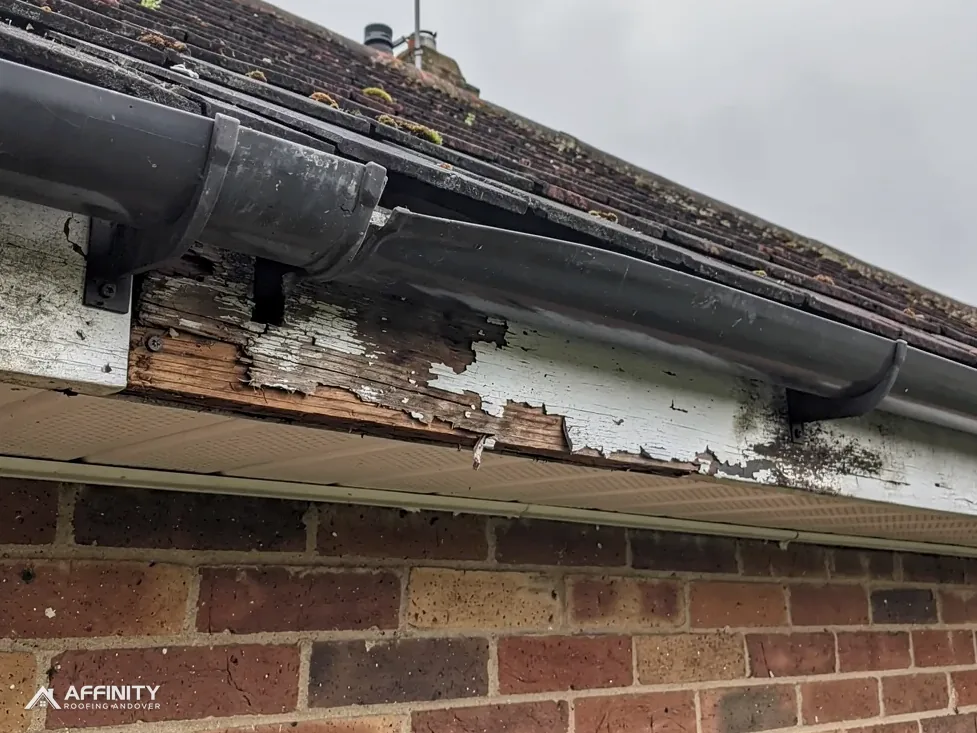
Behind the gutter, the fascia and the rafter tips beneath it take the water when a gutter leaks. Press on the board with a finger or a small screwdriver and look for staining, flaking paint or gaps. Soft timber needs more than cleaning. Our guide to rotten rafter feet explains what happens behind the board.
The roof edge
Slipped tiles, broken slates, cracked ridge ends and moss lines are all visible from the eaves. Granules and grit in the gutter show that tile surfaces are wearing. A gutter full of lead shot or sealant fragments points to failing flashings above.
Leaks at joints and the pipe
Dark streaks below a joint, wet stains at the downpipe sockets and a pipe that is leaning or loose are all things to note and photograph.
Gutter materials
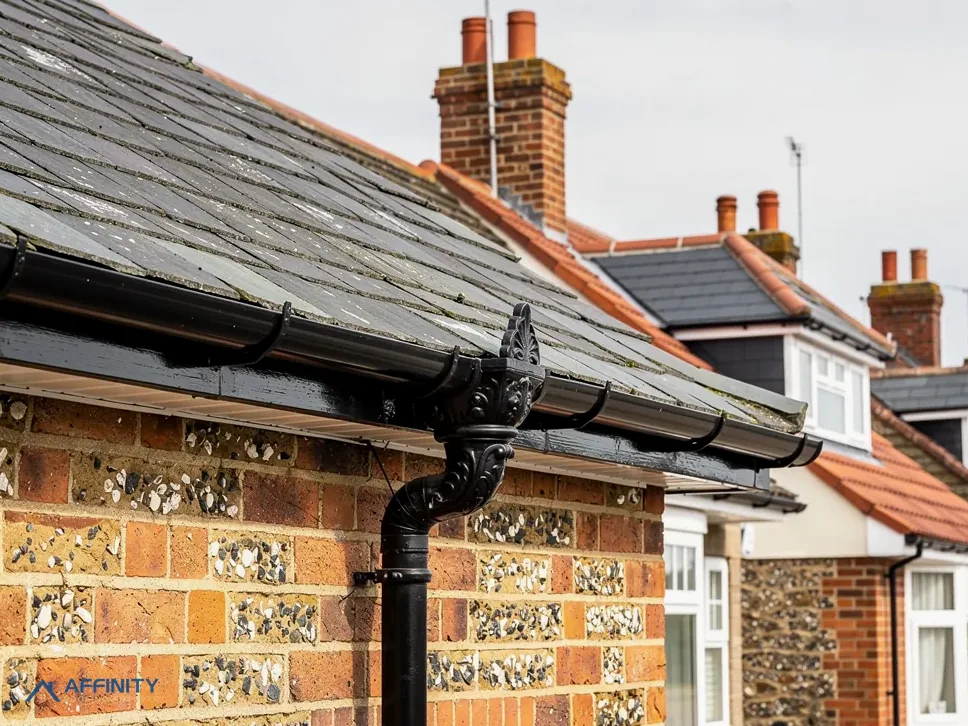
Some older gutters are asbestos cement. The HSE treats careful removal of such rainwater goods as non-licensed work, and breaking them up as a different matter. Do not scrape or smash a gutter you think may be asbestos, and never brush it with a wire brush. Have it identified first.
Nests, wildlife and what not to disturb
Gutters and eaves are popular with birds, and sometimes with bats, so cleaning can run into wildlife law.
Birds
Section 1 of the Wildlife and Countryside Act 1981 makes it an offence to intentionally take, damage or destroy a wild bird's nest that is occupied or still being built. So a nest holding eggs or chicks, or one under construction, is left alone. If a gutter holds an active nest, wait until the birds have finished with it. GOV.UK states that licences are not available for development or construction work in order to disturb wild birds.
Bats
Bats and their roosts are fully protected. Regulation 43 of the Habitats Regulations 2017 makes damaging a breeding site or resting place an offence even without any intent. GOV.UK includes roof repair and replacement in the work that can affect bats. If you find bats or droppings at the eaves, stop and seek advice. Our answer on birds nesting in soffits explains what to do about nests behind the boards.
Other creatures
Wasps, hornets and rats occasionally nest in gutters or behind them. Do not tackle a nest from a ladder.
What we do
We look before we clear. If we find an active nest or signs of bats, we stop, tell you and advise on the next step. The written price for any gutter work allows for this, and the job waits until it is lawful to proceed.
If you are unsure what you have found in a gutter, do not disturb it. Photograph it from a safe distance and ask first.