The short answer
Gutter guards can reduce how much leaf litter gets into a gutter, but they do not remove the need to look at it. Mesh, brush and louvred types each keep out larger debris while letting water through. Moss, seeds, silt and roof grit still build up, and a guard can hide a blockage. Think of a guard as slowing the clearing down, not ending it.
The types you will be offered
Mesh guards are rolls or panels of fine plastic or metal mesh clipped over the gutter, so rain passes through the holes and leaves rest on top. Perforated sheets work in the same way but with punched openings. Both sit flush with the front of the gutter and are a common type to fit to an existing house. They are held by clips, screws or a lip that tucks under the first course of tiles.
Brush guards are long, bristly tubes that sit inside the channel. Water runs through the bristles, and leaves lie on top of them. They are cheap to fit, but twigs and seeds can lodge in the bristles, and they can be awkward to lift out for cleaning.
Louvred or hooded guards cover the whole gutter with a curved lid. Rain follows the curve into the channel while leaves slide off. They look neat and suit new work, but they are the hardest to retrofit and sometimes need the first row of tiles lifted so the lid can slide under the roof covering.
Whatever the type, the guard must be made for the gutter profile you have. A poor fit lets debris in at the edges or causes rain to overshoot the front lip altogether.
What they do well
The main benefit is that large debris, such as autumn leaves, twigs and moss clumps, stays on top rather than packing into the channel. Under a tree that drops a lot in autumn, that can make a real difference to how often a gutter blocks and overflows, and to how long it takes to clear when you finally do. A guard with a fine, tight mesh gives the best result there.
Guards also keep birds, and sometimes small animals, from nesting in the channel. For a house where the gutter is hard to reach, they reduce the number of ladder or tower visits, which are a safety risk and a cost.
Where a roof is bordered by pines or conifers, needle drop can be heavy, and fine mesh is the better choice than a brush. Our guide to gutter cleaning explains the other ways to cut the workload.
A good guard is a practical choice for a one-off tree problem, provided you accept its limits. It is less useful on a house with no trees nearby, where the gutters are not filling with leaves in the first place.
Where they fall short
Guards do not stop fine material. Seeds, pollen, grit from the roof surface and the moss that washes from tiles all pass through or lodge in the mesh, then settle as silt in the channel below. Over time the silt builds up, the capacity drops and the gutter overflows, with the guard hiding the problem until water spills.
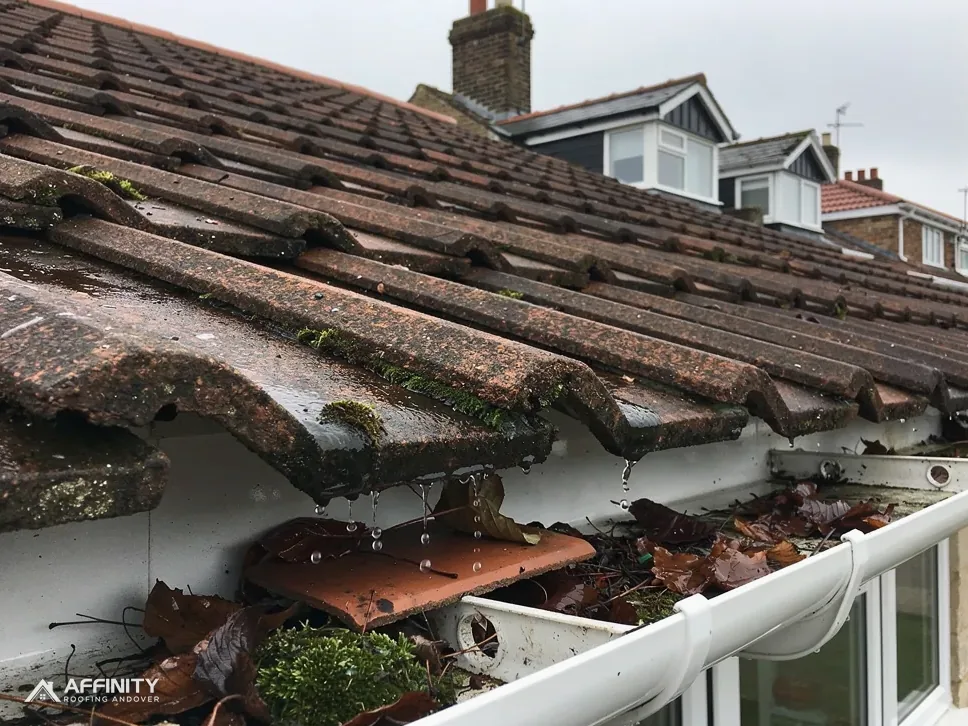
A guard can also catch debris on its surface. A mat of leaves and moss across the top sheds water over the edge instead of letting it in, so the gutter appears dry while rain pours past it. In heavy downpours, the extra resistance can cause overflow even when the gutter underneath is clear.
They add their own faults. A guard clipped on badly can lift tiles at the edge, trap water against the fascia, or make an inspection harder. Our answer on overflowing gutters sets out the other causes that a guard does not touch, such as fall and downpipe capacity.
They still need checks
Even with guards fitted, look at the gutters at least once a year, and after a storm if you can see a problem from the ground. Lift a section of guard, look at the channel, and clear any silt, then check the joints and brackets while you are there. Lift guards carefully, because old plastic gets brittle. A short list helps: check the channel, check the joints, check the outlet and check that rain is entering the gutter rather than shooting over it.
Guards that are clipped to the roof edge, or tucked under the first row of tiles, should not be disturbed by an untrained person, and you should not lean a ladder on them. A roofer can lift them safely and put them back so they sit correctly.
If you are weighing up cost, the question is whether the guard saves enough clearing to justify its price and the odd inspection. Which? (Nov 2025) gives a typical UK range of £75 to £350, ex VAT, for clearing a property's gutters, front and back, which is a useful yardstick. The written price follows a survey, and the guttering, soffits and fascias page explains how it works.