The short answer
Once a year is a sensible minimum, and twice, in late autumn and late spring, suits a house with trees close to the roof. There is no official rule, so let the surroundings and the signs decide. Overflow in rain, plants growing from the channel and water trails down the wall all mean a clear-out is due now rather than at the next scheduled visit.
Trees, moss and what falls in
Gutters collect whatever the roof sheds and the sky drops. Leaves are the obvious load, and overhanging trees make the most difference to how often you need to clear. Broad-leaved trees drop wet litter that packs down, while conifers shed needles that knit into a mat and catch silt.
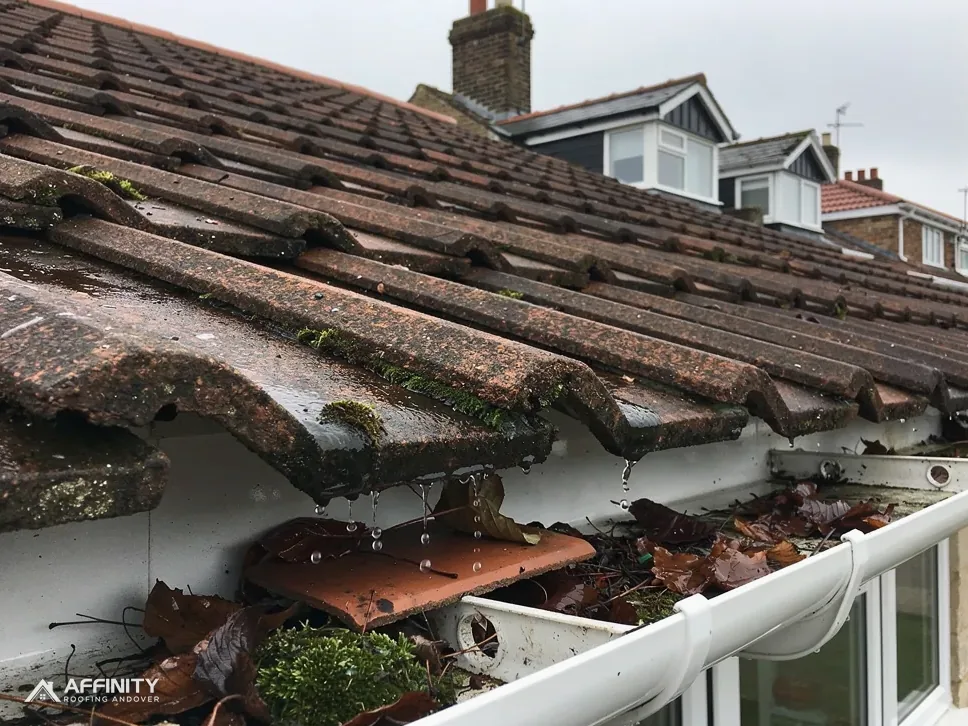
The roof itself adds to it. Moss, lichen and the granular grit from the surface of tiles wash into the gutter in every shower. Over years, the grit builds up as a layer of silt on the bottom of the channel, which narrows it. Moss growth also feeds on that silt, so the problem feeds itself.
Birds add nesting material in spring and droppings all year round, and wind-blown seeds sprout in the damp silt, which is how a gutter ends up with plants growing along it. A house with a wall of climbing plants or a tree a few metres off will fill a gutter faster than one standing clear.
If you are not sure which pattern applies to you, look into the gutter from a safe point at the end of autumn and see how much has gathered.
A seasonal rhythm
For many households a simple routine works: look once the leaves have fallen in late autumn, and again in late spring when seed and blossom have fallen. Add a quick check after any severe storm, since high winds bring twigs, slates and debris into the channel.
Autumn matters most, because clogged gutters and winter weather make a poor pair, and a full channel under frost is hard to clear. Frozen, full gutters are heavy, and the weight stresses brackets and joints. Water that cannot drain over winter soaks the fascia and the brickwork, and overflow in a frost can freeze into ice on the wall.
Spring is the time to catch what winter did, since frost and wind leave their mark, to flush out silt and to look at joints that may have opened in cold weather. A summer look is only needed under trees that shed in warm months.
Where gutters are out of reach, arrange a visit instead of leaning a ladder on them. Our guide to gutter cleaning covers how it is done, and the answer on gutter guards explains how far they reduce the work.
Signs they cannot wait
Do not wait for a diary date if the house is already showing signs. A downpour that sends water over the lip of the gutter is the clearest. So are damp patches or green staining on the brickwork beneath, and dark streaks running down the fascia.
Look up on a dry day, from a bedroom window or the lawn. Check the whole length and note where the lip sits low. Plants or grass growing from the channel, sagging sections with standing water, or a downpipe that stays dry during heavy rain all show a blockage. If water trickles from the downpipe long after the rain stops, the gutter is draining slowly. Listen too: a gurgling or dripping sound inside a wall is a warning that water is going where it should not.
Left alone, a blocked gutter damages the roofline it was meant to protect. Water soaks the fascia and soffit, travels back to the rafter ends and can reach the wall. Our answer on overflowing gutters explains how to tell a simple blockage from a fall or capacity fault.
A clear gutter that still overflows needs a survey, not another clean. The cause is then in the fall, the fixings or the size of the gutter, and repeating the clear-out will not change it.
Doing it yourself or booking a visit
On a single-storey roof, with a stable ladder footed on firm ground and a helper, clearing a gutter by hand is realistic. Wear gloves, bag the debris, flush the run with a hose and check that the outlet is open. Work in dry weather, and keep a firm hold of the ladder at all times. Do not lean a ladder against the gutter itself, because the plastic can crack under your weight.
Anything taller or harder to reach is better left to a professional with a tower or a long-reach system. Working at height carries real risk, and the saving from doing it yourself is small beside it.
As a guide to cost, For scale, Which? (Nov 2025) quotes £75 to £350, ex VAT, for a whole-house gutter clear-out. A house with more corners, more downpipes or awkward access sits towards the top of that range, and we price it once we have seen the access.
Clearing is also the moment to look at joints, brackets and fascias, which our guttering, soffits and fascias page describes in full.