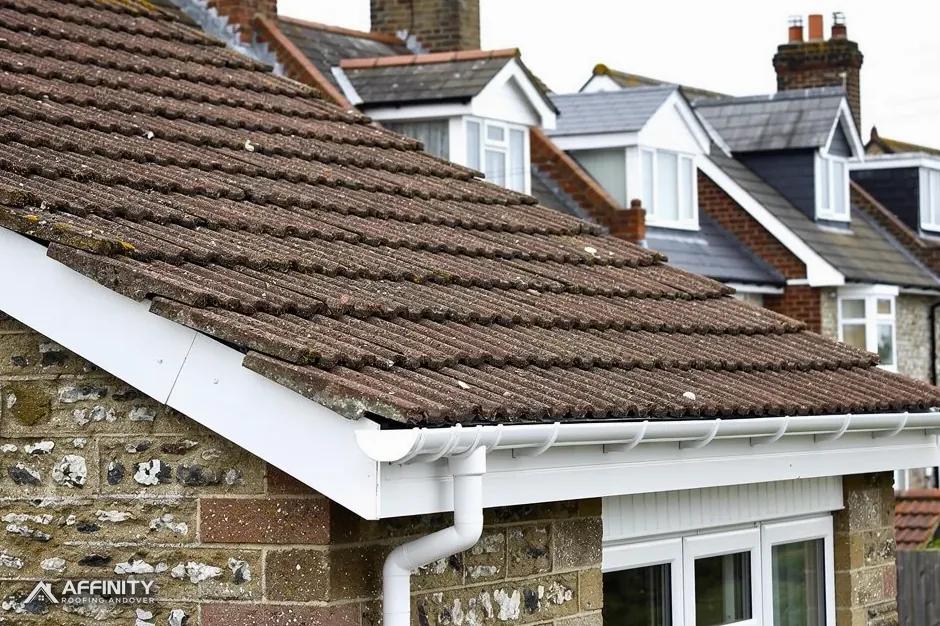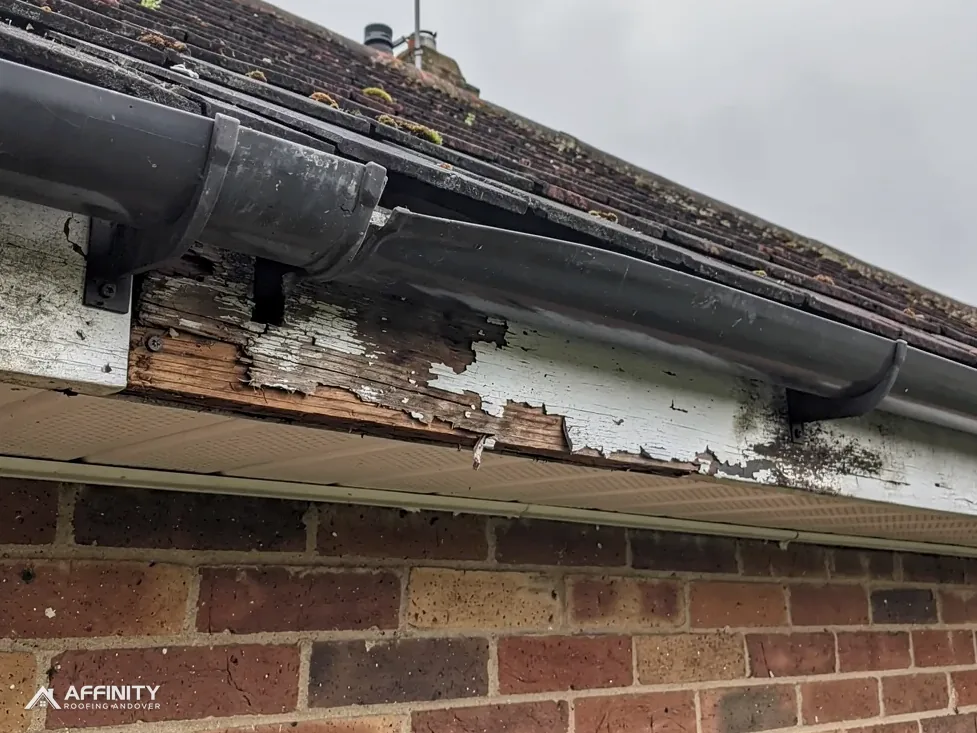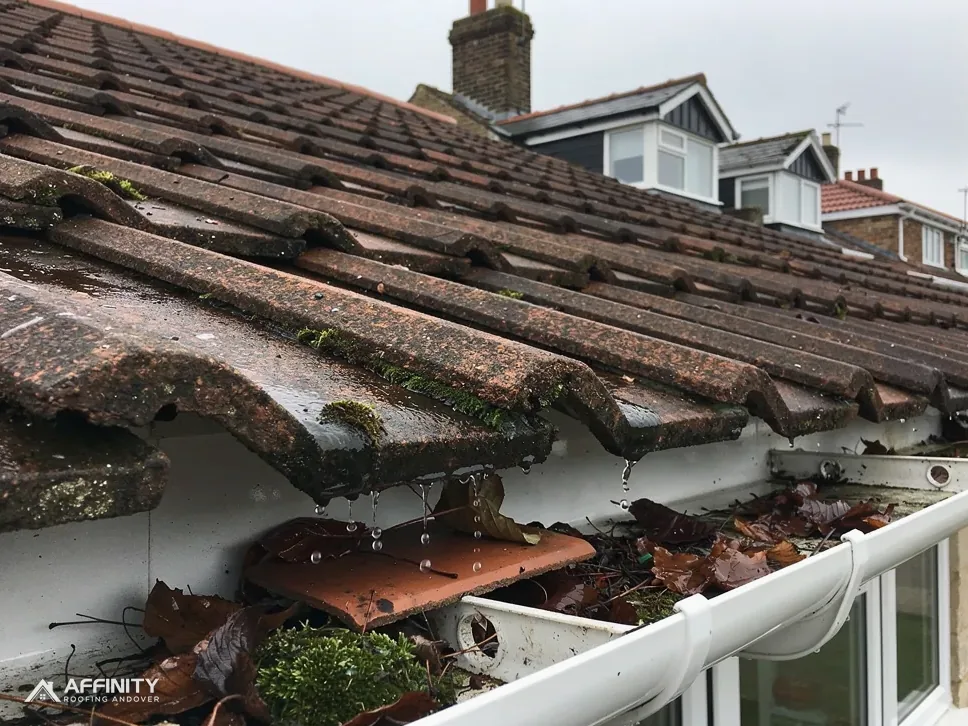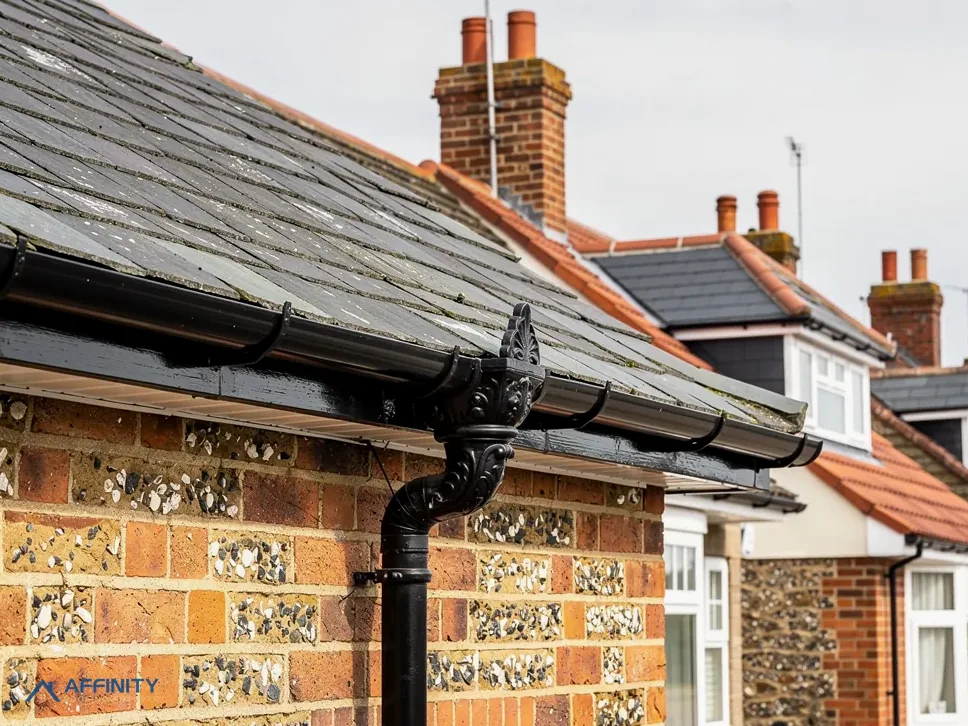
The fascia is the long board at the roof edge that holds the gutter. The soffit is the board on the underside of the eaves, closing the gap between the roofline and the wall. On a typical Andover semi they are the first parts of the roof you can see from the pavement, and when the paint peels and the timber starts to split they look tired.
There are two ways to renew them. Capping, also called cladding or cap-over, fixes new uPVC boards directly over the existing timber. Full replacement strips the old fascia and soffit off, checks and repairs what is behind them, and fits new boards in their place. Capping is quicker and usually cheaper. Replacement lets someone look at the timber behind.
Which suits a house depends on how sound that timber is, how old the property is and, on an older house, what the soffit is made of. Both routes give a tidy result, so the choice is about what lies behind the boards. This guide goes through the choice with a published cost figure, the risk of rot hidden under cladding and the asbestos question. Our guttering, soffits and fascias hub covers the whole roofline.
What capping and replacing each involve
The words get used loosely, so it helps to say exactly what the work is.
Capping over
New uPVC boards are fixed over the existing fascia and soffit. The old boards stay in place and act as a base. The gutters are taken down and refitted, or replaced, and the new boards close over the top. It is a lighter job: no removal of the old timber, less mess and often one day for a modest house.
Full replacement
The old gutters, fascia and soffit are removed. The ends of the rafters, the timbers that slope up from the wall to the ridge, are exposed so they can be checked. Any rot is cut out and repaired. A new fascia, soffit board, ventilation and gutters are then fitted. It is more work and more waste, and it takes longer.
A middle route
Some jobs mix the two, and that is often the sensible answer on a house where one elevation faces the weather harder than the other. The fascia, which bears the weight of the gutter and tends to rot first, is replaced, and the soffit is capped. Or a section that has failed is renewed while the rest is capped. The survey decides, board by board, and the result is written up so you can see which boards are which.
Why the distinction matters
Both finish with white or coloured plastic boards that look identical from the road. The difference is in what is behind them, which nobody can see once the work is done, and that is why photos taken during the job matter. Ask for them.
The cost, and the published capping figure
Capping is the lower-priced option, and the published figures show by how much, though prices in Andover and the villages around it will vary with access and the length of roofline.
MyJobQuote's figure
MyJobQuote gives around £800 for capping fascias and soffits on a typical three-bedroom semi-detached house (Sep 2026). That is a national average for the job, not a price for your house.
For comparison
The same site gives a typical gutter replacement as around £1,000 to £1,600 (Oct 2026), so capping the boards costs less than renewing the gutters, and the two are usually done at the same visit to share the scaffold. Our guide to what new fascias and soffits cost goes through the other published ranges.
Why replacement costs more
The extra goes on removing and disposing of the old boards, repairing timber and fitting new ventilated soffits. Scaffold, where it is needed, is paid either way. Where scaffold stands on the public pavement or road, the highway authority has to licence it. For Andover addresses that is Hampshire County Council, and its own page leaves the application to the scaffold firm rather than the householder. The licence and scaffold cost sit inside the written price.
Why two prices may not compare
If one firm quotes capping and another quotes replacement, the numbers are not comparable. Ask each what is being fitted, what is being removed and what is being checked, and whether the timber behind will be probed. Two firms can quote for different jobs under the same name. The lowest figure may be the one that skips the checking.
The problem with rot under cladding
The main argument against capping is that it covers whatever is wrong with the timber beneath.
Where the rot starts
The fascia sits at the point where the roof drains. When a gutter leaks or overflows, water runs behind the board, soaks the back of the fascia and the ends of the rafters, and keeps the timber wet for long periods. Rot starts where the wood stays wet, and that is behind the board where you cannot see it.
What cladding does
Plastic boards fixed over rotten timber do not stop the rot. They do the opposite: they hide it, trap moisture and remove the visual warnings, such as sagging, flaking paint and gaps. Fixings into soft wood hold poorly, so the new boards can sag or pull away within a few years. The first sign is often a gutter that no longer holds its fall or a board that bows.
The rafter feet
The worst damage is at the rafter feet: the lower ends of the sloping timbers, which sit on the wall plate and reach out under the eaves. If those are soft, the roof edge has lost some of its support. Our guide to rotten rafter feet explains what a repair involves.
When capping is reasonable
Capping makes sense when the existing timber is sound, dry and firmly fixed, and the only complaint is appearance or flaking paint. We check by probing the boards and the rafter ends from the access position before recommending it. If the timber is good, capping over it is a fair choice, and we say it plainly. There is no reason to pay for removal and repair of boards that are doing their job, any more than to cover over boards that are not.
Old soffits and the asbestos check
On an older house the soffit raises a question that has nothing to do with appearance.
The material
Asbestos insulating board was fitted beneath eaves on some older buildings, and the HSE notes that nobody can reliably separate it from look-alike boards by eye. If a house predates 2000, assume the board contains asbestos until a test says it does not.
Why capping is not an automatic answer
It can seem that capping avoids disturbing the old board, since nothing is removed. In practice new boards must be fixed, and fixings go through or into the old soffit. Drilling, nailing or screwing into AIB can release fibres. So the board has to be identified before any method that touches it is chosen, capping included.
What happens if it is asbestos
Which HSE category applies turns on the material and on what the work does to it, and the waste has its own rules too. Our guide to asbestos soffits walks through each step.
What we do
On a house this old the point comes up during the survey, ahead of any price. A board we cannot identify is left undisturbed: nobody drills, scrapes, lifts or fixes through it until its material is known.
Ventilation, gutters and Andover houses
A roofline job is not only about the boards. The details around them decide how well the roof behaves afterwards.
Eaves ventilation
Many roofs rely on air entering at the eaves, through vents in the soffit or a continuous gap behind the fascia. BS 5250:2021, the British Standard on moisture control in buildings, sits behind the guidance on ventilating roof spaces. If the old soffit had vents and the new one does not, or if a plain board blocks an opening that used to work, the loft can become damp. New soffits should carry vents where the roof needs them. Our guide to soffit ventilation explains what to ask for.
The gutters
Gutter brackets fix to the fascia, so a weak board means a gutter that sags. When the roofline is done, the gutters and downpipes should be refitted or renewed in the same visit, set to the right fall, so the water is carried away from the new boards instead of back onto them.
Planning and consent
Like-for-like replacement is not normally a planning matter, but a listed house, a conservation area or an Article 4 direction can change that. For a listed house, or one in a designated area, ask Test Valley Borough Council's planning team about restrictions before work begins.
Making the choice
On a semi with sound timber and a plain roofline, capping is a respectable job. On a house with leaking gutters, a flaking fascia or a suspicion of rot, replacement is the better buy.
How we decide, and what you receive
You should not have to guess which job you need. The survey settles it, and you see the evidence.
The survey
We study the roofline from the pavement and, if it is safe, from a ladder. We probe the fascia and soffit for softness, look for staining, gaps and daylight, check the gutter fall and the brackets, and look at the loft side of the eaves where we can. We take photos of each problem we find.
The recommendation
You hear our recommendation and the reasoning. If the boards are sound, we say capping is fair. If we find soft timber, we show you and recommend replacement of the affected parts. If the house is old enough for the soffit to be an open question, that comes up before the price does.
The written total
You get one written price that states what is being capped or replaced, what the gutters will be, whether the scaffold is included and what happens to the waste. It is the single total for the work, with no extras to follow. Citizens Advice suggests getting at least 3 written quotes, and we are happy to be asked what we assumed.
Whichever route you choose, the work is only as good as the timber underneath it. Ask to see photos of the boards once the old fascia is off or probed.