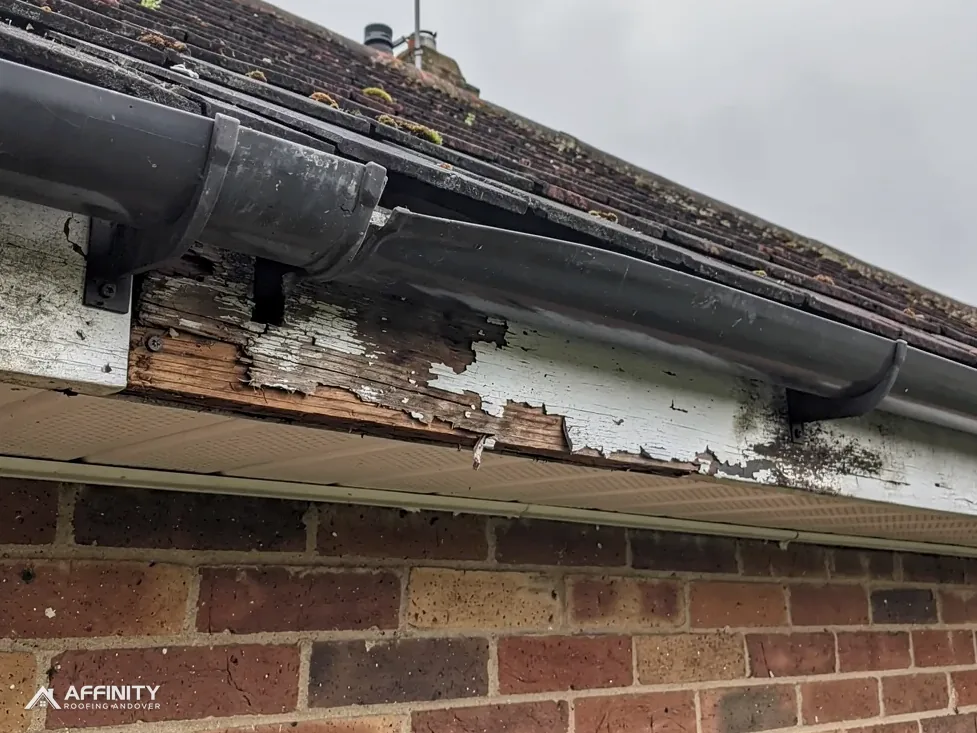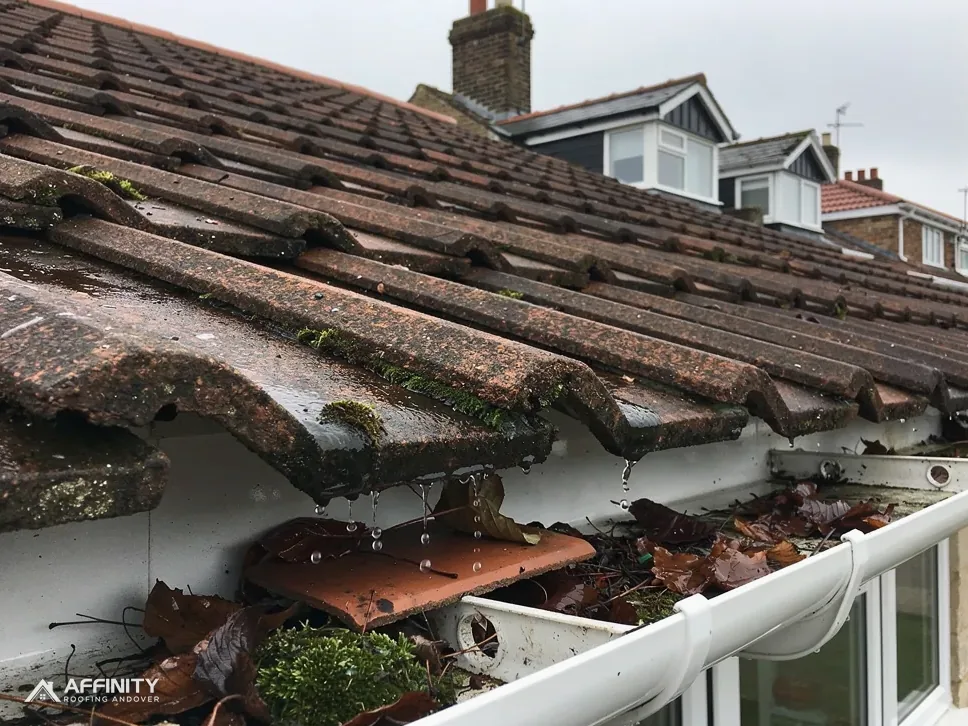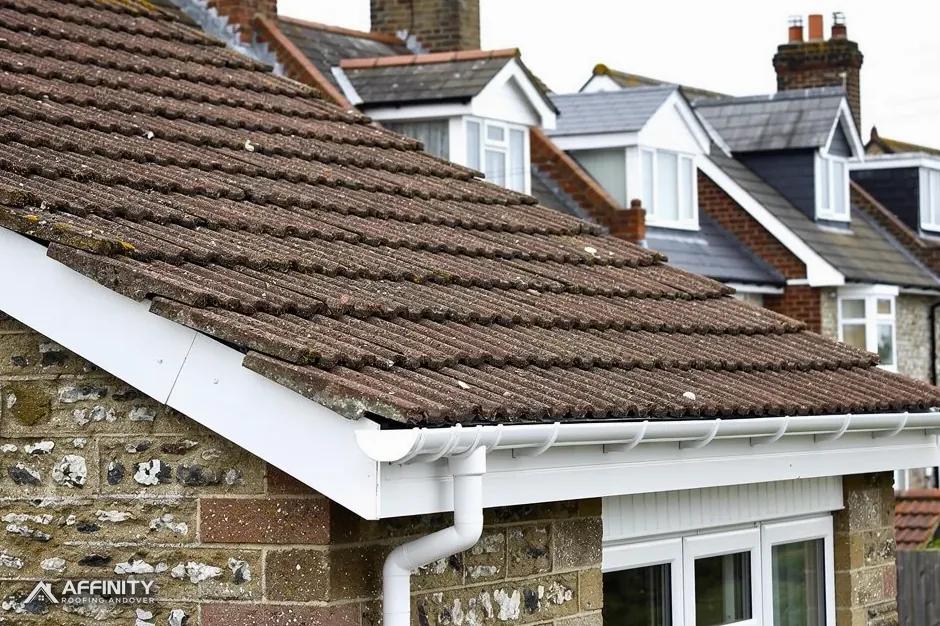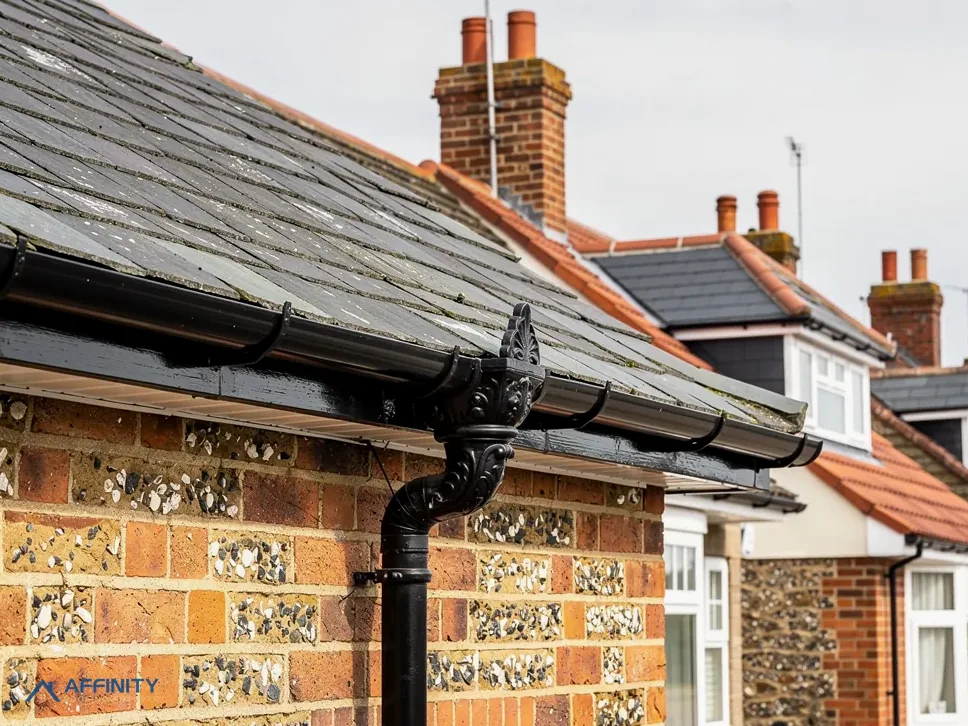
You notice it on a wet day. Water drips off the back of the gutter onto the wall, or a dark tide mark spreads on the brickwork below the eaves, or the fascia board is stained and soft. The gutter looks fine from the ground, and yet the rain is going somewhere it should not.
That is because a gutter is only the last link in a chain. Rain runs down the roof covering, passes over the edge, and has to be carried into the gutter by the underlay and the first course of tiles. If any link in that chain has slipped, perished or been set at the wrong angle, water slips through the gap between the roof and the gutter and runs down the wrong side.
Our guttering, soffits and fascias work starts from the roof down. Window and roofline firms fit fascias and gutters every day, but the layer beneath them belongs to the roofer. This post explains the parts at the eaves, what each one does, the usual faults, and how to tell whether you need a gutter repair, a roofline repair or a roofer. It ends with the questions to ask before work begins.
The parts at the eaves
The eaves form the bottom edge of a roof, the point where the slope finishes above the wall. A handful of components sit there in a small space, and it helps to know their names.
The rafters are the sloping timbers that form the roof's frame, and their lower ends are called rafter feet. The fascia is the board fixed across the rafter feet, facing outwards, and the gutter brackets screw to it. The soffit is the board under the overhang, closing the gap between the fascia and the wall. The battens are the narrow timber laths the covering is fixed to, and the underlay is the membrane stretched across the rafters under them, a second line of defence.
Where the underlay reaches the eaves, it is meant to run down and over the edge so that any water that gets under the tiles is carried into the gutter. Many roofs have an eaves tray or a strip of eaves felt at this point to do the job. The first row of tiles, the eaves course, should overhang the edge so that rain drips clear of the fascia and into the gutter.
The gutter sits below that line and is fixed with brackets to the fascia. It has to be positioned so that the tile edge and the underlay discharge into its centre, and it has to slope slightly towards the outlet.
When one of those components fails or sits wrongly, the gap that opens is small, but rain still runs through it. Because the damage is behind the gutter, it often goes unseen until the fascia rots or the wall below turns green.
Our guide to rotten rafter feet explains what happens when the water reaches the timber.
Perished eaves felt and short underlay
One cause of water running behind a gutter is the underlay at the eaves. Over the years the old bitumen felt used on roofs of earlier generations dries, cracks and crumbles at the edge. It can curl up, or break away, and no longer reaches the gutter at all.
When that happens, water that has crept under the eaves course runs down the underlay and hits the end of it. With nothing to carry it forward, the water drips onto the fascia, or runs behind the board and down the wall. It can also soak the rafter feet, which are timber and rot when kept wet.
Short underlay is a related fault. It may never have been long enough. On some roofs the felt was cut back at the edge, or stopped short of the fascia, so the water had nowhere to go from the start. A re-roof is a chance to correct that, and a good roofer will lap the new underlay into the gutter or onto a tray.
A repair is sometimes possible without stripping the slope. The bottom courses are lifted, the damaged strip is cut away, and a new section of underlay or an eaves tray is fitted and lapped properly under the existing sheet. We photograph the eaves during the repair, so you see the condition of the felt and the rafter feet before the tiles go back.
If the felt is perished across the whole slope, spot repairs at the edge only delay the problem. That is when a re-roof becomes the sensible answer, and our guide to the choice between repair and replacement explains how we weigh it.
Always check the gutter outlets as well, because a blocked outlet can make a perfectly good roof look faulty.
Eaves trays and the underlay that breathes
An eaves tray, sometimes called an eaves support tray or drip tray, is a strip of rigid plastic that sits under the first course of tiles. It gives the underlay a firm shelf to rest on and a clear slope into the gutter. Without one, underlay can sag between the rafters and form a dip that holds water, so the edge stays wet and rots.
The tray also keeps a gap open for air. That brings in the question of ventilation. BS 5250:2021 is the code of practice on moisture in buildings, and Marley applies it to cold roofs. For a non-breathable HR underlay, its guidance asks for a 25 mm opening running the full eaves for roofs of 15° or less, and 10 mm above 15°. Marley adds that a low-resistance breather underlay over a sealed ceiling can rely on the 3 mm of incidental ventilation that normal eaves construction gives, subject to third-party certification.
HR underlay is not breathable. The letters stand for high resistance, and a roofer who describes it as breathable has the wrong material in mind.
What does this mean at the eaves? If you add insulation, change the soffit, or fit solid boards in place of vented ones, you may block the air route the roof relies on. The fault then shows as condensation in the roof space, not as water behind the gutter, but the two often travel together.
Ask what underlay your roof has and how air gets in at the eaves.
A good eaves detail keeps the water going the right way and the air moving.
Fascias, fall and a gutter in the wrong place
Sometimes the roof is fine and the gutter itself is at fault. There are three common versions of this.
A dropped or bowed fascia
If the fascia board has rotted, split or pulled away from the rafter feet, the gutter hangs lower and further out than it should. The roof edge then discharges behind it. Replacing the gutter alone does nothing, because the board carrying it is the problem.
Wrong position
A gutter must sit so that the edge of the tile or the underlay lands in its centre. If it was fitted too low, too high or too far from the wall, water overshoots or runs behind. This happens when the roof covering has changed since the gutter was hung, for example after a re-roof with a thicker tile.
The wrong fall
A gutter should slope very slightly towards its outlet. Brett Martin gives 1 mm for every 600 mm as a guide, and the current standard for drainage layout is BS EN 12056-3:2000. A gutter with no fall holds water, overfills in heavy rain and spills over the back. One with too much fall can run fast and overshoot at the outlet.
Blocked or cracked joints and a split in the gutter back can mimic all of these, so a proper inspection looks at the full run, not just the point where you see the drip. Sagging brackets, loose joints and leaves are quick to check from a tower or ladder with the gutter in your hand.
For a plain blockage, start with a clear-out: Which? (November 2025) quotes £75 to £350, excluding VAT, for emptying all the gutters on a property.
When the fascia needs work, see our guide to capping over or replacing fascias.
The roofer's side of roofline faults
A great deal of roofline work is sold as one job. Replace the fascias, the soffits and the gutters, and the problem goes away. Sometimes it does. Often, though, a new board and a new gutter are hung on an eaves detail that is still wrong, and the rain is back behind them again within a year or two.
That is why the roofer's side matters. A roofer looks at what comes before the gutter: the state of the underlay, whether there is a tray, how far the eaves course overhangs and whether the batten line is right. If those are not corrected, a new roofline sits on a faulty base.
Soffits have a hazard of their own. The HSE lists external soffits as a place asbestos insulating board is found, and says it is hard to tell from a non-asbestos equivalent. We therefore check soffits before cutting or drilling, and our guide to asbestos soffits explains the point.
On cost, MyJobQuote (Oct 2026) gives around £1,000 to £1,600 for gutter replacement, and around £800 for a three-bedroom semi to have its fascias and soffits capped (Sep 2026). Those figures are typical UK ranges. The size of the house, the access, the material and the work found under the old boards all change what you pay, so a survey has to come before a price.
If you live in a listed house or a conservation area, the look of cast iron, timber or other traditional rainwater goods may matter to the council, so ask Test Valley Borough Council before swapping materials.
Whoever you choose, ask them to show you the eaves once the old fascia is off.
Checking from the ground, and what to ask
You can get a good idea of the cause without going near a ladder. Look at the gutter in the rain, or just after, keeping both feet on the ground.
- Water dripping off the back of the gutter, down the wall, points to a gap between roof and gutter.
- Water pouring over the front lip at a joint or corner points to a blockage or a fall problem.
- Green staining on the wall under one section suggests a long-running leak at that point.
- A fascia that is dark, soft or peeling points to rot behind the paint.
- Damp patches on an upstairs ceiling near an outside wall can mean water has got past the eaves.
Take photographs on a wet day and again when it is dry, because the contrast helps whoever comes to look. Do not go on the roof yourself, and do not lean a ladder against a gutter, which is not made to take the weight.
Then ask whoever visits to look at the layer behind the gutter. The questions worth asking are simple. What is the condition of the underlay at the eaves? Is there a tray, and does the underlay reach the gutter? Are the rafter feet sound? Is the gutter fixed at the right height and fall? And if rot shows up once the old fascia is off, what happens then?
A written quote should cover the whole eaves job, as one total price after the survey, and it should say whether scaffolding and VAT are included.
We look at the roofline from the roofer's side, photograph what is behind the gutter and explain it in plain words. If the fault is a blocked outlet, we will tell you, and it is cheaper that way.