A roof that leaks is a roof with a fault, and faults get worse if left. Somewhere above the ceiling a tile has slipped, a flashing has lifted, a gutter has overflowed or a valley has split, and rain is getting in. The sensible response is to find the fault and mend it.
Spray foam offers a tempting shortcut. A salesperson, a neighbour or an online advert suggests that foam under the roof will stop the drips, tighten loose tiles and insulate the loft in one go. For a few weeks it may even seem to work. The stain stops spreading on the ceiling, the draught goes and the loft feels warmer.
The trouble is that foam does nothing to the cause. It sits on the inside of the roof and hides what the roof is doing. This guide explains what the Energy Saving Trust says, how a foamed leak behaves, why foam is not a substitute for fixings and flashings, what a proper repair involves and what to do if the foam is already there.
The pitch, and why it appeals
Understanding the appeal helps owners resist it, and helps them spot the same pitch when it comes dressed as something else, such as a free survey or a grant.
One product, three promises
The sales case for foam over a leaking roof usually has three parts. It will seal the underside of the roof so no more water gets in. It will glue loose tiles in place. It will insulate the loft. Each claim has a grain of truth, which is what makes the whole thing persuasive.
The sticky surface
Foam sprays on as a liquid, swells and sets, and does bond to whatever it touches. So loose tiles and slates do seem to be held after it goes on. A tile that was rattling is quiet. A gap that whistled is closed.
The cost
A foam installation can seem cheaper and quicker than stripping and relaying a roof, or tracing a leak through a wet winter. For an owner facing a visible stain and an unwelcome roofing quote, it is an attractive route. The saving is often false: the repair still has to be made, and now it sits under foam that must come out first.
What the pitch leaves out
It leaves out the hidden half of the story: the water still enters, the fixings still fail and the timbers are now covered. It also leaves out later questions from surveyors and lenders about a roof nobody can inspect. Our spray foam removal page sets out how those questions arise.
What the Energy Saving Trust says
The Energy Saving Trust gives advice on home energy. Its guidance on roof and loft insulation, last updated in May 2026, addresses this very idea, and it is worth reading before you sign anything.
The statement
On the question of foam sprayed onto a leaking roof, the Trust's answer is brief: "We don't recommend doing this." It is a plain answer to a plain question.
Why the Trust would say that
A leak is a roof problem, not an insulation problem. Insulation reduces heat loss. It does not keep water out of a faulty covering, and nothing about spraying foam improves the tiles, slates, flashings or gutters that let the rain in.
Foam type
The two foam types, open-cell and closed-cell, are made differently, as our guide to them explains, but neither kind becomes a leak repair.
Putting the sources together
The RICS consumer guide of March 2023 adds that foam covering the roof timbers prevents full inspection, and that incorrectly fitted insulation can affect ventilation and lead to moisture damage. Together these point the same way: fix the roof first, and think hard before covering it, because a repair is easier to do once than to do under a layer of foam. Our guide to spray foam and condensation explains the moisture side.
How foam hides a leak
The danger of foaming over a leak is not that foam attracts water. It is that it takes away your view of what the water is doing. A leak you can see can be fixed on a convenient day. A leak you cannot see becomes an emergency or a surprise.
The stain disappears
On an open roof, a leak shows as a brown stain on the ceiling, a drip into a bucket or a damp patch on a rafter. Foam can absorb or redirect moisture so that those signals vanish. The ceiling looks dry. The roof is still wet.
The water goes elsewhere
Water that cannot drip through finds another path. It may run along a rafter to a wall plate, soak into the foam itself or collect at the eaves, where timber is already at risk. Trouble then appears in a different room or months later.
The timber stays wet
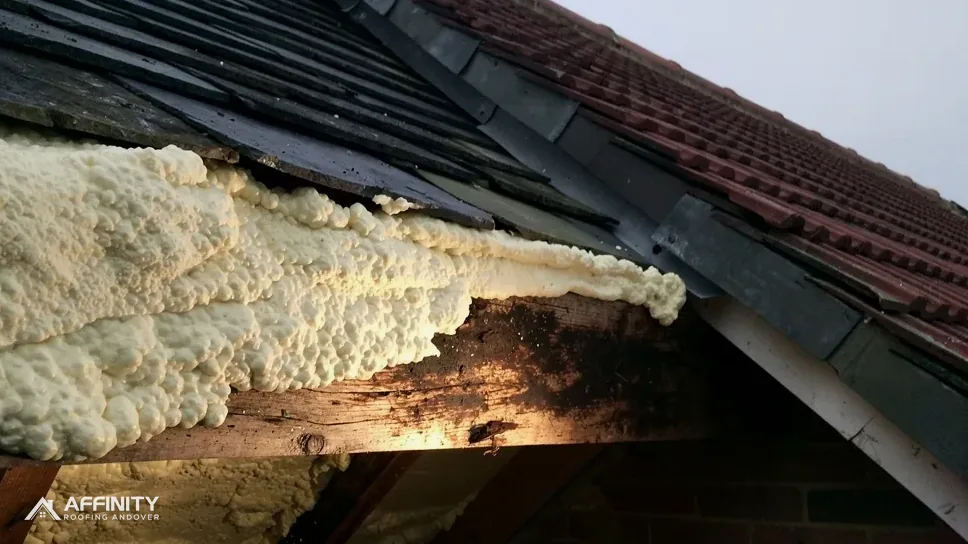
Foam over a leak can hold moisture against the wood. Rafters, battens and wall plates that would have dried between showers stay damp, and decay can progress behind the foam. The rate depends on the leak and the foam, which is why no one can predict it.
Nobody can look
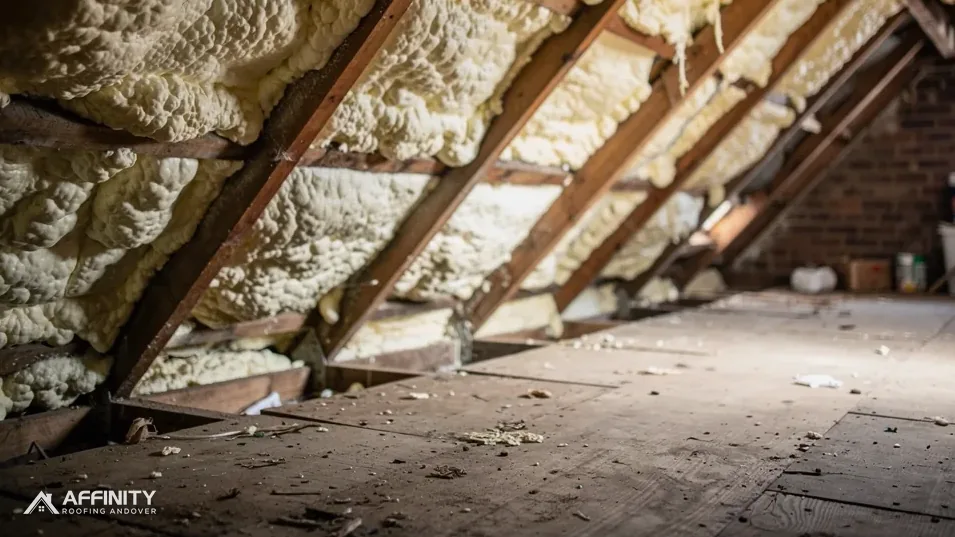
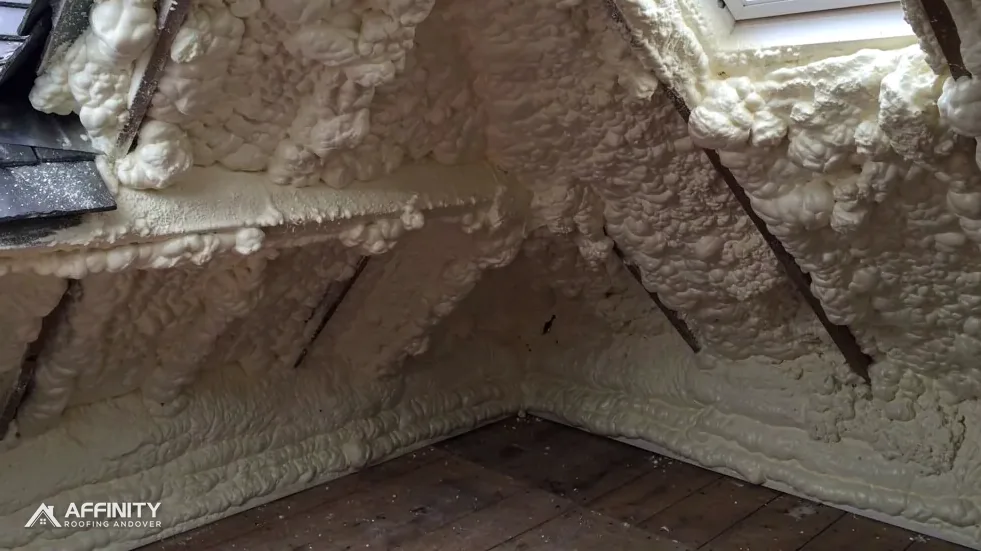
Because the foam covers the structure, a surveyor, a roofer or a future owner cannot see the damage. The first sign may be a sagging roofline or a soft patch found when the foam finally comes out.
Leak and condensation together
A foamed leak may also be wetting the timber from the inside through condensation, so the two problems feed each other.
Why foam is not a repair
Even leaving moisture aside, foam does none of the jobs a roof repair does. The comparison is worth making task by task, because each task on the list is something the roof needs and the foam does not do.
Fixings are not glue
Tiles and slates are held by nails, clips and the battens beneath. Approved Document C, at paragraph 6.8, wants roofing sheets and tiles fixed properly. BS 5534:2014+A2:2018 is the code for slate and tile fixing, and Marley notes that installing to BS 5534 is not a legal duty. A coat of foam from the inside is not a fixing in that sense.
Flashings and valleys
At a chimney, a wall or a neighbouring roof, a lead flashing seals the joint. When one lifts or splits, foam beneath it does not mend it. Rain still enters at the same spot and now runs through the foam.
Slipped tiles stay slipped
A tile that has slid out of line remains out of line, held there by foam. In slate roofs, nail sickness, where the nails have rusted through, continues behind the foam. Our guide to slipped roof slates explains the pattern.
Gutters and drainage
If the root cause is an overflowing gutter soaking the eaves, foam does nothing for it. A blocked outlet or a sagging run sends rainwater against the fascia and into the roof edge, and the cure is clearing, realigning or replacing the gutter, not coating the loft.
Ventilation
Foam can block the eaves and the air path that the roof needs, which Marley's guidance sets at 25 mm or 10 mm with a non-breathable underlay, and 3 mm with a certified breathable membrane over a sealed ceiling.
What a proper repair involves
The right repair follows the cause, and finding the cause is the first job. A repair that treats the symptom, whether that is foam, sealant or a bucket, only postpones the same call.
Trace the leak
We inspect the covering from outside, looking for slipped, cracked or missing tiles and slates, lifted flashings, blocked valleys and overflowing gutters. In the loft we look for the water's route: stained timber, dripping, daylight. Leaks often enter some way up the roof from where they show.
Mend the covering
The repair may be a handful of replaced tiles, a re-dressed flashing, a relined valley or a section of new battens and underlay. Each is a known, finite job with a known result. MyJobQuote's repair average is around £650 (MyJobQuote, Oct 2026), a typical UK marker for repairs of every kind.
Fix the underlay and battens
If the underlay has torn or the battens have rotted where the leak ran, those are renewed in the same visit. It is the layer that foam would have covered.
Check the neighbouring areas
A second fault can sit close to the first. While the scaffold or ladder is up, the rest of the slope, the ridge and the verges are looked over, so a second fault does not turn up in the next storm.
Then insulate
If the loft needs insulation, mineral wool laid at ceiling level does the job and leaves the roof visible. Our guide to insulation after spray foam removal sets out the options.
Make safe first
If water is coming in now, a temporary cover goes on first to limit further damage, and the proper repair follows once the fault is found and the weather allows.
If foam is already over a leak
Foam already over a leak is a manageable situation. Foam can be taken out, the roof can be inspected and the fault can be repaired, and none of it has to be done in a hurry.
Signs to look for
Stains on ceilings that appear after rain despite the foam, musty smells, dark patches on the foam, tiles that continue to slip and rusted nail points showing on the underside. Any of these suggests the leak is still active.
Get it surveyed
Do not strip anything yourself. A loft survey photographs the foam and the visible timbers, and an outside inspection looks for the original fault. Together they tell you whether the leak is still active and how far the damage may have gone.
Your options
The foam can be removed and the roof repaired, removed and the covering renewed where it has failed, or left in place if the roof proves sound and your lender is content. We say which the photographs support.
Lenders and sales
RICS's March 2023 guide suggests asking your mortgage provider where it stands on foam. Should a sale or remortgage be on the cards, get its requirements in writing early.
Doorstep callers
Should someone offer to remove the foam at your door, remember that a contract made at home normally carries a 14-day cooling-off right, with limits. Our guide to spray foam doorstep sales explains.