Condensation is not exotic. It is the same effect that mists a bathroom mirror or runs down a window on a cold morning. Warm air holds more moisture than cold air, and when warm, damp air touches a cold surface it drops some of that moisture as liquid water. In a house, the roof is one of the coldest surfaces there is.
A roof designed to cope with this lets moist air escape and gives the timber a chance to dry. Spray foam can change that. Foam packed against the underside of the covering may shut off the airflow that the roof relied on, and it may seal moisture in against the timber. RICS has said that incorrectly installed insulation can harm ventilation and result in moisture damage.
This guide explains how condensation forms in a roof, how foam can make it worse, the signs to look for and how to tell it apart from a leak. It sets out what a fix involves, from sealing the ceiling to removing the foam, and what the standards expect. It is background, and the survey of your own loft answers the question for your roof.
How a roof collects moisture from inside
Every house makes water vapour. Cooking, washing, drying clothes indoors and simply breathing add moisture to the air, and warm air carries it upwards. A family of four can add a surprising amount over a day, which is why a modern, well-sealed house needs deliberate ventilation to stay healthy.
The journey
Moist air rises through gaps in the ceiling: around light fittings, pipes, the loft hatch and the plaster edges. It reaches the loft, where the temperature drops. Cold roof timber and cold underlay are the first surfaces it meets, and some of the moisture condenses on them.
What the roof is meant to do
A conventional cold roof deals with this by ventilation. Air enters at the eaves and leaves at the ridge or through the covering, carrying the moisture away. Approved Document C expects roofs to be built so that interstitial condensation, the kind that forms inside the construction, does not harm their structure or insulating value. BS 5250:2021, the moisture code, sets out how that is achieved.
Where foam enters the picture
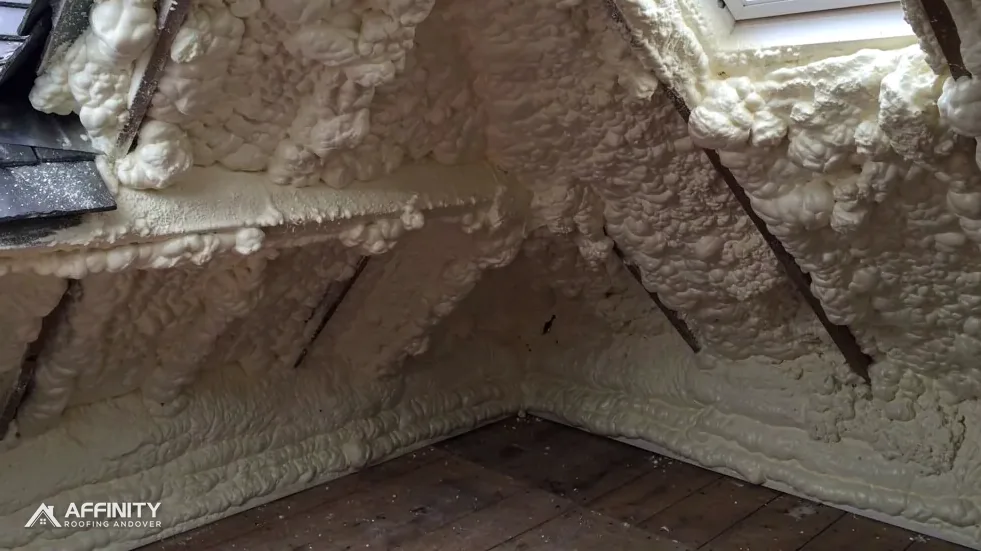
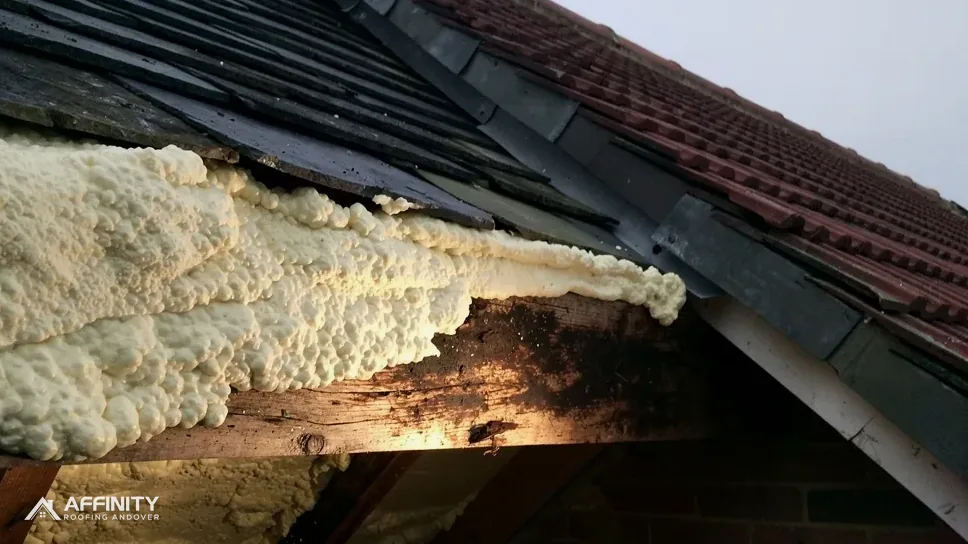
When foam is sprayed across the underside of the roof, it can fill the eaves gap, coat the underlay and close the air path. If the foam is vapour-tight, the damp air from the house cannot reach the timber, which sounds helpful, but any moisture that does get in from a leak or a gap has nowhere to go. If the foam is vapour-open, some moisture passes through, but the ventilation the roof needed is still gone.
For the wider story of foam in roofs, see our spray foam removal page.
Why foam makes the problem harder to see
Condensation in an ordinary loft is visible: drips, staining, mould on the rafters. In a foamed loft, much of the evidence is hidden, and the first sign is often something that happens to the house rather than the roof.
The cover
Foam hides the timber, so a damp rafter cannot be seen or touched. The RICS consumer guide of March 2023 notes that where spray foam covers the roof structure, the structure cannot be fully inspected. Moisture can build up for years behind a layer that looks perfectly clean.
The seal
Closed-cell foam is dense and holds moisture back. Any water that reaches the timber stays. That is one reason why the type of foam in your loft matters so much to the timber behind it.
The false comfort
A foamed loft often feels warm and dry to the hand. The foam is dry on its face, and the person standing in the loft has no way to know what is happening behind it. A dry surface does not prove a dry roof.
Eaves and vents
Foam sprayed hard into the eaves can close the air gap completely. Marley's cold-roof guidance asks for a 25 mm continuous opening there under a non-breathable underlay on pitches up to 15 degrees, and 10 mm on steeper roofs, so a blocked gap removes that provision. Foam also changes how a breathable membrane behaves, because the membrane relies on air on both sides.
Signs: what you may notice
Condensation trouble announces itself in several ways, though rarely loudly. The table links each sign to its likely meaning.
| Sign | Likely cause | Sensible next step |
|---|---|---|
| Musty smell in the loft or top rooms | Damp timber or foam | Loft survey |
| Dark or wet patches on the foam face | Moisture passing through or leaking | Photograph and survey |
| Mould on ceilings below | Moist air in the house | Check ventilation and extractors |
| Drips or stains after rain only | A leak in the covering | Roof inspection |
| Drips on cold mornings, dry after rain | Condensation | Ventilation and sealing check |
| Rust on nails or metal fixings | Long-term damp | Inspect timbers |
| Slipped tiles on a foamed slope | Failed fixings behind the foam | Survey from outside and in |
No single sign is conclusive. Look for patterns, take dated photographs and compare over a winter.
Reading the table
The first column lists what an owner can notice without opening anything. The second is a likely cause, not a diagnosis. The third is the proportionate response. A musty smell calls for a look, not a rebuild. Mould on a bedroom ceiling is a clue about humidity in the house as much as about the roof. Rust is the slowest sign and the most reliable, because metal fixings corrode only where damp has lingered for a long time.
What the signs do not tell you
They do not tell you how much timber is affected, whether decay has begun or whether the covering is also at fault. For that the roof must be inspected, and in a foamed loft that means looking at the edges of the foam, any area that has already been opened, and the outside of the roof, and then deciding with the owner whether to open more.
Keep a diary
A simple log of dates, weather and observations is worth more than memory. Photograph the same spot each time so that changes show.
Leak or condensation?
The two look alike and need different fixes, so telling them apart saves money and avoids repairing the wrong thing. A roofer who replaces tiles to cure condensation, or a ventilation fan to cure a leak, leaves the real fault in place.
When it happens
A leak shows after rain, often within hours, and clusters below a fault: a slipped tile, a failed flashing, a blocked valley. Condensation tends to show in cold weather, especially on still, damp mornings, and spreads across a larger area. It often appears on the north slope, where the roof stays colder.
Where it happens
Leaks run along rafters or battens from a point. Condensation forms evenly on cold surfaces such as the underlay or metal fixings, and may show in the corners and at the eaves.
What the water looks like
Leak water carries dirt from the roof and leaves brown tide marks. Condensation is cleaner, often just beads of water or a fine white or black bloom of mould.
Both together
It is common to have both. A small leak that was foamed over can rot timber while condensation adds to the damp. That is the situation the Energy Saving Trust has in mind when it says, of foam on a roof that leaks, "We don't recommend doing this". Our guide to spraying foam onto a leaking roof goes into why.
What the survey does
We look from outside for covering faults and from inside for the pattern of moisture, then explain which problem you have.
Putting it right
The fix follows the cause, and in a foamed roof it can run from simple to substantial.
Cut the supply of moisture
Reduce the damp air entering the loft: seal gaps around pipes and fittings, fit a draught seal to the loft hatch (Approved Document C expects an effective one), run extractor fans to the outside and avoid drying washing on radiators in closed rooms.
Restore the air path
If foam has blocked the eaves, clearing it and fitting vents or tray vents restores the air path. Under a certified breather membrane above a sealed ceiling, Marley allows the 3 mm left by ordinary eaves construction to do the job.
Repair any leak
A leak is a roof fault. Tiles, flashings and valleys are repaired from outside. The Energy Saving Trust does not recommend foaming a leaking roof.
Remove the foam
Where foam sits against timber that cannot be shown to be dry, or where the roof cannot breathe, removal is the surest step. The roof structure is then visible and can be examined. Our guide to checking roof timbers after spray foam removal sets out what we look for.
Replace and re-insulate
Insulation is part of the fix and not an afterthought. A loft left bare is cold, and cold lofts condense more freely when warm air reaches them, so the sealing of the ceiling below matters at least as much as the material laid on top.
After removal, new insulation goes in so that the roof can still dry, usually at ceiling level with an open space above.
What to do now, and what to ask
Practical steps for an owner who suspects trouble. None needs special equipment, and all of them cost nothing but time.
Look and record
Visit the loft safely, on boards or joists only, in cold weather, with a torch and a phone to photograph with, and ideally with someone downstairs who knows where you are. Photograph the foam, any dark patches, the eaves and the hatch. Note the date and weather. Repeat after a wet week and a cold week.
Look at the house
Check bathrooms and the kitchen have working extractors that vent outside. Condensation in a loft often begins in the house.
Ask your lender
RICS advises owners to check with their mortgage provider whether its policy allows spray foam. If you plan to sell or remortgage, ask now what it will want to see.
Ask for a survey
A loft survey from a roofer gives dated photographs, a view on the moisture pattern and a recommendation. Send us your photos first if you like, and we will say what they suggest.
Beware pressure
If someone arrives at the door urging you to act immediately, remember that a contract signed at home carries a 14-day right to cancel. Our guide to spray foam doorstep sales explains how.
Whatever you decide, make the decision on evidence, not on the first alarming voice you hear.