Finding a slate on the path after a blustery night is a familiar shock. It looks as though the roof has been damaged. More often, the slate was simply no longer attached. It had been hanging on a corroded nail for years, and a gust finished the job.
That distinction drives every decision that follows. If one slate dropped because a ladder knocked it, or because a branch hit the roof, replacing it restores the roof. If it dropped because the nails across that whole area are rusting away, replacing it only fixes the gap you can see, and the next slate to go is already loose.
The sections below explain why slates slip, how to look for the signs without climbing anywhere, how a small repair is made with a tingle or a hook, what the pattern of failures tells you, and when it is time to treat the whole slope. The question is whether a few slipped slates can be repaired without re-roofing. Often, yes, but only after the survey has looked at what is holding the rest.
What slipped actually means
Slate roofs are made of overlapping rows, each slate hanging from a fixing and covered at its head by the row above. A slipped slate has moved down from its place, or dropped out altogether.
Three states
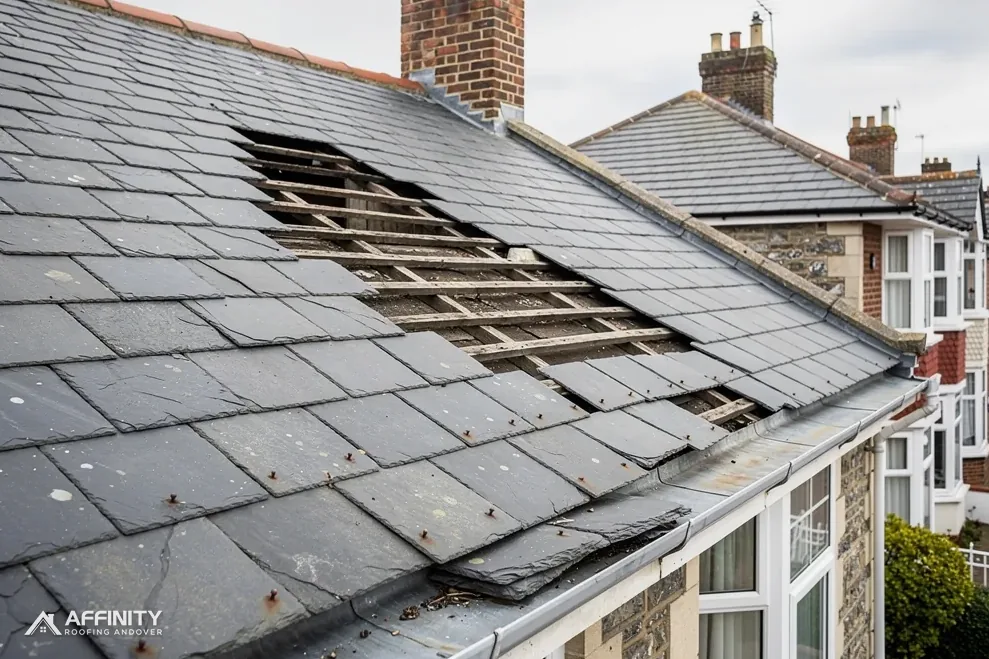
A slate can be partly slipped, with its tail hanging below the line of its neighbours. It can be loose, still in place but free to rattle. Or it can be gone, leaving an open gap through to the underlay. Each state is the same fault at a different stage. A partly slipped slate is a warning, a loose one is closer to failure and a missing one is an opening for rain.
Why a gap matters
The underlay below the slates is a second line of defence, not a primary one. A gap in the slate layer lets water reach it directly. On an old roof, where the underlay may be torn or absent, that water goes straight into the loft. A single gap can stain a ceiling in one wet week.
Why slipped slates cluster
Fixings tend to fail where conditions are similar, so slipped slates often appear in groups. A cluster along one course, or across one patch, points to a shared cause such as a split batten or a row of poor nails. Scattered single slates across a slope tell a different story and are worth a different survey.
Our slate roofing page describes how a slate roof is built, which explains why a single failure can have wider causes.
Why slates slip: nail sickness and its cousins
Slates are among the longest-lasting roof coverings, so when they slip the cause is usually something else.
Nail sickness
The term describes a roof whose nails have corroded. Many older roofs were fixed with ordinary steel or galvanised nails, and these rust. As a nail rusts it thins, loses grip on the batten and finally snaps at the slate's hole. The slate then hangs by a thread or drops. This is a reason for a slate roof that sheds one slate after another, even though the slates themselves are sound.
Fixings that were too few or too small
Some roofs were laid with a single nail per slate where two were needed, or with nails too short to bite properly into the batten. Those slates are held by less than the design intended and give way first.
Battens that have failed
A batten that has rotted or split holds its nails loosely. The nails pull out under the weight of the slate. This often happens near leaks, valleys and chimneys, where the timber has been wet for years.
Frost, wind and impact
Freeze and thaw can crack a slate along its hole. Wind lifts tails on slopes where fixings are marginal. A falling branch, a ladder leant on the roof or someone walking on the slates can snap a few. These are single events, and the repair is usually the end of the story.
Brittle old slates
A thin grey slate on a house built or refurbished before 2000 may be fibre cement, which can contain asbestos. Do not handle fallen pieces; see a survey first.
Looking safely from the ground and the loft
You can learn a lot without climbing anything, and you should not climb, because a slate roof is slippery and a weakened one can give way.
From the garden or street
Step back and run your eye along every row. Slates that sit lower than their neighbours, rows with a wavy line or a patch where the colour changes (fresh underlay or batten showing through a gap) all suggest slippage. Binoculars help. Photograph from a few angles so you can compare over time and show any roofer exactly what you saw.
On the ground
Look at the paths and flower beds beneath the eaves. Fragments of slate, or whole slates, mean something has come down. Check the gutters for slate pieces and nail heads. A scatter of rusty nail shanks in a gutter is a strong clue to nail sickness.
In the loft
With a torch, on boards or joists only, look for daylight through the slates. A pinprick of light is a gap. Look at the battens for dark stains and softness, and at the underlay for tears. Nail points showing through the underside of the roof deck and rusty tips are a good sign of the trouble.
What not to do
Do not climb on the roof, do not lean a ladder on the slates and do not push a slipped slate back by hand from a ladder. A slipped slate pushed back without a proper fixing will slide down again.
If you are unsure what you are seeing, send us your photos. We will tell you what they suggest and whether a survey is needed.
Tingles, hooks and how a small repair is made
The challenge in repairing a single slate is that the nails holding its neighbours are covered by the row above. A slater cannot just drive a new nail.
The tingle
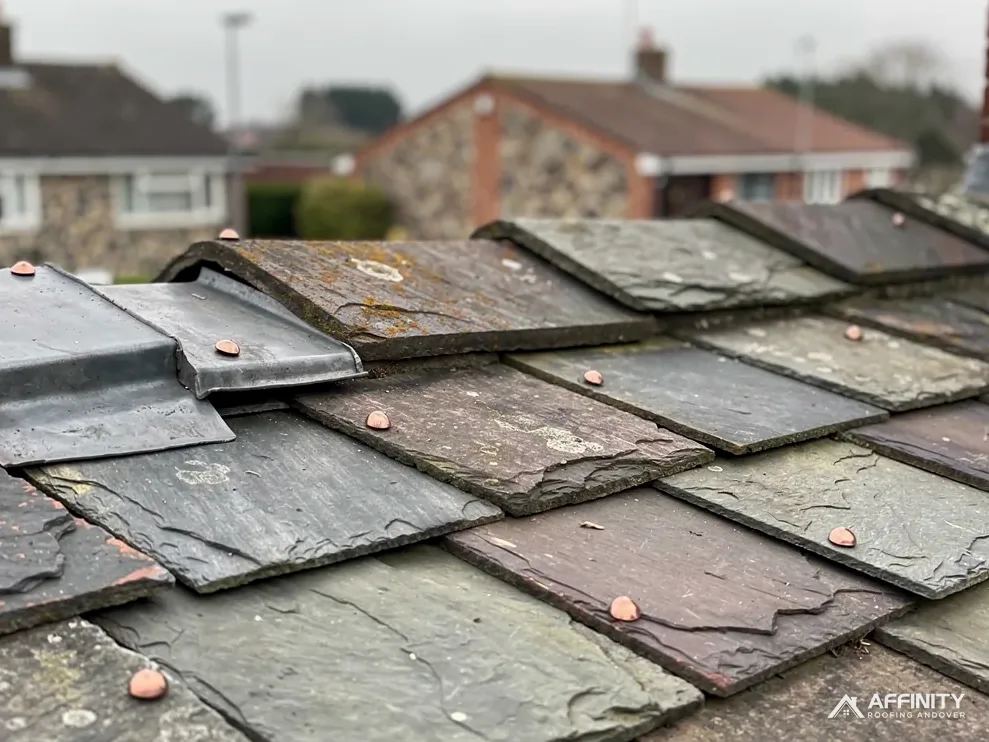
A tingle is a strip of lead, copper or stainless steel, nailed to the batten and bent up around the tail of the replacement slate to hold it. It is the traditional answer to replacing one slate without lifting others. The slate sits in the tingle and is held against the row below. Our answer on the slate tingle goes into detail.
The hook
A slate hook does a similar job in a different shape. Where a roof is steep enough, a hook is a recognised fixing. Cupa Pizarras, a slate supplier, says hooks are not for slopes under 25 degrees, while BS 5534 puts the floor for natural slate at 20 degrees; check the data sheet. On a shallower roof, a tingle is more usual. We compare the two methods in our guide to hooks or nails.
Matching
The replacement slate should match the size, thickness and weathering of the old ones. A bright new slate in a faded roof is visible, so a slater mixes in reclaimed or well-weathered stock where possible.
What a repair visit covers
The slater checks the neighbouring fixings while there, because a repair that ignores them is only half a job. Any slates found loose are re-secured. The gutter is cleared of debris and the area is left tidy. A good repair also photographs the finished slope.
What the pattern of slips is telling you
How many slates have slipped, and where, tells you more than any single slate.
One or two, no pattern
If one or two slates are gone and there is a clear cause (a branch, a ladder, a bird or a known impact), a repair is the sensible answer. Check the neighbours, replace the damaged slates and move on.
A cluster in one area
A group of slips in one patch usually means the battens or nails there have failed. The repair might mean stripping that area, replacing the battens and nails and relaying the slates. This is a larger repair, but still a local one. The fault is often below a leaking flashing or valley, so check those.
Slips across the whole slope
If slates have slipped in many places and the survey shows corroded nails across the slope, the roof is failing as a system. Repairing slate by slate then becomes a loop of call-outs, each one costing a visit and a repair that will not last. At that point, a re-slate with new fixings is better value than serial repairs. Our guide to re-slating a roof explains the job.
The test we use
On the survey we lift a sample of slates in different places and examine the nails. If they are bright and firm, the roof is sound and local repair will work. If they are thin, rusty or snapped, the roof is telling us something.
The photographs of what we find go with your written account, so you can see the same nails we did.
Cost, timing and what to ask
A repair costs far less than a re-slate, and which one you need follows from the state of the fixings across the slope.
A published marker
MyJobQuote's average for a roof repair is around £650 (MyJobQuote, Oct 2026). It covers repairs of all kinds, not slate in particular, so treat it as a rough marker. A total for your slope moves with the number of slates, the reach and what lies beneath them.
Access
A few slates near the eaves of a low roof can sometimes be reached with a ladder or a low tower. Higher or harder-to-reach areas need scaffold, which adds to the cost. For a scaffold that obstructs the highway, the highway authority must license it; in Andover that is Hampshire County Council.
Timing
A missing slate is an open hole. A leaking roof is made safe first, and the proper repair follows. Do not leave a gap through a wet winter.
Questions for any slater
Ask what fixing will hold the new slate, whether the neighbouring nails were checked, what will be done about any further slips, and whether you will get photographs. Have the quote set down in writing, as one sum.
If the roof is old
If the survey shows nail sickness across a slope, the honest advice is that more repairs will keep coming. We will say so, with the photographs to prove it, and lay the repair option next to the re-slate option so you can weigh them.