The short answer
Published guides give GRP roofs a typical life of 25 to 30 years (HomeBuilding) or 25 to 40 years (Less). Those are ranges, not promises. How long yours lasts depends on the quality of the original laying, the condition of the topcoat, whether the edges have cracked and whether the deck underneath has moved. A survey of those points tells you more than the age alone.
The typical range, and the gap between sources
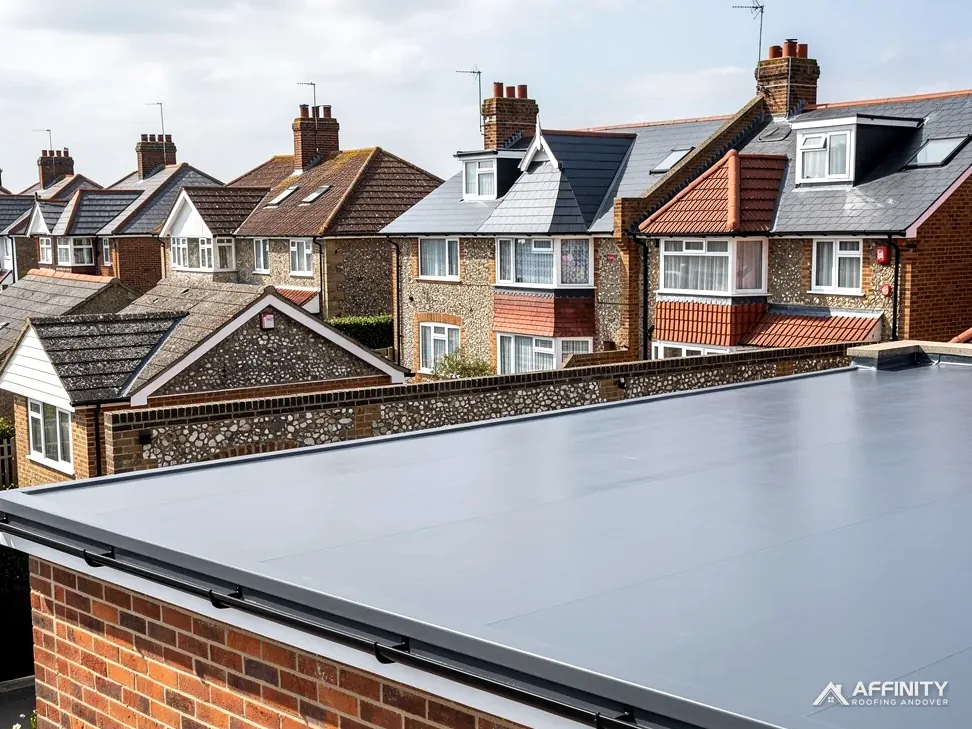
GRP, glass-reinforced plastic, is a covering made on site by laying fibreglass matting and resin over a deck, finished with a pigmented topcoat. It is common on garages, extensions and dormers because it sets as one continuous skin that fits awkward shapes.
HomeBuilding gives GRP a typical life of 25 to 30 years. Less gives 25 to 40 years. The sources agree on the lower end and differ above, which is normal for such figures and shows why a range is more honest than a single number.
These are typical lives for a roof laid well and looked after. They are not guarantees, and a warranty is a separate thing: an installer's promise for a stated period does not mean the roof will last that long, or stop at the end of it.
For comparison, the same two guides give EPDM 25 to 30 years (HomeBuilding) or 30 to 50 years (Less), and felt 10 to 15 or 10 to 20. Our EPDM roof life and felt roof lifespan answers cover those. Price context: HomeBuilding gives £110 per square metre supply-only for GRP (September 2025), against £105 for EPDM and £65 for felt.
The topcoat
The topcoat is the roof's first line of defence. It carries the colour and shields the fibreglass from ultraviolet light and water. As it ages it chalks, fades and may craze into a pattern of fine cracks.
That wear can be dealt with. A sound laminate under a tired topcoat can be cleaned, sanded and recoated, which renews the protection and can extend the roof's life. What matters is whether the cracks stay in the coat or reach the glass fibre beneath.
A roof with a thin or poorly applied topcoat will weather faster than one with a good thick coat. Dark colours absorb more heat, and heat cycling fatigues the surface. Moss and standing water keep it wet, which speeds breakdown.
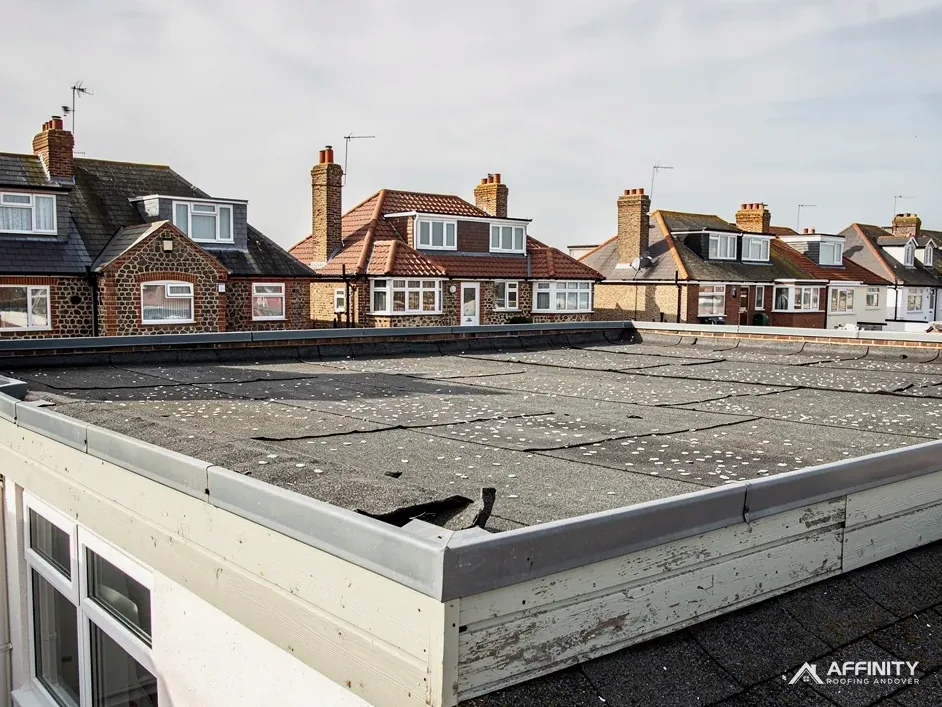
Look at the surface in different lights. A pale, powdery surface is weathered topcoat. Dark stains around outlets show water sitting. Exposed weave, where the pattern of the glass shows through, means the coat has worn away and the laminate is exposed. If you see that, the roof needs attention soon, as our flat roof maintenance answer explains.
Cracking at edges and joints
Fibreglass is rigid, so it cracks where the structure moves. The lines to watch are the joints between boards, the perimeter and any wall it climbs. A hairline crack along a joint that appears in the first few years often means the deck was not fixed or laid properly. Our answer on GRP roof cracking explains the causes.
Cracks shorten a roof's effective life because water gets into the deck and the build-up behind them. A cracked edge is the likeliest place for a leak to begin on an otherwise intact roof.
Early repair pays off. A crack ground out and re-laminated while the deck is dry costs little and keeps water out. Left through several winters, the same crack lets in moisture that rots boards, and the repair becomes a deck replacement.
The perimeter also takes more weather than the middle. Wind, sun and rain concentrate there, and trims and drip edges loosen over time. A roof with sound edges and a sound topcoat is likely to be in the better half of its range.
Ponding adds to wear, so correct falls and clear outlets protect a roof's life, as our minimum fall answer describes.
Judging what is left
Age is a start, not a verdict. A twenty-year-old roof that has been recoated and kept clear may outlast a twelve-year-old one that has ponded since day one. A survey looks at the topcoat, the edges and joints, the outlets, and the deck.
We walk the roof carefully where it is safe, and check the underside from inside when we can. Soft spots, damp patches and a deck that gives underfoot are warning signs. The photographs we take show you the same points, so the report is not just opinion.
The outcome is one of three. A roof in good shape needs only routine care. A tired topcoat with a sound laminate suggests recoating. A roof with cracks, wet boards and widespread wear is near the end, and replacement is the sound choice.
When it is replaced, the build-up can improve, because Approved Document L brings insulation into any renewal of the waterproof layer. Our flat roofing page lists the alternatives, and the written quote that follows the survey is a single figure.