The short answer
Sometimes, but only as a surface treatment. A coating can refresh and protect a membrane that is still sound, and some are sold as a way to extend a roof's life. It cannot close a split seam, dry a wet deck or stop a leak that begins underneath. Paint applied over a failed roof hides the fault for a season and then peels, leaving the repair harder and dearer.
What a coating can and cannot do
A roof coating is a liquid applied in coats that dries into a continuous skin. Some are bitumen-based, some acrylic, some polyurethane. Their job is to protect the surface beneath: to reflect sun, shed water and hide the wear of years.
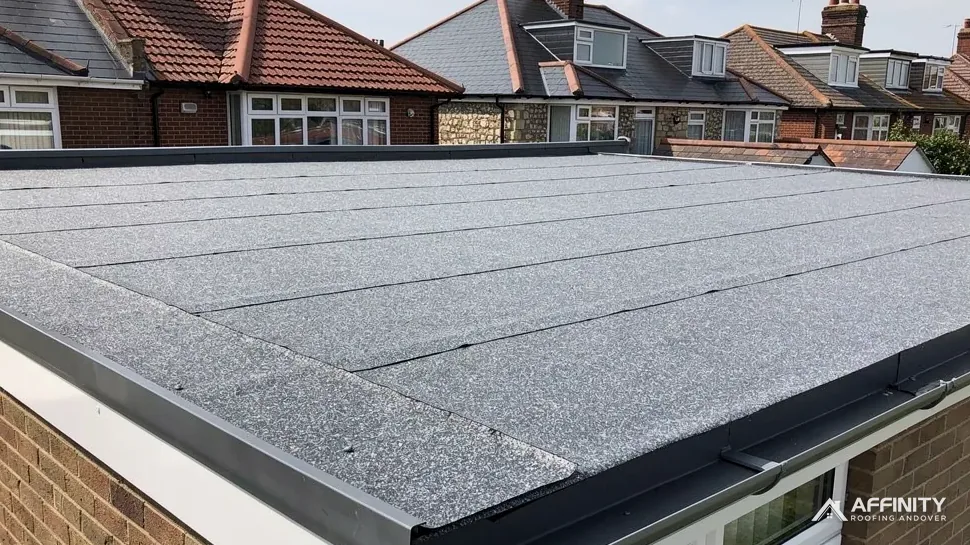
Where a membrane is basically sound and only weathered, that can be reasonable. A felt, EPDM or GRP roof with a faded, chalky surface and no active leaks may be refreshed with a compatible coating, and it can postpone a full replacement.
What a coating cannot do is repair structure. It does not bridge a wide split, rebond a lifted seam, dry out a deck or replace a rotted board. It will not improve the fall that lets water pond. And it does not alter the age of the roof underneath, which still follows its published range.
HomeBuilding gives felt 10 to 15 years, EPDM 25 to 30 and GRP 25 to 30, while Less gives felt 10 to 20, EPDM 30 to 50 and GRP 25 to 40. A coating applied to a roof at the end of that range is a cosmetic job on a tired surface. Our felt flat roof lifespan answer shows how to judge where yours sits.
Surface preparation decides the result
Paint on a roof lasts only as long as its grip on the surface. Roof surfaces collect dust, grease, algae and old coatings, and paint over any of them peels in sheets within a season or two.
Proper preparation starts with cleaning off debris and loose material. Moss and algae need treating. Here the law matters. The Biocidal Products Regulation requires products to be used as their authorisation allows, and the HSE warns the public off biocides meant for professional users only. Advertising, selling or using an unapproved product is an offence under the biocides rules. Approved products are used, with the label followed.
A high-pressure jet is the wrong tool. Marley says jet washes can damage slate and tile surfaces and cut their life considerably, and an ageing membrane or topcoat is also easily scoured, so cleaning is done gently with a brush and approved products.
The surface must then be fully dry. Any dampness trapped under a coating forms blisters, as our answer on flat roof blistering describes. Compatibility is the last check: a coating suited to felt may not bond to rubber or fibreglass.
When paint hides a failed deck
The danger of painting a leaking roof is that it works well enough to look like a cure. A thick coat can cover hairline cracks, and the roof stays dry in a dry week. Then the first hard rain gets in through the real fault, which is still there.
Meanwhile, water that has already entered the build-up is sealed in. A deck that is wet and rotting beneath a new skin has no way to dry. The leak seems to stop while the damage grows, and by the time it shows again, the boards may need replacing, as our answer on rotten flat roof decking explains.
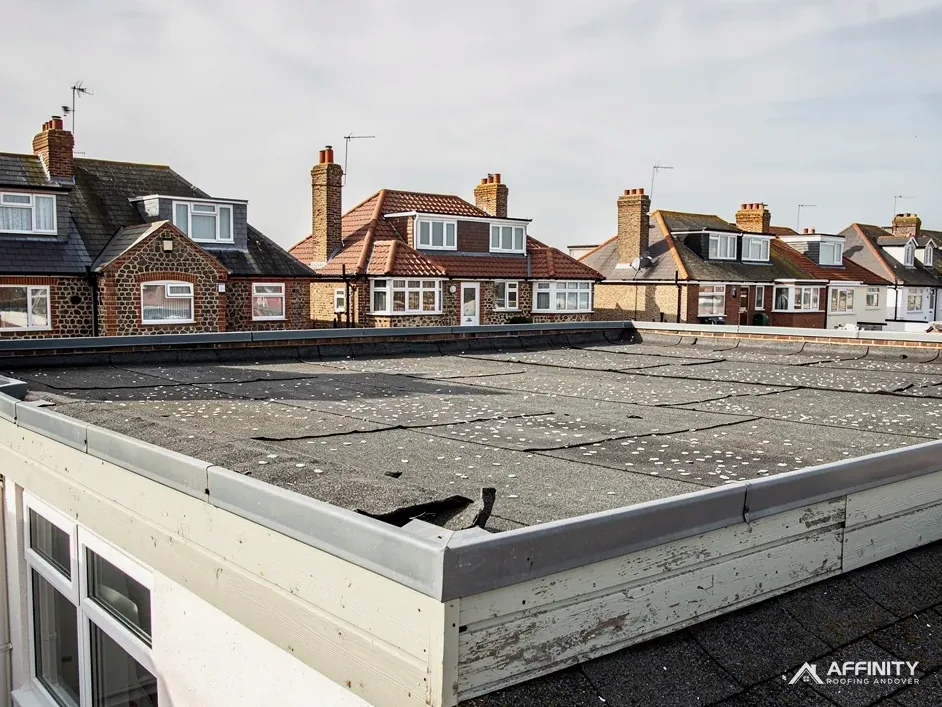
Signs that painting is the wrong move include soft or spongy spots underfoot, a sagging deck, repeated leaks in the same area, blisters across the surface, and a ceiling that stays damp. Each points to a fault beneath the surface.
Paint also makes a later repair awkward. Patching a coated roof means cleaning the coating back to the membrane first, and a roofer asked to assess a painted roof must first work out what is underneath. So the survey looks through the layers and not only at the top.
Coating or replacement, and what each costs
The choice turns on the roof's condition. A sound roof with a worn surface may take a coating. A roof with active leaks, wet insulation, a soft deck or widespread splitting needs repair or replacement, and a coating adds cost without cure.
Replacement is also the point at which the build-up can be improved. A new covering counts as renovation under Approved Document L, so insulation enters the plan, as our flat roof insulation answer explains. A coating does not trigger that.
On price, MyJobQuote (October 2026) shows around £60 per square metre for EPDM and £1,500 to £6,000 for a flat roof replacement, as typical UK figures. HomeBuilding's supply-only costs are £65 for felt, £105 for EPDM and £110 for GRP per square metre (September 2025). They do not tell you what a coating would cost on your roof.
Our survey records the surface, tests for damp and looks at the deck, then tells you whether a coating is sensible. The wider flat roofing page sets out the alternatives, and the written price covers whichever route you choose in one total.