Before anyone decides to remove spray foam, leave it or sell around it, they need facts. How much foam is there? What kind is it? What is the roof doing around its edges? Is there any sign of trouble that justifies opening it up? A survey exists to answer those questions as far as a loft inspection can, and to say plainly where it cannot.
That second part matters. Foam covers the roof structure, and a survey cannot see through it. RICS makes the point in its March 2023 consumer guide, and any honest surveyor repeats it. What a good survey can do is gather the visible evidence, photograph it systematically and set out what the evidence suggests. It leaves the decision about opening the roof to you.
This guide describes the visit stage by stage: what we look for in the loft, the limits of what can be seen, the photographs, the check from outside, and the written report. It also explains what to do with the report afterwards.
Why a survey comes first
Foam jobs go wrong when decisions are made before the facts are in. A survey slows things down at the start so that the rest goes faster, and it is the least costly part of the whole process to get right.
Decisions that depend on it
Whether to remove the foam, whether to remove part of it, whether to re-roof, whether to leave it alone and what to tell a lender or buyer: each depends on what is in the loft and how the roof is behaving. A survey gives the information that those choices need.
Not a sales visit
A survey should not be a sales pitch in disguise. It should leave you with a record you could take to another firm or a different surveyor. If a visit ends with pressure to sign on the spot, treat that as a warning. A contract signed at home also carries a cooling-off right with limits, which our guide to spray foam doorstep sales explains.
Starting point
You may be starting from a surveyor's note on a sale, a lender's query, a damp patch or just curiosity. Whatever the trigger, send us the note or a photograph from the hatch beforehand, and we can plan the visit around the points that worry you most.
A general marker
As a marker, MyJobQuote lists a roof survey at around £300 on average (MyJobQuote, Oct 2026), a typical UK figure for surveys of all kinds. Our spray foam removal page explains what follows a survey, and the price for any work comes afterwards.
In the loft: what we record
The loft visit is the heart of the survey, and it follows a fixed routine so that nothing is skipped. A visit usually takes a while, because the work is in the detail and the loft is rarely roomy.
Type of foam
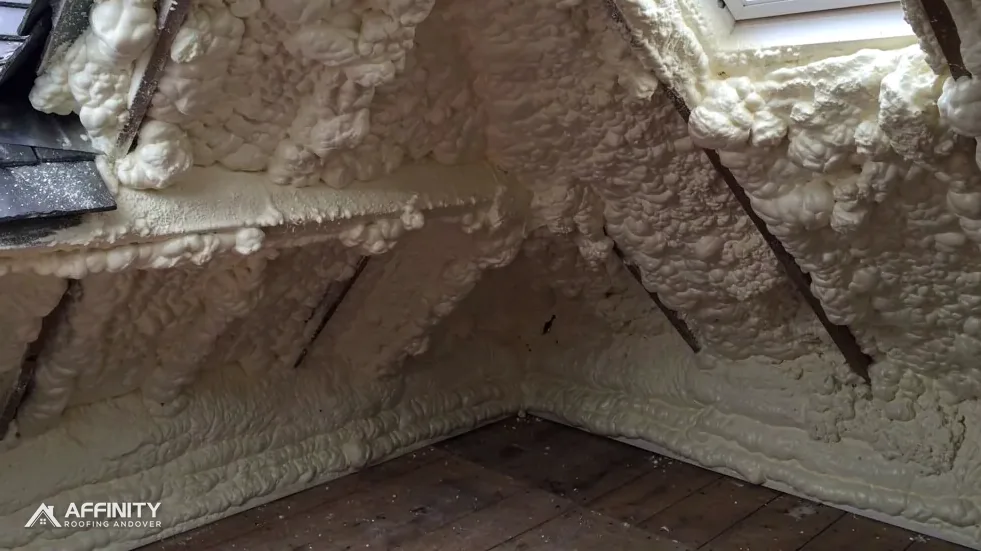
We press gently to tell open-cell, which is soft and springy, from closed-cell, which is rigid. Some lofts hold both. The type changes the risk to the timber and the effort of removal, as our guide to open-cell and closed-cell foam explains.
Extent and thickness
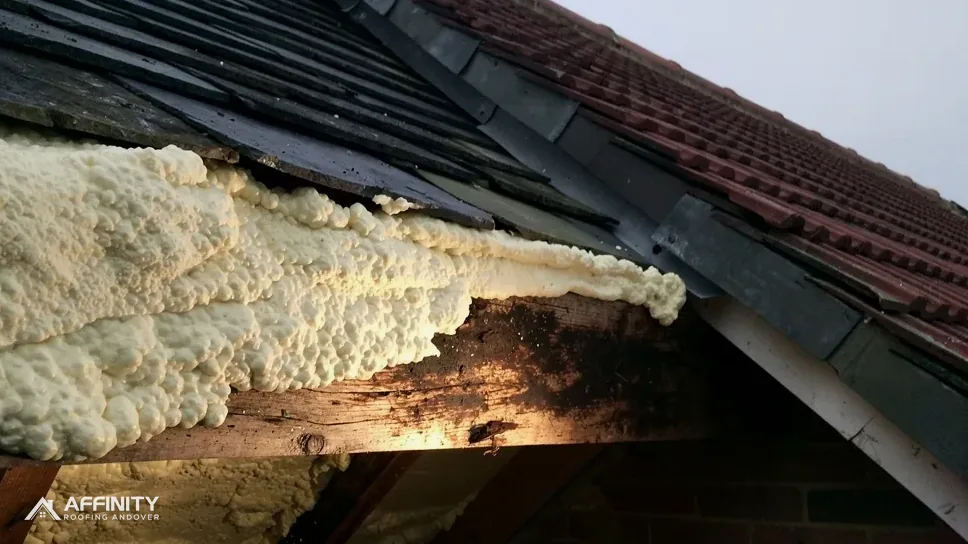
We note which slopes carry foam, whether it runs from eaves to ridge, how thick it is and whether it covers gable walls, chimney stacks or roof windows. Partial and full coverage are planned differently.
What it was sprayed onto
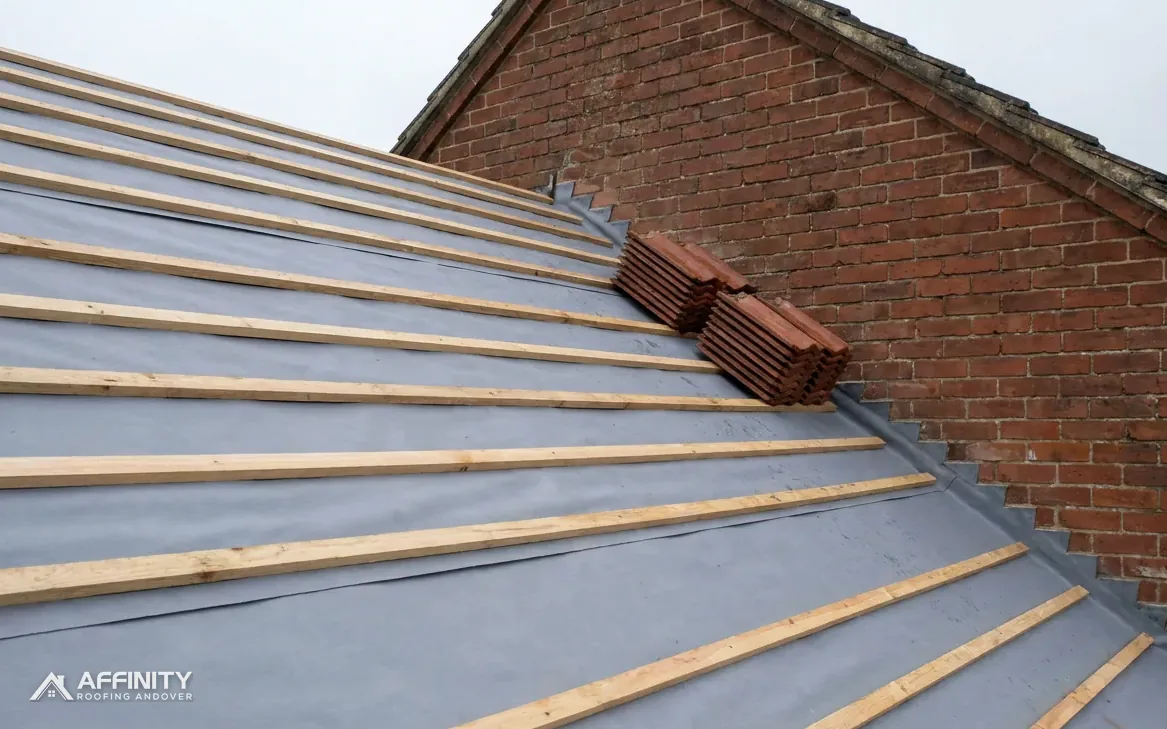
We look for the edge of the foam, where the underlay or battens may be visible, to see whether it went onto a membrane, old felt or bare tiles.
Eaves and vents
We check whether foam reaches the eaves and shuts off the air entry to the roof space. Marley's cold-roof guidance sets 25 mm or 10 mm for a non-breathable underlay, depending on pitch, and 3 mm under a certified breather membrane where the ceiling is sealed.
Signs of trouble
Staining on the foam face, a musty smell, mould, rusted nail tips, daylight through gaps and loose or dropped tiles all go into the notes.
The hatch and the loft
We also note the hatch size and seal, the boarding and the access, since these affect the plan.
The limits of an inspection
It is worth being plain about what a survey of a foamed roof cannot do, because pretending otherwise would mislead you and anyone you show the report to.
What RICS says
In its March 2023 consumer guide, RICS observes that foam over the roof structure rules out a full look at the timbers. That is a limit set by the foam, not by the surveyor. Nobody can inspect what lies under it without opening it up.
What this means for the report
A survey that says the timbers are sound without seeing them is making a claim it cannot back. A responsible report says what was visible, states what was hidden and draws no conclusion about the hidden part. If it points to a risk, it gives the reason.
Where evidence can still be found
We can examine the edges of the foam, any exposed rafter ends or wall plates, the exposed underlay or battens at the eaves, the underside of the ridge and areas around the chimney. We can also check from outside for sagging, slipped tiles and signs of water entry. These clues build a picture, though they do not replace opening up.
Why not just cut a window?
Owners sometimes ask why the surveyor cannot simply cut a small hole in the foam and look. It can be done, and in some lofts it is the right step, but each cut damages the insulation, takes time to make good and gives a view of one spot only. A patch of dry timber tells you little about the rest of the slope.
Opening a small area
Where a decision turns on the timbers, one option is to remove foam from a limited area, inspect and photograph it. We discuss this with you first, because it means cutting into the foam.
Photographs: how they are taken and labelled
The photographs are the part of the survey that lasts, so they are taken methodically. Long after the visit is forgotten, the pictures are what a buyer, a lender or a later roofer will study.
Systematic coverage
Every slope is photographed from the hatch and from each bay within reach, working along the loft from one end to the other. Close-ups of anything notable follow, such as a dark patch, a blocked eaves gap or a rusted nail.
Dated and labelled
Each picture is dated and tied to a slope or a bay, so a reader can match it to a position in the loft. A photograph without a location is of little use to a lender's surveyor.
Scale and context
Where it helps, we include a rule or a hand for scale, and a wider shot to show where a close-up sits. Good records show both the detail and its setting.
Your own photographs
If you can safely look from the hatch, take a few pictures before our visit. Stay on the boards, never step on the ceiling between joists and do not lean into the loft from a ladder in a way that unbalances you. Your pictures help us plan, and they show how the loft looked before.
Why it matters
Pictures can travel where a surveyor cannot, to a solicitor's desk, a lender's underwriter or a buyer's adviser. A buyer's surveyor or a lender may look at the photographs in place of visiting. A clear set answers questions at a distance and prevents delays.
Checking from outside
The roof has an outside as well as an inside, and the outside tells part of the story. A fault that is invisible from the loft is often plain from the garden.
From the ground
We look along each slope from the garden and the street, noting slipped, cracked or missing tiles or slates, sagging in the ridge or eaves line, failed flashings and blocked or leaking gutters. These are the usual causes of water entry, and they show what the foam may be hiding.
From a ladder, where safe
Where access is safe, we look closer at the covering, flashings and ridge. We do not walk on a roof that might be fragile, and if the covering is thin grey sheet from before 2000 that could contain asbestos, it is treated with the care HSE requires.
Putting inside and outside together
A damp patch inside that lines up with a slipped tile outside is a story. A sagging slope outside that matches a bay of damp foam inside is another. Combining the two views is how we form a view without opening the roof, and it is why the outside check is never skipped, even when the loft looks calm.
Special features
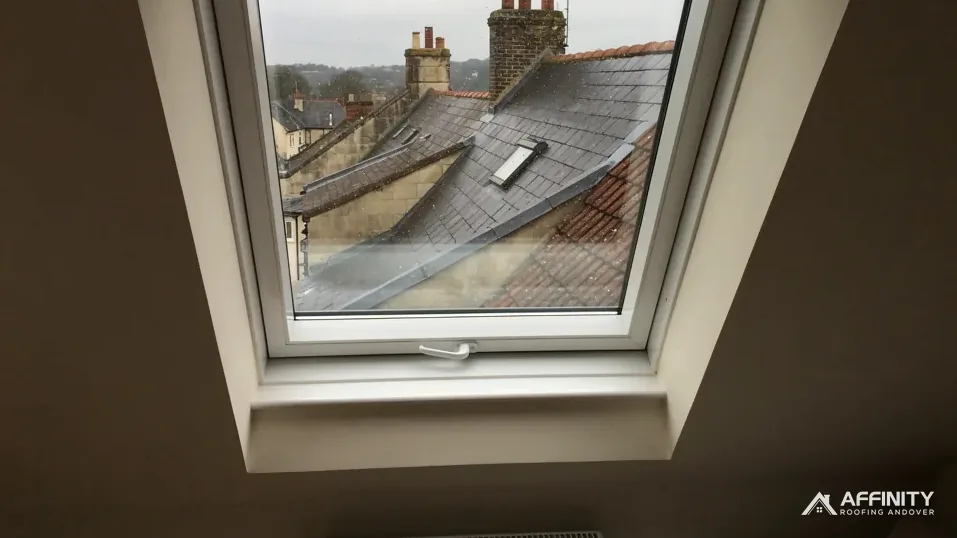
Roof windows, chimneys and valleys are checked closely. Foam sprayed around a window frame can affect the seal and the flashing.
Scaffold
A survey normally needs only ladders. Should the work that follows need scaffold over the road or pavement, the highway authority must license it, and that authority is Hampshire County Council for Andover homes.
The report, and what to do with it
The survey ends with a written account, and the account is what you carry forward. Read it carefully and ask about anything unclear before you act on it.
What it contains
A good report names the foam type and extent, lists the signs seen and not seen, includes the labelled photographs, states the limits of the inspection in plain words and sets out the options and what each one costs you in time and disruption. It does not promise what any lender will do.
Options it may set out
Typical choices are to take the foam out and inspect the roof; to take it out and then repair or re-cover as needed; or to leave it, where nothing is being sold or refinanced and the evidence reassures. Our guide to the spray foam removal process shows what follows if you choose removal.
Using it with a lender
RICS tells owners to put the foam question to their own lender. Show the report to your provider and ask what more it needs, because policies differ from lender to lender.
Using it in a sale
A survey report is the centrepiece of an evidence pack for a buyer. Add the installation paperwork and any history of leaks.
Handing it on
Keep the report with the deeds and the installation paperwork. If you move, it goes to the next owner. If you change lender, it goes to the new one. A record kept in one place gets used, and one scattered across drawers rarely does.