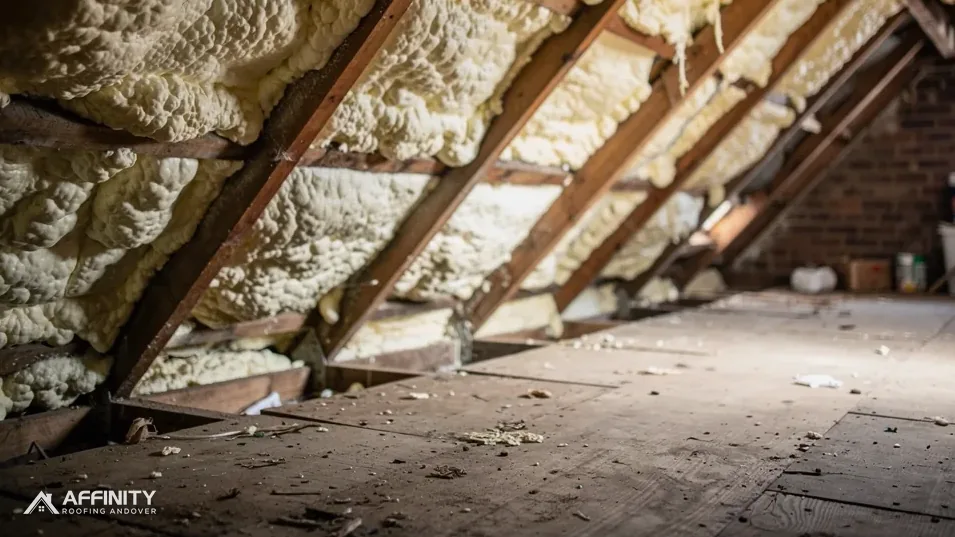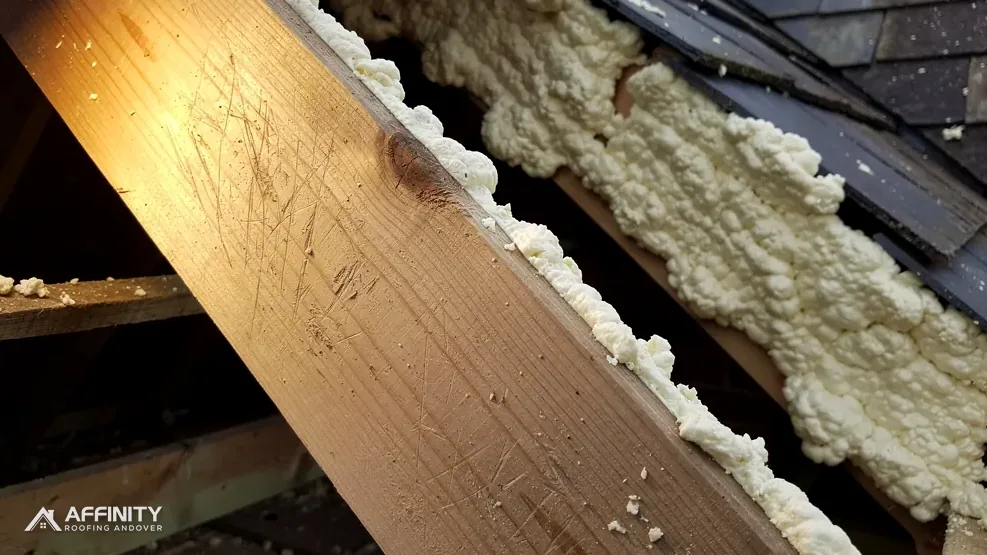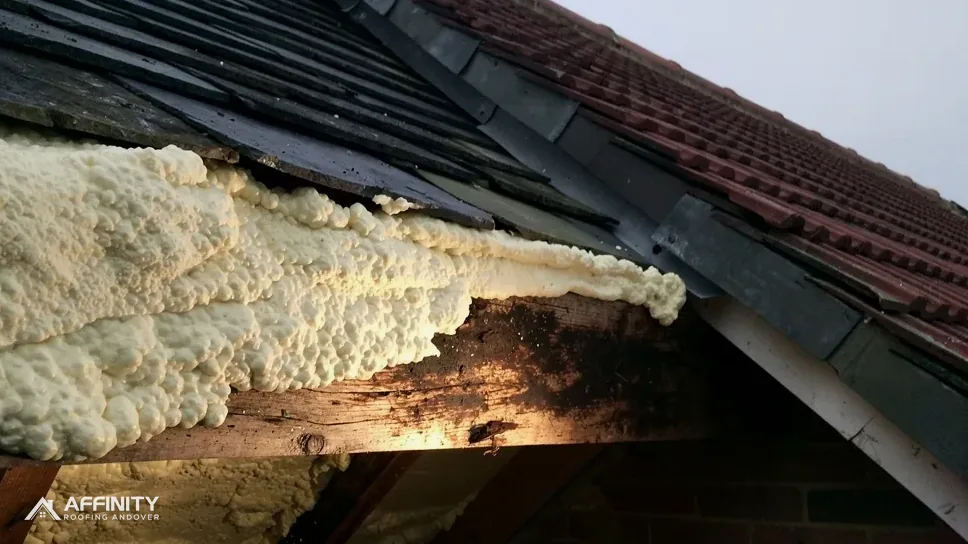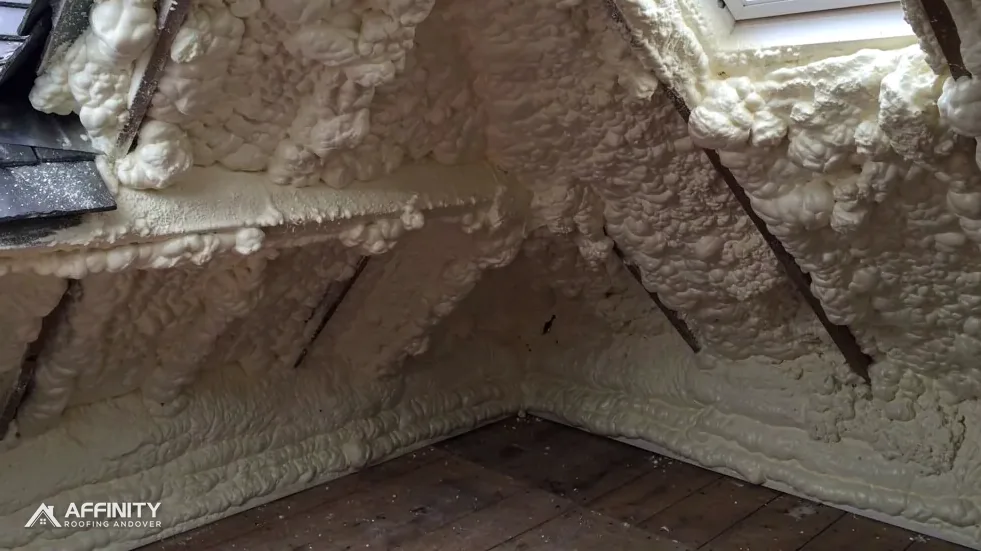
If you have spray foam in your loft, one early question will come from every surveyor, lender or removal firm: is it open-cell or closed-cell? The answer matters a good deal. It touches how the roof timbers behave behind the foam, how hard the material is to take out and what the roof underneath is likely to look like once the loft is clear.
The two names describe the structure of the foam itself. When the liquid is sprayed it swells into a mass of tiny bubbles, called cells. In one product the cells join up, so air and moisture can pass through the mass. In the other each cell is a sealed pocket, so the mass is dense and holds moisture back. The same spraying process makes both, yet the results behave like two different materials.
This guide shows how to tell them apart, sets the two side by side, explains what RICS says about inspection and moisture, and looks at why removal effort differs and what that means for your plans. It is background information. The survey confirms what is actually in your loft.
Cells open and cells closed
The difference between the two foams starts at a scale too small to see, and it appears in nearly everything they do once they are on a roof.
Open-cell
In open-cell foam the walls between bubbles are broken, so the cells connect like the holes in a bath sponge. The result is light and springy. It dents under a finger and recovers, and it is a weak barrier to water vapour. Damp air in the roof space can seep slowly through it.
Closed-cell
In closed-cell foam each bubble is sealed. The material is denser and firmer, hard to dent, and it stops vapour passing. It sets rigid against whatever it touches, which explains why some installers promoted it as a means of steadying loose tiles and adding stiffness to a roof.
Why installers chose each
Open-cell is lighter and swells more, so a deep layer builds up fast. Closed-cell packs more insulating effect into a thinner layer and adds rigidity. Both were marketed as a quick cure for a cold loft. Neither was designed with a later inspection of the roof in mind.
Why it matters to you
The structure decides how moisture behaves behind the foam, how firmly the foam grips timber and underlay, and how it comes away. The rest of this page follows from those three points. For the wider picture of why foam in a roof has become a problem, see our spray foam removal page.
Telling them apart from the hatch
A surveyor confirms the type on site, but you can form a view from the loft hatch with a torch and a steady hand.
The finger press
Press a fingertip gently into the foam somewhere out of the way. Open-cell gives like a firm sponge and slowly rebounds. Closed-cell resists, feels like hard packaging and takes no dent. If you cannot leave a mark, suspect closed-cell. Do not dig, cut or scrape: a sample is not worth disturbing the roof or breathing the dust.
Look and sound
Open-cell often looks pale, matt and slightly ragged on its face, and a tap gives a dull, muffled note. Closed-cell tends to be smoother, sometimes with a thin skin, and a tap gives a sharper knock. Colour is a poor clue because dyes vary between products.
Paperwork
The installer's invoice, a data sheet or an installer guarantee may name the product. Dig it out, since a lender or surveyor could ask to see it, and it saves us guessing.
Lofts with both
Some lofts hold both kinds. One firm may have foamed the front slope and another the back, or a hard layer may sit over a soft base. We map each slope separately and photograph each, so nothing is assumed from one sample.
Send a picture
Take photographs from the hatch and send them to us if you would like a first opinion before booking. They help us plan the visit, even though they never replace it.
Damp behind the foam, and the rot question
Moisture is the reason roof timber matters. Dry wood lasts for centuries, and wet wood starts to decay. Two ways of getting wet are worth separating, because the foam type affects each differently: water arriving from outside through a fault in the covering, and damp arriving from inside as warm air from the house meets a cold surface and condenses.
What open-cell allows
Open-cell foam is partly vapour-open. Damp reaching the rafters can, in principle, pass out through it, giving the timber some chance to dry. That does not make it safe, because a roof leaking behind it can wet the wood for months before anyone sees a stain.
What closed-cell does
Closed-cell foam seals tight against timber and underlay. If damp gets in, it has few ways out. A small leak at a tile, a lifted flashing or condensation forming on a cold surface can sit against the wood for years, hidden by the foam itself.
A matter of degree
A partly vapour-open foam may give damp timber more chance to dry than a sealed one, but that is a matter of degree, not a clean bill of health. Both types cover the timber, and both can be put on badly.
RICS on ventilation and inspection
In its March 2023 consumer guide, RICS warns that insulation fitted incorrectly can upset roof ventilation and lead to moisture damage, and that foam over the roof timbers makes them impossible to inspect in full. Our guide to spray foam and condensation describes the signs to look for.
The two foams side by side
A table helps to set the differences next to each other. It describes the general behaviour of each type, and your own loft is confirmed by survey.
| Point | Open-cell | Closed-cell |
|---|---|---|
| Feel | Soft, springy | Rigid, hard |
| Vapour | Passes slowly | Held back |
| Timber hidden (RICS) | Yes | Yes |
| Grip on timber | Releases more readily | Bonds hard |
| Removal | Cut in blocks, hand tools | Slow cutting and scraping |
| Underlay risk | Some, with care | Greater, may tear |
| What we check behind | Staining, soft spots | Rot, rusted nails |
Notice what the table does not say. It does not say that either type is acceptable to leave in place for good. Both hide the roof structure, which is the point RICS makes, and both can mislead a buyer's surveyor. The table compares how the foams behave, not whether either suits a roof.
A fixed line cannot be drawn between a safe foam and an unsafe one. The condition of the roof under it settles the matter, and that is what the survey reports.
Reading the table honestly
The word "lower" in the rot row describes odds across many roofs, not the outcome on yours. A closed-cell loft can have perfectly dry timbers, and an open-cell loft can have a rafter that has been wet for years. Neither result is predictable from the foam alone. That is why a lender or surveyor who asks about the type should be told it is a starting point for the inspection, not a verdict, and why we photograph the timbers rather than rely on the label.
Foam type also changes the questions a buyer's surveyor asks. Expect a request for evidence of dry timbers, whichever type you have.
Removal effort: soft and hard
The practical difference between the two shows most clearly on the day the foam comes out.
Open-cell
Because it is soft, open-cell foam is generally cut back in blocks and peeled from the rafters with hand tools. It lets go of timber more easily, often comes off in bigger pieces and so bags up faster. A fine film stays on the wood and needs cleaning off, and the operator slows down at the underlay and the back of the covering.
Closed-cell
Closed-cell is slower, more careful work. It adheres to the rafters, the battens and the underside of the covering, and has to be cut and scraped away in small sections. A heavy hand cracks tiles or rips the underlay, and old felt may peel away with the foam. If the foam had been steadying the tiles, each one is checked for a proper fixing once the support is gone.
Waste and time
Closed-cell makes more fragments and dust for the same area, while open-cell makes more bulk. We judge both on the survey from the thickness we can see.
Tiles that were leaning on the foam
Where closed-cell foam was used to hold slipped or loose tiles, the tiles may have relied on it. Once it is cut away they can move. We refix them before leaving, and the survey notes any that were already failing.
Same sequence
Whichever type is present, the order is survey, protection, careful removal, inspection and record. Our guide to the spray foam removal process sets out each step.
What each type leaves behind, and your options
The roof under the foam depends on the type and on what it was sprayed onto, and the decision about what to do depends on the roof. Take the findings one at a time, because each leads to a different repair and a different cost.
Under open-cell
We expect timbers that have had some chance to dry, though not always. We look for dark patches, soft spots and rusted nails. A roof that leaked before the foam went on may show water trails down the rafters.
Under closed-cell
We look more closely. Moisture has had little chance to leave, so any rot can be well advanced. We probe darker areas, check the batten ends and nails near the eaves and photograph each finding.
What it was sprayed onto
Foam goes onto a breathable membrane in some roofs, old felt in others and bare tiles or slates in the rest. Many old slate roofs were laid with no underlay at all, which means the foam hides slipped slates and corroded nails.
Your options
You can remove the foam; remove it and repair or re-cover the roof where the survey says so; or leave it, if no sale or remortgage is planned, the timbers are dry and your lender is content. RICS advises checking with your mortgage provider whether its policy allows foam at all. Our guide to checking roof timbers after spray foam removal lists what the inspection covers.
Send a hatch photograph and any paperwork. The written price follows the survey.