Slate is a heavy, brittle covering held in place by almost nothing: a nail or a small metal hook, driven into a timber batten. That fixing carries the slate's weight, resists the wind trying to lift it and has to keep doing so through decades of damp, frost and heat. When a slate slips, it is usually the fixing that failed, not the stone.
Two methods dominate. Nail fixing is the traditional way, with each slate holed near its head and pinned to the batten. Hook fixing grips the slate with a metal hook set on the batten, with no hole through the stone. Each has a place. Each has limits set out in the standards and in manufacturers' guidance, and each leaves a different mark on the finished roof.
This guide explains how the two work, where the pitch limits come in, what a council in a conservation area is likely to prefer, how wind changes the picture, and what to ask your slater. It is general information, and the survey of your own roof settles the choice.
How a nailed slate is held
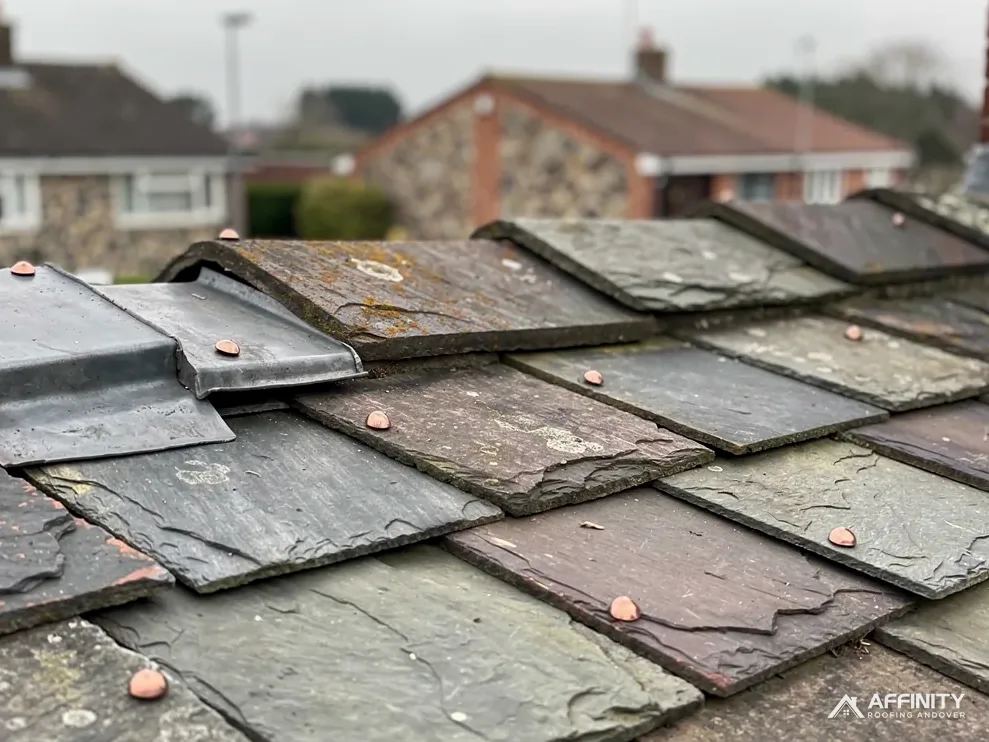
Nailing is the older method and still the default for slate roofs. Understanding it explains why failures happen where they do, and why a roof that looks tired from the street is often only suffering from rusted fixings. The stone has the long life; the steel has the short one.
Head nailing
Each slate is punched or drilled with two holes near its upper edge, the head. Two nails go through those holes into the batten beneath. The next course up overlaps the nail heads, so the fixing sits under cover and the rain never touches it. The slate hangs from the nails, and the slate below also pins its tail down a little.
The nail itself
The nail matters more than the slate in many failures. Slate outlasts ordinary steel nails, so roofs made with poor nails slip long before the stone is spent. Corrosion-resistant nails, copper or stainless, are used for that reason. Ask your slater which metal is going in and how long the nails are, as that single detail often decides whether a roof is still tight in fifty years.
Nail sickness
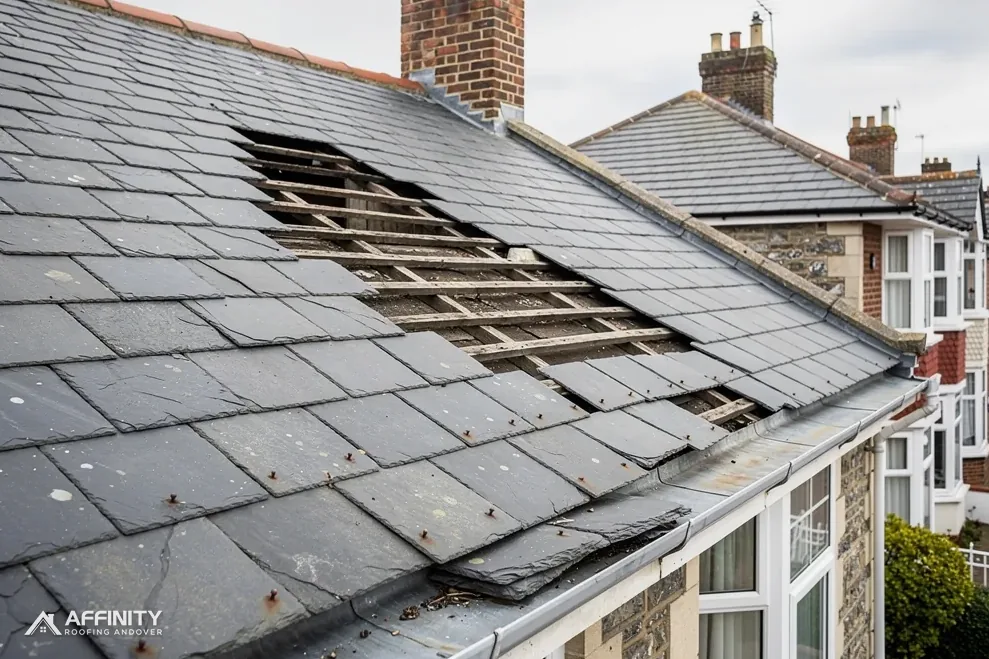
When nails corrode, the slate slips or hangs by a thread. The roof develops gaps, rattling slates and sagging courses even though the slate itself is fine. That condition, sometimes called nail sickness, is a common reason to re-slate a roof whose stone is still sound. Our guide to slipped roof slates explains the signs.
Why holes matter
The holes sit far enough from the edge to avoid cracking the slate, and a slate holed too close to the edge may split at the first nail. A good slater rejects those pieces before laying.
How a hooked slate is held
A hook fixing works on a different principle. Instead of a nail through the slate, a metal hook catches the slate and is anchored in the batten. The slate rests in the hook and is held against the roof by its own weight and by the course above.
The hook
The hook is a strip of corrosion-resistant metal, shaped to curl round the lower edge of the slate and hold it against the roof. It is driven into or fixed on the batten beneath, so the slate hangs in the hook. Because no hole is needed, the method suits slates that have been cut to size without holing, and slates that would be at risk of splitting under a nail.
Where it is used
Hook fixing is common on some modern slating systems and on repairs where a single slate must be replaced without lifting its neighbours. A tingle, the strip of metal used to replace a single broken slate, is a related device that holds a new slate where a nail cannot reach.
The limit on pitch
Hooks suit steeper roofs. The manufacturer Cupa Pizarras advises against using hooks on any roof under a 25 degree pitch. BS 5534 indicates that the minimum pitch for natural slate itself is 20 degrees. So a slate roof can be laid down to 20 degrees in principle, but between 20 and 25 degrees the fixing should be a nail and not a hook.
What you see
A hook shows along the bottom edge of the slate, a small curved line of metal under each tail. On a roof meant to look traditional, that detail changes the finished appearance.
Which suits which roof
The choice depends on the pitch, the look, the slate and the job. It is rarely a matter of preference alone, and a slater who offers one method for every roof is not reading the roof in front of them. The survey measures the pitch and checks what is there before any fixing is chosen.
A new or re-slated pitched roof
On a full re-slate at a pitch of 25 degrees or more, either method is available, and the choice comes down to appearance, the slate supplied and the slater's practice. On shallower roofs, between 20 and 25 degrees, nailing is the one that fits Cupa's advice. Our guide to re-slating a roof shows where fixing sits in the order of work.
A single repair
Replacing one slate within a nailed roof is awkward, because the old nails are covered by the course above. The slater cannot easily drive a new nail without lifting the slates around it. A hook, a tingle or a similar device allows the new slate to be held in place without disturbing the others. It is a repair method, and not a substitute for proper fixing across a roof.
A heavy or irregular slate
Thick, heavy slates strain nail holes. Some stone suits hooks better than others. The slate supplier's data sheet gives guidance, and the slater will follow it.
Mixed fixings
Some roofs combine the two: nails across the main field and hooks at awkward details, where a nail hole would sit too close to the edge. This is sound practice when it is done deliberately and not by accident.
The look on conservation roofs
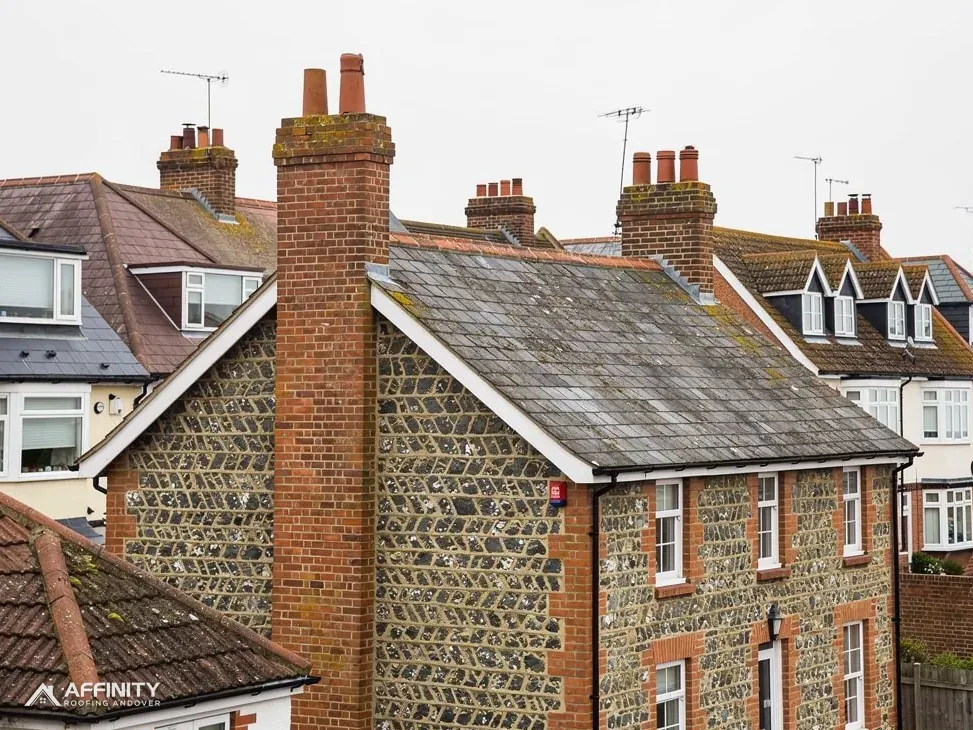
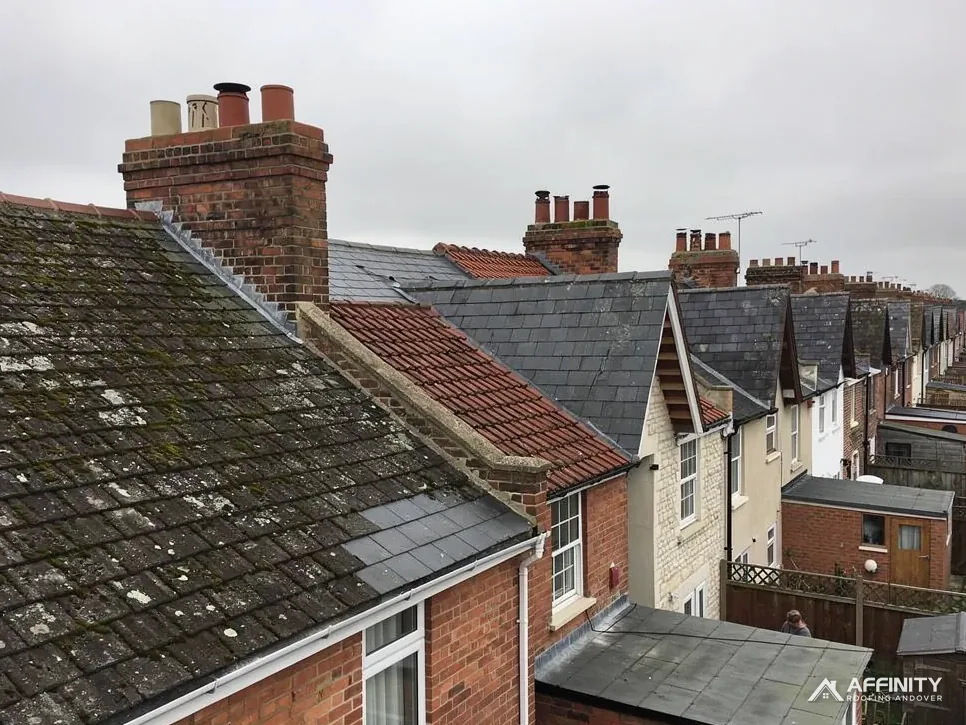
On a street of period houses, the fixing is part of the roof's appearance, and councils notice. Small details such as a visible hook can matter to a planning officer more than the owner expects, because the officer is judging the street as a whole.
What shows
A traditionally nailed roof shows nothing of its fixings. Every slate presents a clean, flat tail. A hooked roof shows a short line of metal at each tail, in a regular pattern, which can read as a modern detail. From the street, the effect is small, and from a first-floor window it is plain.
What a council may expect
Councils vary in how closely they scrutinise fixing details. Basingstoke and Deane's advice for the Article 4 conservation areas of Basingstoke town asks owners to retain original Welsh slate and clay tiles, which shows how some planners think about authenticity. In the Andover area, what applies at your address is for Test Valley Borough Council's planning team to say, including whether an Article 4 direction is in force. Our guide to slate roofs in conservation areas deals with consent.
Listed buildings
On a listed house, the detail is part of what was listed. A hook replacing an original nail fixing is a change that the council may regard as affecting character. Ask first and file the answer with the quote.
Matching what is there
The simplest rule is to fix the new slates the way the old ones were fixed, unless the old method has failed or the pitch rules it out.
Wind, edges and extra security
Wind tries to lift slates from underneath, and the fixing has to resist it. The effect is not the same everywhere on a roof.
Where the load is greatest
The edges of a roof take the highest uplift: the eaves, the verges at the gable ends, the ridge and the hips. The middle of a slope is calmer. For this reason, slaters often add extra fixings at the edges, such as a second nail, a clip under the tail or a stronger hook. BS 5534:2014+A2:2018 is the British Standard behind slate and tile fixing, and the fixing specification follows from the roof's height, shape and position.
Position matters more than postcode
A roof on a tall building, a roof on an open hilltop and a roof on a sheltered terrace all deserve a fixing plan that suits them, wherever in the Test Valley they stand. Your slater should explain the plan used on yours, including what extra fixings go in and where.
Tails and clips
Where slates are laid at a low pitch, the tails can chatter in a gust. A clip or a hook that holds the tail down stops that. This is another reason that hooks and nails often appear together.
Dry verge and ridge
At the edges of the roof, mortar by itself is not relied on. Marley notes that the 2014 revision of BS 5534 made that clear, and BS 8612 is the test specification for dry-fix verge, hip and ridge systems.
Questions to ask your slater
A short conversation before the work starts tells you whether the fixing has been thought about. The questions are not trick questions. A good slater answers them readily, and has usually asked them already of the roof.
Which fixing, and why?
Ask which method the roof will use, and what pitch the survey measured. If the pitch is below 25 degrees and the answer is hooks, ask how that squares with the manufacturer's advice.
What nails?
Ask the metal and the length. Cheap galvanised steel is not a match for slate that will last for generations, and steel is the first nail to rust through.
How many per slate?
Two nails per slate is usual. Ask whether any extra fixings go in at the eaves, verges, ridge and hips.
What will show?
Ask what the finished tail will look like. If a hook will be visible and the house is in a conservation area or is listed, ask whether the council has been consulted.
What is in the quote?
Ask for the price in writing as a single total, so fixings, battens, underlay and waste all sit inside it. The Citizens Advice advice on home improvements is to gather quotes from 3 traders or more.
Our slate roofing page sets out the wider job and what each stage involves. Write down the answers you are given, because a fixing specification is far easier to check on paper than to recall from a conversation on the doorstep.