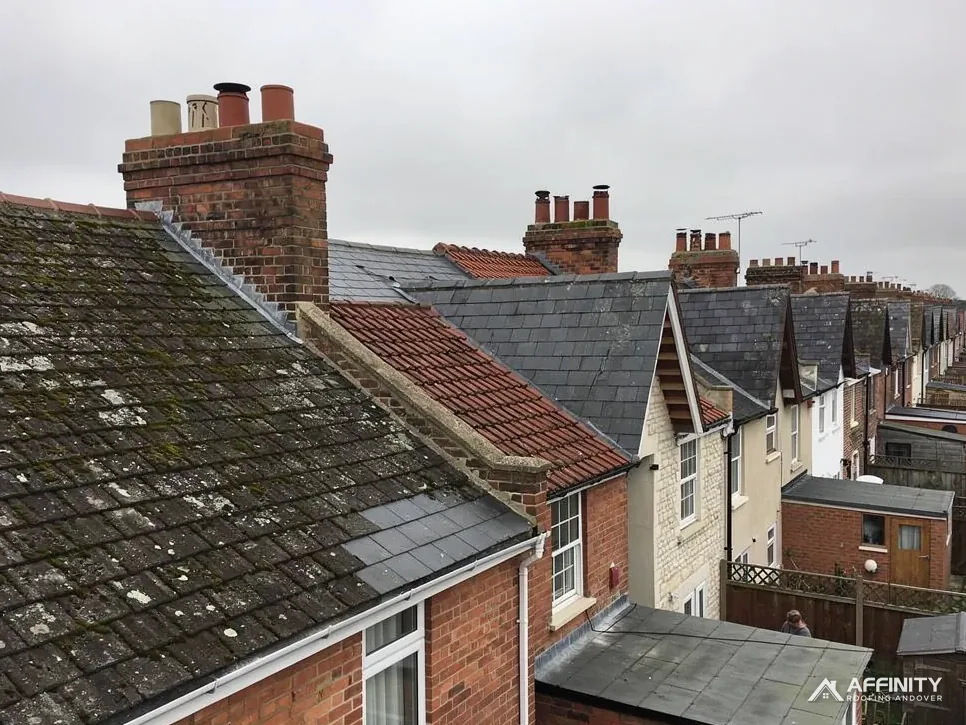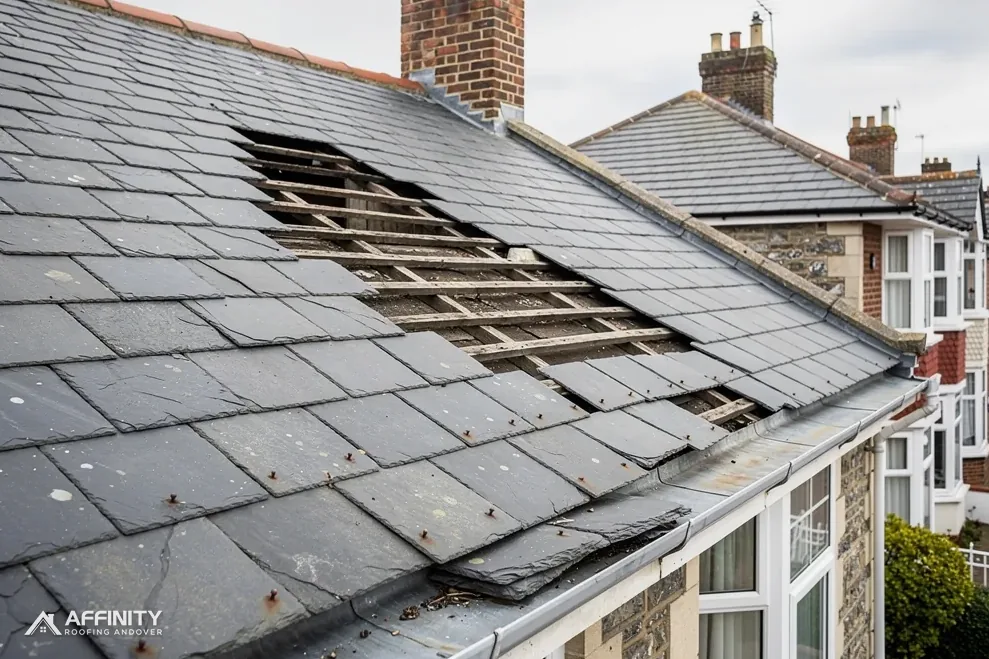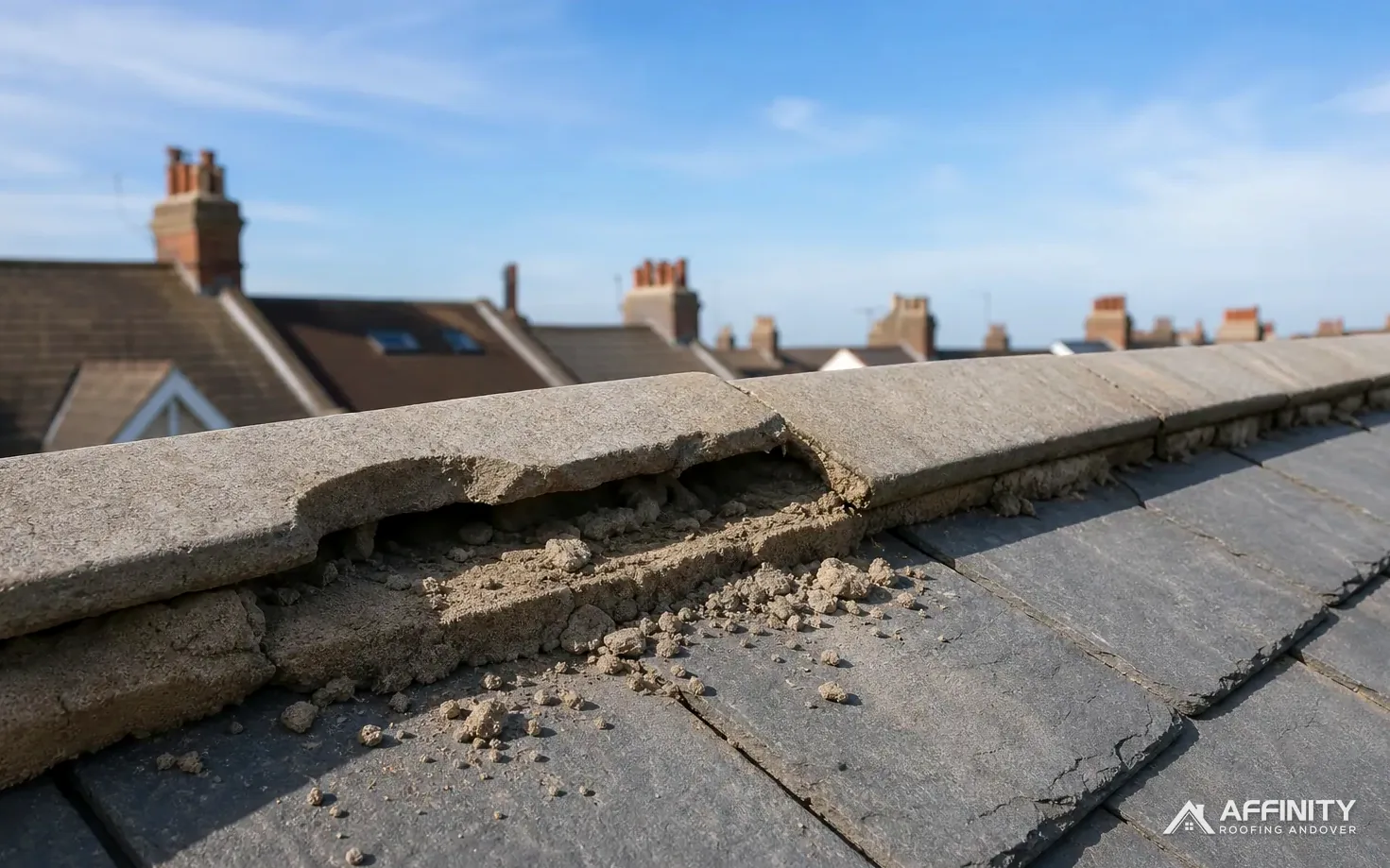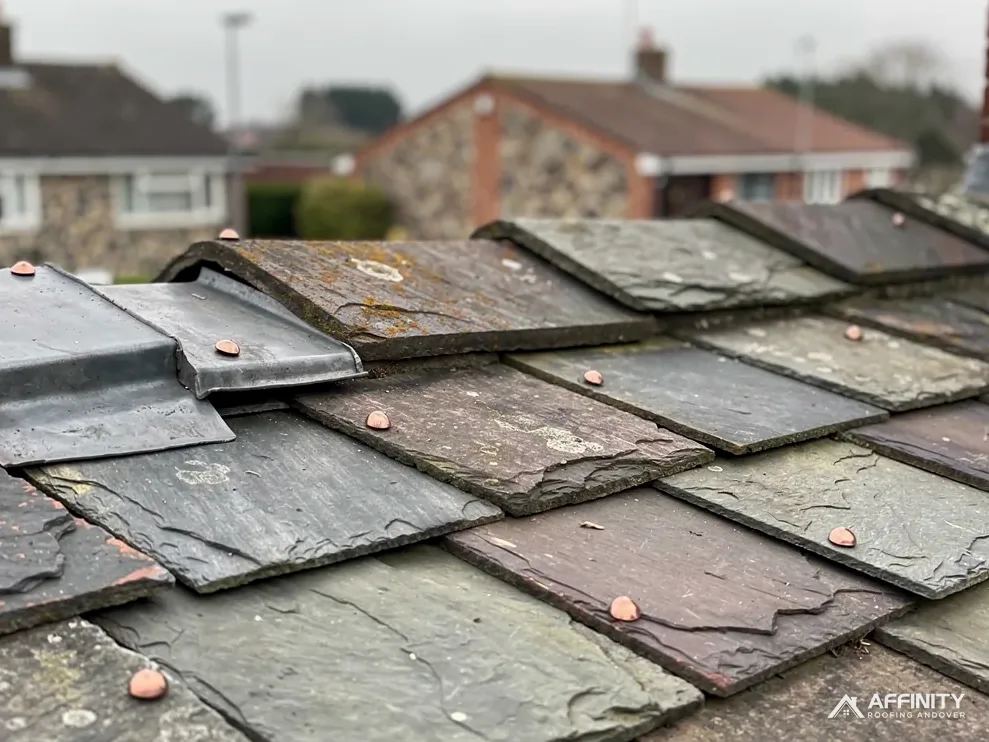
From the pavement, an old fibre-cement slate looks very like a natural one. It is thin, flat and grey, laid in neat courses, with a hint of green where moss has taken hold. Up close it is a manufactured sheet of cement reinforced with fibres, and on many older roofs those fibres were asbestos.
Asbestos cement in good condition is stable. The danger arrives when a sheet is broken, drilled, scrubbed or crushed, because that releases fibres into the air. A leaking or mossy old slate roof is therefore not a job for a ladder, a stiff brush and a free weekend. The Health and Safety Executive (HSE) publishes clear guidance on the material, and we follow it.
The sections below cover why the year 2000 matters, what makes a roof fragile, the gap between careful lifting and breaking sheets up, how the waste has to travel and what your options are. It is general information. A survey and, where needed, a laboratory result settle the facts for your own roof.
Why the year 2000 is the line
For a building from this period, HSE's advice is blunt: presume asbestos wherever the construction or refurbishment dates from before 2000. That is a precaution, not a diagnosis. You treat the roof as asbestos-containing until a test shows otherwise, and you avoid any work that could disturb it.
Why the eye cannot tell
Asbestos cement and its modern asbestos-free equivalents were made to look alike. Colour, thickness, edge profile and surface texture are poor clues, and moss and weathering change both. Only a sample, taken with the right controls and analysed in a laboratory, says what a particular slate is.
Roofs with more than one date
A house built in the 1930s may have been re-covered in the 1960s, and a house from the 1990s may have gained a rear extension in that decade, with its own covering. Each part of a roof has its own date. A porch, garage or extension may wear a different covering to the main house, so the pre-2000 rule is applied part by part, by the date each was built or last re-covered.
Finding the age
If you do not know the age of the covering, look for paperwork: an earlier survey, a seller's pack, an old building control certificate. Our survey adds photographs of the slates, fixings and edges, which feed the decision about sampling.
Begin with the question of what the roof is made of. Any action comes after the answer. Ask the seller, the previous owner or the neighbour with a matching extension whether any survey was ever done, because a document from twenty years ago can save a sampling visit.
A fragile roof is a hazard before any removal
HSE's guidance on this material is that a roof of it is fragile every time, whatever it looks like. The warning is about people as much as the sheets, and it shapes how every visit is planned. A sheet can look sound and still give way under a person's weight, and a fall through a roof is a serious injury before any fibre is considered.
What fragile means in practice
Nobody should walk across an old fibre-cement roof, lean a ladder against its face or lay boards on it as though they would spread the load. Look from the ground or from a scaffold platform, and organise the work so that nobody has to step on the covering. Many accidents happen during gutter clearing or while chasing a leak, when someone steps onto the slope without thinking.
Moss makes it worse
Moss holds water against the surface, and winter frost can open fine cracks. The surface becomes slippery as well as brittle. Marley does not recommend jet washing slates or tiles, and on an old asbestos-cement roof it is far worse, because abrading the surface can throw fibres and fragments into the garden and towards neighbouring windows. If moss worries you, tell us and we will assess it during the survey.
Access comes first
A fragile roof needs edge protection, crawling boards or a scaffold platform at eaves level, depending on the work. For an Andover address, the licence for a scaffold that blocks the road or pavement comes from Hampshire County Council under the Highways Act. Scaffold erected wholly within your own plot needs no highway licence. We arrange access before any work starts and tell you what to expect each day.
The first stage of any job on this kind of roof is a safe way to reach it, long before the first slate moves.
Careful lifting and what it must not become
HSE separates asbestos cement that is handled with care from asbestos cement that is broken up. The difference changes the paperwork and the controls on site.
Non-licensed work
Under HSE's list, roof sheeting and rainwater goods made of asbestos cement are non-licensed work when they are lifted out carefully, without being broken. HSE adds that weathered material still counts, provided it is not otherwise substantially damaged. A sound slate released whole from its fixings fits that description.
Notifiable non-licensed work
Once sheets are going to be shattered or crushed in the process, the job moves up a category into what HSE calls notifiable non-licensed work. That brings notification, medical surveillance and written records, and the register of work, which acts as a health record, is kept for 40 years. This is why smashing old sheets into a skip is both dangerous and a regulatory problem.
Boards under the eaves
Roofs may also carry asbestos insulating board (AIB), found in places such as external soffits. HSE notes that AIB is difficult to tell apart from non-asbestos boards. HSE treats AIB work that is going to last longer than a short job as licensable. For that reason the soffits and the boarding under the eaves are checked first and kept separate from the slate question.
We list the categories because homeowners ask which one applies. HSE sets them according to the material and what is done to it, and no roofer can pick a category by preference, and a competent surveyor and, where needed, an analyst decide for your roof. The aim is always the same: lift whole, bag at once, leave the site clean.
Waste: wrapping, labelling and carriers
The route the slates take away from the property deserves the same attention as the lifting. Asbestos waste is hazardous waste, and the rules are stricter than for ordinary rubble.
Wrapping and labelling
For removal work, HSE says to wrap asbestos waste twice and label it. Sheets go flat into heavy polythene, sealed, wrapped again and marked. They are never thrown, dropped from height or stacked loose, and the wrapped load waits somewhere secure until collection.
Never an ordinary skip
Asbestos waste is kept out of uncovered skips and out of the ordinary rubbish stream. HSE accepts a lockable or sealed skip for suitable asbestos cement waste, which is a container nobody can tip, open or add to. A builder's skip left on the drive with its top off is out of the question.
Consignment notes and carriers
Asbestos waste moves on a hazardous waste consignment note. The household exemption from consignment notes covers domestic hazardous waste other than asbestos waste, so ask your council before taking any in your car. The carrier needs upper-tier registration with the Environment Agency, and you may ask to see it.
Questions worth asking
Ask where the waste will go, what the note will show and who carries it. A tidy firm answers without hesitation, and a vague reply is a reason to ask again. Ask, too, what happens to the polythene, the gloves and the suits used on the job, because those are asbestos waste as well and should be wrapped and carried the same way.
Our slate roofing page explains how a conventional slate roof is stripped and relaid, which gives context for what changes when the slates are asbestos cement.
Leave it, repair it or replace it
An asbestos cement roof that is in good order and left alone is not an emergency. The right move follows how the roof is behaving.
Leave it and watch it
If the sheets are whole, dry underneath and undisturbed, doing nothing is a legitimate choice. Photograph the slopes from the ground, note new cracks or slipped slates, and keep climbing, drilling and scrubbing well away. Have a surveyor look from a safe position now and then, especially after storms.
Repair
Spot repairs on a fragile roof put someone on or near the material every time. Swapping a single cracked slate for another of the same type is not simple, as the fixings may have corroded and the neighbours may be brittle. A repair suits a small, contained fault. A roof with many slipped or cracked slates has usually passed that point.
Replace
When the covering is failing, replacing it brings the roof up to current standards and ends the repeated risk of disturbing old sheets. MyJobQuote gives around £2,750 for asbestos roof removal, a typical UK figure (MyJobQuote, Sep 2026). Your own total depends on the roof area, access, how the sheets are fixed, the waste route and the new covering.
What goes on instead
The new covering might be natural slate, modern fibre-cement slates with no asbestos, or a tile. Our guide to natural slate versus fibre-cement slate compares the slate options. Building Regulations approval, with a structural opinion, comes into play if the new covering weighs 15 per cent or more than the old. For planning, re-roofing a house is normally Class C permitted development, though a conservation area or a listed house needs a harder look. Whether an Article 4 direction reaches your address is for Test Valley to confirm.
What the survey does and does not do
A survey of a suspected asbestos-cement roof is slower and more careful than an ordinary inspection, and that is deliberate. The slates are the obvious subject, but the gutters, the flashings, the rooflights and the outbuildings often turn out to matter just as much.
Looking without touching
The roof is studied from the ground, from the loft side and, where access is safe, from a platform. Photographs cover the slates, their fixings, the ridge, the verge edges, the soffits and the gutters. Cracks, slipped slates, moss and earlier repairs are noted. Nothing is lifted, scraped or cut at this stage, and the photographs give you a record to show anyone else you consult.
Sampling, if it is needed
A sample goes to a laboratory when the age or look of the roof leaves doubt. The sampling is controlled, the cut edge is sealed and the piece is bagged. The result tells you whether the slates contain asbestos, and from that the route follows. If they do not, the job becomes an ordinary slate or fibre-cement repair or re-cover.
What you receive
You get photographs, a plain account of the findings and a recommendation, then one written price for the chosen route, with nothing started until you agree to it. If asbestos is present, the price covers controlled removal, the waste and the new covering. If it is absent, the price covers whichever repair or re-cover suits the roof.
Related cost guide
Where the roof is tired and replacement is coming, read what a new slate roof costs for the published prices and what moves them.