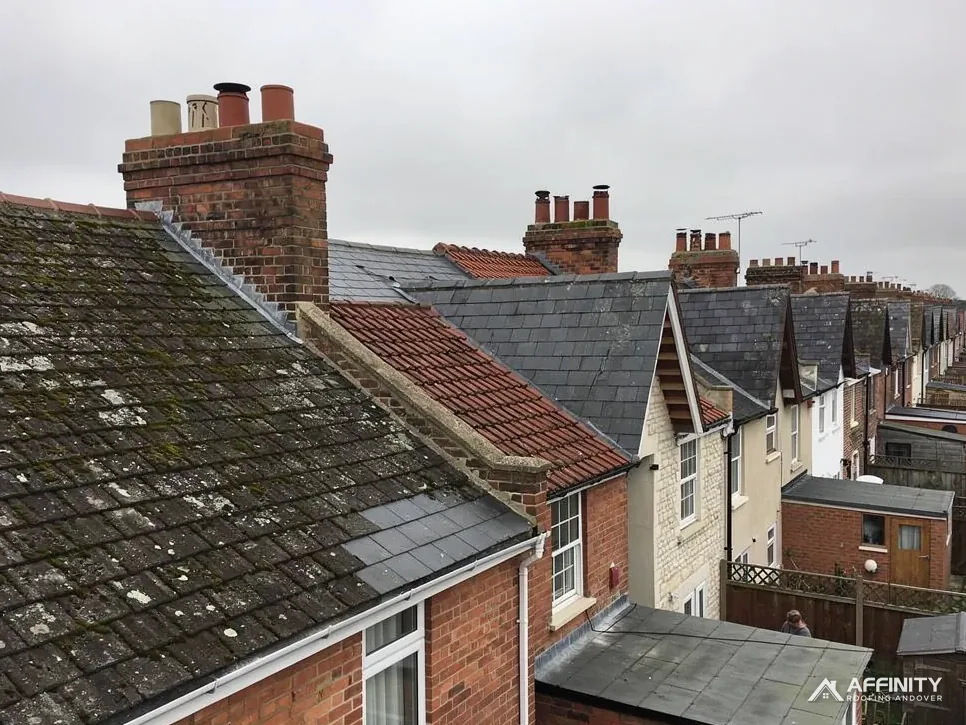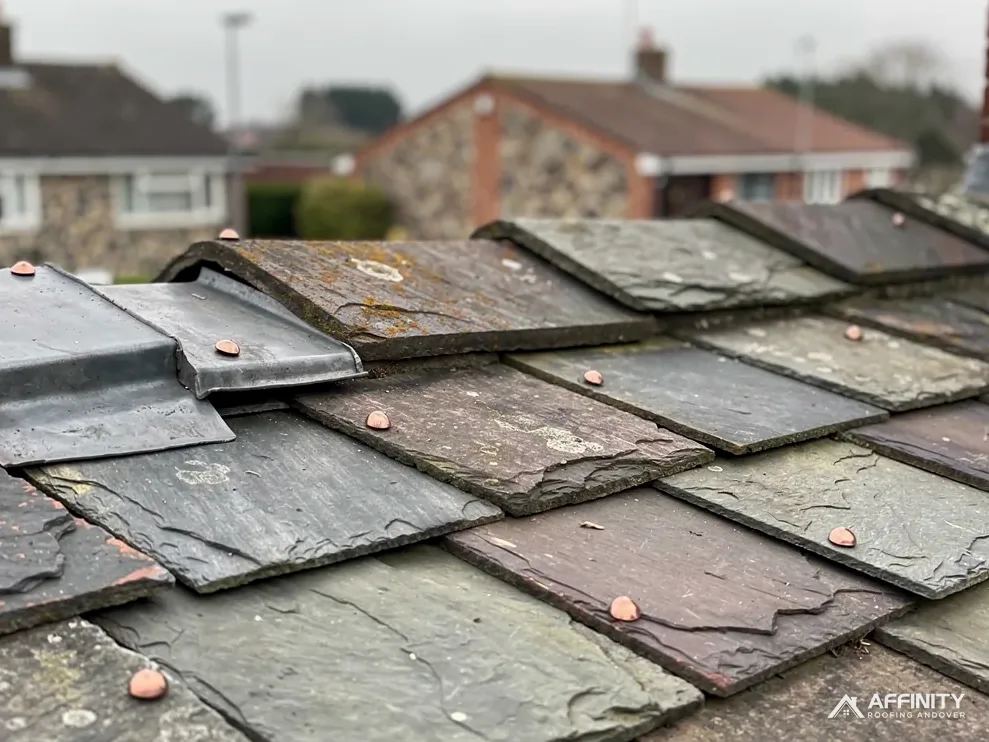
A homeowner choosing a slate roof in Andover meets two very different products under one name. Natural slate is split from quarried rock, so each piece has its own grain, thickness and slight irregularity. Fibre-cement slate is a manufactured sheet, pressed from cement reinforced with fibres, cut to a regular size and coloured in the factory.
The two can look similar from a distance, and the price gap makes it tempting to treat them as interchangeable. They are not. They age differently, they weigh differently, they carry different life expectancies and, in a conservation area or on a listed house, a council may accept one and refuse the other.
This guide compares them point by point: what they are made of, how many years each is likely to give, what the published cost sources say, how they look on the roof, how a council is likely to see them and what a sensible choice looks like for different houses. The figures come from named sources, quoted as typical ranges and never as guarantees.
What each product is made of
The materials explain nearly everything else on this page, so they come first. A quick look at how each is produced shows why one keeps its colour for generations and the other is judged on its surface finish.
Natural slate
Natural slate is a metamorphic rock that splits cleanly into thin sheets along its cleavage plane. Quarries in Wales, Spain, Cornwall, Cumbria and elsewhere supply it, and each source has its own colour and finish. Welsh slate tends to be sold as the premium material, and Spanish slate is the common, lower-priced import. Reclaimed slate is old stock lifted from other roofs and reused.
Fibre-cement slate
A fibre-cement slate is a manufactured flat sheet of cement, sand and reinforcing fibres, pressed and cured in a factory. Modern products use non-asbestos fibres. Older products, from before 2000, may contain asbestos, which is a separate and serious matter covered in our guide to old fibre-cement slates and asbestos.
Why the difference shows
A natural slate keeps its character as it weathers, with its colour holding and its surface showing the rock's grain. A manufactured slate depends on its surface finish, which can fade, chalk or collect moss in a way that natural stone does not. Neither is better in every circumstance. The choice follows the building, the budget and the planning position.
Both sit on the same battens and underlay, and both need correct fixings. The slate roofing page covers the build-up beneath either covering, including the underlay and ventilation that decide how the timber below stays dry through the winter months.
Side by side: life, cost, look, weight and consent
The table below sets the published figures next to each other, so that a reader can see the gaps at once, with each source named. All lifespans are typical ranges and not promises. Everything in the cost row is a typical UK figure and never a price from us.
| Point | Natural slate | Fibre-cement slate |
|---|---|---|
| Typical life | Welsh 100+ years, Spanish 75 to 100, reclaimed Welsh 50 to 80 (HomeBuilding, Sep 2025) | 30 to 40 years, given by HomeBuilding for fibre-cement (Eternit) tile |
| Cost band | Average new slate roof around £7,800 (MyJobQuote, Oct 2026) | Priced for your roof after the survey, because product ranges differ widely |
| Look | Varied grain, edges and tone, even within one batch | Uniform size, edge and colour |
| Weight | Read the product data sheet for the slate you choose | Read the product data sheet for the slate you choose |
| Conservation areas | The usual expectation where the original roof is slate | The council decides; artificial slates are named as unlikely to be acceptable in some areas |
A new covering that weighs 15 per cent or more than the one it replaces triggers Building Regulations approval along with a structural check, so the weight row carries the most consequence when you change material. Get the manufacturer's data sheet for each product you are weighing up, and show the figures to the surveyor before anything is ordered, as a small difference per slate adds up across a whole roof.
Lifespan: a range, never a promise
Life expectancy is where the two products part company most clearly, and where the sources are easiest to misread.
Natural slate
HomeBuilding & Renovating's table of materials, last updated on 30 September 2025, gives Welsh slate as 100+ years, Spanish natural slate as 75 to 100 years and reclaimed Welsh slate as 50 to 80 years. Those ranges describe the slate itself. A roof's actual life depends on whether the nails corrode, whether the battens stay sound, how the ridge and flashings behave and whether anyone damages the slates by walking on them.
Fibre-cement
The same HomeBuilding table gives fibre cement (Eternit) tile as 30 to 40 years. That is a product listed as a tile, so use it as a guide to the material and not as a promise for any particular slate. A manufacturer's warranty is a different matter from a lifespan, and a warranty is not a promise that the roof will last that long.
What the gap means for you
A longer-lived covering can make sense over a long ownership period, or on a house you intend to hold. If you plan to sell within a few years, a shorter-lived product may satisfy a buyer's surveyor equally well. The right answer is personal. What does not change is that lifespans are ranges, and a roof laid badly will fail early whichever product it uses.
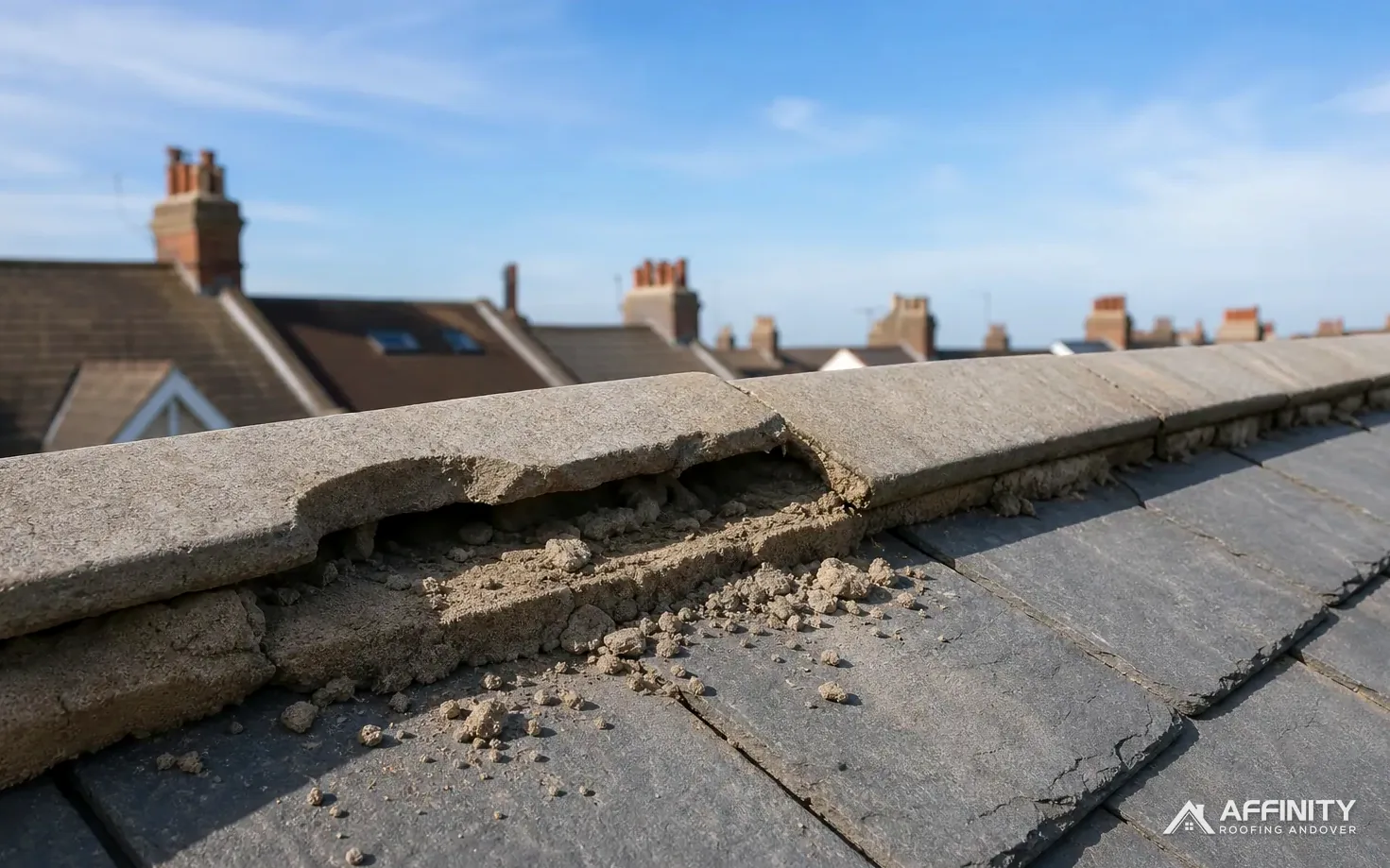
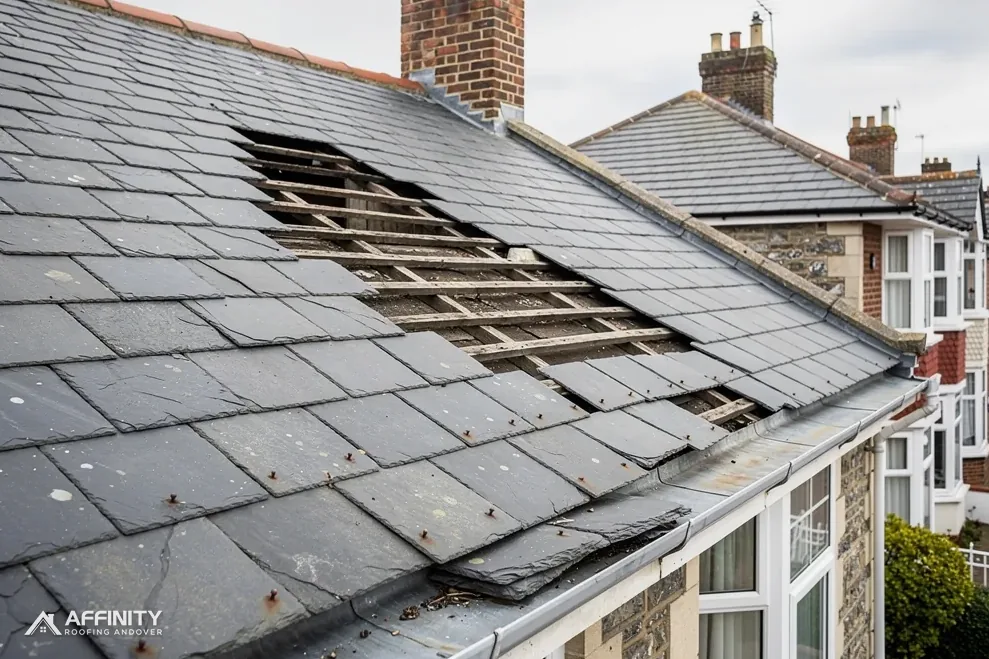
Underneath either covering, the battens, underlay and fixings can fail before the slate. The decision about the slate should be made alongside a decision about those parts, and not in isolation.
What the cost sources say
Cost is a natural first question, and the straight answer is a set of ranges with caveats attached.
The natural slate anchor
Fitting a slate roof averages around £7,800 on MyJobQuote's cost page (MyJobQuote, Oct 2026). Treat that as a typical UK figure. A real total moves with the roof area, the pitch, the access, the state of the timber underneath and the slate you pick.
Welsh against Spanish
HomeBuilding's supply-only table prices Spanish natural slate and Welsh slate per square metre, with Welsh priced at roughly 2.5 times Spanish. These are supply-only prices per square metre, so we use the ratio and never multiply a per-square-metre figure into a total. The ratio tells you which slate is the premium choice and roughly how much the supply cost moves. Our guide on Welsh or Spanish slate goes through it in detail.
A whole-roof comparison
HomeBuilding runs a worked example too: a three-bedroom semi with 65 square metres of roof, finished in plain concrete tile, at £10,000 to £15,000, against a possible £18,000 if the same house went to Welsh slate. It shows how much a slate choice can lift the total, though the comparison is with concrete tile and not with fibre cement.
Fibre-cement slate
No separate typical range for a re-cover in fibre-cement slate is carried here, because product lines and thicknesses differ widely. Ask for each option to be quoted as a single total after the survey, and compare like with like, checking whether scaffold and VAT sit inside the figure. The roof area, the pitch and the access will matter as much as the choice of sheet.
Look, weathering and the conservation question
On a street of old houses, the look of the roof is not a matter of taste alone. It is part of how the area reads, and councils treat it that way.
How they look from the road
A natural slate roof has a quiet variation. Slates differ slightly in thickness and tone, edges catch the light unevenly and the roof shimmers a little after rain. A fibre-cement slate roof is more regular, the courses are evenly spaced and the colour is consistent. On a new-build street this looks fine. On an old terrace the contrast with neighbouring natural slate can be obvious.
What a council has said
Basingstoke and Deane applies Article 4 directions to four of its town conservation areas. Its advice there asks owners to hold on to the original roofing, naming Welsh slate and clay tiles, and describes concrete tiles and artificial slates as unlikely to be accepted. That is one council's position for its own streets. It shows how some planners think, and it is not a rule for Andover.
Andover
Andover has its own conservation area, with a boundary supplied by Test Valley to planning.data.gov.uk. Test Valley's Article 4 position is not something we can state, so ask the council's planning team whether a direction applies at your address and whether it would accept a manufactured slate on a roof that was originally natural. Our guide to slate roofs in conservation areas covers the consent side.
A listed house is a separate question, and there the council's expectation of natural, matching slate is stronger still. Asking early saves a refused application and a second round of ordering, which is the dearest way to find out.
Choosing between them for your house
No product wins in every circumstance, so here is how the choice breaks down by situation.
An older house in a conservation area
If the existing roof is natural slate, replacing it with natural slate is the safest route with the council and the one that best respects the building. The extra cost buys the planning position as well as the stone, and it removes the awkward question of how a mismatched patch will look in ten years' time.
A 1930s to 1990s house with no designation
Where no planning designation applies, the choice is mostly about budget, appearance and how long you will own the house. A manufactured slate can give a clean, even finish at a lower supply cost, though the shorter life range is worth weighing. Whether a particular product is cheaper overall depends on the written quote for your roof.
A roof that is already fibre cement
If the existing slates are thin grey sheets of uncertain age, find out what they are before choosing. A pre-2000 roof is assumed to contain asbestos until tested.
A heavier or lighter covering
Changing from a light covering to natural slate may add enough load to need a structural check. Building Regulations approval is needed once a new covering is 15 per cent or more heavier. We raise the question on the survey, not afterwards.
Whichever you choose
Ask for photographs of the existing battens and underlay, a plain account of what will be replaced and one written price. Both products fail early if laid on rotten timber, and a good slate on a bad batten is still a bad roof. So the survey lifts a few slates and checks the timber below before any material is chosen.