Slate has a reputation for lasting a lifetime, and the reputation is mostly deserved. A quarried natural slate is hard, dense and slow to weather. Yet slate roofs do reach the end of their working lives, and when they do the cause is rarely the stone. It is the small metal nails that hold each slate to its batten, rusting away behind the overlap where nobody can see them.
The result is a roof that looks fine from the road and then starts shedding slates one at a time. The usual diagnosis is nail sickness, the roofing trade's term for fixings that have corroded to the point where they can no longer hold. It leads to the question owners most want answered: is this a repair, or is it time to re-slate?
This post gives typical lifespans for slate from a published cost guide, explains how nail sickness and its signs work, sets out when repair beats replacement, and describes re-slating with reclaimed slate. It also covers the minimum pitch for slate, the planning side for old Andover streets and a typical UK cost.
Typical lifespans, and what they mean
HomeBuilding (Sep 2025) publishes lifespans for slate in its table of roof coverings. For Welsh slate it gives 100+ years. For Spanish natural slate it gives 75 to 100 years, and for reclaimed Welsh slate 50 to 80 years. These are typical ranges, never promises, and they describe the stone, not the roof as a system.
The distinction matters because a roof is made of more than slate. Each slate hangs on a timber batten and is held by nails. Beneath the battens lies an underlay, and around the edges sit the lead flashings, the ridge and the verges. Each of those parts has its own life. A Welsh slate that could last a century can be on a roof whose nails gave out sixty years ago.
This is why age alone settles little. A slate roof that is 120 years old and still sound is not unusual, and one that is 60 years old and shedding slates is not either. The fixings, the battens and the detailing decide how long a particular roof lasts, together with how well it has been maintained.
The three types in the table differ in origin and in price. Welsh slate is the traditional premium choice. Spanish slate is the more common choice for new work, and reclaimed slate has already had one life and is sold for repairs and conservation work. HomeBuilding's per-square-metre prices are for supply only, with no labour, so we quote a ratio: Welsh slate is dearer than Spanish, by a factor of about two and a half.
The answer for your roof depends on what you have now.
Nail sickness: what fails and how to spot it
A slate is fixed near its top edge with two nails driven through holes punched in the slate and into the batten behind. The slate in the course above overlaps those nails, so they are hidden and sheltered, and on a good roof they stay dry. When they do not, they corrode. A nail that was iron or poorly coated slowly rusts, thins and snaps, or rusts into the timber so it no longer grips.
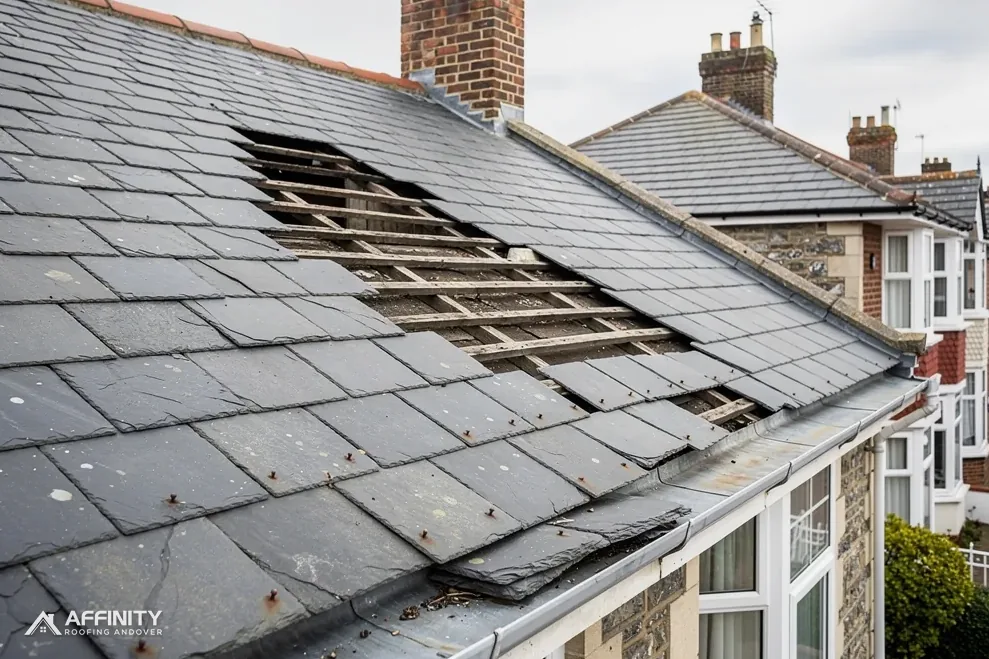
The slate then has nothing to hold it except friction and the overlap of its neighbours. In wind, or under the weight of a person, or just through gravity, it begins to slip down. That is nail sickness, and it tends to be general: if one fixing is going, so are the ones around it.
Some of it shows from the garden. A slate that sits lower than its course leaves a ragged line, and a gap marks where one has fallen. Broken pieces on the path or lawn are another clue, and so are slates that have slid and are held only by their tails. Inside, daylight at the roof edge or damp patches on a ceiling are the later signs.
A roofer confirms it from close up. A few slates are lifted and the nails are inspected. Rusty, thin or snapped nails across the area mean the problem is systemic. Clean, firm nails and a handful of broken slates mean it is local.
If you have several slipped slates and want to know why, our guide to slipped roof slates explains what each pattern indicates.
The nail sickness diagnosis matters because it changes the right repair. Replacing one slipped slate at a time on a roof with failing nails is a short-term answer that gets repeated every winter.
Repairing slate: tingles, hooks and limits
Where only a few slates are affected, a repair works well. The lost or broken slate is replaced and held with a small strip of metal fixed to the batten that curls up behind the slate above and locks the new one in place. The trade calls these strips tingles. Each one marks a repair, and a roof with a scatter of them has been mended before.
Slate hooks are a related method, using a stainless hook in place of a nail. Cupa Pizarras recommends keeping hook fixings off any pitch below 25 degrees, and notes BS 5534's 20-degree minimum for natural slate; check the data sheet too. Pitch decides what is possible, so check it before you accept a method.
A repair suits a confined fault, where the slates around it are sound and the nails nearby are in good condition. It also suits a house you are selling, or one waiting for a bigger job, where the roof just needs to stay watertight meanwhile.
It stops making sense when repairs recur across several slopes, when the nails are corroded throughout, when slates are delaminating into layers, or when the battens beneath are soft. At that point you are paying again and again for a roof that will not hold.
For scale, MyJobQuote (Oct 2026) quotes around £7,800 as the typical UK figure for fitting a whole slate roof. Your own price depends on the area, the slate chosen, the access and what lies beneath, and our written quote follows a survey.
The signs in the roof, not the age of the house, tell you which side of the line you are on.
Re-slating, and reclaimed slate
Re-slating means stripping the slope, renewing what is beneath and laying the slates again. On a sound roof with failing fixings, it is often the sensible middle course between endless patching and a brand new covering.
The process is straightforward in outline. The slates are taken off carefully, sorted and stacked. The battens and underlay are inspected and renewed where needed, and the nails are replaced with new, corrosion-resistant fixings. The good slates go back on, with new ones, or reclaimed ones, filling the gaps from those that broke.
Reclaimed slate comes from other roofs and is cleaned and sorted. HomeBuilding gives reclaimed Welsh slate 50 to 80 years, a shorter figure than new Welsh slate, which makes sense because it has already served a life. Its advantages are that it matches an existing roof in colour, texture and thickness, and that it keeps the character of an older building. Its drawbacks are variable quality and the need to sort it carefully. Our guide to reclaimed roof slates explains what to look for.
How many of your existing slates can be reused is the question that sets the cost. If most come off intact, re-slating is far cheaper than new slate throughout. If many snap during lifting, the saving shrinks. A good roofer will say what to expect before stripping, and will photograph the slope as it comes off.
The underlay deserves attention at this point. It is easy to replace while the slope is open and impossible to reach once it is closed.
A re-slate leaves the roof looking much as it did, and it can extend the working life of slates that were nearly done. Our slate roofing work follows this pattern, and a re-slate is one of its common outcomes.
Slate in older streets and conservation areas
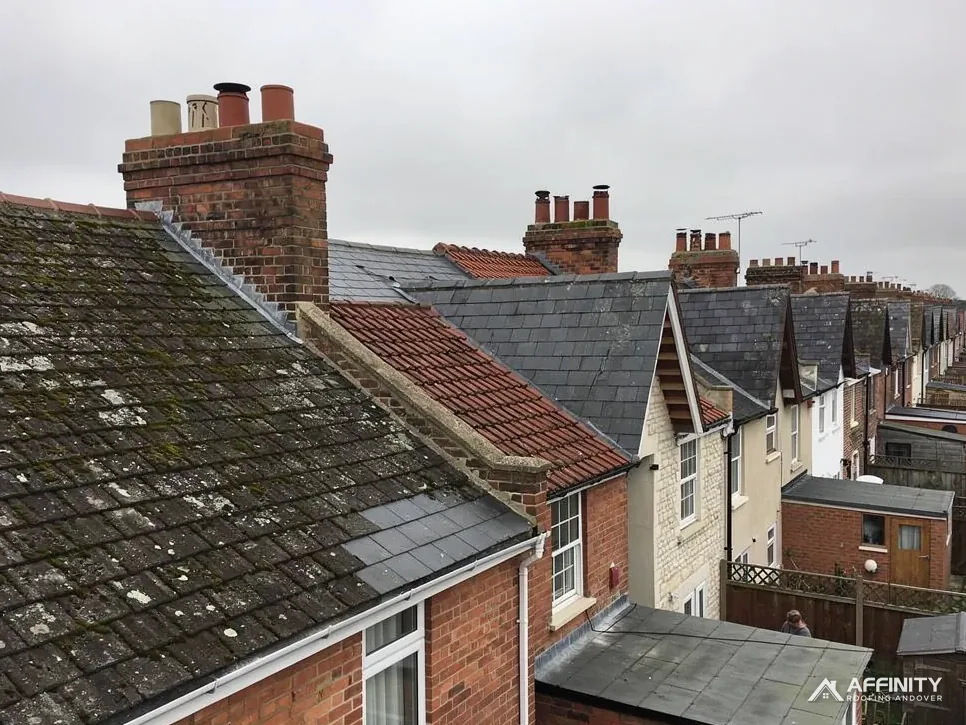
Slate suits many older buildings, and in a protected setting its look is part of the character. Andover has a conservation area, and several of its landmark buildings are listed Grade II*. What a particular street is roofed with can only be told from the roofs themselves.
In practice the planning side comes down to three checks. First, Class C normally lets you re-cover a house, so like-for-like re-slating of a house is normally permitted development, and a conservation area is article 2(3) land with no Class C exclusion. Second, an Article 4 direction can withdraw that right, so ask Test Valley Borough Council's planning team whether one covers your street. Third, a listed house also needs consent as a listed building, since swapping the slate changes its character.
Councils elsewhere can be specific. Basingstoke and Deane's own Article 4 guidance for four town conservation areas wants the original Welsh slate and clay tiles retained, and warns that concrete tiles or man-made slates will probably be refused. Those rules cover Basingstoke's own streets, but they show how seriously some authorities treat natural slate.
Any replacement of slate with a heavier covering is a Building Regulations matter too, because a switch that makes the roof 15 per cent or more heavier needs approval, with the structure checked first.
Our guide to a slate roof in a conservation area goes through the consent steps.
A church roof follows another route again, because worship buildings of the Church of England use the faculty system.
Deciding: repair, re-slate or replace
A few plain questions point to the right answer.
- How many slates have slipped, and are they in one area or spread across the roof?
- What do the nails look like when a few slates are lifted?
- Are the battens firm, or soft and split?
- What is the underlay like beneath the slates?
- Is the roof pitch above the minimum for the fixing method in use?
- Does the house sit in a conservation area or carry a listing?
If the nails are sound and the damage is local, repair. If the nails are failing throughout but the slates and battens are good, re-slate, reusing what you can. If the slates are delaminating, the battens are rotten and the underlay has gone, a new covering is the honest answer, with reclaimed or new slate depending on what planning allows.
Ask a roofer for photographs of each of those things, taken on your roof, and ask them to explain what they show. A fair verdict rests on evidence you can see.
Treat any lifespan figure as a range, not a promise. HomeBuilding's 100+ years for Welsh slate describes the material at its best, and a roof reaches it only if the fixings, battens and detailing last too.
Do not assume that a slate roof must be replaced because it is old. Equally, do not assume that it is fine because it looks it from the road. A survey costs little, and it settles the question with evidence.
Our survey photographs the slope, the nails and the battens and explains them in plain words, then prices the option that fits as one written total. Where a repair is all you need, the repair is what gets quoted.