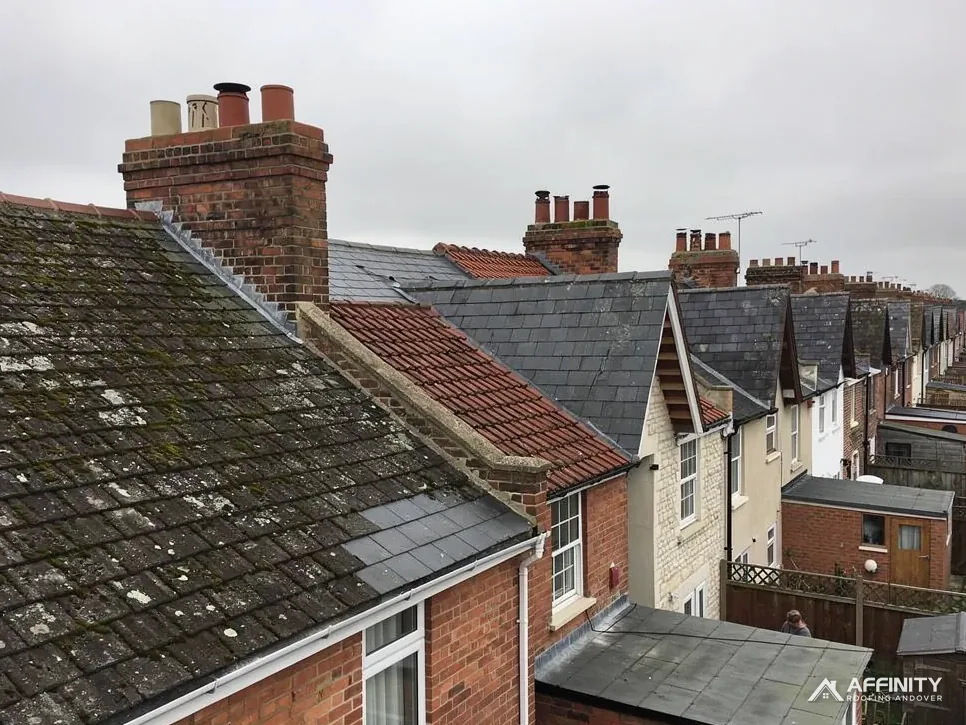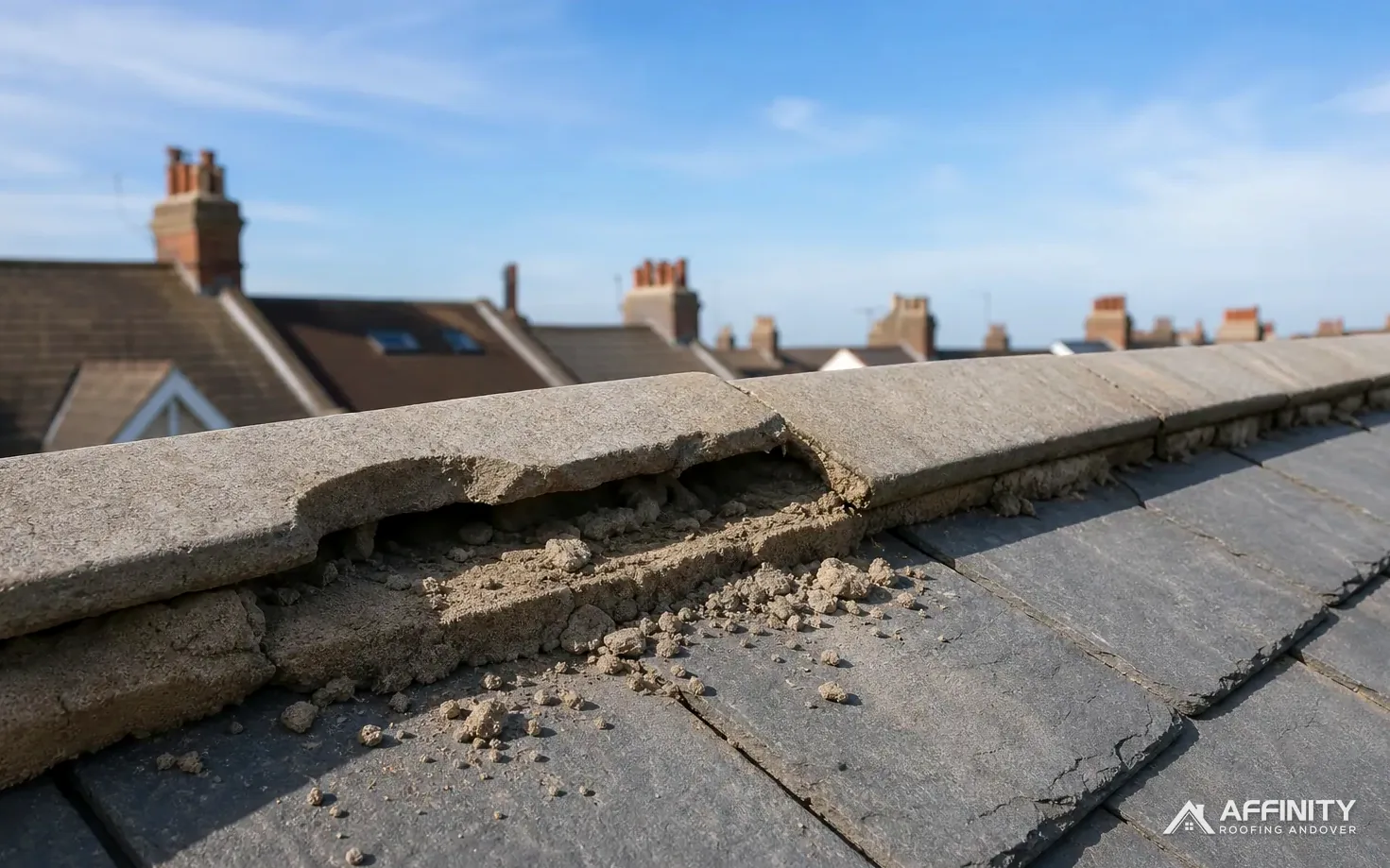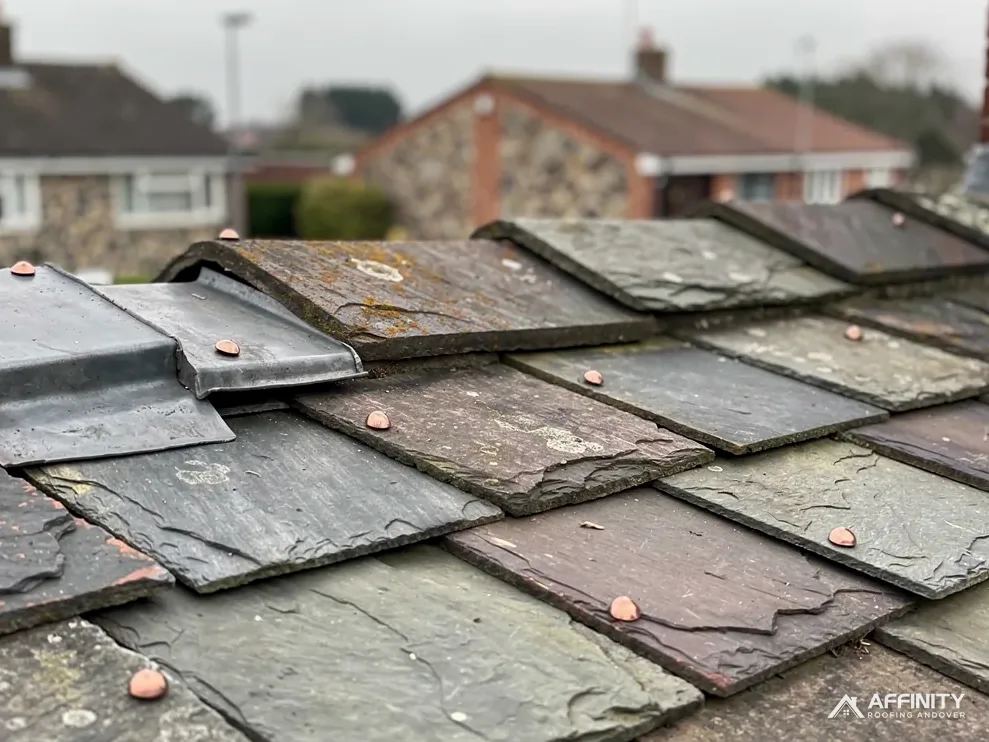
Conservation areas make owners nervous about roofs. The fear is a letter from the council and an order to strip off a new covering. In practice, a like-for-like re-slate on an ordinary house in a conservation area is usually allowed without any planning application. What matters is knowing why, and knowing the one exception that can reverse the answer.
That exception is an Article 4 direction: a decision by a council to take away some permitted development rights across a named area. Where a direction bites, a job that is normally automatic becomes one that needs an application. Which areas have a direction, and what each one covers, differs from council to council, and for several councils in this region we cannot say what a direction covers, so the council has to tell you.
The sections below set out the starting position for a slate roof, the things a conservation area does and does not switch off, how directions work, how to check an Andover address, how to choose slates that a cautious planning officer will recognise as a match, and what to do if the answer turns out to be that you need to apply.
The starting point: re-roofing a house is allowed
Begin with the rule, because it is more generous than it sounds and because everything else is an exception to it. Owners who start from the exceptions end up asking the wrong questions and paying for advice they did not need.
Roof alterations as a class
Planning law does not require an application for every change to a house. The General Permitted Development Order lists classes of work that are allowed automatically, and roof alterations form one of them: Class C of Part 1. A re-roof counts as an alteration to a roof, so for an ordinary house a change of covering usually sits inside it. Taking old slates off and putting new slates on is about as plain a case as exists.
The conditions inside the class
Class C carries limits. New work may not stick out more than 0.15 metres from the original roof surface, and may not lift the roof higher than it stood before. Chimneys, flues, soil pipes and solar panels are carved out of the class by C.1(d), so work to those is judged separately. A slate-for-slate re-roof meets the first two limits without trying, because the new slates sit at the same level as the old ones.
A repair may not be development at all
Section 55(2)(a) of the 1990 Act takes work out of the definition of development if it leaves the building's outward look materially unchanged. A close replacement of failed slates with matching ones can therefore sit outside the planning system altogether, which is the tidiest outcome on a street where the council is watching.
Where the rule does not reach
These rights belong to dwellinghouses. A flat is not one for this purpose, and a block containing flats has no Class C rights.
What a conservation area switches off
A conservation area is a designation under planning law, applied to an area of special architectural or historic interest. It carries extra controls, and it also carries a common misunderstanding about what those controls reach.
Article 2(3) land
The General Permitted Development Order treats conservation areas, National Parks and National Landscapes as "article 2(3) land", and some rights do not apply there. For roofs the key loss is Class B, which allows dormers and other additions to a roof slope. Anyone wanting a dormer in such an area must apply for planning permission.
What stays on
Class C has no exclusion for article 2(3) land. That is the point that surprises people: a conservation area does not remove the right to re-roof a house. The right survives unless something further, such as a direction under Article 4, takes it away.
Why people believe otherwise
Councils talk about protecting the character of conservation areas, and neighbours repeat it. The talk is accurate for dormers, for some changes to front elevations and for demolition. It does not turn a plain change of covering into a planning matter. The area's character still counts whenever an application is made for something that does need one.
A useful habit
When anyone tells you what the conservation area forbids, ask which work and which document says so. A real restriction can be named. A vague one usually cannot.
Our slate roofing page describes the work itself.
Article 4: how to read a direction
GOV.UK describes an Article 4 direction as a tool for the government or a council to cancel particular permitted development rights inside a set area. Everything depends on the wording of the particular direction.
What a direction names
Every direction lists the class or classes it removes and the area or addresses it covers. Some remove only rights over a street frontage, or over chimneys, or over gates and walls. Others take in roof coverings. A direction that removes Class C is what turns a routine re-slate into an application. One that removes only fence and gate rights has no effect on your roof.
Basingstoke as an example
Basingstoke and Deane Borough Council applies directions in four town conservation areas, and its published advice says roof changes there need planning permission, as do fascias, soffits, guttering and solar panels. On materials it asks for original slate and clay roofing to stay, and it says modern substitutes, concrete tile or artificial slate among them, will probably not be acceptable. The council also publishes a map of its conservation areas. All of that is Basingstoke's position, not Andover's.
Other councils
Wiltshire Council, West Berkshire Council, the New Forest and Southampton publish Article 4 data under their own names, and each council can say what its own directions remove. Test Valley, Winchester, Eastleigh and Swindon answer for their own areas. So for every address outside Basingstoke the honest course is to ask the council which classes, if any, apply.
Checking an Andover address
Three checks, in order, will tell you where you stand. None needs a professional, and all can be done from a chair with a laptop, a cup of tea and ten minutes of patience.
Is the house in a conservation area?
Andover has a conservation area, and the boundary supplied by Test Valley to the national planning data site, planning.data.gov.uk, takes in the town centre. The council holds the appraisal with its date and extent, and we cannot quote those details. Some villages nearby carry designations too. Check the council's map for your road, and never conclude that your house is outside one because a neighbour thinks so.
Does a direction apply?
Email the planners at Test Valley Borough Council with the address and put one plain question: is the property covered by an Article 4 direction, and if so, does it remove the right to re-roof under Class C? Keep the reply with your quote.
Is the house listed?
Historic England's online list lets you search the National Heritage List for England by address. A listed house keeps Class C, but listed building consent is needed on top for work that changes its character. Our guide to slate roofs on listed buildings covers it.
Why in writing?
A phone call leaves no record. An email protects you if the question comes up at a sale or from a neighbour. Our survey photographs the roof, so you can attach them to your enquiry.
If your address is across the county boundary, in Wiltshire or West Berkshire, put the same question to Wiltshire Council or West Berkshire Council instead.
Choosing slates a planning officer recognises
Even where nothing needs approval, a re-slate that matches the street avoids friction with neighbours and the council and protects what the house is worth when you come to sell.
Material
Where the existing roof is natural slate, natural slate is the safe replacement. Fibre-cement and other manufactured slates are more uniform and are more likely to be questioned in a conservation area. Our guide to natural slate and fibre-cement slate compares them.
Size, coursing and tone
Match the size and thickness of the old slates, keep any graded courses, and choose a tone that sits with the neighbours. A roof that suddenly looks newer and flatter than the rest of the terrace is exactly the change that draws comment.
Fixings and details
Keep the ridge, hips and verges to the existing pattern. Hook fixings leave a visible line of metal at each tail where nailed slates show nothing, so on a street of nailed roofs, nailing is the closer match. BS 5534:2014+A2:2018 is the standard behind slate fixing.
Reuse what is sound
Sound slates from your own roof have the right weathering and are the best possible match. Sorting them as the roof is stripped, then laying them where they show most, keeps the street's colour. New slates go in among them, spread across the slope and not in one bright patch.
Photograph the result
Pictures of the roof from the road, before and after, answer any later query about whether the work changed the street.
If the answer is that you must apply
Sometimes the council's reply is that a direction covers your address and removes the right. That is not a refusal. It means the work needs an application, and the council will decide on its merits, usually with the street's character in mind.
What to prepare
A good application starts with photographs of the existing roof from the street and from the loft, a short description of the slate in place, and the specification of the slate you propose. A sample laid dry on the roof is often more persuasive than any description. Attach the survey photographs we take, since they show the actual condition of the slates and fixings.
Timing
Do not order slate or book a scaffold until you know the answer. A scaffold over the road or pavement also depends on a licence, issued for most Andover addresses by Hampshire County Council, so the timetable has two clocks running. Plan the start date after both.
Pricing around a pending answer
The written price you receive follows the survey and sets out the work as agreed. Where an application is pending, the price can record that the start date waits for the council's answer, so neither of us is caught out.
If the council prefers a different material
Councils sometimes ask for natural slate where the owner proposed a manufactured one. That is a decision for them. We would rather you hear it before ordering than after.