The short answer
Yes, sound slates can be taken off, sorted and laid again, and reclaimed slate bought from a yard is reused in the same way. What cannot be reused is the fixing. Old nails are usually the reason a roof is failing, so the slates go back on new corrosion-resistant nails, with cracked, flaking or too-short slates set aside.
What makes a slate worth saving
Slate is a long-lived material, and in many failing roofs it is the nails, battens or underlay that have worn out while the slates themselves are fine. HomeBuilding's guide gives Welsh slate 100+ years, Spanish natural slate 75 to 100 years and reclaimed Welsh slate 50 to 80 years, as typical ranges. A slate sitting at 60 years old in a roof with rusted nails has plenty of life left.
The test is the slate, not the roof. A reusable slate is whole and flat, with firm edges and no soft, layered face. A sound slate rings when tapped, and one with hidden damage sounds flat. The corners are intact, and the holes where the nails went are not torn or chipped.
Looks help as well. Slates that have weathered together on one roof match one another better than a mixed new batch will, and a roof relaid in its own slates keeps the colour and character it had, which matters on older and listed houses.
Reuse also avoids sending sound material to a skip, and it cuts the cost of buying a full new set. The saving is real only if the slates survive the sorting, which is the next step.
Sorting, rejecting and re-holing
Once the roof is stripped, the slates are sorted by hand into piles. Good slates are graded by size, because slate roofs are laid in courses that shrink in width as they rise, so each size belongs in its own part of the slope. Cracked, delaminated or chipped slates are set aside. A rejected slate shows hairline cracks, flaking faces or broken corners.
Expect some loss. Taking slates off a roof is delicate work, as the old nails grip and the edges break, so a share of the slates will not survive. That is why a reuse job normally includes a quantity of replacement slate to make up the numbers. Where the old slate is a rare size, colour or thickness, reclaimed slate from a salvage yard is the next best match.
A slate whose nail holes are damaged can sometimes be saved by cutting it down and punching new holes further up, though the shorter slate has to go where a smaller size is wanted.
We lay out the rejects and the keepers beside the scaffold so you can see the count, rather than ask you to accept a figure on trust.
New fixings and new materials underneath
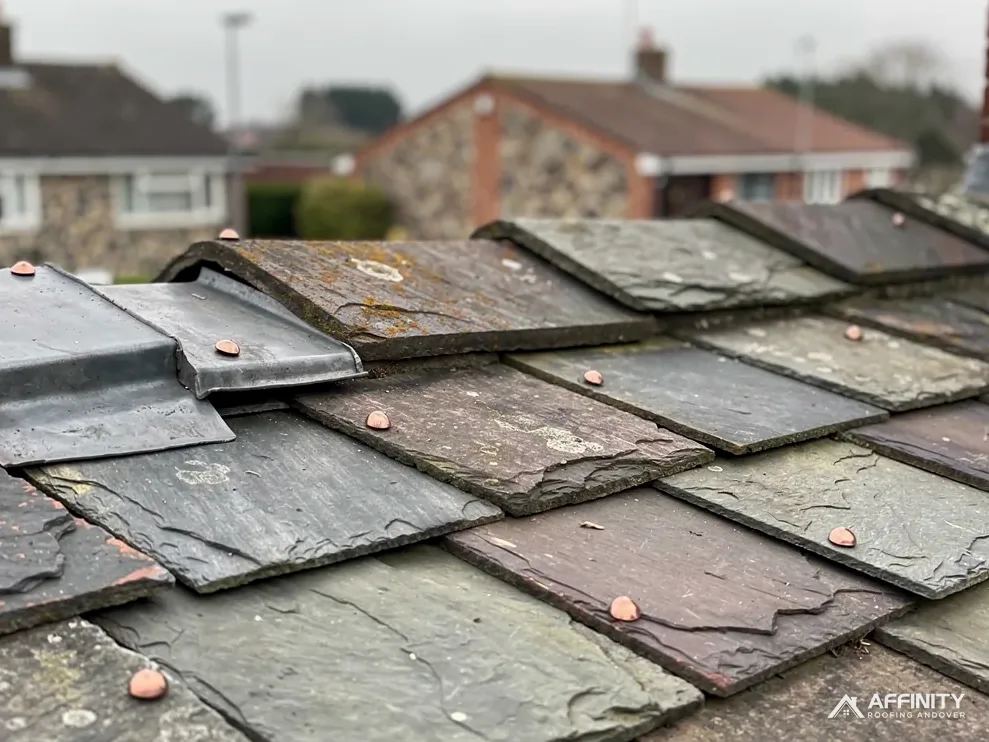
This is where the reuse is won or lost. Slates are held by nails driven through their heads and covered by the next course, so a failing nail is invisible until the slate drops. When we re-lay a slope, every slate is nailed afresh with copper or another corrosion-resistant nail. Our answer on copper nails for slate explains why.
Reusing the old nails would defeat the point. They have already corroded to some degree, and a roof laid on them would develop the same slipping slates within a few years.
The battens and underlay come under the same scrutiny. With the slates off, the timber is exposed, and soft or rotten battens are replaced. An old felt underlay that has dried and cracked goes too, because a new roof on a failed underlay still lets water through the laps.
This is the main extra cost of reuse compared with a repair, and it is where the money does its work. A relaid roof on new nails, battens and underlay gives you a covering that behaves like new, with slates that have already proved they last.
The re-slating a roof page covers the whole process.
Reclaimed slate from a yard
Slates taken from another building follow the same rules as your own. They are checked, sorted and fixed on new nails. A reclaimed slate arrives with its own history, though, so you cannot assume it is sound. A dealer's stack can include slates with hairline cracks or soft layers that only show once they are on a roof.
Matching is the usual reason to buy reclaimed. On an older house it can supply slates of the right size, thickness and weathering to blend with the existing roof. Our page on reclaimed roof slates deals with buying them.
On price, HomeBuilding's supply-only table puts reclaimed Welsh slate well below new Welsh and a little above Spanish per square metre. New Welsh sits at a large multiple of Spanish, which is why salvage often looks attractive, but no per-metre figure turns into a total without a survey.
The supplier's data sheet and your surveyor's judgement matter more than the label on the stack. We inspect delivered slates before they go up, and we reject any that fail.
Our slate roofing page describes the options, with a single written total after the survey.