A slate that has sat on a roof for a century has already proved something. It has survived frost, sun, wind and the occasional dropped ladder, and what remains is usually the toughest part of the stone. Builders, conservation officers and owners of period houses often want it back on a roof for that reason, and for the way weathered slate looks.
The catch is that reclaimed slate is not a standard product. Each batch comes from a different roof with a different history. Some arrives sorted, sized and ready to lay. Some is a skip of mixed pieces, many of them too thin, split or nail-damaged to be worth fixing. Telling the two apart is the whole skill.
This guide covers what reclaimed slate is, how to check a batch, where it suits a roof and where it does not, how lifespan and price compare with new slate, how it is fixed and what to ask any supplier. It answers a plain question: can reclaimed slates be reused? Often, yes, with conditions.
What counts as reclaimed slate
Reclaimed slate is natural slate that has been taken off one roof and sold for use on another, or lifted from your own roof and put back. The two cases are different, so it helps to name them.
Slate from your own roof
On a re-slate, the old slates are sorted as they come off. Sound ones are cleaned, graded and laid again. This is the most reliable kind of reuse, because you know where the slate has been and you can see how it behaved. It also keeps the roof's weathered look and cuts the amount of new slate to buy.
Slate from a salvage yard or dealer
Dealers buy slates from demolitions and re-roofs, then clean and sort them by size and thickness. Good ones label their stock by origin, size and the number of slates in a bundle. Poor ones sell pallets of mixed material with no history. Provenance matters: slate from a Welsh quarry looks and weathers differently from Spanish slate, and a batch that claims to be one and turns out to be the other will not match a period roof.
What it is not
Reclaimed does not mean cheap. The stone is already cut and trimmed, but the cleaning, sorting, storage and carriage cost money, and the supply of good Welsh stock is limited. It also does not mean fibre-cement. Old thin grey slates that are not rock may be asbestos cement, covered in our guide to old fibre-cement slates and asbestos, and they are never sold or reused as natural stone.
Everything else here refers to natural slate only.
Checking a batch before you buy
You can judge a lot about a batch of slates in an afternoon with a bundle, a hammer-free tapping test and a good eye.
The ring test
Hold a slate up by one corner and tap it gently with a knuckle or the handle of a tool. A sound slate gives a clear ring. A dull thud means a hidden crack or delamination, where the layers of the rock have begun to part. Slates that flake at the edges when handled are on their way out.
Thickness and size
Reclaimed slates from the same roof are often a consistent thickness, which makes them easy to lay. Mixed batches vary, and a roof laid with uneven thickness shows it in wavy courses. Check that you have enough slates in each size you need. Many older roofs use graded sizes, graded from wide, heavy slates low down to small, light ones near the top, and one size across the board will not do.
Nail holes and damage
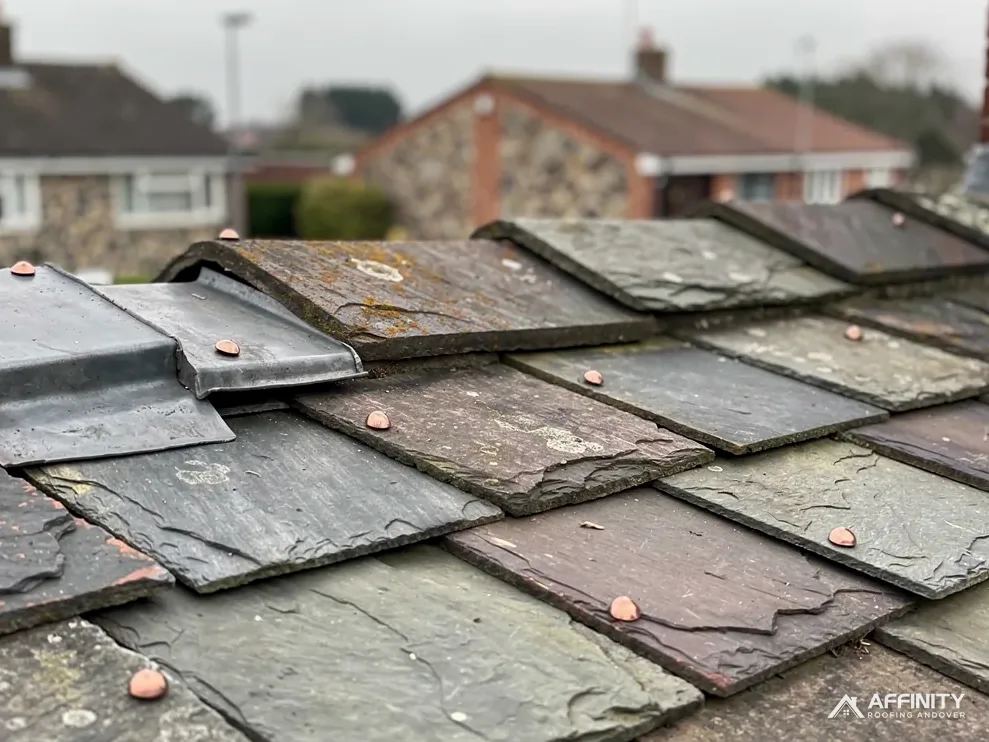
Every reclaimed slate already has nail holes from its first use. They sit near the head, and the slate has to be laid so that the old holes are covered by the course above, or re-holed. A slate with a broken head, a chipped corner or a large cracked hole is a reject. Wear on the surface is normal, but a slate whose face is flaking in layers will not last.
Colour and weathering
Hold several from different parts of the bundle side by side. A batch from one roof is consistent. A mixed batch has patches that will show as bands once it is laid, and by then it is too late to sort them. Look also at the underside: a slate with fresh rust marks or white salts there has been wet for a long time and may carry hidden decay.
Matching a period roof
Reclaimed slate earns its keep where the aim is to make a repair or a re-roof disappear into an existing roof.
Same origin, same look
Welsh slate has a distinctive range of blue-grey and purple tones, and Spanish slate tends to be darker and more uniform. A repair to a Welsh roof is usually best made with Welsh stone of similar age. Reclaimed slate often fits better than a brand-new import, because the weathering has already softened the colour and edges. Our guide to Welsh or Spanish slate compares the two origins.
Mixing old and new
Where a roof needs more slate than it can supply, the usual practice is to scatter new slates among sound old ones across the whole slope, rather than put them in a single patch. The result weathers as one. A fresh patch of bright slate on a faded roof catches the eye for years.
Listed buildings and conservation areas
In a conservation area or on a listed building, the council may expect the original material or a close match. Reclaimed slate often meets that expectation better than a new product. A listed house adds a second hurdle, since work that changes its character needs listed building consent, so ask Test Valley Borough Council's planning team early. Keep the supplier's description of the batch with the paperwork, because a planning officer may ask where the material came from.
If you are unsure of the original material, ask for a sample and compare it dry on the roof. Seen in daylight against the existing slates, tone and thickness difference shows far more plainly than it does in a yard or on a screen, and a few minutes of that comparison can avoid an expensive mistake.
Lifespan and price, as ranges
The published figures give a feel for reclaimed slate against the alternatives, though they should be used with care.
Lifespan
HomeBuilding & Renovating, in a table last updated on 30 September 2025, gives reclaimed Welsh slate a life of 50 to 80 years. For comparison, the same table gives new Welsh slate as 100+ years and Spanish natural slate as 75 to 100 years. These are typical ranges for the material, not promises. The shorter range for reclaimed slate reflects its history: it has already used some of its life, and its nail holes and wear reduce the margin.
Price
HomeBuilding's supply-only prices put reclaimed Welsh slate above Spanish and well below new Welsh. These are supply-only prices, so we quote the pattern and not a per-square-metre total. In plain terms, reclaimed Welsh costs more than imported Spanish and a good deal less than new Welsh. Do not scale a supply price by your roof area to guess a job. Labour, fixings, sorting and waste do not rise in step with it.
The real cost
A reclaimed roof can cost more to lay than a new one, because the slates have to be sorted and re-holed, and breakages run higher. Ask for the quote to cover the whole job as one total after the survey, and expect the supplier's grading to be part of the conversation.
Our wider slate roofing page explains how the covering fits into the roof as a whole. Compare any two options as complete jobs, with the same scaffold, the same underlay and the same ridge, so that the slate is the only variable between them.
Fixing reclaimed slates properly
Reclaimed slate is only as good as the way it is fixed, and it asks more of the slater than new stone does.
Nails and holes
Reclaimed slates are normally laid with corrosion-resistant nails through the existing holes, or through new holes if the old ones are too low or damaged. A slate must be held by its head so that the course above covers the fixing. A slate with the old hole too close to the edge risks cracking when nailed.
Headlap and pitch
Headlap is how far each slate reaches over the one two rows beneath, and it has to suit the pitch. BS 5534 indicates a minimum pitch of 20 degrees for natural slate. Reclaimed slates of varying length need the gauge worked out carefully so that no slate is under-lapped. A short slate with a thin lap on a shallow roof is a leak waiting for wind-driven rain.
The standard
BS 5534:2014+A2:2018 is the code that governs fixing slates. It is not itself a law, but it sets out how slates are fixed and lapped, so a reclaimed roof laid to it follows the same fixing rules as a new one.
Underneath
A reclaimed slate covering sits on the same underlay and battens as new slate. Putting old stone on rotten timber wastes the effort, so the batten condition is part of the survey, whether the slate is new or old. Tired underlay is renewed at the same time, since it is out of sight once the slates go back. Our guide to re-slating a roof follows the whole job from strip to ridge.
Questions to ask a supplier
Whether you buy from a yard or from a dealer's website, a few questions separate a good supplier from a hopeful one. Put them before you hand over a deposit, and write down the answers.
Where did it come from?
Ask for the building or the quarry. A supplier who knows the source can tell you the slate's age, size range and likely life. One who says only that it is "old Welsh" may be guessing.
How many are sound?
Ask what proportion of a bundle is usable, and who sorts it. Buying more than you need by a sensible margin allows for breakage. The proportion varies batch to batch, and we plan for it on the survey.
Is any of it fibre-cement?
Natural slate rings and splits along its grain. Fibre-cement sheets are flat, uniform and often grey. A pre-2000 roof is treated as containing asbestos until tested, so never accept a mixed pile.
Can you see the stock?
Go and look at it, or ask for photographs of the actual bundle, not a catalogue picture. Compare size, colour and surface to the roof you are matching.
Who takes it away?
If your own old slates are being replaced, ask what will happen to those that are sound. A good contractor will sort them, stack them and tell you what can be reused. Photographs show you what was kept, what was binned and why, and you can ask for the sound stack to be left clearly separate from the rubbish.