The short answer
Roof slates flake when their thin internal layers separate, a process called delamination. Water gets between the layers, freezes and pushes them apart, and the surface peels away in sheets or crumbs. Weak or poor-quality slate does it sooner. A few flaking slates can be replaced, but flaking across a whole slope usually means the covering is wearing out.
Delamination: slate coming apart in layers
Slate began as mud pressed into rock, and it still splits along the fine grain it grew with. That same grain is what makes it flake. The layers lie roughly parallel to the face of the slate. While they stay tightly bonded, the slate is hard and almost waterproof. When bonding is weak, or when moisture works its way in at an edge, the layers begin to separate.
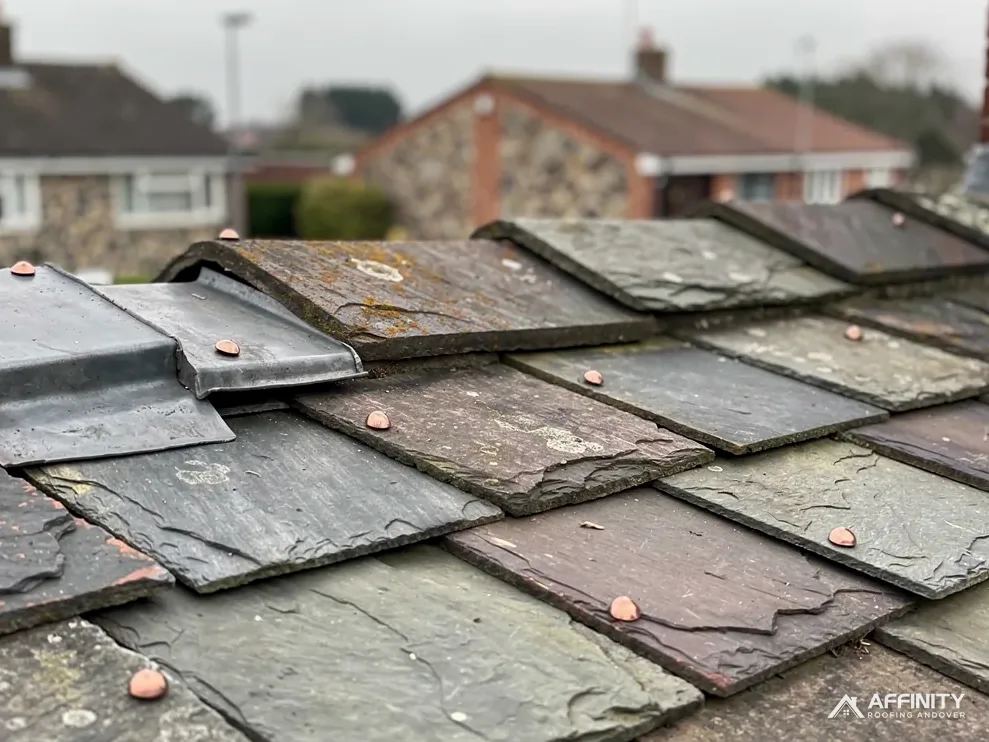
The mechanism is mostly water. Moisture enters at the tail or at a nail hole, sits between the layers and freezes in cold weather. Ice takes more room than water, so it prises the layers apart a little further each winter. Eventually a skin lifts off the face, leaving a rough, pale patch and a pile of fine grit in the gutter below.
Soft minerals in the stone can speed things up. Some slates carry streaks of material that weather faster than the rest, and these become the starting points for flaking. Salts, atmospheric acids and persistent damp from a shaded slope all play a part.
None of this makes slate a poor roof. It means the quality of the individual slate counts for a great deal.
Quality, age and where the flakes come from
When one batch of slates flakes and another does not, the usual difference is quality. Slate is graded by quarries and suppliers, and cheaper slate with a less dense structure weathers faster. HomeBuilding's published price differences show how much the market separates one origin from another: Welsh slate is priced well above Spanish per square metre, and quality is part of the reason for the gap.
Age matters as well. HomeBuilding gives Welsh slate 100+ years, Spanish natural slate 75 to 100 years and reclaimed Welsh slate 50 to 80 years, as typical ranges. A slate that flakes early in life has either a weak batch behind it or a damp roof around it.
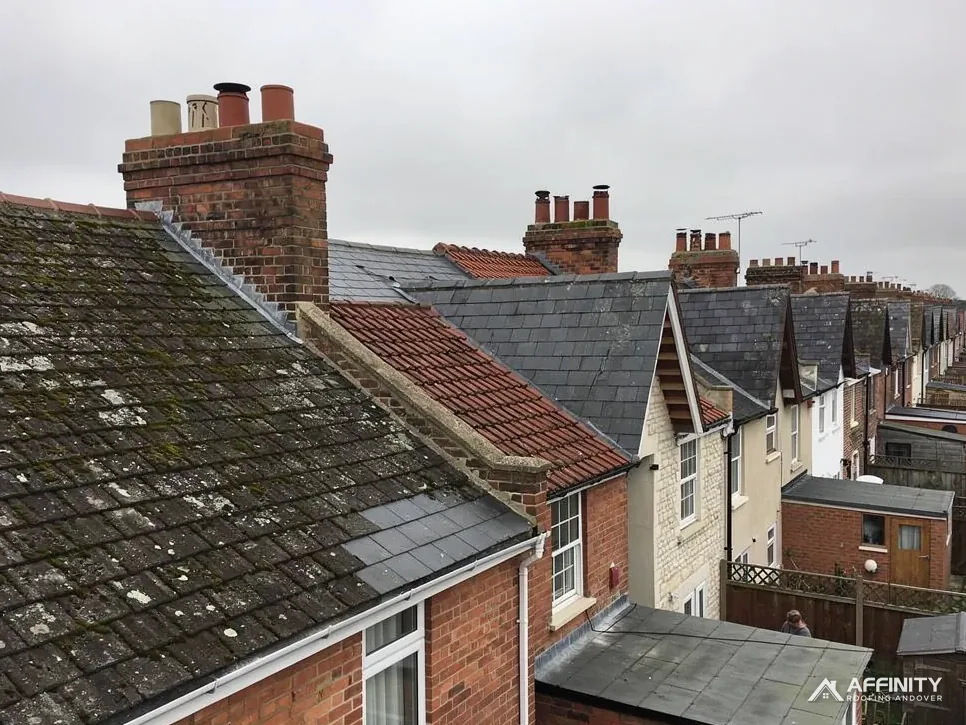
The location of the flakes is informative. Flaking that is concentrated low on a shaded slope points to damp. Flaking that is scattered evenly across the roof points to the slate itself. A single patch, close to a gutter that overflows, points to the water supply.
We photograph the pattern across the roof, so you can judge for yourself whether one corner is affected or the lot.
Replacing a few flaking slates
Where flaking is confined to a handful of slates, replacement is a sensible repair. Each damaged slate is released from its nails, a matching slate is slid in, and a tingle holds the new one at the tail. The slates around it are left undisturbed, as described in our answer on replacing a single slate.
Matching is what makes the repair last. A modern slate pushed into a roof of old, weathered ones can stand out in colour and thickness, and a thinner replacement may not sit flat. Sound reclaimed slate of similar age may be the nearest match when the roof is old.
There is a limit to this approach. Replacing flaking slates one by one is only worthwhile when the neighbours are sound, because each repair disturbs the courses around it and the flaking slate beside the repair is already on its way out.
It is worth looking in the loft after a hard frost or heavy rain. Fine grit on the insulation or a patch of daylight at a joint tells you where slates are failing. Send us what you find and we can plan the access.
Re-slating when flaking is widespread
When flaking has reached most of a slope, the slates are telling you they have given what they can. Patching a roof in that state is a cycle of repairs that gets steadily more expensive, and each one leaves another weak slate beside it.
The alternative is to re-slate the slope. The old slates come off, the battens and underlay are examined and replaced where they are tired, and new slates go on with corrosion-resistant nails. Any old slates that are still sound can be sorted and reused on a less exposed slope or on a lower-risk area. Our answer on reusing old roof slates covers how that sorting works, and the re-slating a roof page explains the full job. Our slate roofing hub gathers the rest.
Where the house is listed or inside a conservation area, the slate is part of how the building looks, so a like-for-like replacement and the right consent route matter before work begins.
You will get our recommendation with the evidence beside it, and one written total price, leaving the choice between repair and re-slate with you.