The short answer
Slate roofs usually leak at three places: where slates have slipped or cracked, where lead flashings, soakers and valleys have split or lifted, and where the old fixings behind the slates have rusted. The slate itself rarely fails. Underlay behind it acts as the back-up layer, and a leak often shows inside a long way from where water gets in.
Slipped and cracked slates
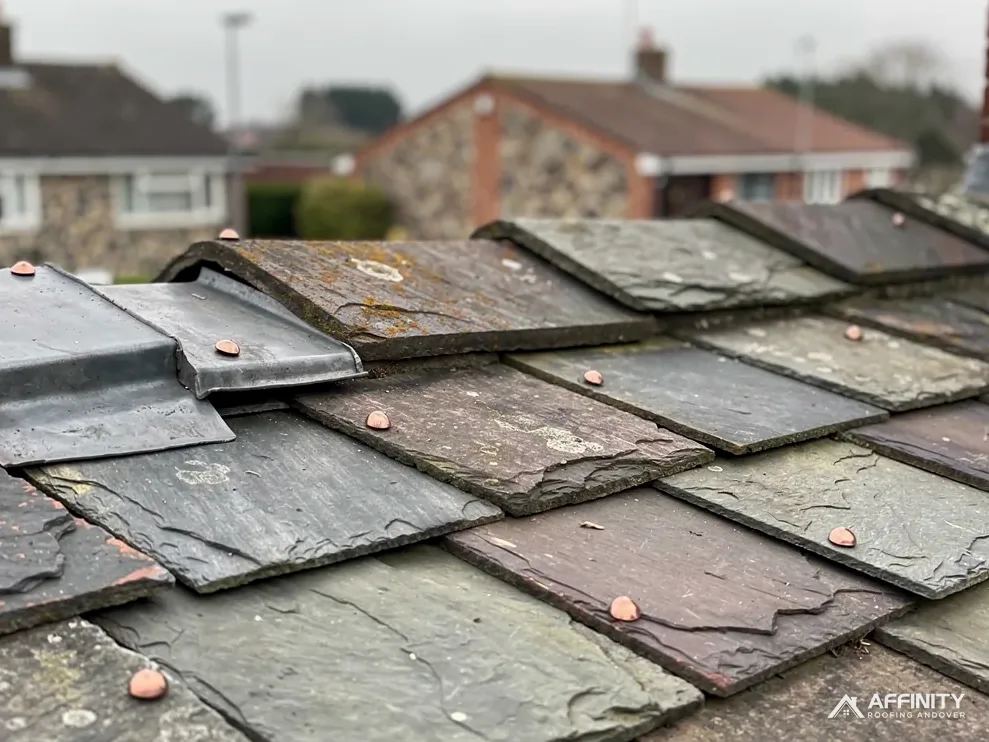
Each natural slate hangs on two nails driven through holes near its head into the batten, the timber lath the slates are fixed to. If one nail rusts through, the slate drops a little and leaves a gap. If both go, the slate slides out entirely. Either way the course above is no longer being protected by the overlap, and water reaches the underlay directly.
Cracks are the other common cause. Slate is brittle underfoot, so a roof crossed by a satellite installer, a chimney sweep or an earlier roofer can carry cracked slates that only open up in a freeze. The break may sit on a part of the slate that is hidden by the course above, which is why you can have a stain on the ceiling and a perfectly tidy-looking slope.
The remedy for one or two is a patch repair using a tingle, a narrow strip that holds a new slate by its tail. Our answer on the slate tingle explains how it works. A cluster of slipped slates in one area tells a different story, taken up below, and the wider job sits on our slate roofing page.
Flashings, soakers and valleys
The slates themselves are rarely the weak point. The detailing around them is. Wherever a slated slope meets something else, lead is used to carry water across the join. A flashing is lead strip let into a wall or chimney and dressed down over the slates. A soaker is a small L-shaped piece of lead tucked beneath the slate courses beside a wall or abutment. A valley is the channel formed where two slopes run together and drain.
Lead is sold by code, a thickness. Royston's cast-lead brochure lists code 3, at 1.32 mm, for soakers only and the heavier codes 4 and 5 for flashings and valley gutters. Thin or old lead splits where it is bent, lifts at the edges, or cracks after repeated expansion and contraction.
Lead flashing can last for over 80 years, MyJobQuote says, so a failure at ten years usually points to poor fixing. Each of these junctions gets checked on the survey, with the lead lifted where we need to see it. Our answer on slate roof valleys goes into the detail of how they are built.
Nail sickness
When many slates go within a short span, the cause is often the fixings and not bad luck. Roofers call it nail sickness. The old iron nails corrode inside the batten and shed their grip, so slates start slipping in groups, along a course or across a whole slope, rather than one at a time.
Slate lasts far longer than the nails that hold it. HomeBuilding's table gives Welsh slate 100+ years and Spanish natural slate 75 to 100 years, which shows how much of the roof is still sound when the fixings start to give up.
The signs are slates sitting a little low on their courses, slates that rattle that chatter in a gust and a growing list of tingles from earlier repairs. Each repair is a nail that has already failed. At the point where a roof is being patched every season, repair after repair becomes poor value and the better answer is to lift the slates, fit new battens and fixings, and re-lay the sound ones. Our guide to slipped roof slates weighs up the choice.
Underlay, and tracing a leak to its source
Underlay is the waterproof layer fixed across the rafters beneath the battens. It is not meant to keep a roof dry on its own, but it catches whatever gets past the slates and sends it towards the gutter. When it is torn, perished or lapped badly, water that has slipped past a slate no longer drains out and starts to find its own route into the loft.
This is why a stain on a ceiling rarely sits below the fault. Water runs along the surface of the underlay, down a rafter or onto the wall plate and drips where it meets something it can follow. The place it appears may be a metre or more from the place it entered.
We trace it from both sides: the loft to see where timber is stained or damp, and the roof to see what is above that spot. Whether the underlay is a non-breathable HR type, per Marley's ventilation guidance, or a breather type decides how the loft has to be ventilated, so we note the type and record it for you. The choice matters most when a roof is re-slated. Please do not climb up to look at any of this yourself.