The short answer
The slate producer Cupa reads BS 5534 as putting the lowest pitch for natural slate at 20 degrees, and it adds a second limit: no hook fixings once the slope drops under 25 degrees. These are starting points: each slate has its own data sheet, and the head-lap, the overlap between courses, has to be matched to the pitch.
The figure to work from
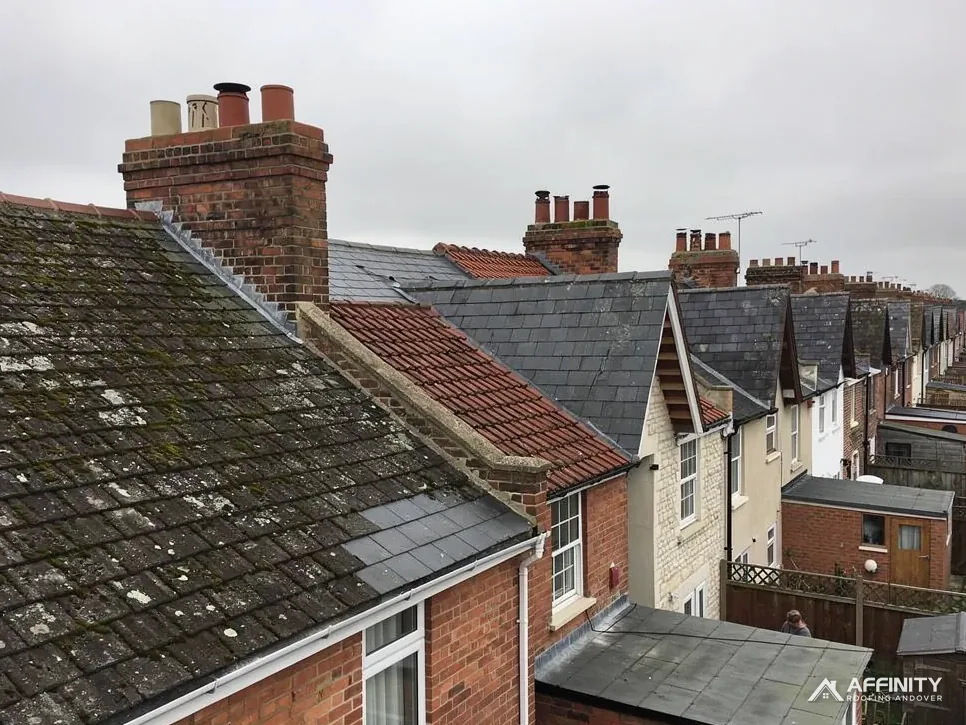
Cupa, a slate producer, reads BS 5534 as giving 20 degrees as the lowest pitch for natural slate. That is the number roofers and designers keep in mind. Pitch means the angle of the slope to the horizontal, measured in degrees, so 20 degrees is a gentle but definite slope, not a near-flat one.
Treat it as a floor, not a target. A slate roof laid right at that limit has little margin for exposure, so the slate, the overlap and the underlay must all be picked with care.
It also helps to see where slate sits next to other coverings. Marley's published minimums for its own products run from 12.5 degrees for its Mendip 12.5 concrete tile up to 35 degrees for its plain concrete tile, and from 15 degrees for the Lincoln pantile up to 40 degrees for the Canterbury clay tile. Natural slate, at 20 degrees, sits inside that range, below the plain tiles and above the lowest interlocking tiles.
A slope shallower than that is not a slate job. It needs a different covering, and the survey is where we tell you, instead of stretching the material.
Why the pitch matters: head-lap
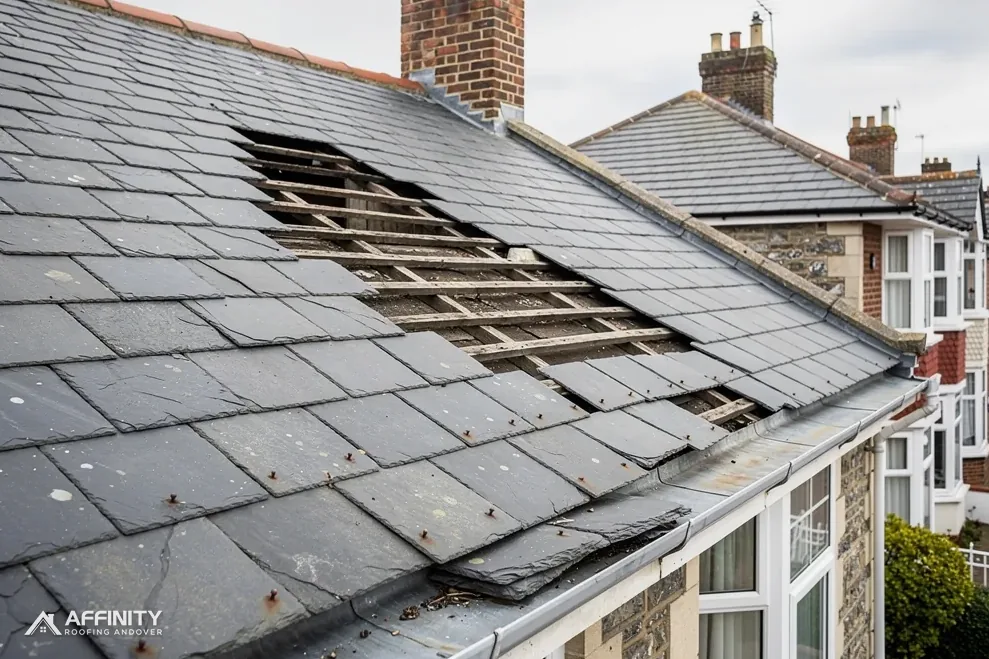
Slate is laid in overlapping courses. The head-lap is the distance by which each slate reaches over the top edge of the slate two courses beneath. It is the hidden layer that stops wind-driven rain from creeping up the joints, and our answer on slate head-lap explains it in full.
Pitch and head-lap work against each other. On a steep slope, water runs off quickly and gravity helps keep it moving, so a smaller overlap is enough. On a shallow slope, water moves slowly and the wind can push it uphill, so more overlap is needed to keep it out. A roof that approaches the lower limit therefore uses more slate to cover the same area, with a bigger overlap and a smaller visible part of each slate.
That affects cost as well as performance. Greater head-lap means more slates per square metre, and the supplier's data sheet fixes the exact figure for that slate at that pitch.
If a quote for a shallow slate roof seems to use the same layout as a steep one, ask why. The pitch should change the setting out, and a surveyor should be able to explain how.
Fixings change as the roof flattens
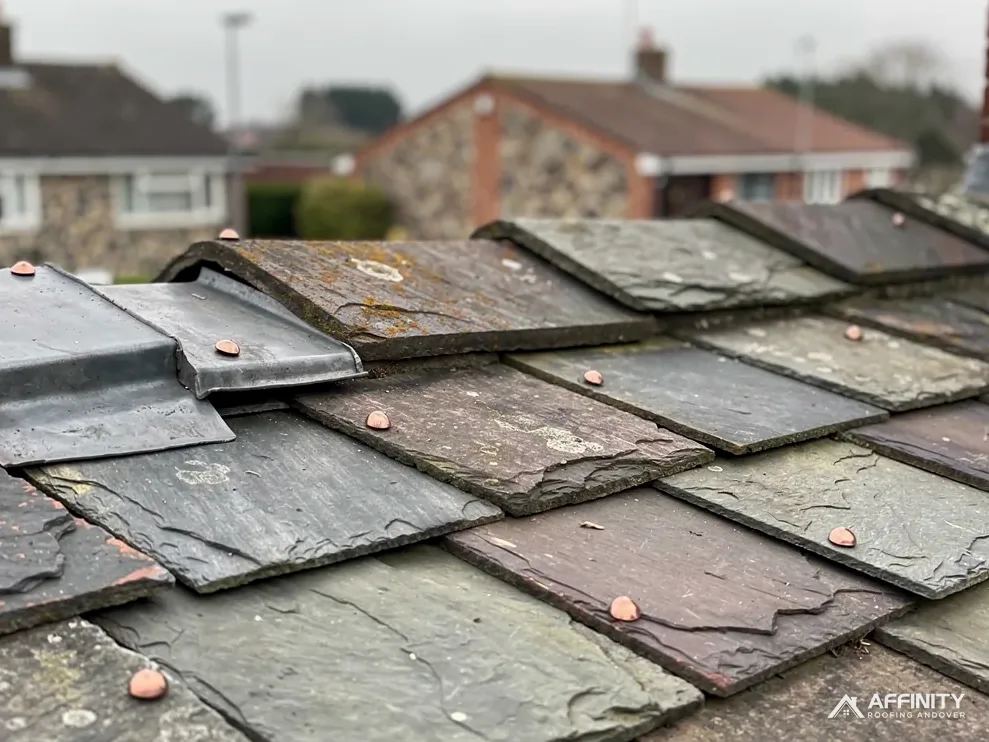
Pitch also decides how a slate may be held. Cupa advises against hooks on any pitch under 25 degrees. Between 20 and 25 degrees, then, hooks are ruled out, and the supplier's data sheet sets the fixing to use. Our comparison of slate hooks and nails sets out when each is suitable.
This is why the figure is called a minimum and not a norm. Below 25 degrees the choice of fixing narrows, and the margin for error in the underlay, battens and overlap is small.
The British Standard behind it, BS 5534, is not a law. Marley points out that installing to BS 5534 isn't required by law. Its pitch guidance still matters, because a slate roof laid below it has less margin in the laps if something goes wrong.
If you plan an extension or a porch roof, ask what pitch the design allows before choosing the covering. A pitch that is too shallow for slate will not be cured by extra sealant later.
Check the data sheet, then the roof
The 20 degrees is a general reference. Each slate on the market has its own data sheet from the supplier, which sets the minimum pitch for that slate and the head-lap for each pitch band. That sheet outranks any rule of thumb, including ours, and it is the document to ask for.
Exposure counts too. A roof on an open site or at the top of a tall building takes more weather than one sheltered by trees, and the supplier's guidance may call for a larger overlap there. We do not assume that the minimum is enough because the number is met.
At survey we measure the actual pitch of the slope with a level or an angle gauge. Dormers, extensions and porches often sit at a lower angle than the main roof, so each gets its own reading. If one falls under the natural slate limit, we set out the alternatives, which could be another covering or a change to the roof structure.
Find more on the covering itself on our slate roofing page. One total price, in writing, comes after the measuring is done.