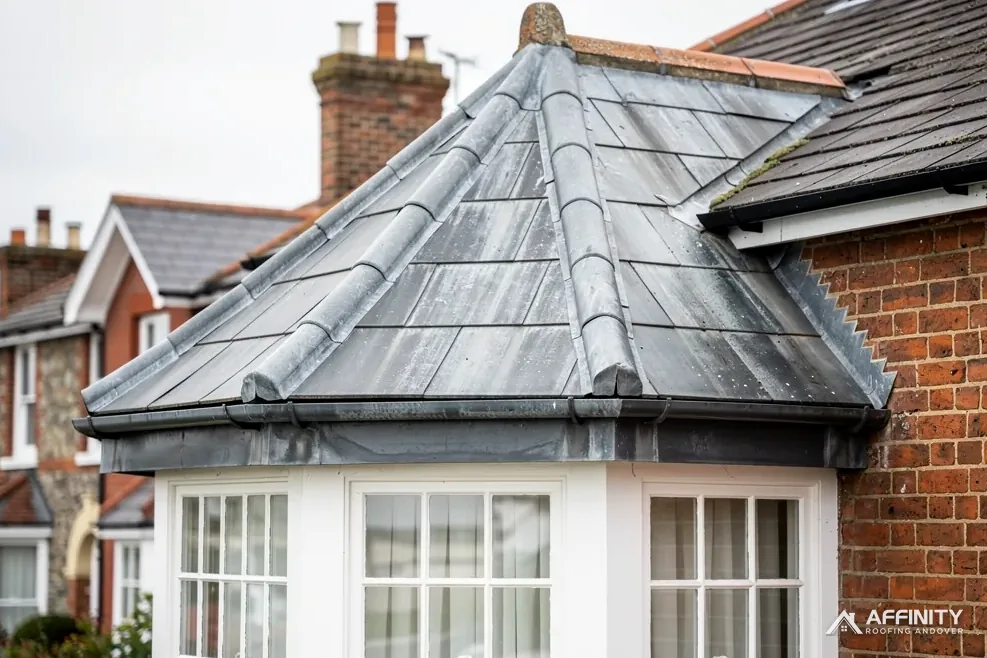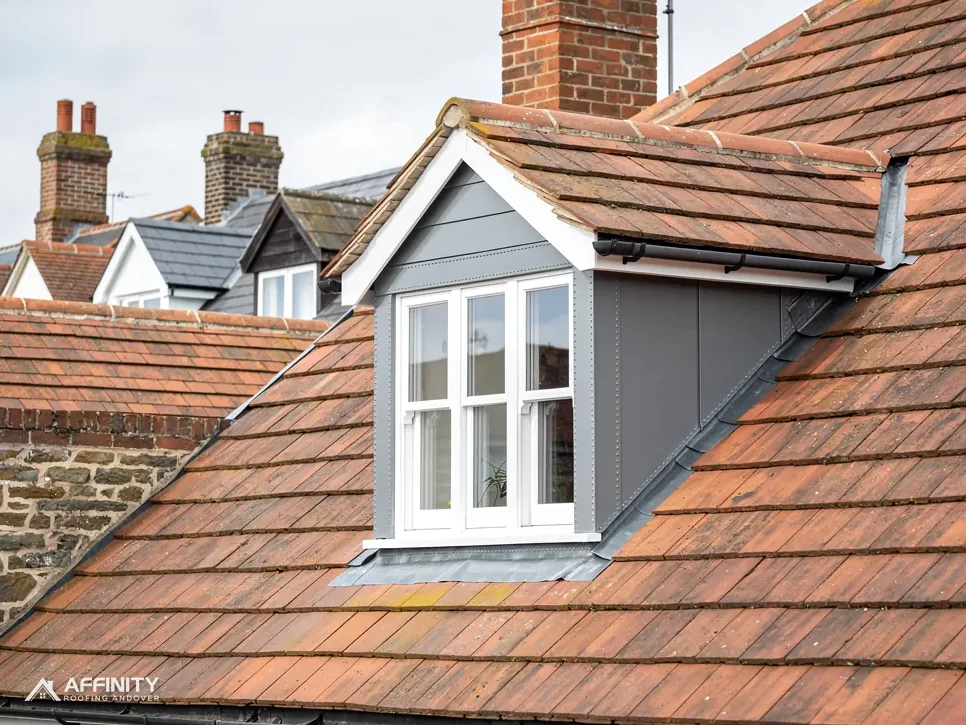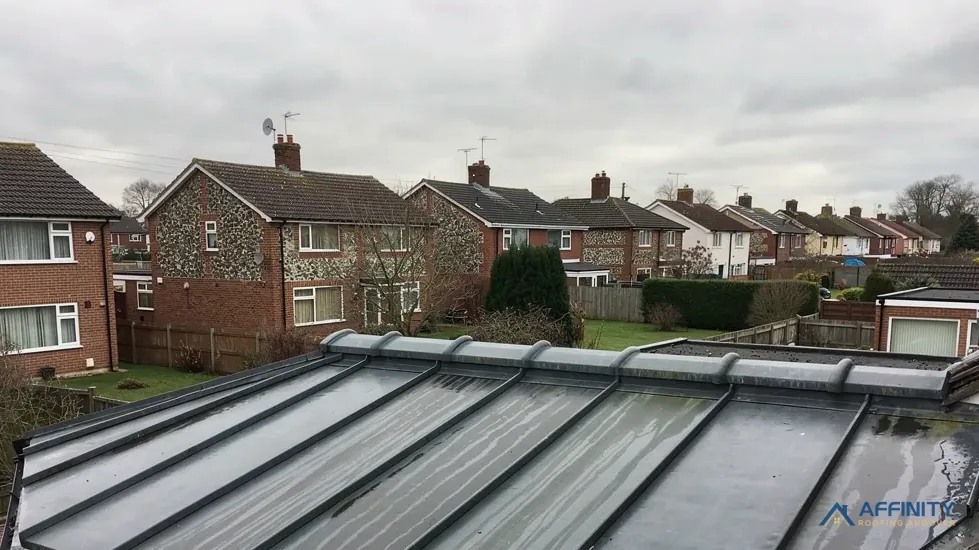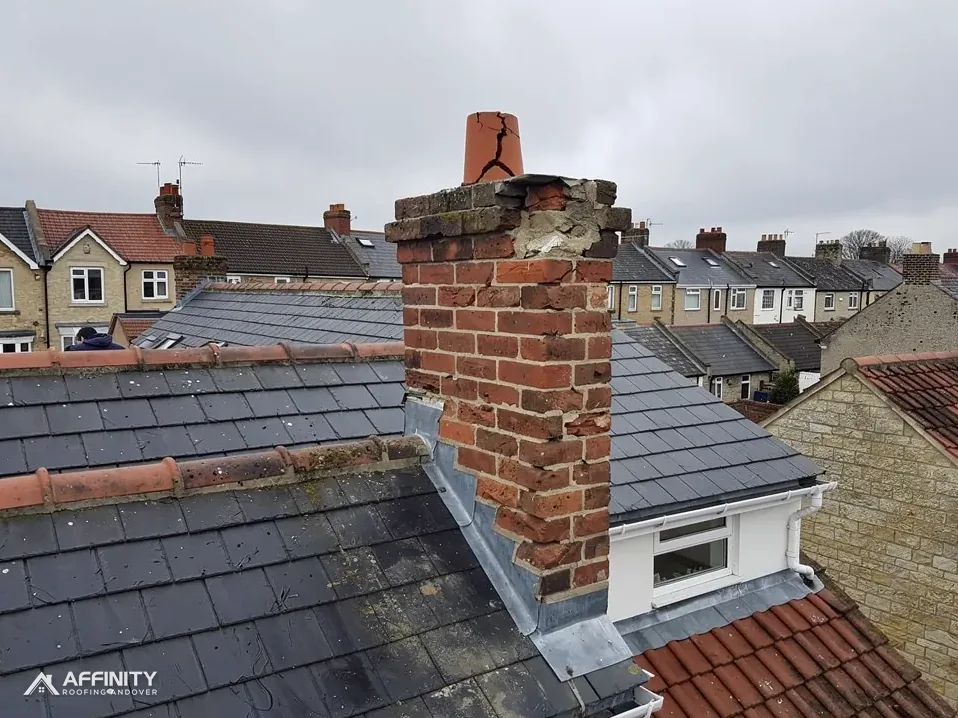
When two roof slopes run into each other in a V, the line between them is a valley. Everything that lands on both slopes runs towards it, which makes it one of the busiest drainage channels on the roof and one of the least forgiving when something goes wrong. A valley lined with lead is the traditional answer, and a well-laid one can outlive the tiles on either side of it.
Valleys fail slowly and then suddenly. Lead splits along a crease where it has been bent too tightly, or thins where leaves have sat, or lifts where the fixings have loosened, and the first sign inside the house may be a brown ring on a ceiling after a heavy shower. By then the timber boarding under the lead has often been damp for some time.
This guide describes the signs to look for, how the code and length of the lead are chosen, how a replacement is done, what the published average cost is, and when a repair or another material makes more sense. It is written for houses in Andover and the Test Valley, where an extension or a porch often brings a valley with it.
Signs that a valley has failed
Most valley trouble can be spotted without leaving the ground, and a pair of binoculars helps. Never go onto the roof to look at a valley. The tiles beside it are often the most fragile on the slope.
On the outside
Look for lead that has visibly cracked or opened along its length, dark patches where the metal has worn thin, and lead that has crept down so that the top end no longer reaches the ridge. Look too at the tile edges either side of the channel. Chipped, slipped or mossy tiles at the margin can mean water is overflowing from the valley onto the slope. Gaps of sealant along the lead are a sign that someone has already tried to patch it.
Inside the house
A ceiling stain that traces a diagonal line from the corner of a room towards the edge of the roof suggests a valley leak. In the loft, look along the rafters beneath the valley for dark, damp or soft timber. A torch and a quick look at the underside of the boarding often tells a surveyor more than the top surface does.
Debris and overflow
A valley full of leaf litter and moss holds water against the lead. In a heavy downpour the channel can fill and send water sideways under the tiles. Clearing debris is a sensible first step, and it costs the least.
Lead is slow to fail but difficult to inspect, so if you can see any one of these signs, ask for a survey and photographs.
Choosing the lead code for a valley
Lead sheet is sold by code. A code is a number that stands for thickness and weight, and the right one depends on what the lead is doing. Royston Lead's cast-lead brochure gives code 4 as 1.80 mm and 20.41 kg per square metre, code 5 as 2.24 mm and 25.40 kg, code 6 as 2.65 mm and 30.05 kg, code 7 as 3.15 mm and 35.72 kg, and code 8 as 3.55 mm and 40.26 kg.
Which codes suit a valley
The same brochure marks codes 4 to 8 as suitable for a pitched valley gutter, and codes 5 to 8 for a parapet, box or tapered valley gutter. A parapet or box gutter sits between two walls or behind a parapet and collects far more water than a pitched valley, which is why the thicker codes are listed for it. Code 3 is for soakers only, the small pieces of lead that are slipped under tiles at a wall or chimney.
How the choice gets made
The heavier the code, the longer the lead tends to resist the stress of repeated expansion, and the more the material costs. A short valley at a small porch is a different job from a long one across a hipped roof. For a deeper look at the two codes compared there, see our answer on code 4 versus code 5 lead.
We set the code on site, after seeing the length, the pitch and how much water the valley carries, and we name it in the written price so that you know what is going on the roof.
How long a valley run can be
Lead moves with the temperature, so a long valley cannot simply be one long strip. A run that is too long will gradually creep downhill and can crack at the point where it is held. Published lead guidance caps the length of each piece, and where the valley is longer than that, the lead is laid in sections with a lap between them.
Laps and falls
Each section is overlapped by the next, upper over lower, so that water running down the valley cannot get under the join. The valley itself needs enough fall for water to run off quickly. A very shallow valley, such as one on a low-pitched extension, drains slowly and shows wear first.
The width of the channel
The lead is cut wide enough to turn up under the tiles on either side. A narrow cut leaves the edges exposed to wind-driven rain, and a very wide one is wasteful. The tiles beside the valley are cut to a neat line, and the gap between them and the centre of the valley must be wide enough for leaves to wash through.
Why we measure on site
No table of lengths can replace measuring the actual valley. The specific limits come from the lead guidance for the code in use, and we apply them to what we find. Approved Document C (para 6.9) points to BS 6915 for recommendations on lead, which is where the detailed rules sit.
If the valley is a short one, the issue is more often fixings and falls than length.
What happens when a valley is replaced
A proper replacement is a small re-roof of the valley area, and it follows a set order.
Stripping back
The tiles or slates along both sides of the valley are lifted and stacked. The old lead comes off, and with it the old boarding if it is rotten. Rotten boarding is common because the lead above it has been leaking for some time. The rafters are checked for damp or rot, and any damaged timber is replaced.
The new bed
New boarding goes down, sometimes with tapered firring pieces under it where the fall needs correcting. A separating layer goes over the boards, then the lead. The lead is laid from the eaves upward in the lengths the code and valley length allow, each section lapped over the one below.
Closing it up
The tiles are relaid or replaced beside the new lead, cut to a clean line. Hip ends, ridge junctions and any soakers at the bottom end are finished last. Our lead roofing page describes the other places lead is used on a roof.
What the photographs show
The survey photographs the old valley from above and, where the loft allows, from below. During the work we photograph the exposed boards and the finished lead, so you can see what went in under the tiles. The finished job is checked against the gutter below to make sure the water leaves cleanly.
The published average and what moves it
The MyJobQuote average for a full valley replacement is around £540 (page dated 7 September 2026). That is a typical UK average for one valley and not a price for yours. No survey, no figure.
What pushes a price up
A long valley, a steep or high roof that needs scaffold, rotten boarding, a heavier lead code and tiles that are brittle and need replacing all add to the job. A valley on a hipped roof with a junction at the bottom is more work than a straight one. Tiles that cannot be matched will cost more than ones that are available.
What can bring it down
Easy access, sound boarding and tiles that lift without breaking all help. Doing two valleys together, or combining the work with a chimney flashing, spreads the set-up cost. Our guide to lead flashing cost goes through the published chimney range and the factors common to both jobs.
Not the only figure that matters
Lead valleys last. MyJobQuote's guide gives lead flashing over 80 years, and HomeBuilding gives lead on a flat roof 60 to 100 years. These are typical ranges and lower bounds, not warranties, but they show why a well-made valley is usually a once-in-a-generation job. A cheaper patch that has to be redone in five years is not cheaper in the long run.
The written price follows the survey and covers the whole job as one total.
Repair, GRP or lead: choosing the right fix
Not every failing valley needs replacing, and not every replacement has to be in lead.
When a repair is enough
If the lead is sound but has lifted, or a seam has opened in one place, re-dressing and re-fixing it may be all that is needed. The test is the condition of the metal and the boards. Lead that is split in several places, thin along its length, or covered in old sealant has had its day.
When GRP makes sense
Glass-reinforced plastic valley troughs are factory-moulded to a standard width and laid into the valley. They suit straight valleys on newer roofs, where the geometry is regular. On older roofs with irregular tile lengths, or valleys that bend, they are harder to fit well. Our answer comparing GRP and lead valleys covers the trade-offs. GRP's published life is 25 to 30 years (HomeBuilding, Sep 2025) or 25 to 40 (Less, Oct 2026), well short of lead.
Conservation and listed houses
On a house in a conservation area, ask Test Valley Borough Council whether an Article 4 direction applies before the look of the roof changes. Replacing lead with lead in the same position seldom alters the appearance, but a new material might. Works that affect a listed building's character need listed building consent.
The sensible order
Survey first, then decide. A photograph of the failing seam usually makes the choice obvious.