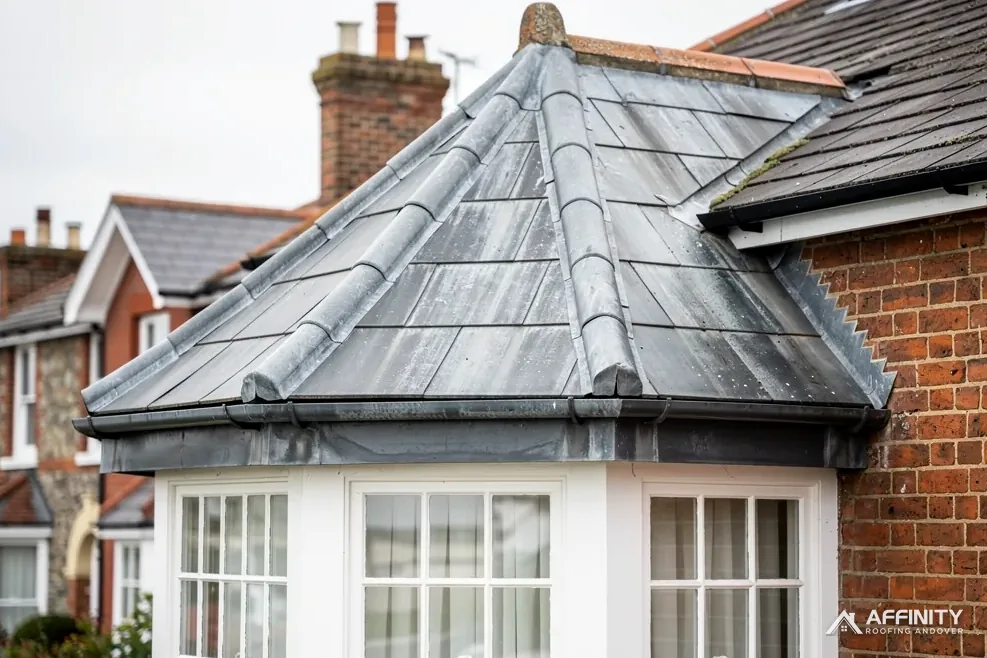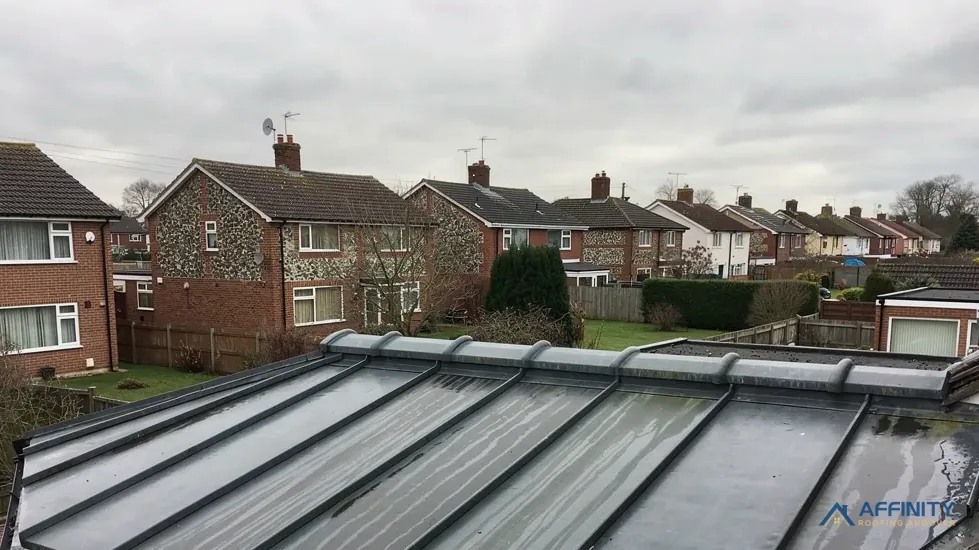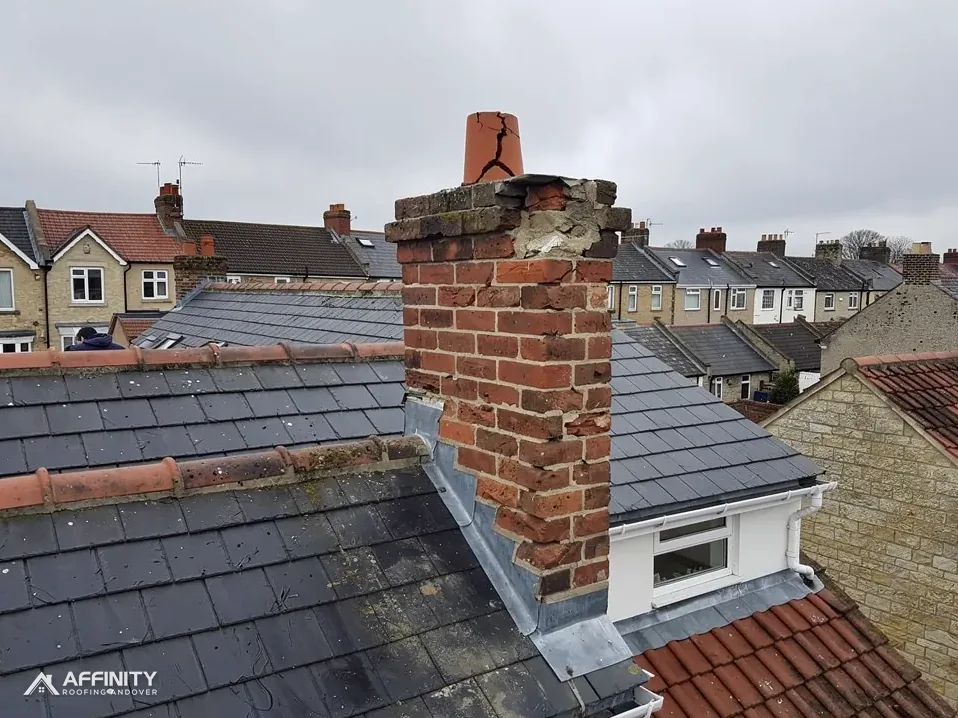
A chimney breast pushes up through the roof, and the join between brick and tile is the hardest place on the roof to keep watertight. Rain runs down the stack, meets the slope and has to be turned aside, in a gap that the roof covering cannot close by itself. The traditional answer is sheet lead, folded and fixed so that water runs over it and away.
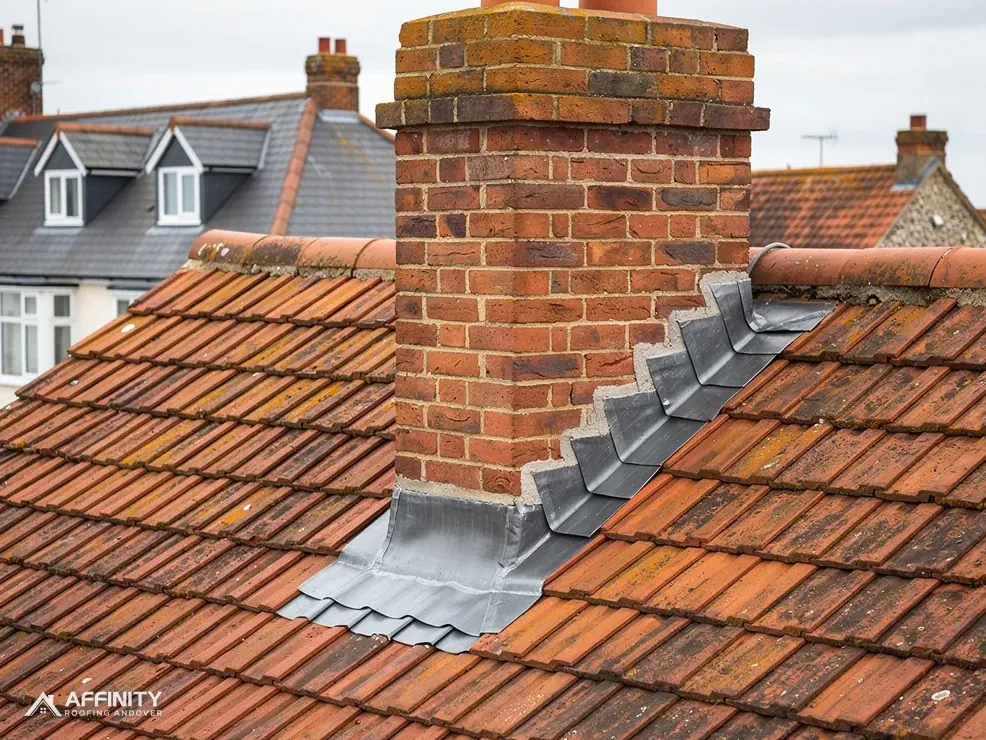
A chimney does not get a single strip of lead. It gets four connected pieces, one at the front, one on each side and one behind, and each does a different job. The front piece is the apron. The side pieces are stepped flashings. At the back, where the roof slope meets the stack from above, there is a back gutter. Cover flashings and soakers complete the system. A leak usually means one of these has failed, and finding which is half the repair.
This guide explains each part, the lead thicknesses used, the ways it fails, what published cost figures suggest and how the work is done. Our lead roofing hub explains the wider service.
The four parts and what each does
The lead around a chimney is a system of pieces that overlap, so that water passes from one to the next and off the roof.
The apron
The apron is a single piece of lead at the front of the stack, the side facing down the slope. It is turned into a groove in the brickwork and laid down across the tiles, so water running down the face of the chimney lands on the lead and runs over the tiles below. Our answer on lead apron flashing covers it in detail.
Step flashings
On each side the chimney is vertical and the roof slopes, so the flashing steps up with the brick courses. Each step is a separate piece, lapped over the one below it. It is tucked into the mortar joints and dressed down onto the tiles. The stepping follows the slope of the roof.
Soakers
A soaker is a small, rectangular piece of lead folded to sit under each tile or slate course at the side, linking with the step flashing above. It lets the roof covering and the flashing work together. Our answer on lead soakers explains how they are used.
The back gutter
Behind the stack the roof slope runs up to the chimney, and water would pool against it. The back gutter is a lead-lined channel that carries the water round either side of the stack and onto the slopes beyond. It is the most complex part, and the one most likely to be badly made.
Cover flashings
Pieces turned into the brickwork to cover the upper edges of the lead below, so water cannot get behind them.
How lead is fixed to a chimney
Fixing is where much of the quality is decided. Good lead badly fixed fails as quickly as poor lead.
The raggle
A raggle is a groove cut into the mortar joints of the brickwork, about the depth of a brick course. The top edge of the flashing is turned into the groove. A raggle cut into a single joint is cleaner than cutting into the brick, and follows the stepping of the courses.
Wedging and pointing
The lead is held in the raggle with lead wedges, small folded strips driven into the joint, and then pointed with mortar or sealed with a flexible compound suited to the job. The wedges hold the lead tight against the movement of the wall. Mortar alone shrinks and cracks, and a sealant by itself is not a lead repair. Our guide to why sealant is not a lead repair sets out the difference.
Dressing and clips
The lower edge is dressed down over the tiles and, on larger pieces, held with lead clips, so wind cannot lift it. Dressing lead into the profile of the roof covering needs care: too tight and it cracks, too loose and it flaps.
Laps and lengths
Pieces are lapped generously, and long runs are kept to lengths that allow for expansion. Lead moves with temperature, and long unbroken strips split. That is a main reason why pieces are separate.
Lead codes for chimney work
Lead sheet is sold by thickness, and the thickness is described by a code number. The right code for each part follows the way the lead is used.
The codes
Royston Lead's cast sheet brochure lists the codes with their thickness and use. Code 3 is 1.32mm and is shown for soakers only. Code 4 is 1.80mm and the brochure lists it for soakers, flashings, pitched valleys and dormers. Code 5 is 2.24mm and is used for flashings, valley gutters, parapet and box gutters and dormers. Code 6 is 2.65mm for the same uses.
What that means for a chimney
For flashings and aprons, Code 4 and Code 5 are the working choices, and the brochure's lists show both are suitable. Soakers can be Code 3 or 4. A back gutter is a gutter, and the brochure lists Code 5 and above for the heavier gutter types. A thicker code is stiffer, lasts longer under movement and costs more by weight. Our answer on Code 4 against Code 5 lead compares them.
The standard behind it
Approved Document C refers to BS 6915:2001 for recommendations on lead sheet roofing. Lead work follows BS 6915, not BS 6229, which covers flexible membranes on flat roofs only. Ask which code and which standard your quote follows.
Lifespan
According to MyJobQuote (22 Sep 2026), lead flashing can last for over 80 years, which is a floor and not a promise. A well-made flashing can last a long time. The pieces that fail early are usually the badly fixed ones, not the lead.
Why chimney flashings leak
Leaks at a chimney tend to follow a few patterns. Spotting which pattern fits yours speeds up the repair.
Pointing and sealant gone
The mortar or sealant that holds the lead into the raggle shrinks and cracks. Water gets behind the flashing and into the wall. The lead itself may be perfect. Our answer on lead flashing that comes away from the wall covers the signs.
Cracked or split lead
Lead that was fixed too rigidly, or in too long a piece, cracks at the folds as it expands and contracts. A split lets water straight through.
The back gutter
A blocked or badly formed back gutter overflows, or leaks where it meets the stack. Leaves, moss and silt collect behind the chimney, where nobody looks. Because the water runs behind the stack, the first sign may be a stain high on the chimney breast indoors.
Lifted or loose lead
Where clips are missing or the lead is too thin, wind can lift it, and rain gets under. Poor dressing leaves gaps.
Wrong materials
Bitumen strip, tape and cement fillets are quick fixes that fail within a few seasons. A cement fillet cracks away from the brick and the tiles, because the three materials move differently.
The chimney itself
Not every leak is flashing. Cracked brickwork, failed flaunching round the pots and a missing cap can all let water into the stack. A survey looks at the whole chimney, not only the lead.
Cost, as a published range
Lead around a chimney is a modest job in the scheme of roofing, but it is access-heavy, and that decides much of the price.
The MyJobQuote range
MyJobQuote gives full chimney leadwork as between £350 and £920 (22 Sep 2026), noting that the figure depends on scaffold. That range is a typical UK figure for replacing the lead around a chimney, and is not a price for your house or one of ours.
What moves it
Scaffold or a tower is a large variable, since a chimney stands at the highest point and may be on a steep slope. Stack size, flue count, the covering around it, the brickwork's state and the lead code all play in. A pair of adjoining stacks cost more than a single one. Our guide to lead flashing cost goes through the published ranges.
Sharing scaffold
If the roof needs other work, such as slipped tiles near the chimney, repointing or a new cap, doing it in the same visit shares the access. It is worth asking what else the survey found.
Scaffold on the highway
Scaffold on a public footway takes a licence from Hampshire County Council in the Andover area, and the scaffold firm applies for it. If scaffold is needed, it sits inside the written quote.
The quote
A written quote gives one total for the lead, fixings, pointing, access and waste. The standard rate of VAT is 20 per cent, so ask if a figure includes it.
Repair or renew, and how we check
Not every leaking chimney needs all four pieces replaced. The survey sorts out what is needed.
What we look at
We check each piece, starting from the ground and moving to a ladder or scaffold only where that is safe: the apron, the steps, the soakers, the cover flashings and the back gutter. We look at the pointing, the lead's condition, the fixings, the chimney brickwork, the pots and flaunching, and the tiles round the base. From inside, we check the chimney breast and the ceiling nearby for staining. You get photos of what we see.
Repair
If the lead is sound and the pointing is the weak spot, a section can be raked out and repointed or re-wedged. A split piece can sometimes be replaced alone. A repair is appropriate where the lead is in good order and only a part has failed.
Renewal
If the lead is old, thin, split in several places, or fixed with the wrong materials, the better course is to renew the whole system. A patch on tired lead often fails next to itself. Renewal gives the chimney a complete set of new pieces fixed to the right code.
Listed and older homes
On a listed building, lead is the expected material and changes may need consent. In a conservation area, check with Test Valley Borough Council's planning team. Our answer on lead roofs in a conservation area explains more.
Never seal a leaking chimney junction with tape or bitumen as a permanent fix. It hides the failure and stains the brick.