The short answer
Rotten decking cannot hold a roof covering, so it has to be cut out and replaced before anything new goes on. The usual signs are soft or spongy spots underfoot, sagging, and a ceiling that stays damp. New boards are laid on sound joists, and the roof is recovered. Because the work reaches the roof structure, the Part L insulation rules for the rebuilt roof need to be checked with building control.
How rot shows itself
The deck is the layer a flat roof covering sits on, usually plywood or boards on timber joists. When water gets into it and stays, the wood softens and decays. By the time the damage shows, it may have spread well beyond the original leak.
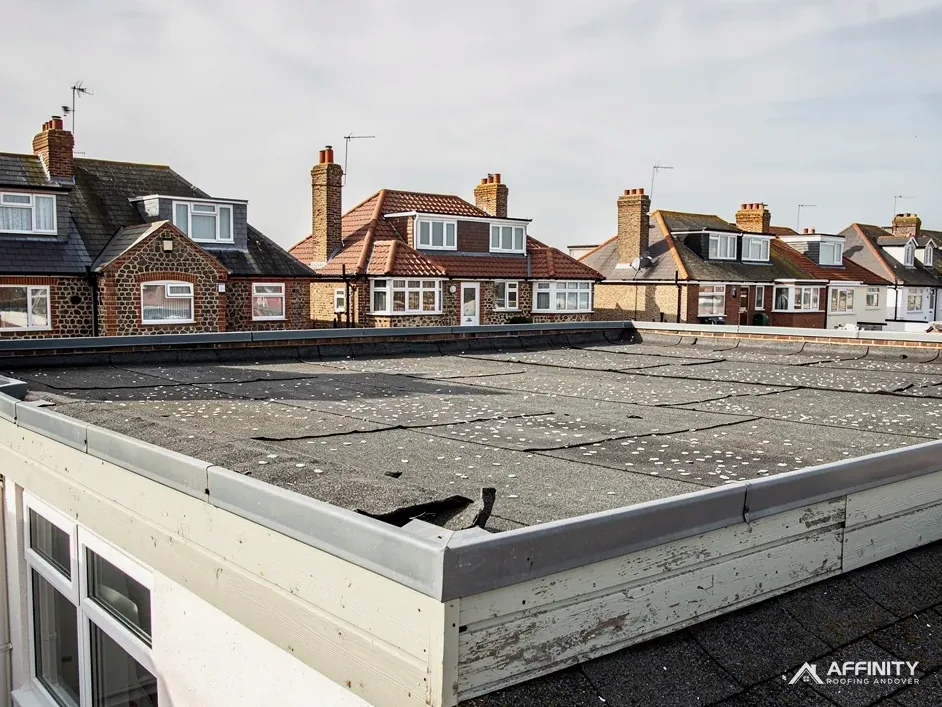
Underfoot, the first sign is a spongy patch where the deck gives instead of springing back. A roof that dips between joists, or ripples where it should be flat, has lost stiffness. Water may stand in the dip, which then worsens the rot.
From inside, look for ceilings that stain repeatedly, plaster that bulges or sags, and a musty smell. In the roof void, if you can see it, dark stained or crumbling timber is a warning, and so are fine white threads of fungus.
Rot has several causes. A long-running leak is one. Condensation inside the build-up, as our answer on condensation under a flat roof explains, can soak a deck with no leak at all. A covering laid over a damp deck traps water, and ponding on a roof with poor falls keeps the surface wet.
Please do not walk on a roof you suspect is soft. A rotten deck can give way under a person.
What replacing the deck involves
The old covering and any insulation come off first, exposing the boards. Each is checked, and the extent of the rot is marked out. Joists beneath are inspected too, because rot spreads, and a joist that has softened at its end or along its top edge may need a new section or a doubled timber alongside.
Rotten boards are cut out back to sound material. New decking goes on, fixed firmly to the joists, with joints supported so there is no movement at the edges. If the roof has lost its falls, the opportunity is taken to restore them with firring strips or tapered boards, so that water drains. Our minimum fall answer explains the target.
The new deck must be dry before the covering goes on. A damp deck sealed in again will rot or blister the new roof. In wet weather the work is paused and the open roof is covered.
Then the roof is recovered: insulation if it is being added, a vapour control layer if the design includes one, and the new membrane. Laying a new covering over a wet or rotten deck is never the answer, a point our overlay answer makes in more detail.
Insulation rules once the deck is rebuilt
Replacing the deck takes the work beyond a simple re-cover, and the insulation rules follow. Approved Document L Volume 1 treats a renewed flat roof membrane as renovation, which uses Table 4.3. There, an existing roof worse than 0.35 should be improved to 0.16, subject to the 15-year payback and feasibility tests in paragraph 4.13.
New or replacement elements fall under Table 4.2, where the roof target is 0.15. Which table applies to a roof with a new deck is a point to settle with your building control body or a registered building control approver before the design is fixed, because the rules treat renovation and replacement differently.
In practice, a rebuilt flat roof is nearly always insulated as part of the work. The deck is exposed, and a warm deck build-up with boards over the new deck is the natural way to do it. The upstands and thresholds must be adjusted for the extra depth.
The 2026 edition takes over on 24 March 2027, for ordinary building work in England, with the tables renumbered 3.2 and 3.3. Our flat roof insulation answer goes through the figures.
Cost, extent and what the survey shows
The cost of a deck repair depends on how much rot there is. A single patch of boards under a leaking outlet is a modest addition to a re-cover. A whole deck and a section of joists is a larger job, and it can double the effort of the roof.
That is why the survey matters. We inspect from above and below, probe suspect areas, use a moisture meter and photograph what we find, so the extent is on record before a price is given. If the full extent only appears when the covering is lifted, we tell you at that point, with photographs, and the plan changes only with your agreement.
For national context, MyJobQuote (October 2026) shows flat roof replacement at £1,500 to £6,000. Treat that as a typical UK spread and nothing more.
Published covering lives, such as 25 to 30 years for EPDM from HomeBuilding, assume a sound deck, and a new roof laid on rotten boards wastes them. Our flat roofing page sets out the options, and the written price covers the deck and covering together as one total.