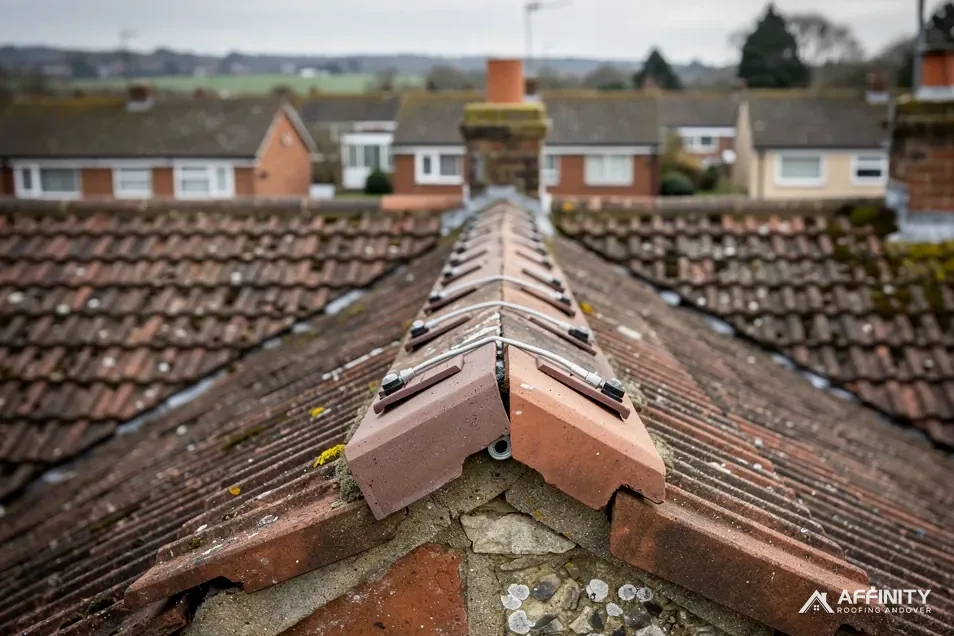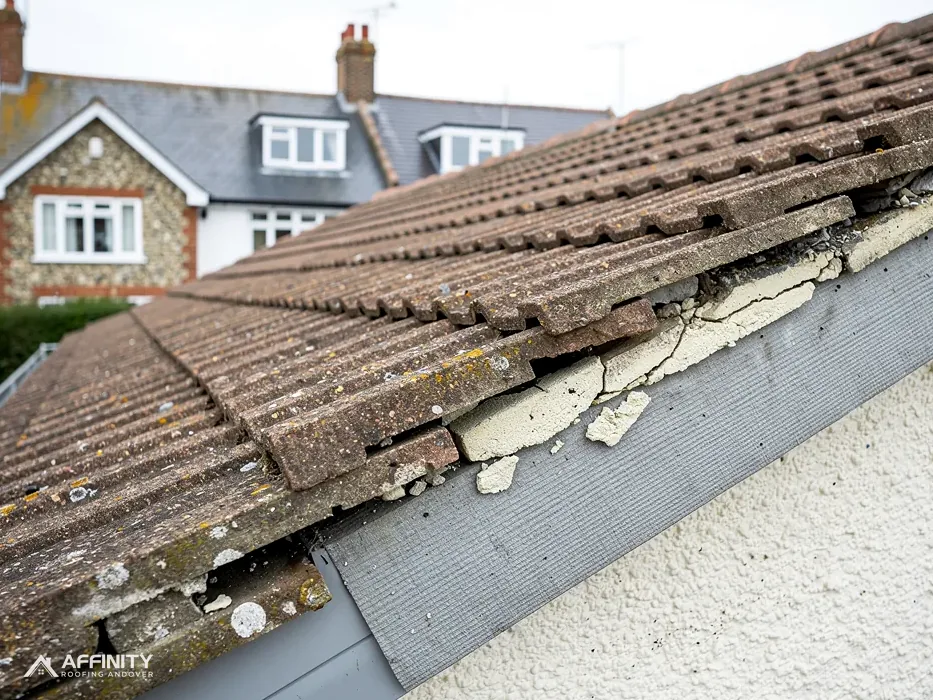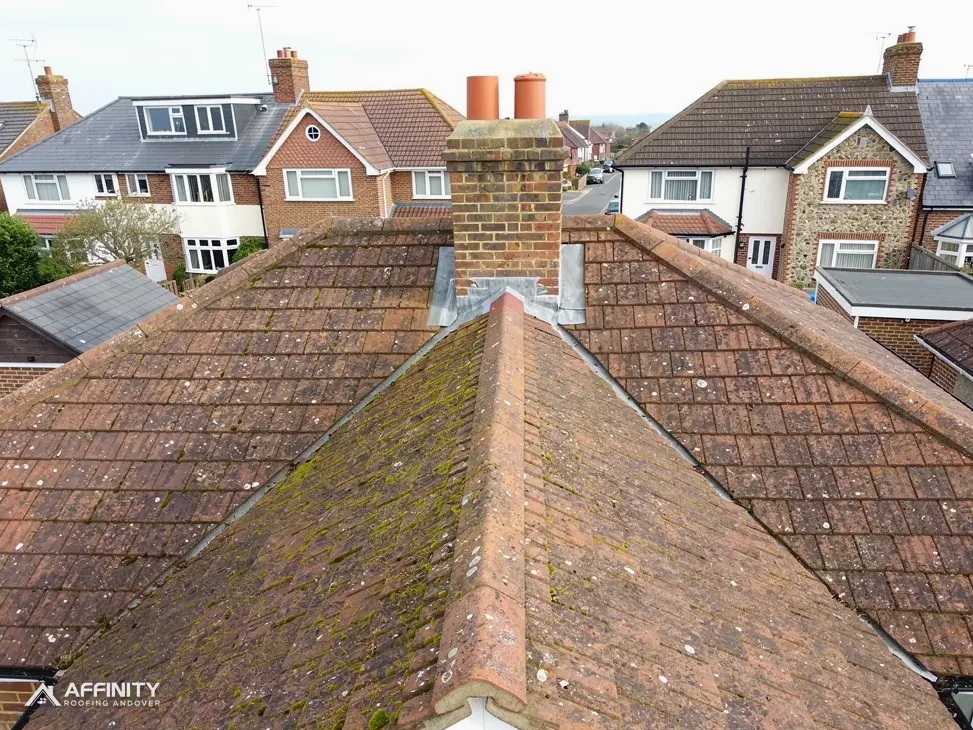
Wind strikes a gable wall, climbs it and spills over the top edge of the roof, tugging at each tile as it passes. That is why a verge, the tiled edge above a gable, can work loose while the slopes behind stay sound, and why a loose tile there should not wait for spring.
A tile that has moved can have several different causes. The mortar bedding may have cracked and dropped away. The nails or clips may have rusted through. The undercloak underneath may have rotted. Or the tile may simply have been cut badly when the roof was laid. Each cause calls for its own fix, and a repair aimed at the wrong one will not last.
This guide explains how verge tiles come loose, how a mortar repair compares with a dry-fix one, how a gable end is reached safely and when the highway authority has to be involved. It sits under our dry ridge and dry verge service pages and is for anyone who has noticed a tile out of line above a side wall.
Why verge tiles come loose
A verge is exposed on every side: wind from the front, wind from behind and weather from above. The only thing holding many of them is a thin strip of mortar, and that strip does a great deal of work for its size.
Cracked bedding
Mortar shrinks as it cures and then swells and contracts with each season. After enough cycles it splits, then opens into gaps, then breaks into lumps. Once the bed under an edge tile has gone, the tile is held by its own weight and perhaps a nail. A strong gust is enough to lift it.
Rusted fixings
Old verge tiles were often pinned with plain steel nails, and some were never pinned at all but simply laid in mortar. Rust swells, splits the tile around the hole and leaves a fixing that looks in place but holds nothing. Stainless steel or copper avoids the problem for the next repair.
A rotten undercloak
Beneath the edge tiles lies a strip, the undercloak, that carries them across the wall top. When timber or fibre board in that position softens, the tiles above lose their seat and tilt outwards. A short answer on what a verge undercloak is explains the part.
Frost and age
A tile that soaks up water and then freezes can lose its face in flakes or split along its length. An edge tile in that state can sit loose even when the bedding is sound, so each tile is tested, not just the mortar around it.
What a loose edge tile puts at risk
A tile that has moved is more than an untidy line. It affects the roof, the wall below it and anyone passing underneath.
Falling pieces
A gable often rises well above a side path, a drive or a garden. A slipped tile that drops from that height is dangerous, and the ground below is where people walk and park. Keep both away from the foot of the gable until the edge is secure.
Water in the wall
Rain entering at a verge runs down inside the gable, or into the roof void. It stains bedroom walls near the ceiling, can rot the ends of the roof timbers and soaks the insulation. A damp patch high on an end wall after rain is a reason to look at the verge above.
Wind underneath
When edge units come loose, gusts reach under the covering and lift neighbouring tiles one at a time. What began as a single loose tile can become a patch of lost ones in a single gale.
If a gale takes tiles
Photograph the damage and tell your insurer before arranging permanent work. The Financial Ombudsman Service lists wear and tear among the exclusions it commonly sees, so a verge that was already loose may be treated differently from one a storm tore off. No outcome can be promised. A separate guide on the signs that ridge or verge fixings are failing lists what to record.
Mortar repair or dry-fix at the verge
There are two ways to put a verge right. One keeps the traditional bedded edge and strengthens it. The other replaces it with a manufactured trim held by clips and screws.
Mortar with a fixing
Loose tiles are lifted, the old bedding is chipped away, the undercloak is checked and renewed if it is soft, and the tiles are laid again in fresh mortar with a mechanical fixing added. The gable stays as it was, which matters on an older house. For one or two loose tiles on an edge that is otherwise firm, this is the proportionate repair.
Dry-fix
A dry verge suits an edge where several tiles have failed, where the bedding has gone along a whole slope or where the owner would rather not return to repointing. The kits are tested to BS 8612:2018, and BS 5534:2014+A2:2018 is the code of practice for fixing the covering itself. Marley states that following BS 5534 is not required by law.
How to choose
Let the evidence decide. One tile out of line on an edge that is sound points to a repair, and so does a single chip from a stray branch. A whole edge with crumbling bedding, split tiles and rusty nails points to a rebuild, and often to dry-fix. Our guide to dry verge systems for interlocking concrete tiles describes the kit types.
Reaching a gable end safely
The gable is often the hardest face of a house to work on. It sits at the side, usually over a passage or a drive, and the edge is the most exposed place on the roof.
Ladders, towers and scaffold
A low gable on a bungalow can be reached from a ladder, with a roof ladder resting on the slope for the work at the edge. A taller one needs a tower or scaffold, since leaning out from a ladder at the edge is not safe. Height, ground conditions and the length of the job decide which.
When the highway comes in
For an Andover address, the licence that Highways Act 1980 s169 requires when scaffold would obstruct the road or footway comes from Hampshire County Council. In Hampshire County Council's process the scaffolding firm lodges the paperwork, not the householder, and its lead time is ten clear working days from application. Hampshire County Council charges £211.90 on application for the first 2 weeks, then £72 per extra 2-week period, and offers no extensions.
On private land
Hampshire's page adds that private roads need no licence for scaffolding, so a tower set up wholly inside your boundary stays outside this process.
Fixing the date
At the survey we agree how the gable will be reached and where the equipment will stand. If a licence is involved, its notice period is built into the booking, so nobody starts work on the road before the paperwork is in place.
Keeping a loose edge safe until the repair
Waiting for a repair date with a loose tile above a path is uncomfortable. A few sensible steps help, and a few well-meant ones make things worse.
What you can do
Move cars and bins away from the foot of the gable and warn anyone who uses the side passage. If a piece has already fallen, photograph it where it landed before clearing it, then pick it up carefully. Take pictures of the whole gable from a few angles and note the date, because the order of events can matter later, whether for an insurer or for the repair itself. A ruler or a coin beside a fallen fragment shows its size.
What to avoid
Stay off the roof, and do not rest a ladder against the verge or the gutter to get a closer look. An edge tile that appears loose may be the only thing holding its neighbours, and a ladder against it can bring several down. Sealant squeezed into the gaps from below traps water and hides the fault, so skip that too.
What happens on our side
Where water is already coming in, making the roof safe comes first. A loose edge tile is secured or taken off so it cannot fall, and the area beneath is protected, before the full survey and repair.
Birds and bats
If birds are nesting in a gap at the verge, or you have seen bats using one, tell us before work starts. WCA 1981 s1 is breached by anyone who intentionally takes or damages an active nest, and the Habitats Regulations 2017 reg 43 protect bat roosts without any need to show intent, so the survey allows for both.
Survey, consents and the cost of a repair
A verge survey starts on the lawn. We study each gable through binoculars for movement, gaps and staining on the wall below, then go up for a close look where that can be done safely. The undercloak, the nails and clips, the bedding and every edge tile get a hands-on check, and the photographs go to you.
Consent points
A like-for-like repair rarely raises a planning question, because work that does not materially change a building's outside appearance is not development. If the house is listed, listed building consent covers alterations to its character, and a conservation area or an Article 4 direction can restrict changes. Ask Test Valley Borough Council's planning team when either applies.
What it costs
A single tile repair is a small job and a full verge rebuild is a bigger one, and the national figures show the spread. Which? gives £75 to £400, ex VAT, for replacing up to six broken or missing roof tiles (Nov 2025), and MyJobQuote has a dry verge system at usually between £500 and £2,000 (8 October 2026). Those are typical UK ranges, not a figure for your gable, and our price comes after the survey.
Where to begin
Take a picture of each gable edge from the garden and note anything that has come down. From the pictures we can usually tell whether the job looks like a repair or a rebuild, and the visit confirms it.