The short answer
It depends on your policy, and no payout is certain. Insurers separate storm damage from wear and tear, and the Financial Ombudsman asks whether a storm was the main cause and whether the roof had already deteriorated. Ring your insurer first, make things safe, and keep photos and receipts. Look up what your own policy means by a storm before you assume either way.
Gale, or a ridge already giving way
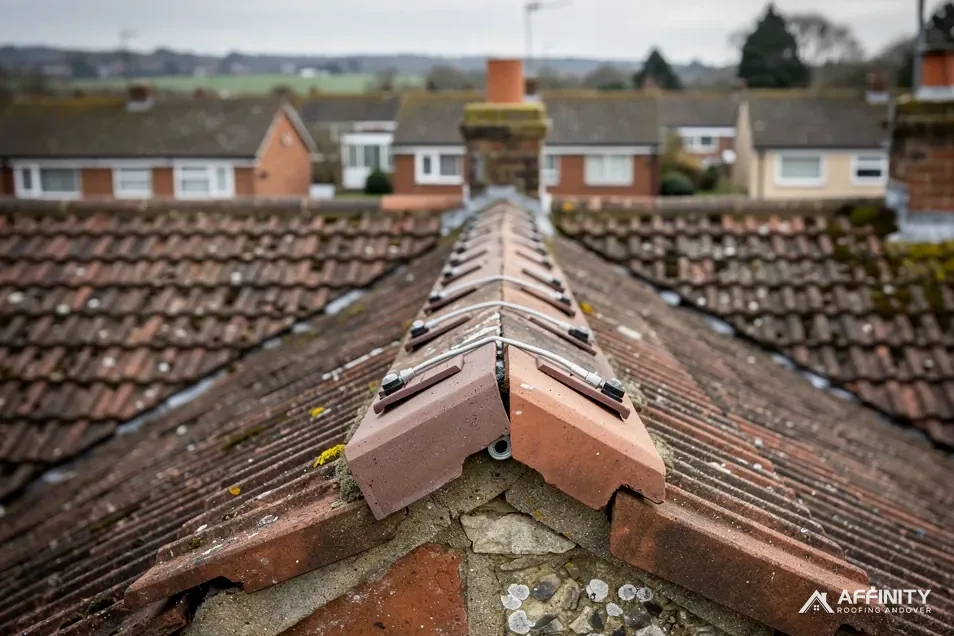
Curved capping tiles form the ridge, the crest of the roof and its most exposed line. When a gale takes some of them, a claim turns on one question: did the wind do this, or was the ridge on its way out already?
The Financial Ombudsman Service says a storm normally means violent winds, often bringing rain, hail or snow, and that a downpour or snowfall on its own may be enough. It looks at the Beaufort Scale. Some insurers, it notes, set a wind level below which they will not call it storm-force. Your own policy's wording therefore matters, and no general answer works for everyone.
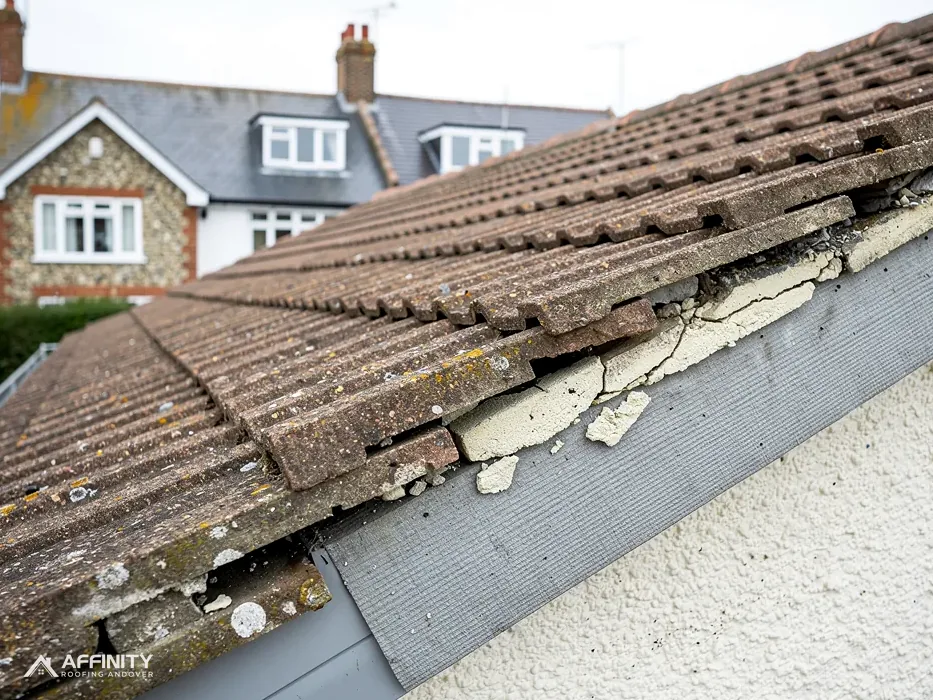
Where a claim is refused, the Ombudsman looks at the cause rather than the label. A claimant whose roof was already poor, and who knew it, has a weak case with the Ombudsman, and so does one where the storm simply exposed a fault. Many policies carve out slow deterioration and ordinary ageing.
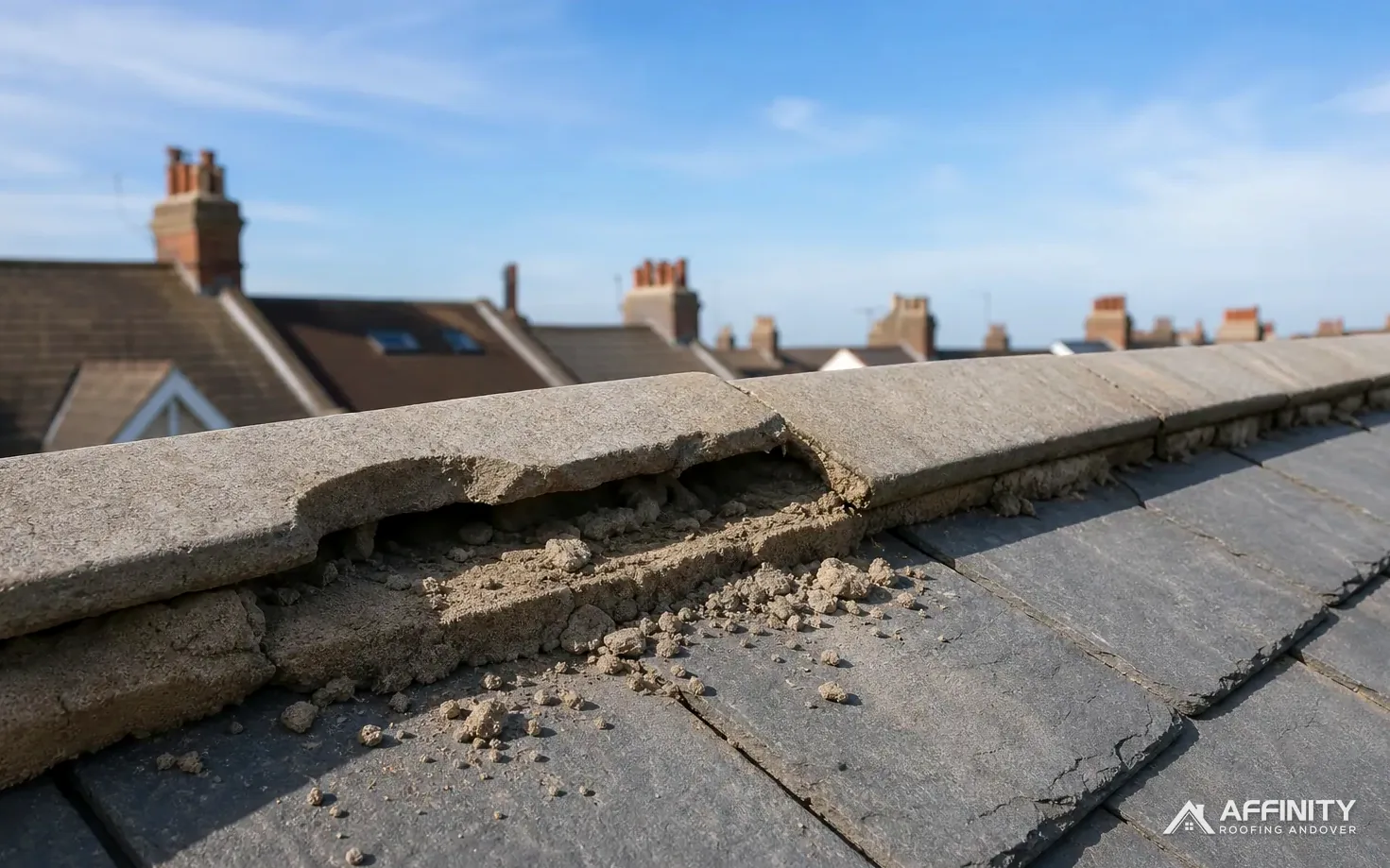
For a ridge, the difference is easy to picture. A sound tile torn off its bed by a gust is one story. A bed of crumbling mortar that finally let go is another.
What to do in the first hours
Safety comes first. Keep people and cars away from the ground below the ridge, and stay off the roof. Loose tiles shift under a hand, and a ridge is the highest, most slippery part of it.
Then tell your insurer. The usual advice is to report the loss, patch the damage so it gets no worse, and keep records. Which? reports that most insurers run emergency helplines, so find the number on your policy.
A temporary repair is a make-safe, not a rebuild. It might mean refixing or covering an open ridge so rain stays out. If water is getting in, making the roof safe comes before anything else, and the damage is photographed as we find it, with the missing tiles and the state of the bed in view.
Do not throw anything away yet. Broken tiles and fallen mortar are evidence, and some insurers want to see them. Keep every receipt too, including for the temporary work, since receipts back up a claim.
Whatever cover turns out to apply, the permanent repair is worth planning with a proper survey. Our answer on scaffolding for ridge tile repairs explains the access.
Photos, receipts and what they show
The Institution of Structural Engineers advises that pictures of the damage are vital to a claim, as they show the insurer what happened. A ridge is treated like any other part of the roof in that respect.
Useful pictures start wide, with the whole house in shot so the tiles can be placed. Then come the ridge line itself, any gap where tiles are missing, the fallen pieces on the ground, and the state of the bed and the timber strip beneath where they are exposed. A date on each helps.
Our survey photographs are taken for the repair and can help your claim too. We describe what we see in plain terms, such as bedding that was sound or crumbling, and the decision on cover stays with your insurer.
If the answer is not what you hoped for, the Financial Ombudsman Service is free to use, on 0800 023 4567. You can turn to it if the insurer has not given a final response within eight weeks, or within six months of a final response.
A claim handler may ask for a written quote for the permanent work. That follows our survey, and covers the whole ridge repair in a single total.
Repairing the ridge afterwards
Once the claim is moving, the permanent repair needs a plan. A ridge that has lost some tiles often has a bed and a batten that need checking along its whole length, not only where the gap is.
The repair usually lifts the loose tiles, sorts the sound from the broken, and refits them with mechanical fixings. Marley points to the 2014 revision of BS 5534 as the moment mortar by itself stopped being accepted for ridge and hip tiles, so a refit adds fixings to the bed. Our answer on reusing ridge tiles covers the sound ones.
Costs vary with access and length. Which? lists a new ridge tile at £80 to £300 excluding VAT, and MyJobQuote gives £225 to £550 for a ridge. For storms, MyJobQuote says repairs start at around £300, and extensive damage reaches £1,200. These are typical UK ranges, so read them as context, not as a price for your house.
When you collect other quotes, look at what each one includes, such as VAT and scaffolding. The dry ridge and verge page describes the repair itself.