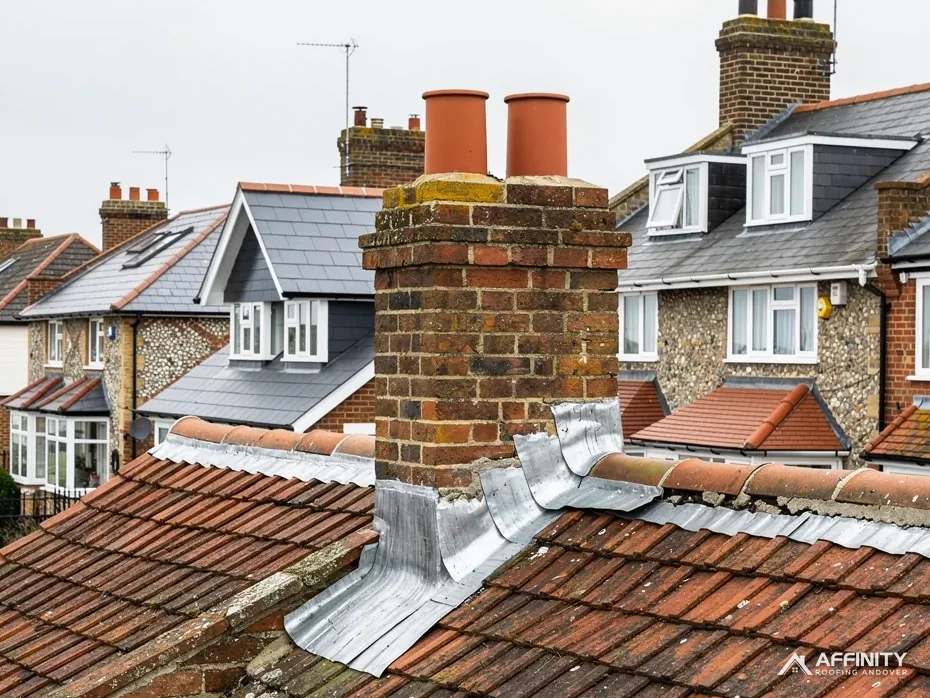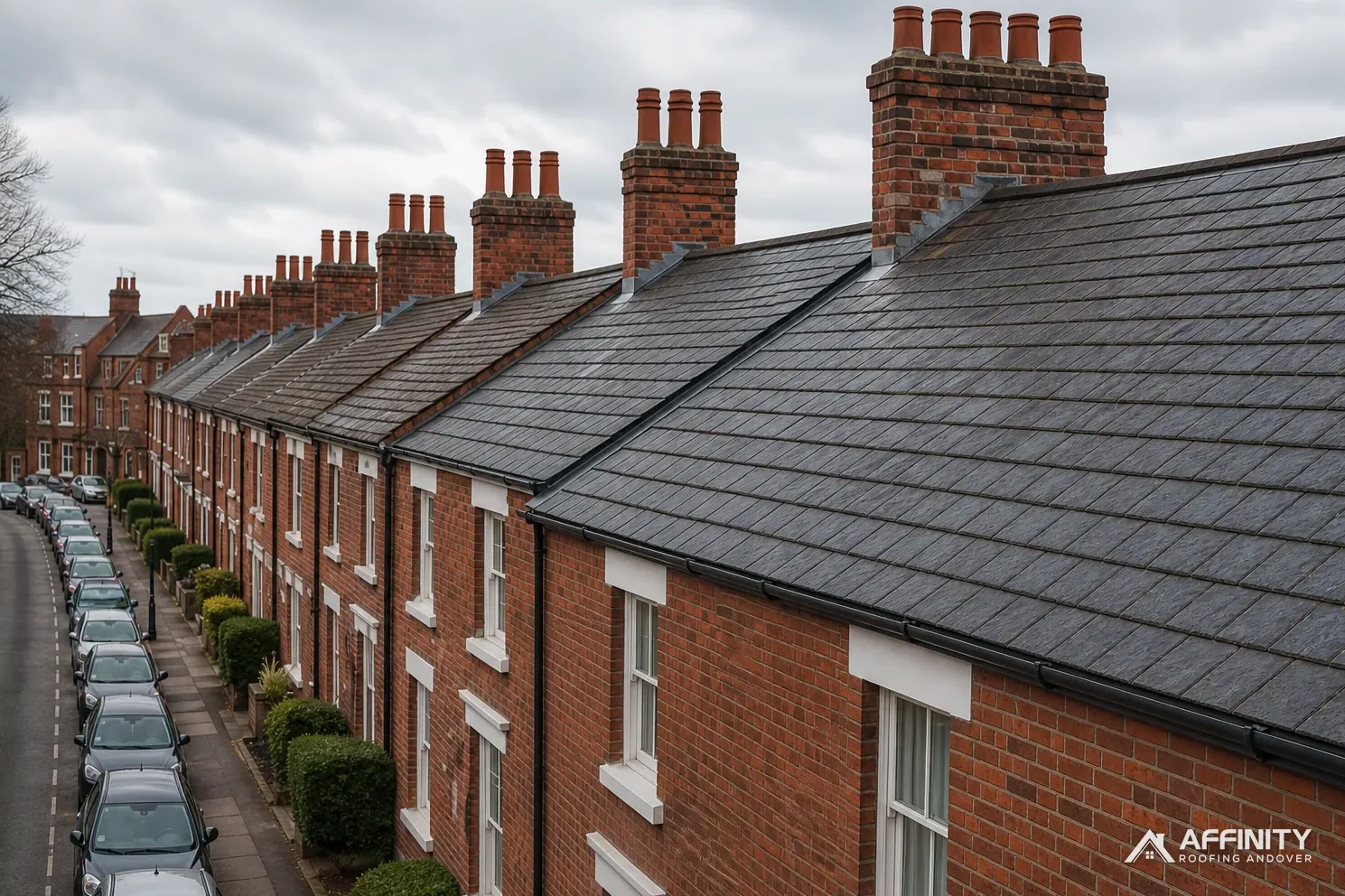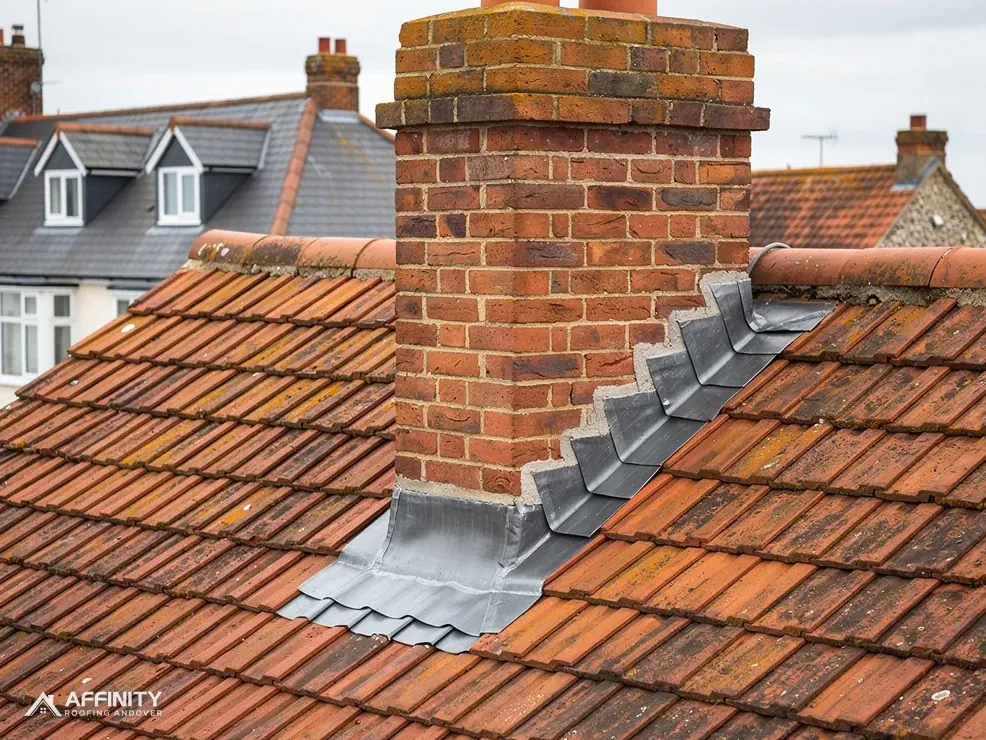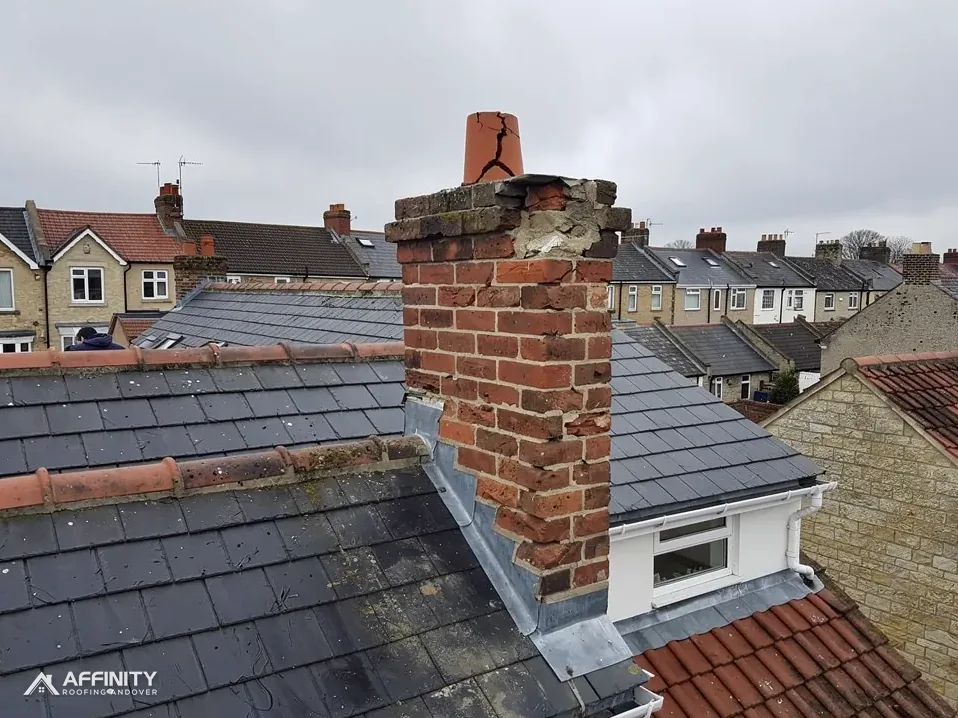
The chimney stack is a prominent feature on an old roof. It also takes weather from every side: it stands clear of the ridge, it is wet on every side, and it carries the pots, the flaunching and a ring of lead where it meets the slope. On a listed house it carries something else too, which is a legal status.
Listing covers the whole building, and a chimney is part of it. The Planning (Listed Buildings and Conservation Areas) Act 1990, section 7, requires listed building consent for works that affect the character of a listed building. A loose pot or a crumbling course of brick can feel like maintenance, and sometimes it is, but the safe habit is to treat the question as one for the council before any work begins.
This guide explains what listing means for chimney work, what like-for-like repair involves, who to ask and what to send them, which buildings follow a different route, and what we look at when we survey a listed stack. It is general guidance and not legal advice: the council's planning team has the final say on your own building.
What listing means for a chimney
A listed building is protected as a whole. The list entry describes the building, but the protection is not limited to the words in the entry, and a chimney stack, its pots and its flashings all count as part of the building. Work that alters its character as a building of special interest needs listed building consent from the local planning authority, under section 7 of the 1990 Act.
That is separate from planning permission. Listed houses keep their permitted development rights for roof alterations under Classes B and C of the General Permitted Development Order, but they still need listed building consent as well. Having one does not replace the other.
Grades and what they tell you
The grade measures importance and does not hand chimneys a different rulebook. Andover's town centre holds several Grade II* buildings, a higher grade than the common Grade II, and the consent question is the same at either one.
Check the entry first
The National Heritage List for England (NHLE) is searchable by address and shows your grade and list entry number. Quote that number when you write to the council. It saves a round of questions and tells everyone which building is meant.
If you are unsure the house is listed, ask. Standing inside a conservation area is a different status with its own rules, and a house can be in one and not the other.
Like-for-like repair, and where the line sits
Under section 55(2)(a) of the Town and Country Planning Act 1990, works that do not materially affect the external appearance of a building are not development. That is the planning idea behind like-for-like. It helps with ordinary houses, and it is the reason a re-cover of a plain house roof is normally permitted development. It does not settle the separate listed building question, which asks about the character of the building, not only its outward look.
What we mean by like-for-like
When we describe a repair as like-for-like we mean the same material, the same size, the same bond or pattern and the same method as the part being replaced. A brick stack is repaired with matching bricks laid in the existing bond. A pot is replaced with one of the same type and height. Lead flashing is replaced in lead, not swapped for a bonded strip or a mortar fillet.
Where the line moves
The line shifts when the new work changes how the chimney looks or behaves. Taking a stack down a few courses, rebuilding it in a different brick, capping it in a new material, rendering brickwork that was left bare or replacing a hand-made pot with a modern one can all change its character, and each is a reason to talk to the council before you hire anyone.
A repair that is plainly the same as before may be agreed without a formal application, but that is the council's judgement about your building. Where the answer is not obvious, we write down what we propose and ask.
Ask the council first: who, and with what
For a listed building in Andover or anywhere in the Test Valley, the local planning authority is Test Valley Borough Council. Elsewhere in our area it is the council named for your address: Basingstoke and Deane, Winchester City Council, Wiltshire Council, West Berkshire Council and the others each decide for their own listed buildings. Inside the New Forest and South Downs National Parks, each park authority handles planning, although Winchester City Council processes most South Downs cases in its own district as a host authority.
What to send
A short, clear request gets a short, clear answer. Give the address and, if you have it, the list entry number. Add a few sharp photos of the stack from the ground and from the roof side, a plain description of what is wrong, and what you propose to do about it. Say whether the work is a repair or a change. We supply our survey photos and a written description for customers who want to send them on.
Why before, not after
Asking first costs little. It also stops a job being priced and booked around a method that the council then refuses.
For Test Valley addresses, contact the council's planning team and check its current process on the day. Any reply time is for the council to say.
Do not book scaffolding until you know what the council will accept. A scaffold on a listed building is an early cost, and it is wasted if the method changes.
Churches, scheduled monuments and other special cases
Not every protected building follows the same consent route, and the difference matters for chimneys on vicarages, chapels, halls and farm buildings.
Churches in use
Where a Church of England church is in regular use, the ecclesiastical exemption applies and the church's faculty system stands in for listed building consent. St Mary's in Andover is Church of England, so chimney work there goes through a faculty. Catholic, Methodist and United Reformed congregations follow their own denominations' systems, and Baptist churches follow the Baptist Union's scheme.
Unitarian and Quaker meeting houses, closed churches and buildings held by the Churches Conservation Trust are not exempt and need listed building consent in the normal way.
Scheduled monuments
A scheduled monument has its own regime. Work on one needs scheduled monument consent, which the Secretary of State grants, and works that lack authority breach section 2 of the 1979 Act on ancient monuments and archaeological areas. A chimney on a building that stands on or forms part of a scheduled site goes down this route.
Homes that are not listed
An unlisted house in a conservation area keeps its chimney free of listed building consent, but the area adds its own controls. Conservation areas are article 2(3) land, which removes permitted development for dormers, and an Article 4 direction can take away further rights. The council can tell you whether one applies to your street, and its map is the place to look instead of guessing.
What we check on a listed stack
Our survey starts from what the stack is made of, not from a list of standard repairs. We look at it from the ground first, then from the roof, then from the loft where the flue runs through.
The stack itself
We look at the brick or stone for cracking, loose courses and open joints, at the mortar for how far it has eroded, and at the line of the stack for any lean. A stack that leans is a separate matter that needs a structural view, not a patch. We look at pots for cracks and for how well each is seated, at the flaunching, which is the mortar slope that holds the pots and sheds water, and at the top course for movement.
Lead and the roof junction
Flashing is the strip of metal, normally lead, that seals the stack to the roof. Lead flashing can last for over 80 years, according to MyJobQuote (22 September 2026), so on an old roof it may be original and perfectly sound, or it may have failed at a single joint. We lift only what we need to see, and we keep notes of any lead that is original so the council can see it was left alone.
Photos and a written description
Every finding goes into photographs that show the part in context. You receive the set with a plain description of each defect and the repair we would propose. That same bundle is what the council needs if consent is required, so it does double duty. We also note which parts look original, such as hand-made bricks, old pots or early lead, because the council will want to know what survives before it agrees to anything being replaced.
Access
A stack nearly always means scaffolding. If it reaches over a pavement or road, the scaffold needs a licence under section 169 of the Highways Act 1980. For Hampshire addresses the authority is Hampshire County Council, whose scaffolding firms apply for their customers: £211.90 for the first 2 weeks, then £72 for each further 2 week period. Its stated notice is ten clear working days. Where every standard and board sits inside your own boundary, the licence falls away, so a stack set back from the road may avoid the process entirely.
Cost, timing and the next step
Listed work is priced after consent is settled, not before it. The price depends on the material, the height, the access and what the survey finds, and a stack that needs only its flaunching reset costs very differently from one that needs several courses taken down and relaid.
For a sense of scale on one element, MyJobQuote gives a typical UK range of £350 to £920 for full chimney leadwork, and says the figure depends on scaffolding (22 September 2026). That is a national guide to one part of a repair, not a price for your house.
One written price
Our quote arrives in writing as one total covering the agreed job, with the method set out in plain words. If consent is needed the quote says so, and the booking waits for the council's answer.
Where we stop and start
If the stack is unsafe now, we make it safe first. That might mean taking off a loose pot, fixing a temporary cap or fencing the area below, and nothing more than is needed to stop a fall. Permanent work on a listed stack waits for consent. A temporary measure that leaves the fabric as it is does not change the building, but tell the council what you did.
You can read how the rest of the service fits together on our chimney repairs page, and our guides to chimney flaunching and chimney repointing cover two of those repairs in more detail. If your house is in a conservation area but not listed, our answer on chimney repairs in a conservation area sets out that route.