You glance up at the roof and the chimney does not look right. It is not quite vertical, or it seems to bow along its height, or the pots sit at an angle against the sky. Sometimes it is a trick of perspective, because a stack seen from low down at an angle can look crooked when it is not. But sometimes the stack really has moved, and then it needs attention.
A chimney stack is a tall, narrow tower of brick with little to hold it but its own mortar and the roof timbers below. When the joints swell, the base shifts or the weather works on one face more than another, the whole tower can tip. A lean that starts as a few degrees can grow, and bricks or pots from a leaning stack can fall onto the roof, the garden or a neighbour.
This guide describes why stacks lean, how to check for a lean from the ground, what to do straight away for safety, how a leaning stack is repaired or rebuilt, and the practical points around scaffold, neighbours and insurance. Our chimney repairs hub covers the other stack jobs.
Why chimney stacks lean
A stack leans because something has changed in how it is built, how it is loaded or how the weather acts on it. Several causes often work together, and a survey is the only way to tell which applies.
Chemical attack on the mortar
A well-known cause in older brick stacks is sulphate attack. Sulphates, which can come from the brick, from flue gases or from rainwater carrying soot deposits, react with the cement in the mortar. The reaction makes the mortar expand. If one face of the stack stays wetter than the others, the joints on that face swell more, and the stack can be pushed out of line. It is a slow process, and the first sign is often cracking along the horizontal joints.
Weather on one face
Rain and frost work harder on the faces that stay wet longest. Frost that freezes water in the joints can break them up. A stack that is wetter on one side than the other may weather unevenly and begin to bow.
Failures below the stack
A stack is carried by the roof structure or the wall beneath it. If the timbers have rotted, if a chimney breast was removed without proper support, or if the wall has moved, the stack can settle and tip. A failed flashing that lets water into the base can soften the support over time.
Extra weight and age
Heavy pots, an aerial or a satellite dish fixed to the stack add load and leverage. An old stack with weak lime mortar may simply have run out of strength.
The causes can overlap, which is why the repair must address the cause and not only the lean.
Checking a lean from the ground
You can find out a good deal without leaving the garden. Never climb to look, and never lean a ladder on the stack.
Check against a vertical
Stand well back from the house, in line with the stack, and hold up a plumb line, a string with a weight, or compare the stack with the edge of a door frame or a vertical corner of the house. Take a photograph. Do the same from a second position at right angles. A stack that leans in both views is moving in a diagonal direction.
Look for cracks and steps
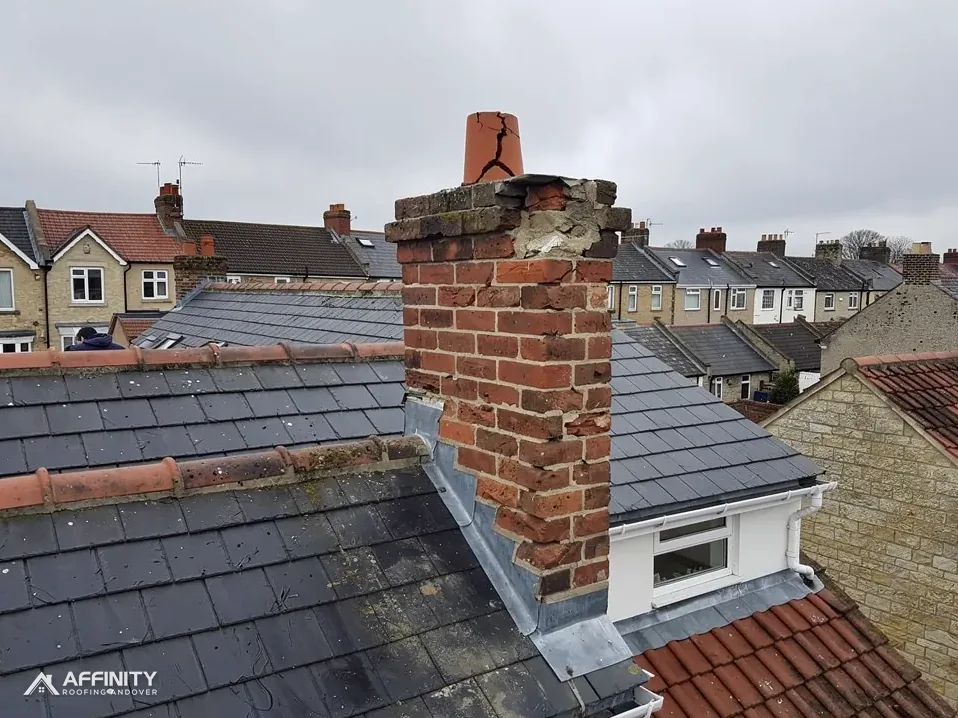
Use binoculars to look at the joints. A horizontal crack that runs across a face, joints that are open on one side and tight on the other, or a stepped crack running diagonally through brick and mortar show that the brickwork has moved. A bow, where the middle of the stack bulges, is as serious as a lean.
Look at the pots and the flaunching
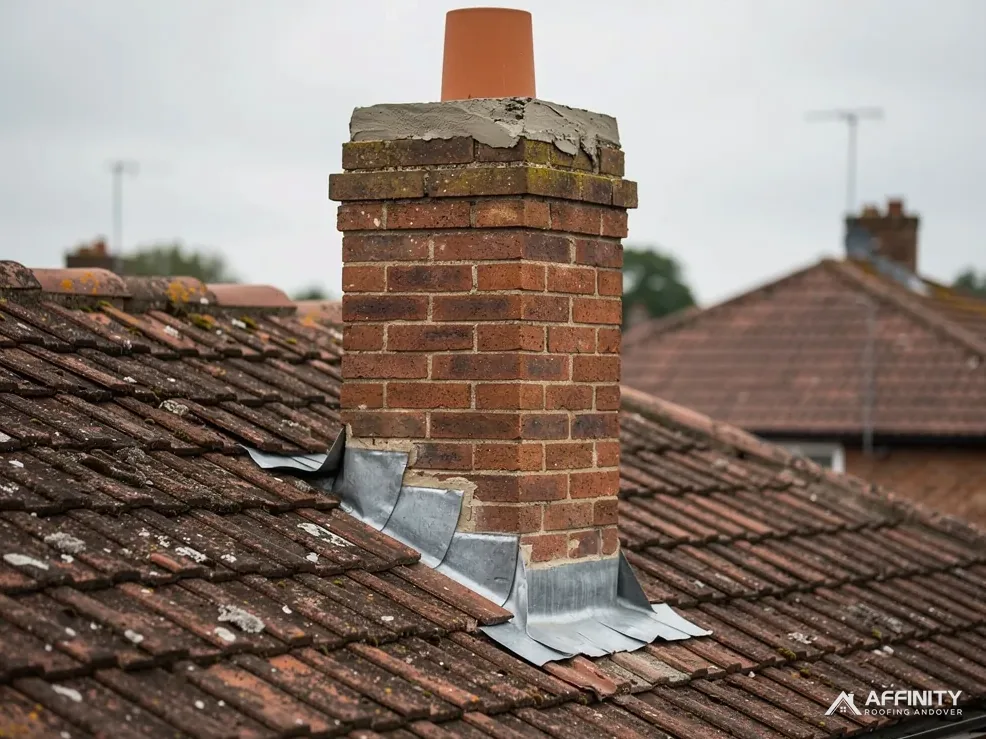
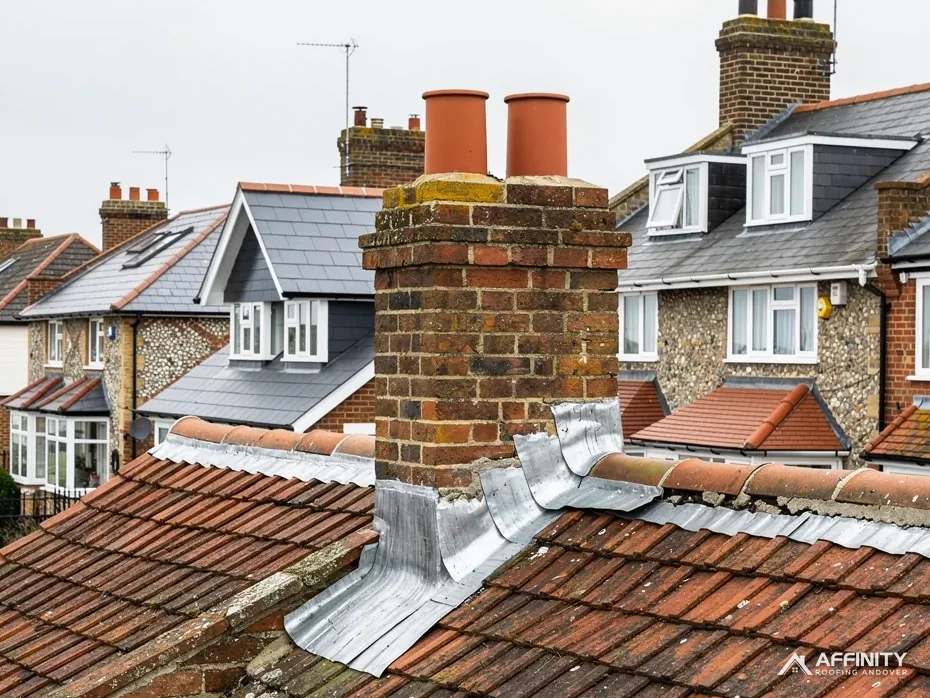
Pots that sit at different angles from each other, or flaunching that has cracked away from the brick, may show that the top of the stack has shifted. Fragments of mortar in the gutter are a warning.
Monitor it
Photograph the stack from the same spot each month, and compare. A change between photographs is more important than the angle itself. Send them to a roofer with your address.
Inside the house, look for new cracks around the breast and in the ceiling near it, and for damp. They can show movement from below.
Safety: what to do straight away
A leaning stack can drop bricks without warning, and a storm can bring down a stack that has leaned for years. Treat it as a hazard until a roofer has looked at it.
Keep clear
Keep people, pets and vehicles away from the area beneath the stack, on both sides of the house. That includes the garden, the drive and any neighbour's boundary within the fall zone. If the lean is marked, string a barrier across the area so nobody walks under it.
Stay out of the rooms below
If bricks are loose and the stack leans over a room, consider keeping children out of the bedroom directly beneath until it is checked. Do not light a fire in a fireplace served by a leaning flue.
Do not tackle it yourself
Do not climb up, pull at loose bricks or fix anything to the stack. Pushing against a leaning stack can bring it down. Call a roofer, and send photographs.
Temporary measures
A roofer may propose scaffold with a protective deck, which both gives access and catches falling material. In some cases the stack is taken down in part straight away to make it safe, and rebuilt later.
Tell the neighbours
If the stack leans toward a neighbour's house, or the shared wall, tell them. They are entitled to know of the risk, and they may have signs of movement on their side.
We make a leaning stack safe first, then survey and photograph it before any price is written.
Repair or rebuild
Repointing does not straighten a stack. If the bricks have moved, new mortar in the old joints does not put them back. The repair that lasts for a leaning stack is to take down the affected section and rebuild it.
How far down
The roofer takes the stack down to sound, level brickwork, which may be a few courses above the roof or most of the way to the roof line. A survey in the loft shows whether the base is firm. If the cause was below the stack, such as rotten timbers or a failed flashing, that is put right as well, or the rebuilt stack will lean again.
Rebuilding to match
The stack is recorded, dismantled, sorted and rebuilt with sound or matching brick, a mortar that suits it and new flashings and flaunching. The guide to when a chimney needs rebuilding covers how the work proceeds.
A small lean
A stack that has leaned slightly and has been stable for years is not always an emergency. Even so, a roofer should look at it, and the result should be written down. If the survey finds sound brick and no active movement, the answer may be monitoring plus a repair to the flaunching and pointing.
When it is time to take it down
Where a flue is no longer used and the stack is badly damaged, removal below the roof line may be the better option. Our guide to removing a chimney stack explains it.
Get the answer in writing, with photographs of what was found at each level.
Scaffold, the highway and the neighbours
Rebuilding a stack needs a scaffold, and a leaning stack often needs one sooner, because it is unsafe to approach by ladder.
Highway consent
If the scaffold takes up pavement or road space, the highway authority must consent under section 169 of the Highways Act 1980. For Test Valley that is Hampshire County Council. Hampshire County Council says the scaffolding company applies for the customer, asks for ten working days, and charges £211.90 for the first two weeks and £72 for each further two weeks. The lead time is why a roofer may make the stack safe in some other way first.
Your own land
If the scaffold stands wholly inside your boundary, no highway consent is involved. A neighbour's garden may be the only way in, in which case ask permission early.
Shared stacks
Where the stack serves two houses, it is shared, and the Party Wall etc. Act 1996 may apply to work on it. Removing a breast, jamb or flue that sticks out from a party wall needs notice, and a neighbour's silence is not agreement. Party wall questions go to a party wall surveyor.
Nests and roosts
Stacks attract nesting birds. Section 1 of the Wildlife and Countryside Act 1981 punishes whoever intentionally damages a nest in use, so the work is planned around any occupied nest. Signs of bats call for specialist advice first.
Ask your roofer who is applying for any licence, and what start date it allows.
Cost, insurance and keeping records
The cost of dealing with a leaning stack depends on how far the stack has to come down, the height of the house, the access, the quality of the match and whether the cause lies below the roof. It is therefore settled after a survey, and one written total is given. Scaffold is often the largest single part, and a stack that must be made safe quickly may need it sooner than a planned repair would.
If a storm brought it on
If wind or a storm has moved or damaged the stack, the insurer should hear first; then secure the area and keep your photographs and receipts together. The Financial Ombudsman says it asks whether there was a storm, whether the damage is consistent with storm damage, and whether storm conditions were the main cause. A complaint is weak where the owner knew beforehand that the stack was in a bad state, or where the storm only exposed a fault that already existed. Read our guide on how to make a roof insurance claim for the steps.
Records matter
Dated photographs of the stack over the months before a failure are valuable evidence of its condition. Keep any survey report, invoices and the roofer's photographs with your house papers.
Selling the house
A buyer's surveyor can see a leaning stack from the road. A written survey and a completed repair, with photographs, answer the question before it is asked.
If you can see a lean, send us photographs and the address, and we will say what we think before any work is agreed.