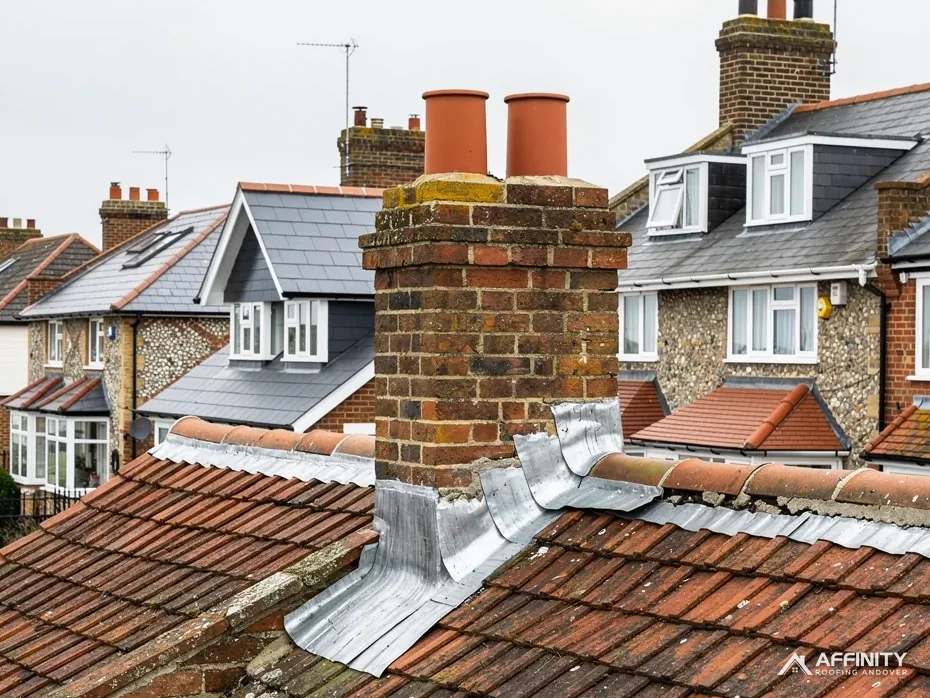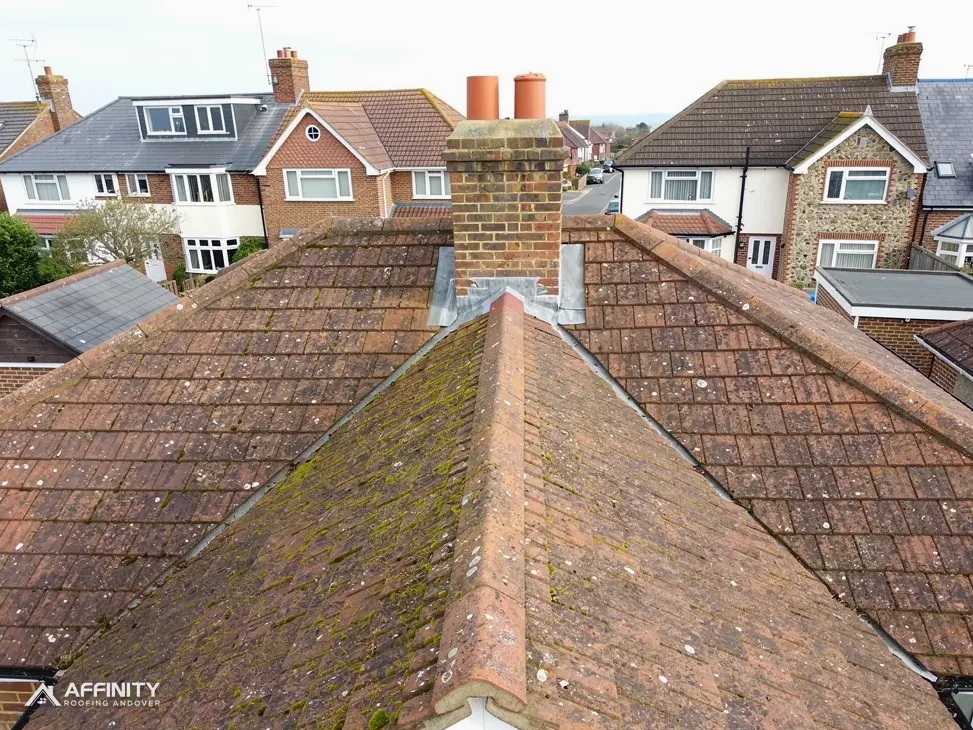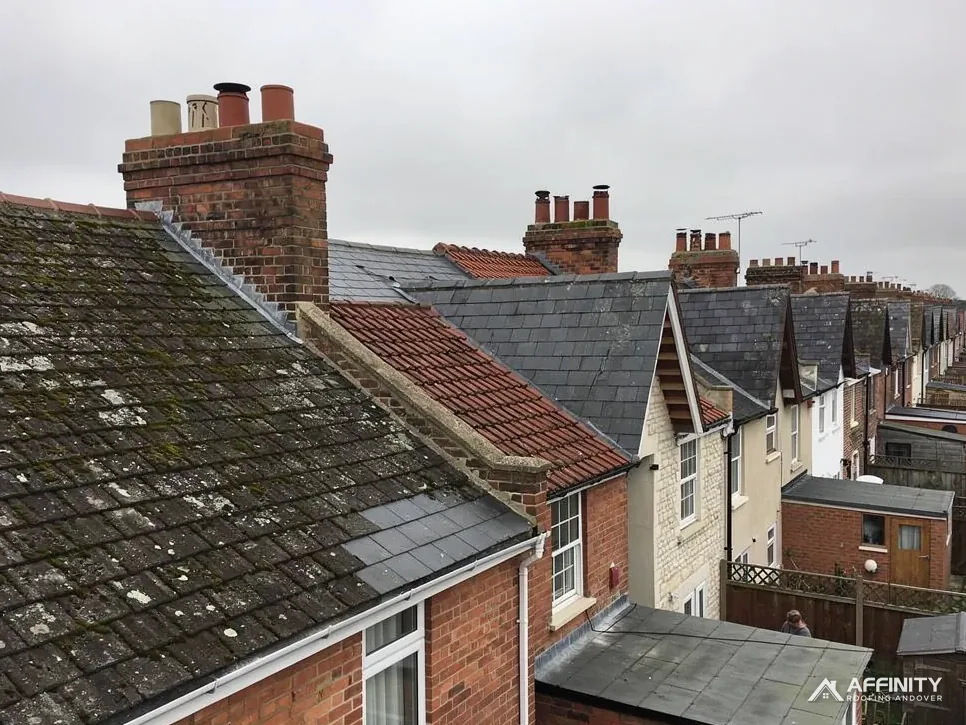
Look up at a chimney stack from the garden and you see brick, then pots, then a grey band of mortar that holds the pots to the top of the brickwork. That band is the flaunching. It is the most exposed piece of mortar on the house: it faces the sky, takes every shower and every frost, and carries the weight of the pots without any shelter from the roof below.
When it is sound, it does two jobs quietly. It beds the pots in place, so that wind cannot rock them, and it slopes away from each pot, so that rain runs off the top of the stack rather than into it. When it cracks, both jobs fail together. The pot loosens, rain reaches the gaps, and the damp works down the stack towards the ceilings.
This guide explains what flaunching is, how it fails, the signs you can read from the ground, and how it is renewed properly. It belongs with the rest of our chimney repairs advice, and the same visit often covers the pots and the flashing below.
What flaunching is, and what it is for
A chimney stack is a column of brick built up through the roof, with a flat top. On that top sit the chimney pots, the clay or concrete tubes that carry each flue above the brick. Between the pots and the brick is a bed of mortar, shaped into a gentle slope. That sloping bed is the flaunching.
Two jobs in one
First, it fixes the pots. A pot is heavy and tall, and the flaunching holds its base so that wind and vibration do not move it. Second, it sheds water. The slope runs away from the pot towards the edge of the stack, and a small projection at the edge, sometimes called a drip, throws water clear of the brickwork below.
Why the top of a stack needs this
The top of the brickwork is the one surface of the stack that rain falls on directly. Without a sloped, sound cap, water would sit on the flat brick and soak down through the joints. The flaunching is, in effect, the roof of the chimney.
How it differs from pointing
People sometimes confuse flaunching with pointing. Pointing is the mortar in the joints between bricks, down the sides of the stack. Flaunching is the cap at the top, around the pots. They are different repairs, though a roofer will usually inspect both on the same visit, and our guide to repointing with lime or cement mortar covers the joints.
How flaunching fails
Flaunching fails slowly, and from the ground it can look like a minor blemish until it does not. Mortar left in the open shrinks, cracks and weathers. Frost works into any hairline, and water that freezes in a crack widens it.
The usual causes
Age is the main one. Flaunching laid decades ago has been through a great many winters. A mix that was too weak crumbles. A mix that was too hard, or laid too thin, cracks away from the pot because the pot and the mortar do not move together. Settling of the stack, a pot that was already cracked, or a bed laid in poor weather can all start the trouble.
What the failure looks like
A thin crack running round the foot of a pot is common. A wider gap where the mortar has pulled away lets water straight down beside the pot. Pieces of mortar on the roof below, or in the gutter, show that it is breaking up. A pot that tilts or sits unevenly shows that the bed beneath is no longer holding.
What happens next
Water that gets in at the stack head runs down inside the brickwork and the flue. In the short run it stains the chimney breast in the room below. Over the longer run, it dissolves mortar in the joints, rusts anything metal and, in frost, can push brickwork apart. A repair at the top, caught early, is a fraction of the work of a rebuild.
Birds also pick at loose mortar and sometimes nest around the pots. If a nest is in use, work waits, as the Wildlife and Countryside Act 1981 treats intentional damage to an occupied nest as an offence.
Signs to read from the ground and indoors
You can learn a good deal without going near the roof. Use binoculars or a camera with a zoom, and look at the top of each stack on a clear day. Never climb to look.
From the garden
Look for cracks that circle the pots, gaps between the pot and the mortar, and flaunching that has a rough, sandy or crumbly surface. Look for greenery growing on the top, which means the mortar is holding water. Check that each pot stands upright, and that the slope runs outward, not inward. Fallen fragments on the roof or in the gutter below are a warning sign.
From inside the house
A brown patch on the chimney breast, damp wallpaper, or plaster that crumbles and flakes can all point to water in the stack. Because the damp can travel, the stain may be a floor or two below the leak, and it may only appear after sustained rain. In the loft, look at the brickwork where the stack passes through for dark tide marks.
Not every stain is the flaunching
A damp breast can also come from failed flashings, a blocked or sealed flue, or condensation. Our guide to chimney capping and ventilation covers the sealed flue problem. A survey finds out which, and a photograph taken at the top of the stack shows what is happening there.
Take dated photographs from the same spot every season. They show changes that are hard to spot from one visit to the next.
Repairing or renewing it properly
There is a tempting quick fix: smear sealant or a bag of cement over the cracks. It rarely lasts. The new material bonds poorly to the weathered old surface, and water gets behind it. A proper repair removes what has failed and rebuilds it.
Small defects
If the flaunching is largely sound and there is a local crack or a small void, a careful repair can be made by raking out the loose material and filling with a suitable mortar. The test is whether the old mortar around it is still firm. If it sounds hollow or crumbles, the repair is a false economy.
Full renewal
A full renewal takes the old flaunching off, checks each pot, and re-beds them in fresh mortar, sloped to shed water, with a neat drip at the edge. The mortar should suit the brick and the stack, not just be the nearest bag to hand. On an old stack, a softer, more flexible mortar often suits the brickwork better than a hard cement mix.
Weather and timing
Mortar needs mild, dry weather to cure. Laying fresh mortar in a hard frost, or in heavy rain, risks a bed that fails in its first winter. A roofer who tells you the work will wait for the right conditions is looking after your money.
Pots and the stack as part of the same visit
Any cracked pot should be replaced at the same time. Our guide to chimney pot replacement explains what to look for. Re-bedding a cracked pot in new mortar only delays the day it fails.
Access, scaffold and safety at the stack top
The top of a chimney is the highest and least forgiving part of the house. Work on it needs proper access. A ladder against a gutter or a slate is not enough, and a roof ladder on a steep pitch is only part of the answer.
Scaffold or tower
For most houses, a scaffold or access tower brings the roofer to a safe platform at the stack. That also lets the repair be done carefully, with the right tools and with time to look at the brickwork below. The quote should say whether the scaffold is included.
On the highway
Scaffold that occupies the highway needs the highway authority's consent under section 169 of the Highways Act 1980. Our guide to preparing your home for roof work explains who applies and the lead times by council.
Safety for you
Keep children and pets away from the base of the stack while work is going on, and do not stand below it. Falling mortar and tools are the risk. After the work, ask the roofer to show you photographs of the finished top, from several angles.
What a good record looks like
A good survey shows the stack top before, with each fault marked, and after. It lets you check the work without climbing anything, and gives you something to compare in later years.
A good roofer will also tell you if the flaunching is the least of the stack's problems, such as leaning brickwork or failed flashings, so that you can plan the next repair.
What the price depends on
There is no single price for flaunching, because stacks differ so much. Your own price comes after a survey, but you can see what moves it beforehand.
The stack itself
The number of pots matters, because each one has to be lifted, checked and re-bedded. A one-pot stack on a low roof takes less time than a wide stack with six pots over three storeys. The size of the top, the state of the brick beneath and whether the pots are reused or replaced all change the time on site.
Access
The height of the house, the pitch of the roof and whether there is room for a scaffold on the drive or only on the pavement all affect the cost. The scaffold carries its own cost, and it should be stated on the quote.
Extras found at survey
Cracked pots, loose brickwork at the top, failed lead flashings or a nest in the flue may add to the work. A good roofer will show you each one in a photograph and say what it adds before starting.
One total price
Ask for a single written total with VAT shown, covering scaffold, materials, labour and waste. If a roofer quotes a bare figure for the flaunching without saying how the stack will be reached, ask the question before you agree.
The repair is rarely the whole picture, and it is worth asking the roofer to look at the rest of the stack while the scaffold is up.